
CC DMX512&RDM Decoder
8 productsSkyDance CC DMX512 & RDM Decoder Series is specially designed for DMX-controlled constant current LED lighting systems, converting standard DMX512 digital signals into regulated constant current PWM outputs for precise, smooth 0–100% dimming.
Available in 1-channel models with selectable 250–3000mA output and 4-channel models with 150–500mA, 350–1200mA, or 700–1750mA output per channel, this series accommodates a wide range of constant current LED modules and fixtures, including single-color, tunable white (CCT), RGB, and RGBW lighting.
- DMX512 & RDM Compatibility: Supports DMX512 control and RDM bidirectional communication, allowing remote DMX address configuration and communication between the DMX master and decoders.
- High-Precision Dimming: Selectable 8-bit or 16-bit grayscale resolution, seven adjustable PWM frequencies from 250Hz to 16kHz, and selectable linear or logarithmic dimming curves on supported models.
- Standalone Operating Modes: Built-in RGB/RGBW dynamic programs and independent dimming modes allow operation without an external DMX signal.
- Easy Configuration: Integrated digital display and setting buttons provide convenient local DMX address and operating parameter adjustments.
- Reliable Quality & Protection: Reverse-polarity protection and short-circuit protection. With CE and RoHS compliance and a 5-year warranty, they offer dependable performance for architectural lighting, commercial spaces, and professional DMX-controlled constant current LED projects.


How a Constant Current DMX512 Decoder Works
Unlike a CV decoder that supplies a fixed voltage to LED strips, a CC decoder regulates the output current while automatically adjusting the output voltage according to the forward voltage of the connected LED string. An external DC constant voltage power supply provides power to the decoder, while its internal DC-to-DC conversion circuitry maintains the selected constant current for the LED load.
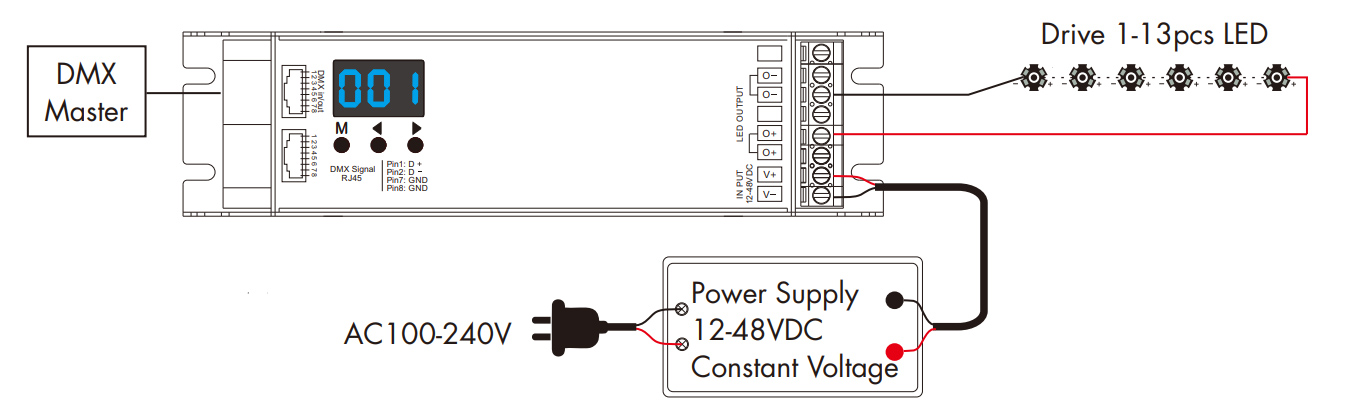
This control method is ideal for driving high-power LED chips, constant current LED modules, architectural spotlights, downlights, and professional lighting fixtures that require a specific operating current rather than a fixed-voltage supply.
How to Select the Correct Output Current & Voltage
Correct current and voltage matching is essential when choosing a constant current DMX decoder.
1. Match the Rated LED Current: Check the LED module or fixture datasheet for its rated operating current, such as 350mA, 500mA, 700mA, or 1050mA. Select a decoder with a matching output current. Never set the output current higher than the LED load's rated specification.
2. Calculate the Required Output Voltage: For series-connected LEDs, calculate the total forward voltage by adding the forward voltage of each LED device in the string. The decoder must support the resulting voltage within its rated output range.
3. Select a Compatible DC Power Supply: The DC input voltage must be within the decoder's rated input range and higher than the total forward voltage of the connected LED string, as required by its DC-to-DC buck regulation design.
4. Check Output Power Capacity: Calculate the LED load power based on its forward voltage and operating current. Ensure that each channel's output power and the decoder's total power capacity remain within the specified limits.
For professional architectural and commercial lighting projects, careful planning of LED current ratings, series voltage, decoder placement, DMX addressing, and power distribution helps ensure consistent lighting performance and easier system maintenance.
FAQ About CC DMX512&RDM Decoder
Direct engineering answers on wiring, DC voltage calculations, milliamp configuration, and troubleshooting constant current DMX decoders for architectural and stage fixtures.
A CC DMX512 & RDM decoder receives standard DMX512 and RDM control signals and translates them into a regulated constant current PWM output to drive raw LED chips, spotlights, or downlights directly. Unlike standard controllers that push a fixed 12V or 24V rail, this unit regulates the output amperage (such as 350mA or 700mA) while letting the voltage float to match the exact forward voltage of your series-connected LED diodes. It gives stage consoles, architectural processors, and lighting desks precision 0 to 100% dimming and color control over commercial fixtures that don't have built-in onboard drivers.
You set the output current on a CC DMX512 decoder using onboard DIP switches or digital menu keys before powering the unit on, matching your fixture's rated milliamps exactly. Our 4-channel models like the D4C-L allow selectable steps from 150mA up to 1200mA across each channel, while the heavy-duty D4C-XE covers high-wattage architectural fixtures from 700mA up to 1750mA. Never adjust current settings while the power supply is energized, and never set the decoder to a milliamp rating higher than your LED module's thermal rating.
Fixtures connected to a constant current DMX512 decoder must always be wired in series, never in parallel. That means running the positive output terminal to the anode (+) of fixture one, connecting fixture one's cathode (-) to fixture two's anode, and continuing the loop until the final cathode returns to the decoder's negative terminal. If you wire constant current fixtures in parallel, the regulated amperage divides unevenly between strings. If one diode opens up, the remaining string absorbs the full current and burns out instantly.
Across our 8 dedicated models in this CC DMX512 RDM decoder category, capacity ranges from compact 3-channel and 4-channel units up to high-density 32-channel rack units like the D32C 32-channel decoder. The D32C packs 32 individually addressable 350mA channels into a single DIN-mount footprint, handling up to 32 separate white spotlights or 8 discrete RGBW downlight clusters from one 12-48V DC power feed. For centralized equipment racks where you need clean wire management and individual universe mapping without stacking dozens of small plastic boxes, high-density decoders cut panel space by over 60%.
An RDM-enabled CC DMX512 RDM decoder allows two-way communication so you can set DMX start addresses, monitor operating temperatures, and detect open-circuit faults remotely from the lighting console. Instead of sending an installer up a scissor lift to manually press digital display buttons or flip DIP switches on twenty decoders hidden in high ceiling bays, an RDM controller queries the fixture tree over the existing DMX cable and reprograms channel addresses in seconds. It also alerts the operator immediately if an LED string disconnects or overheats during operation.
Video strobing happens when a CC DMX decoder operates at a standard 250Hz or 500Hz PWM dimming frequency that clashes with camera sensor shutter speeds. Our adjustable decoders feature selectable PWM frequencies ranging from 500Hz up to 8kHz via the digital display menu. Switching the decoder from the factory 500Hz default to 4kHz or 8kHz eliminates rolling horizontal shutter bands on high-frame-rate broadcast cameras and phone sensors, making them flicker-free down to 0.1% light levels in broadcast studios, commercial auditoriums, and film sets.
A CC DMX512 RDM decoder uses switching step-down regulation to maintain exact milliamps, which generates heat if the DC input voltage is excessively higher than the LED load's forward voltage. For example, powering a single 3.2V white LED from a 48V DC power source forces the internal buck regulator to dump substantial voltage, raising internal board temperatures. Keeping your input power supply roughly 3V to 6V above the maximum series forward voltage of your fixture string ensures the unit runs cool, keeping enclosure temperatures well within the rated -30°C to 55°C operating threshold.