
WiFi Controller Series
6 productsSuperLightingLED offers the LeyNew WiFi Controller Series for smart DMX master integration, addressable SPI LED strip programming, and common-anode PWM programming and control of single-color, CCT, RGB, RGBW, and RGBCCT LED strips.
Users can configure lighting programs, adjust colors and brightness, create dynamic lighting effects, and manage connected LED systems through compatible smartphone apps, PC software, or DMX lighting control platforms, depending on the selected model.
From professional DMX512 lighting integration and pixel-level SPI programming to multi-channel analog LED strip dimming, LeyNew WiFi controllers offer versatile control options for residential, commercial, decorative, and entertainment lighting projects.


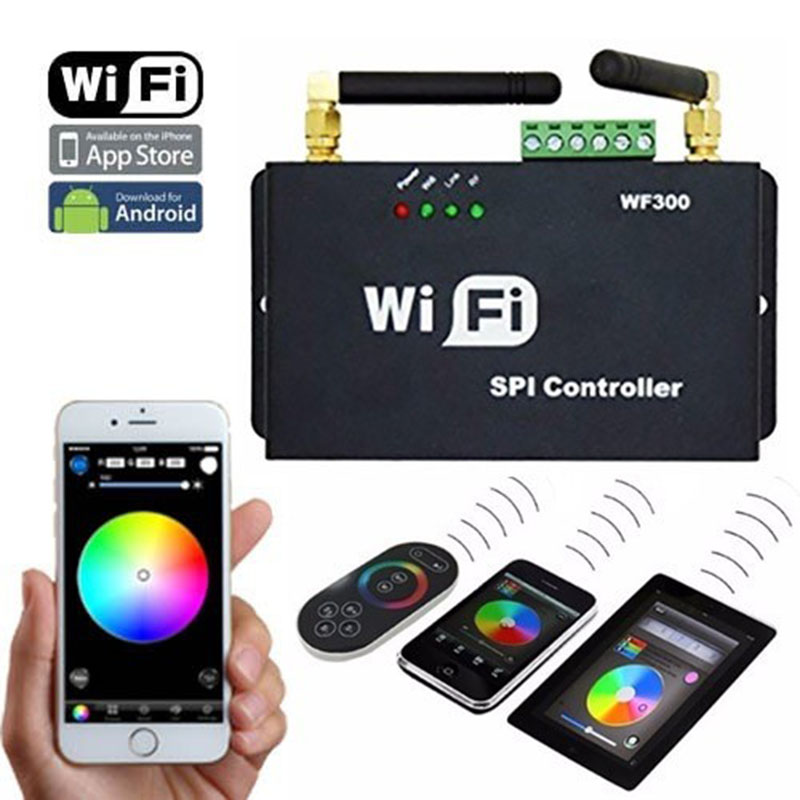
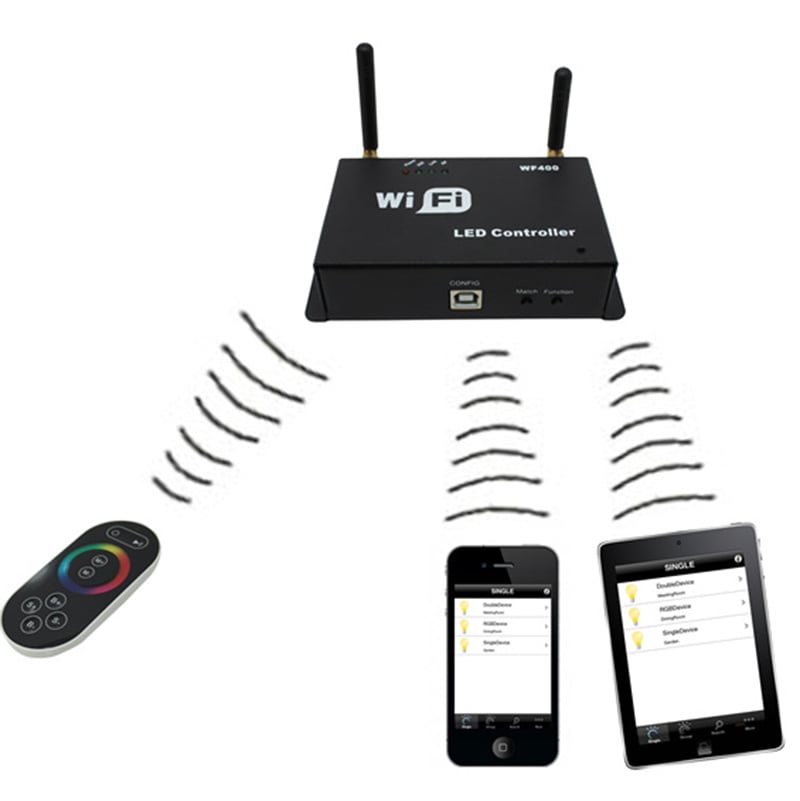
Flexible WiFi Lighting Programming Through Smartphone Apps and PC Software
LeyNew WiFi controllers provide different programming and configuration methods according to their supported hardware and software platforms. Compatible smartphone applications offer convenient wireless operation, including power switching, brightness adjustment, color selection, and dynamic effect control.
The TC421 programmable controller also supports PC software for creating customized lighting schedules, setting time-based brightness transitions, and arranging automatic lighting changes throughout the day.
For larger installations, the WiFi and Art-Net control device WF311 can be integrated with professional lighting software to create more advanced DMX scenes and synchronized lighting programs.
Users can select the appropriate control method according to the controller model, project requirements, and desired level of programming flexibility.
FAQ About WiFi Controller Series
Direct answers to field wiring, 2.4 GHz network setup, and multi-channel loading questions for our LeyNew WiFi LED controllers.
A wifi led controller almost always fails onboarding because the router is broadcasting on 5 GHz only or using combined band steering. These low-voltage controllers require a dedicated 2.4 GHz 802.11 b/g/n wireless band. Log into your router settings, temporarily split your 2.4 GHz and 5 GHz SSIDs, and turn off cellular data on your phone while pairing. Also keep the controller within 10 to 15 m of the access point during initial handshaking. If you are integrating a multi-zone layout, see our smart app connection guide for step-by-step wireless pairing.
A controller led wifi unit will run locally without active internet access once paired, or by using its direct AP (Access Point) mode. Units like the WF100 and WF400 broadcast their own local SSID, letting your phone connect directly to the hardware to adjust scenes and dimming. If you join the controller to a local WLAN router, you can send local commands over the intranet even if your broadband WAN connection goes down. However, remote control outside your local network and voice assistant integration do require an active internet uplink.
Metal enclosures and crowded 2.4 GHz wireless channels are the two main reasons a controller wifi led unit drops off your network. Installing an aluminum or steel control enclosure creates a Faraday cage that attenuates the 2.4 GHz signal below operating margins. Always mount the antenna externally or choose an ABS junction box. In dense commercial buildings, set your router's 2.4 GHz channel to a fixed 1, 6, or 11 rather than auto-channel, and avoid installing the unit within 1 m of high-frequency switching drivers or magnetic transformers.
Yes, but you must select an SPI-enabled model like the WF300 rather than a standard PWM dimmer. The WF300 outputs direct data and clock lines engineered for addressable digital ICs such as WS2811, UCS1903, and LPD6803 across DC 5V to 24V operating rails. Standard 4-channel or 5-channel constant-voltage dimmers modulate ground for analog circuits and cannot generate the digital timing packets needed for WS2811 addressable tape. Always verify whether your LED strip needs variable voltage pulses or a dedicated SPI serial data line.
Yes, using our WF310 hardware converter. The WF310 accepts wireless incoming lighting commands via WiFi and translates them directly into a standard balanced DMX512 digital signal over terminal blocks. That allows you to adjust full DMX theatrical fixtures or low-voltage decoders directly from a phone or tablet without dragging physical XLR control cables back to a central console. If your project expands into complete commercial lighting consoles with physical faders, explore our 155 models in the DMX master decoder consoles section.
Exceeding the rated amperage will trigger thermal shutdown or burn out the output drive transistors on the circuit board. If your DC 24V strip installation pulls 28 A and your wifi led controller is rated for 20 A maximum, you cannot wire the full load directly to the screw terminals. Instead of overloading the unit, run the controller's PWM output into an external RGBW data repeater. The repeater reads the PWM dimming duty cycle and draws operating current from a secondary power supply, allowing unlimited run lengths while keeping perfect dimming synchronization.
The TC421 is an autonomous, standalone programmable time controller. While everyday WiFi controllers require active app commands or persistent network connections to execute scenes, the TC421 stores up to 24-hour schedules with multi-step output curves directly on its internal non-volatile memory. You build the schedule via PC host software or your mobile phone over WiFi, sync it once to the TC421, and the unit executes the fade, sunrise/sunset, and color sequence automatically on its internal clock, even through power outages.