
M Series LED Controller Set
19 productsLTECH Wireless LED Controller Sets – Ready-to-Use Control for LED Strip Lights
LTECH M Series, Mini Series, and Mini Pro Series LED controller sets provide a convenient, ready-to-use solution for wireless LED strip lighting. Each matched set combines a compatible LED controller with its corresponding RF remote, eliminating the guesswork of selecting separate control components. Choose the set that matches your LED strip type, voltage, and lighting functions, then enjoy convenient wireless dimming, color adjustment, and lighting control.
The included remote is matched to the controller in each set. Classic M/Mini remotes and Mini Pro series (P Controllers) remotes use different RF platforms, so they should not be assumed to be interchangeable. Before ordering, confirm the required DC voltage, output current, channel configuration, and certification status of the selected model.
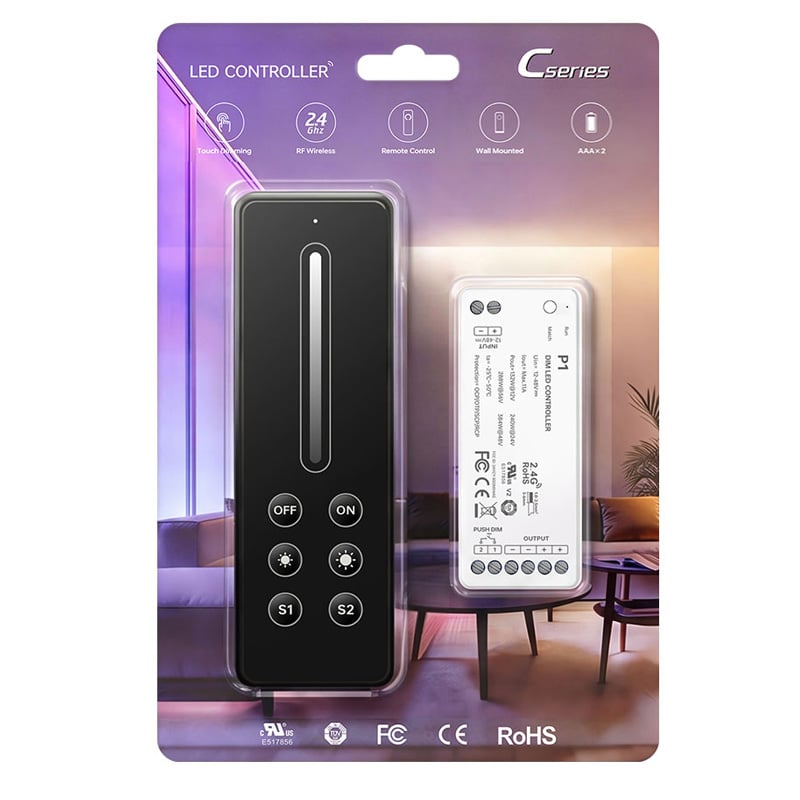


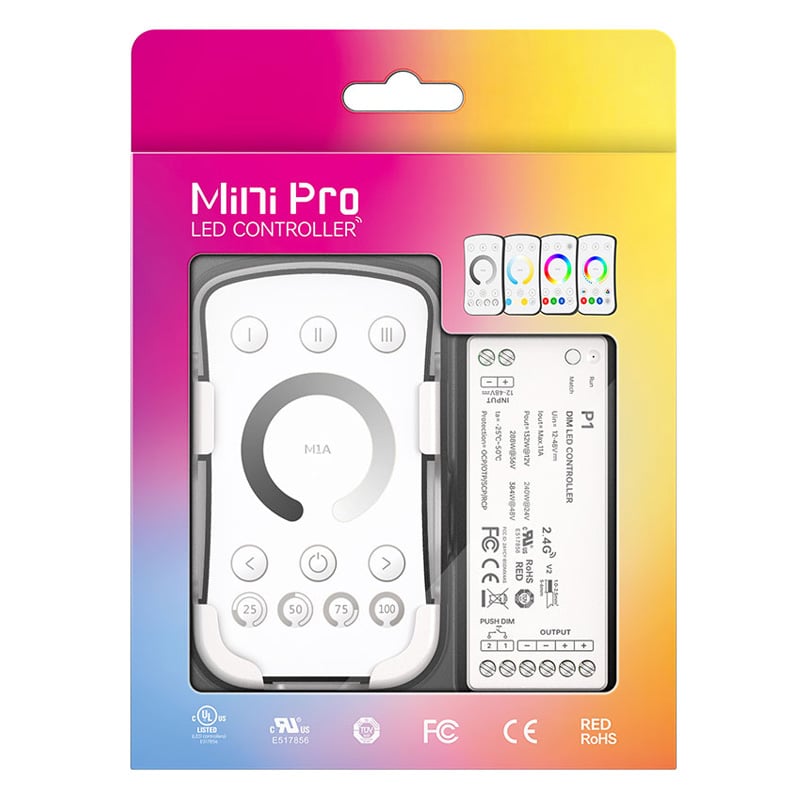
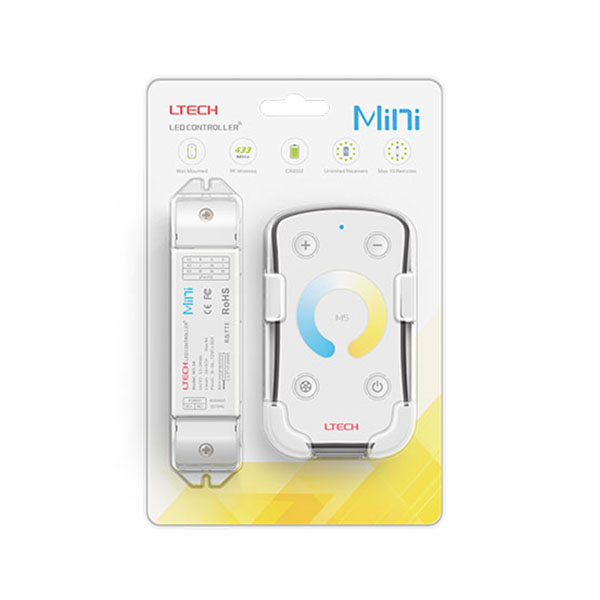


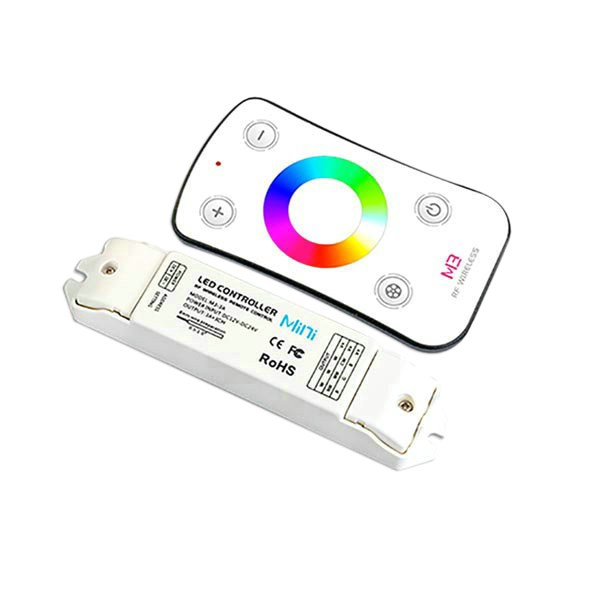
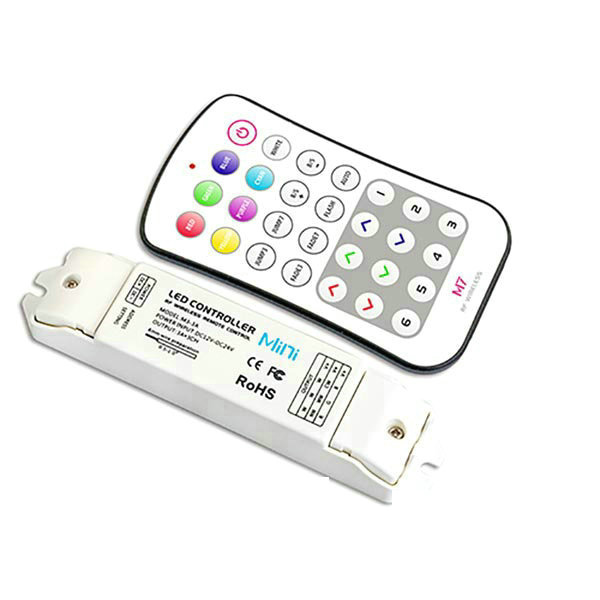
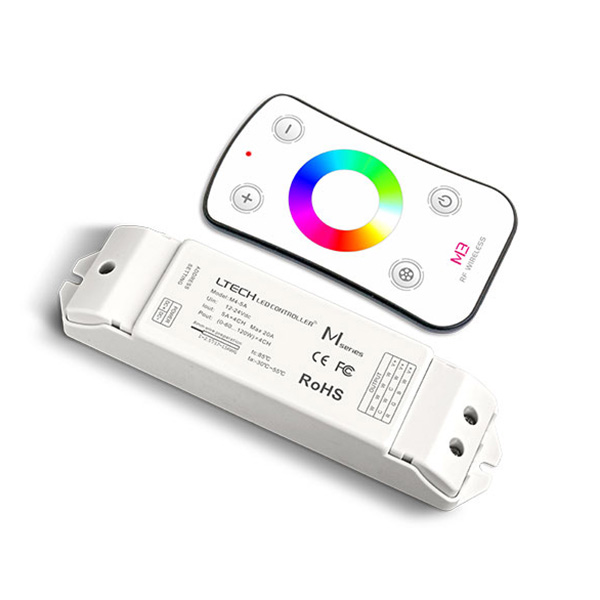
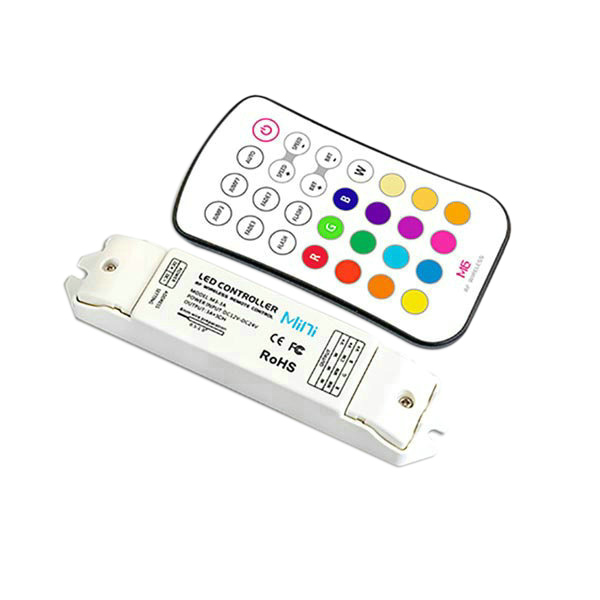
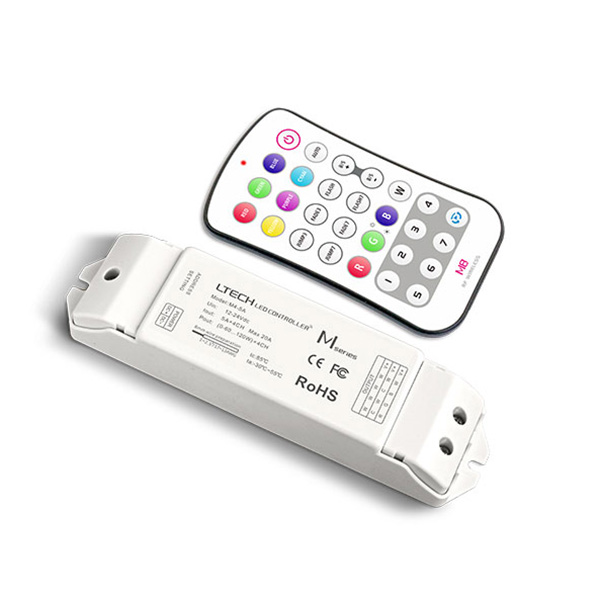

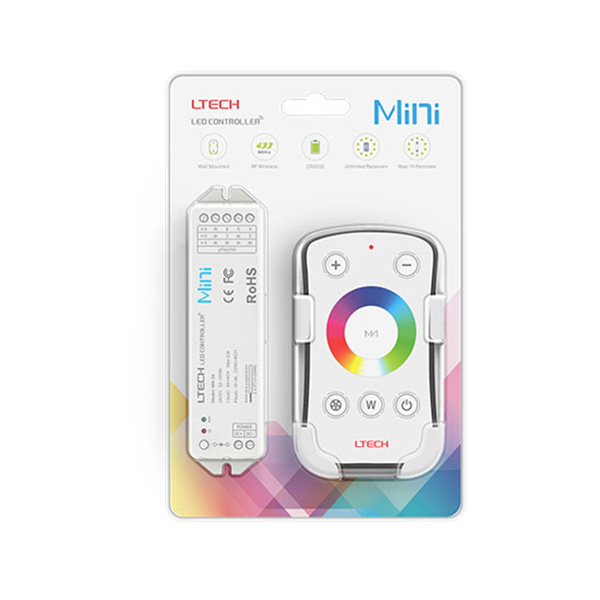
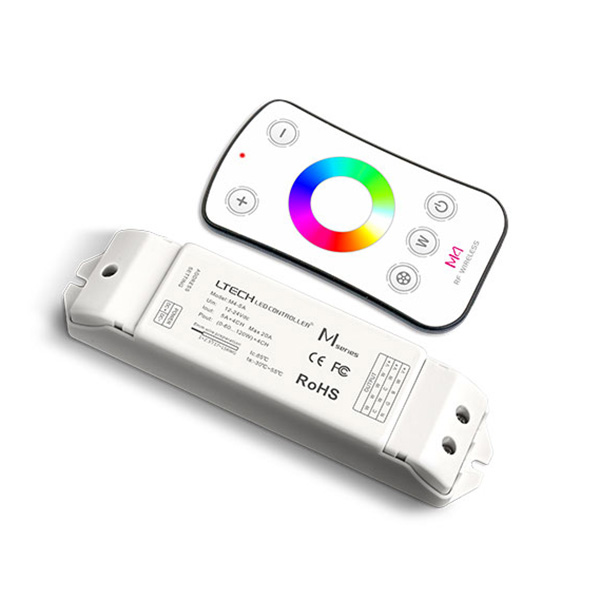


Classic M Series & Mini Series: Reliable 433.92MHz RF Control
Classic LTECH M Series and Mini Series controllers use 433.92MHz RF wireless technology, offering straightforward remote control for everyday LED strip lighting. These systems are suitable for residential projects, cabinet lighting, cove lighting, decorative illumination, and other installations that need reliable wireless dimming or color control without a more complex smart lighting setup.
- Convenient wireless operation: Adjust compatible LED strips using the matched RF remote without needing a direct line of sight in typical installations.
- Straightforward installation: Classic models are designed for compatible low-voltage LED strips, with many models supporting 12–24V DC input.
These classic systems are a practical choice for users who prefer straightforward handheld control and do not require the expanded voltage range or newer RF platform offered by Mini Pro.
Mini Pro Series: 2.4GHz RF, Higher Voltage Support & Certified Options
The newer LTECH Mini Pro Series introduces 2.4GHz RF control and a more flexible range of compact LED strip controllers. Selected models support 12–48V DC, expanding compatibility beyond the 12–24V range of many classic controller sets. This makes Mini Pro worth considering for projects using compatible 12V, 24V, 36V, or 48V constant-voltage LED strips.
Mini Pro controllers are available in different channel configurations, from single-color dimming to tunable white, RGB, RGBW, and five-channel RGBCW lighting. The controller must still match the LED strip's voltage, channel configuration, and current requirements.
Some Mini Pro controllers, remotes, and matched sets are UL-certified products. For North American installations, this can be an important consideration when product certification is required by the project or installation specification.
FAQ About M Series LED Controller Set Systems
Direct answers on wiring limits, RF pairing, channel loads, and system design for Ltech M Series hardware from our pre-sales engineering desk.
Every receiver in an M Series LED controller set uses auto-identification firmware that adapts its output channels to whichever hand remote you pair to it. If you sync an M1 remote, the M4-5A receiver assigns all 4 channels together as a unified single-color dimmer. If you pair an M2 or M5 remote, it remaps the hardware into a 2-channel tunable white controller for dual-white LED strip lights. Pair an M3 or M6, and channels 1 through 3 become red, green, and blue. Sync an M4 or M8 remote, and channel 4 activates for pure white on RGBW LED strip setups. You can swap lighting formats without unmounting your receiver from the ceiling.
An M Series LED controller set with an M4-5A receiver handles up to 5A per channel across 4 channels, with a maximum continuous ceiling of 20A total. On 12V DC circuits, that translates to 60W per channel or 240W total; on 24V DC circuits, that delivers 120W per channel or 480W total. If you are running our compact M3-3A or M4-3A 3-channel receivers, the limit drops to 3A per channel (9A total, or 108W at 12V and 216W at 24V). We recommend capping your continuous load at 80% of these ratings to keep internal MOSFET temperatures below 65°C inside enclosed millwork.
An M Series LED controller set relies on 433.92MHz sub-GHz radio frequency because longer wavelengths penetrate drywall, plywood cabinetry, and sheet metal studs far better than crowded 2.4GHz signals. In real residential and commercial jobsites, 2.4GHz Wi-Fi signals scatter when passed through masonry or crowded metallic framing, while 433MHz penetrates up to 30 meters through standard interior partitions without dropping frames. Because it operates on a dedicated sub-band, your LED strip lighting will not experience command latency or signal collisions when local Wi-Fi networks stream heavy data.
Yes, you can sync an unlimited number of M Series receivers to a single hand remote within its 30-meter operational sphere. Every receiver in an M Series LED controller set listens on the same 433.92MHz channel once learned. To sync, press the ID learn button on each receiver for one second, then tap any key on the handheld remote. The connected LED strip lights will flash once to confirm sync. All synchronized receivers will now shift brightness, color mixing, and dynamic fades in unison, eliminating the need to home-run low-voltage wiring back to a single cabinet.
An M Series LED controller set delivers 4096 levels of 12-bit grayscale pulse-width modulation, compared to the coarse 256-step 8-bit dimming common in entry-level hardware. In real installations, 256-step controllers visibly step and stutter when fading between 0.1% and 5% brightness. With 4096 discrete steps, the gamma-corrected dimming curve appears completely fluid to the human eye, even during slow 10-second crossfades.
Nine times out of ten, an unresponsive M Series remote is caused by a depleted 3V CR2032 button cell or an interrupted ID learning sequence. First, verify the indicator LED on the remote lights brightly when a button is pressed. Second, re-pair the receiver: hold the ID learning key for 3 seconds until the status indicator flashes, press any remote key, and watch for the LED strip lights to blink twice. If the receiver still fails to pick up commands, confirm it is not enclosed inside a fully sealed steel junction box, which acts as a Faraday cage and blocks the 433MHz radio waves.
Standard M4-5A and M3-3A receivers operate strictly within a 12V to 24V DC input window, but our advanced Mini M Series LED controller sets using the P1 receiver handle wide-range 12V to 48V DC input. The Mini series receivers like the M1A+P1 package handle up to 11A continuous current at 48V DC, translating to 528W of single-channel dimming capacity from one receiver chassis. Never feed 48V into a legacy M4-5A or M3-3A unit, as the internal linear regulator will exceed its 28V breakdown threshold and permanently damage the RF logic circuit.
Yes, our SPI-16S paired with the M16S remote brings M Series wireless RF capability to digital addressable LED tape light installations. Unlike constant-voltage M4-5A units that control the entire strip uniformly, the SPI-16S generates digital clock and data line signals compatible with 16 common ICs, including WS2811, WS2812B, UCS1903, and TM1812. The M16S remote lets you select from 16 dynamic color-chasing patterns, change travel speed across 8 levels, and calibrate pixel quantities up to 1020 ICs directly over 433MHz wireless without writing custom Arduino code or running software.