
DALI Series
4 sub-categoriesStandard DALI Lighting System Architecture
A standard DALI (Digital Addressable Lighting Interface) system consists of key components working together for centralized intelligent control:
This architecture is commonly adopted by many well-known lighting control brands such as Skydance, Sunricher, and MiBoxer (Mi-Light), forming a reliable and standardized DALI lighting ecosystem.Beyond Standard DALI: Ltech Smart Integration
Beyond Standard DALI: Ltech Smart DALI Integration
However, the Ltech DALI series goes far beyond a traditional DALI lighting system.
At SuperLightingLED, the Ltech product range integrates DALI lighting control with modern smart home technologies, transforming conventional lighting into a more intelligent and human-centric system.
Ltech DALI solutions incorporate advanced features such as:
Wireless configuration and intuitive smartphone control.
Human presence and microwave motion detection for automation.
Fast, touch-based device setup and parameter adjustment.
Dynamically adapts to user behavior and environmental conditions.
These innovations enable lighting systems to not only respond to manual control, but also adapt dynamically to user behavior and environmental conditions. This makes Ltech DALI systems ideal for modern residential projects, smart homes, commercial spaces, and high-end architectural lighting applications.
With Ltech, lighting is no longer just about turning lights on and off—it becomes part of a smart living environment.

DALI Master Controller
LTECH DALI Master Controllers & System Components
LTECH DALI Master Controller series provides more than wall-mounted dimming panels. It includes the essential control, communication, expansion, sensing, and signal-integration components needed to build a complete DALI intelligent lighting system.
DALI is an addressable lighting protocol, allowing compatible devices to be controlled individually or organized into groups and scenes. LTECH provides smart programming and configuration tools, including Bluetooth and NFC programming products, to simplify device setup and parameter management.
Depending on the project, a DALI system can combine wall control panels, DALI bus power supplies, signal repeaters, relay units, smart control modules, motion sensors, programmers, and protocol converters with compatible DALI dimmers and LED drivers. This modular structure makes it possible to control individual luminaires, groups, zones, and lighting scenes while expanding the system as the project grows.
A typical LTECH DALI lighting control architecture can be understood as: DALI Control Panel / Smart Module / Sensor → DALI Bus + DALI Bus Power Supply → DALI Dimmer / DALI Driver / Relay / Signal Converter → LED Strip / Downlight / Fixture / Other Lighting Load. For larger installations, DALI signal repeaters and additional bus infrastructure can be added to extend the control network.
CV DALI Low Voltage Driver
LTECH Low Voltage DALI Dimming Controllers for LED Strips
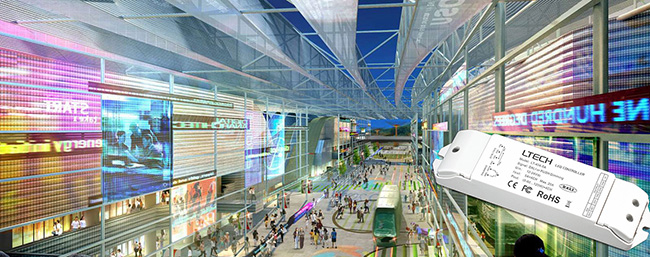
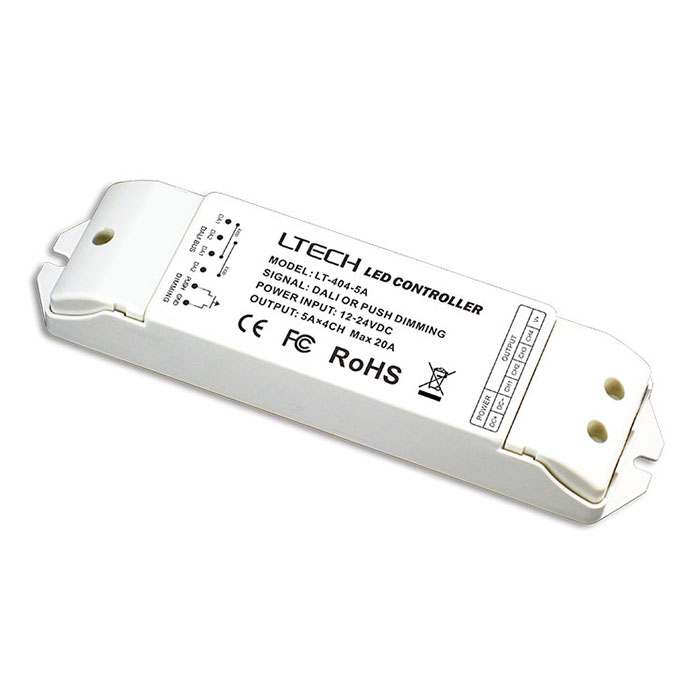
LTECH CV DALI Low Voltage Drivers are DC-input DALI-to-PWM dimming controllers designed to integrate conventional constant-voltage LED strips and LED fixtures into a professional DALI lighting system.
Unlike an AC-input DALI driver, these low-voltage LED controllers require a separate constant-voltage power supply. The controller receives the DALI digital signal and converts it into PWM output for compatible low-voltage LED lighting.
A typical system is: AC Power → 12V/24V/36V/48V Constant Voltage Power Supply → LTECH DALI DC Controller → DC LED Strip Lights (Single Color / CCT / RGB / RGBW), with the DALI bus connected directly to the LTECH controller for addressing and dimming commands.
This architecture is especially useful when a building already uses DALI but the final light source is a conventional PWM-controlled LED strip rather than a luminaire with a built-in DALI driver.
LTECH models follow the DALI IEC 62386 standard and use a standard DALI logarithmic dimming curve for smooth, predictable brightness control. They come with a 5-year warranty and are FCC, CE, and RoHS certified; some even have UL, TÜV, BIS, and DALI-2 certifications.
This makes them particularly suitable for architectural LED strip installations in hotels, retail spaces, restaurants, offices, residences and other projects where DALI is already used as the building lighting-control protocol.
CV DALI Dimmable Driver
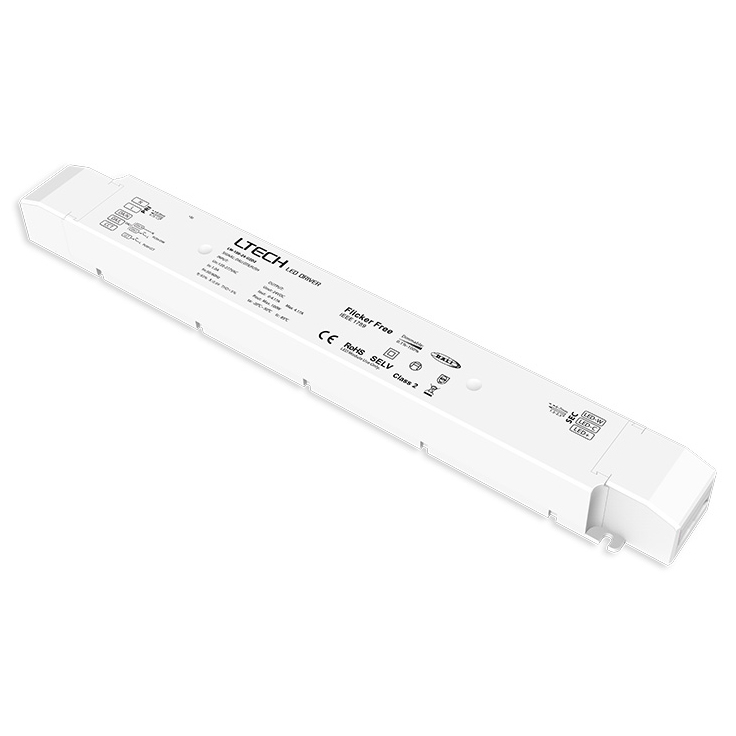
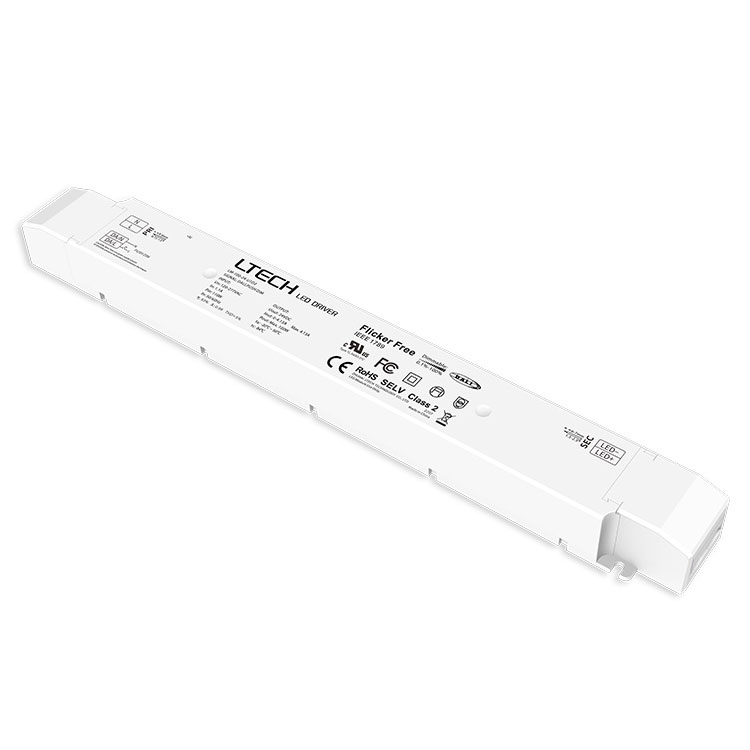
LTECH Constant Voltage DALI Dimmable LED Drivers AC-DC
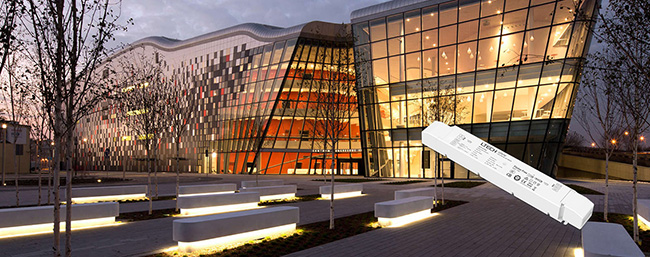
LTECH Constant Voltage DALI Dimmable Drivers combine AC-to-DC LED power conversion and professional DALI lighting control in one device. They connect directly to mains power, provide a regulated low-voltage output for constant-voltage LED lighting, and receive DALI commands for dimming, addressing, grouping, scenes, and other lighting-control functions.
A typical system is: AC Power → LTECH DALI CV Driver → 12V / 24V LED Strip Lights, with the DALI bus connected directly to the driver for lighting control.
This integrated architecture eliminates the need for a separate non-dimmable LED power supply and external DALI PWM controller, making the system cleaner and easier to specify for architectural LED strip projects.
North American DALI-2 models support 120–277VAC universal input and are available with UL-listed and 5-year warranty configurations, while other DALI-2 product families are designed for 200–240VAC markets. LTECH drivers also comply with standards or certifications such as CE, FCC, RoHS, safety extra-low-voltage requirements, and ErP energy-efficiency requirements.
CC DALI Dimmable Driver
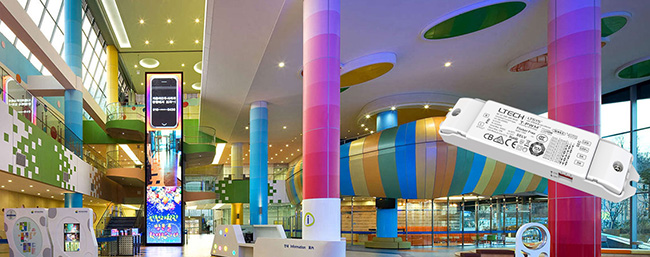
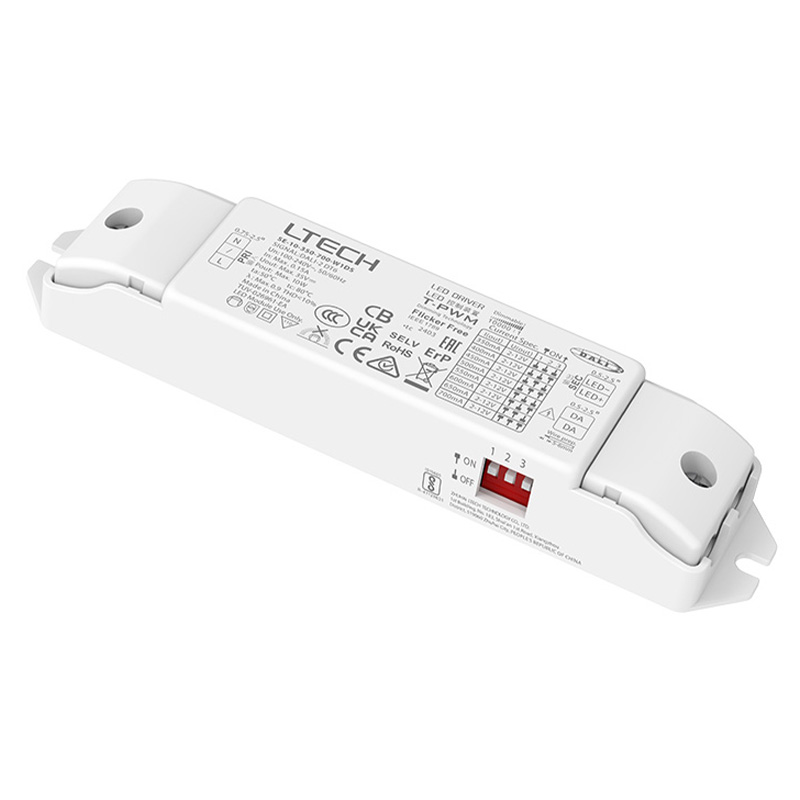
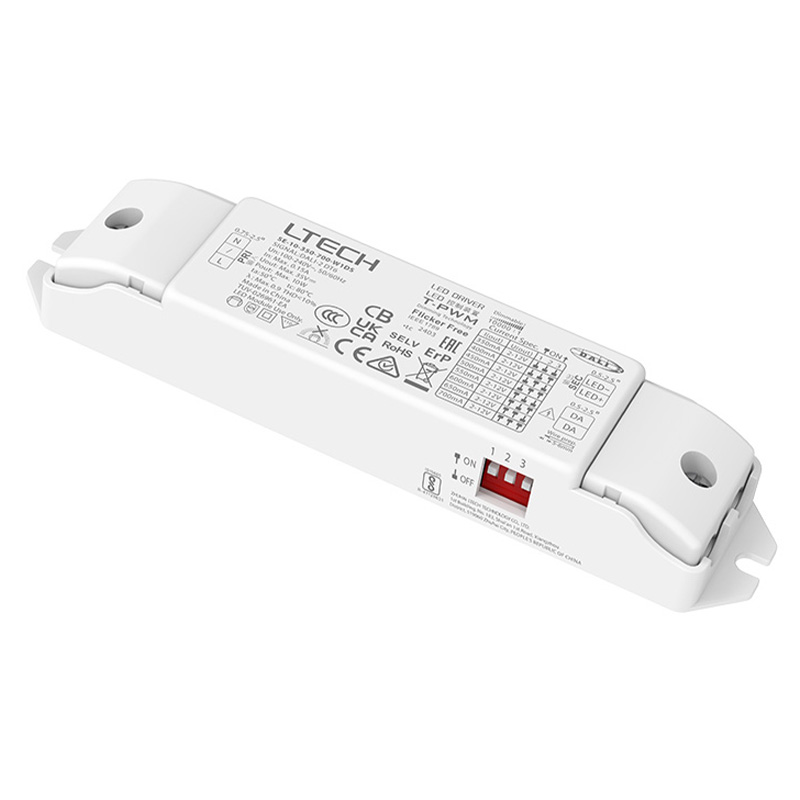
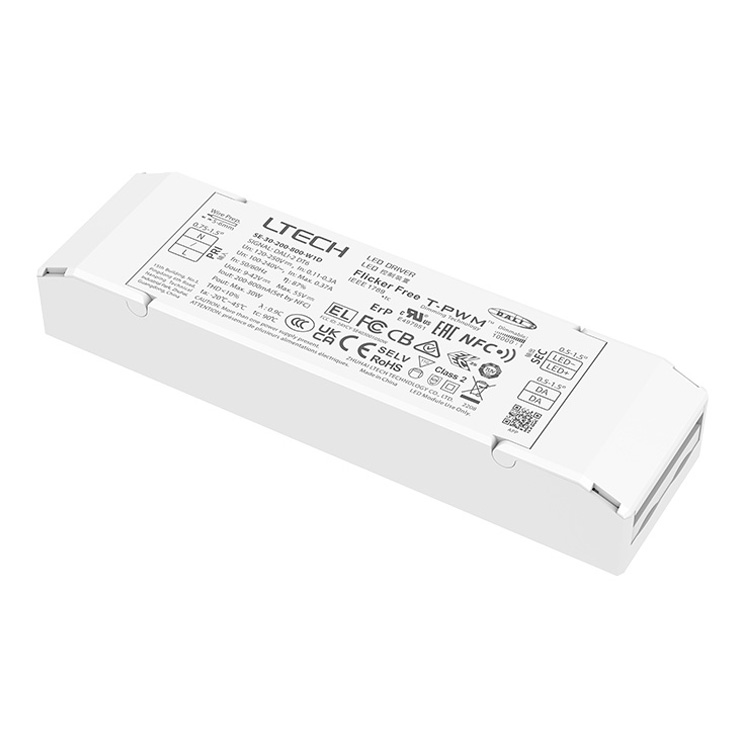
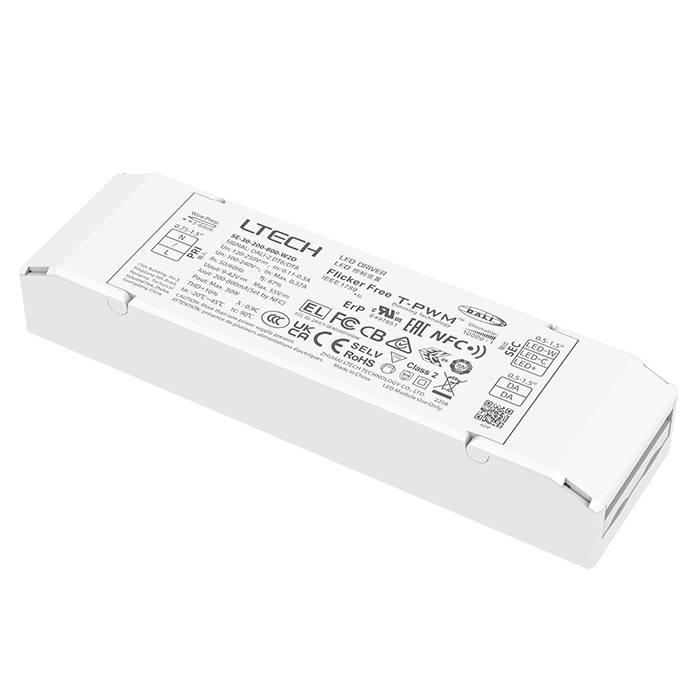
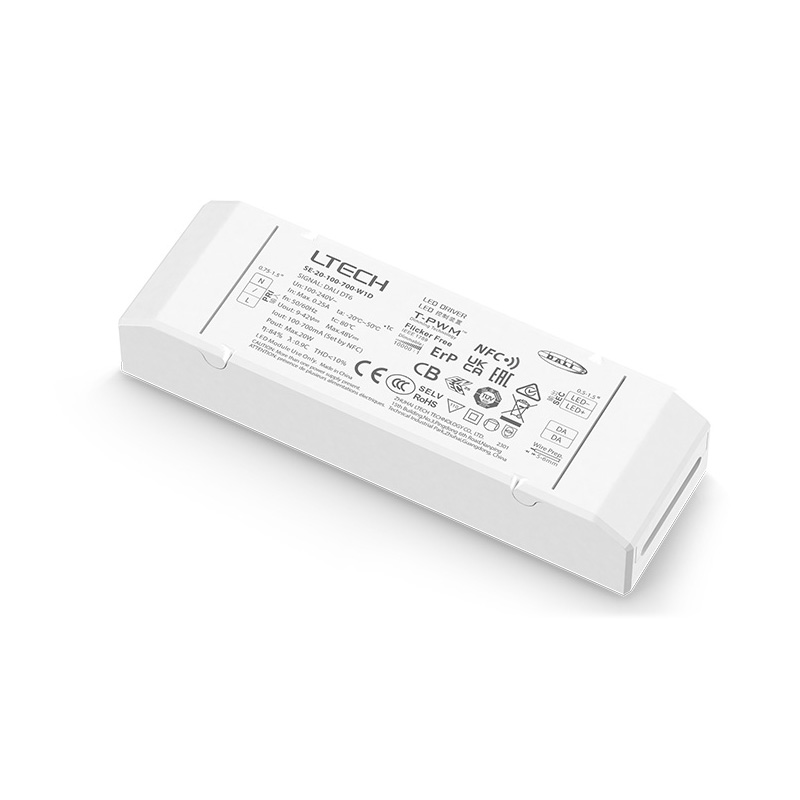
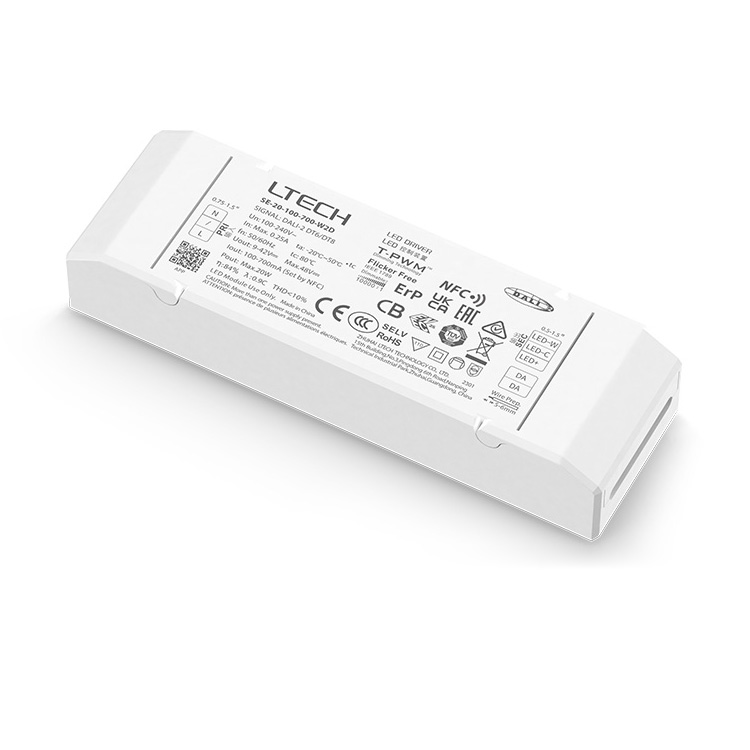
Constant Current DALI LED Driver provides constant current output to drive LED lights, compatible with digital address programmable lighting interface to quickly execute instructions for a certain light.
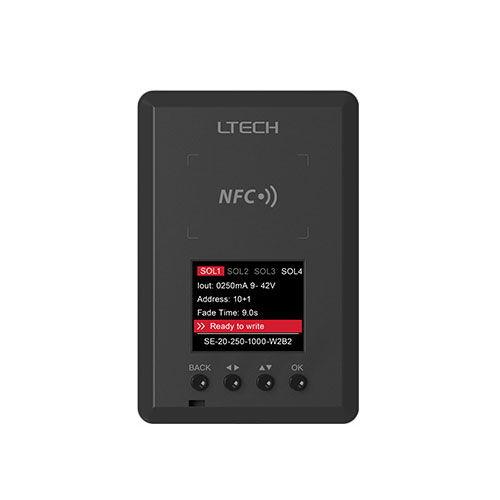
Ltech Constant Current DALI LED Driver adopts a combination of digital control technology and multiple dimming technologies to achieve delicate dimming effects. The LT-NFC DALI programmer developed by Ltech recently makes the control of the lighting system more convenient and quick. We also have Sunricher NFC DALI CC driver, supporting user to use NFC programming tools to set parameters quickly.
LTECH Intelligent dimmable led driver have excellent performance:
T-PWM digital dimming maintains CRI(color rendering index).
0~100% flicker-free, High-Frequency Exemption. Dimming range from 0-100%, LED start at 0.01% possible.
Multi-current & wide voltage, suitable for different power LED.
Over temp. / Over voltage / Over load / Short circuit protection,recover automatically.
Best-selling DALI Series
1–20 of 112 products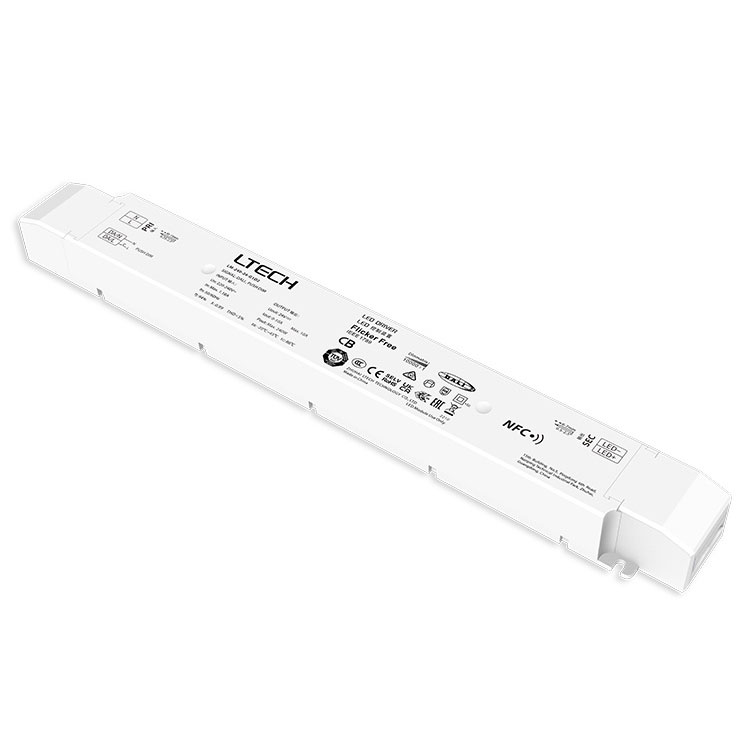
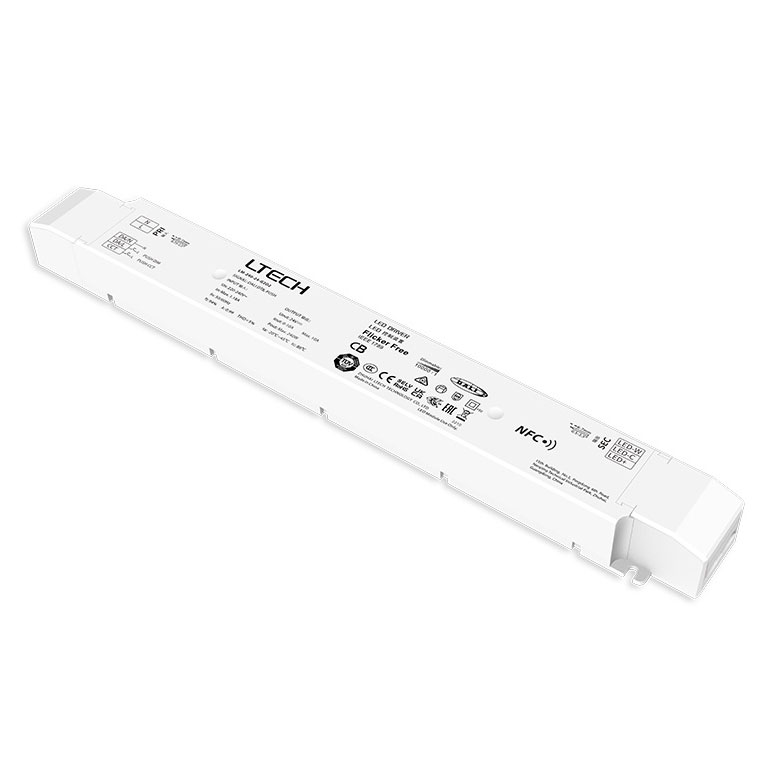

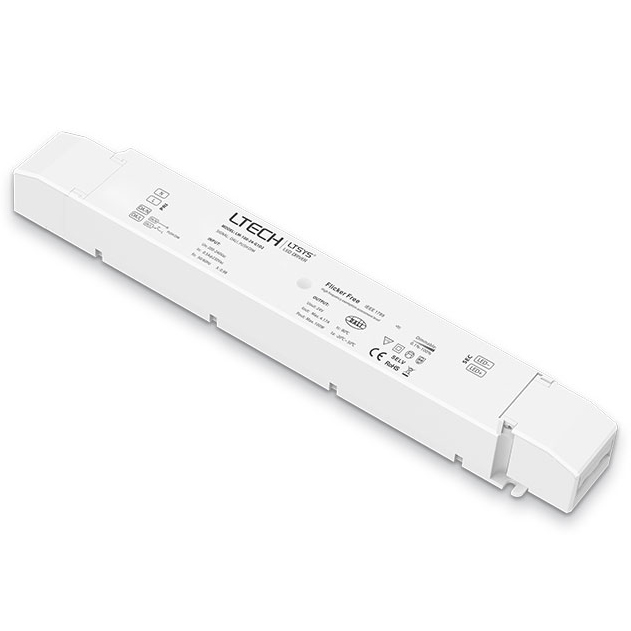
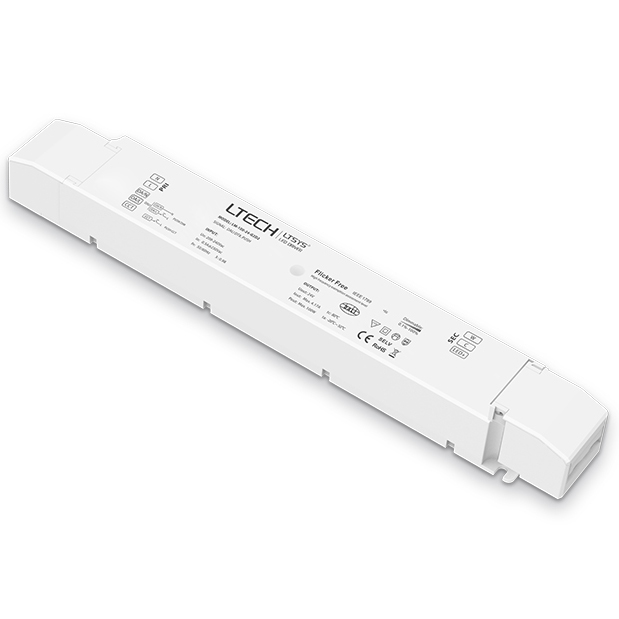
Slim 6-in-1 Dimming LED Driver DALI-2 & 0-10V & Push Dim Flicker Free
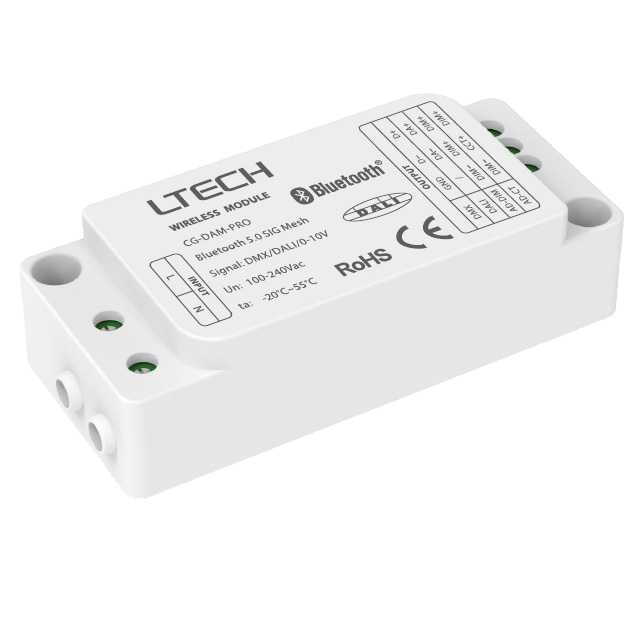
Bluetooth 5.0 Sig Mesh Wireless LED Control Module GC-DAM-PRO


How Does a DALI Lighting System Work?
A DALI system operates through a two-wire communication bus that allows each connected device to receive individual digital commands. Every driver or luminaire is assigned a unique address, enabling precise control such as dimming, grouping, and scene setting.
Unlike traditional analog systems, DALI enables bidirectional communication, allowing the system to monitor status, detect faults, and provide feedback in real time.
For a more detailed explanation of DALI dimming methods and system configuration, you can explore our DALI dimming guide.
DC-DC vs AC-DC DALI Drivers: How to Choose?
Choosing between DC-DC and AC-DC DALI drivers depends on the type of lighting system and power architecture used in your project.
• DC-DC DALI drivers are designed for low-voltage lighting systems where a separate DC power supply is already in place. They are commonly used with LED strip lights (12V / 24V / 36V / 48V) and are ideal for applications such as cove lighting, linear lighting, and architectural accent lighting.
• AC-DC DALI drivers operate directly from mains voltage (such as 120V or 220–240V) and convert it into a regulated output for lighting fixtures. They are typically used for downlights, panel lights, and other integrated luminaires that require direct connection to AC power.
DALI Dimming FAQ: DALI-2, DT6/DT8 and 0-10V
DALI-2 is an updated version of the original DALI (Digital Addressable Lighting Interface) standard. It offers improved interoperability, stricter certification requirements, and expanded features.
Compared to DALI, DALI-2 supports additional device types such as input devices (sensors and switches) and ensures better compatibility between products from different manufacturers.
DT6 and DT8 are different device types within the DALI standard, defining how lighting devices are controlled.
DALI DT6 is used for single-channel lighting, such as standard dimmable white LED fixtures. Each channel is controlled independently.
DALI DT8 is used for multi-channel lighting, such as tunable white (CCT) or RGB/RGBW lighting. It allows multiple channels to be controlled as one device, enabling synchronized color or color temperature adjustments. DT8 is commonly used in modern lighting systems that require dynamic color control.
The main difference is that DALI is a digital, addressable control system, while 0–10V is an analog control method.
DALI allows individual addressing of each device, group control, scene setting, and bidirectional communication for status feedback.
0–10V controls all connected lights on the same circuit together and does not support addressing or feedback. DALI offers greater flexibility and control, especially in complex lighting systems.
DALI and DMX are both lighting control protocols, but they are used for different applications.
DALI is mainly used for architectural, commercial, and residential lighting, focusing on stable dimming, grouping, and energy efficiency.
DMX (DMX512) is designed for stage lighting and entertainment, offering fast signal transmission and precise control of dynamic lighting effects.
A standard DALI system can support up to 64 devices per DALI line. Larger systems can be expanded by using multiple DALI lines and expanders.