
DALI Control Series
13 productsBuild your home DALI LED strip lighting system with these MiBoxer Mi-Light DALI lighting fixtures, utilizing DALI standard protocol IEC62386, the PWM output with soft brightness dimming and full compatibility, compatible with white/single color, CCT, RGB, RGBW, and RGB+CCT output modes.
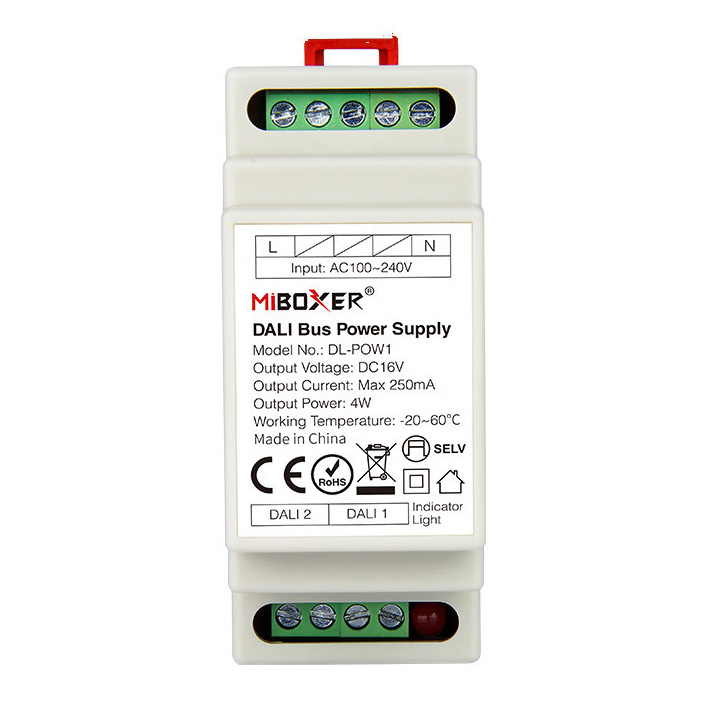
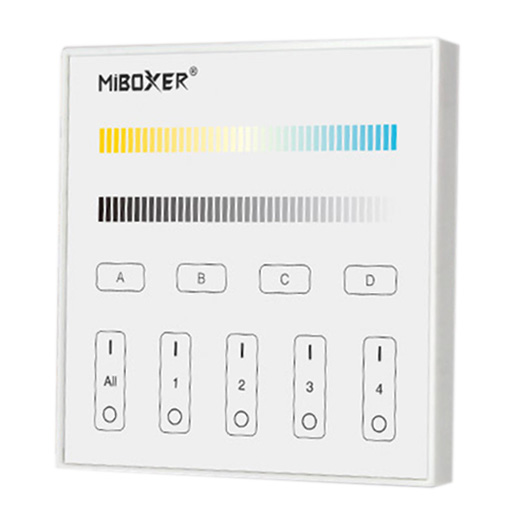
Power for the entire DALI lighting system is transmitted from the DALI Bus power supply to the individual light fixtures via the DALI bus. The DALI led strip controller and touch control panel are on the DALI bus.
High-end DALI controllers such as the Mi-Light DL-X allow you to choose between linear or logarithmic dimming of the LED strips, making the dimming more predictable, precisely controlled, or more in tune with human perception. Our DALI NFC driver also supports precise dimming through accepting the conmand of DALI master controllers.
In a huge DALI lighting system, individual or group lighting control is achieved by setting unique DALI addresses to correctly configure and control the DALI lighting equipment.





FAQ About DALI Control Series
Direct answers to technical questions about wiring, addressing, and integrating DALI LED strip controllers and wall panels.
DALI lighting control is a bidirectional digital protocol governed by IEC 62386 that sends commands over a 2-wire bus to addressable drivers and controllers. In an LED strip installation, your constant voltage power supply provides DC power (12V or 24V) to the controller, while the 16V DC DALI bus carries digital instructions for brightness and color. Each DALI LED strip controller receives an individual short address from 0 to 63, letting you adjust single runs, assign them to up to 16 groups, or trigger 16 scenes without rewiring your load cables. To explore the protocol details, read how dali dimming works.
For DALI LED strip lights, the core difference is how many bus addresses the controller consumes to manage multi-channel color. A DT6 (Device Type 6) device uses one unique address per channel, meaning an RGBW tape run takes four addresses out of your 64-device bus limit, and color mixing must be calculated by your master controller. A DT8 (Device Type 8) unit like our DL-X controller uses a single address to manage tunable white, RGB, RGBW, or RGB+CCT tape via color coordinates (xy) or calibrated color temperature (Tc). That saves bus capacity and guarantees synchronized color shifts without channel lag.
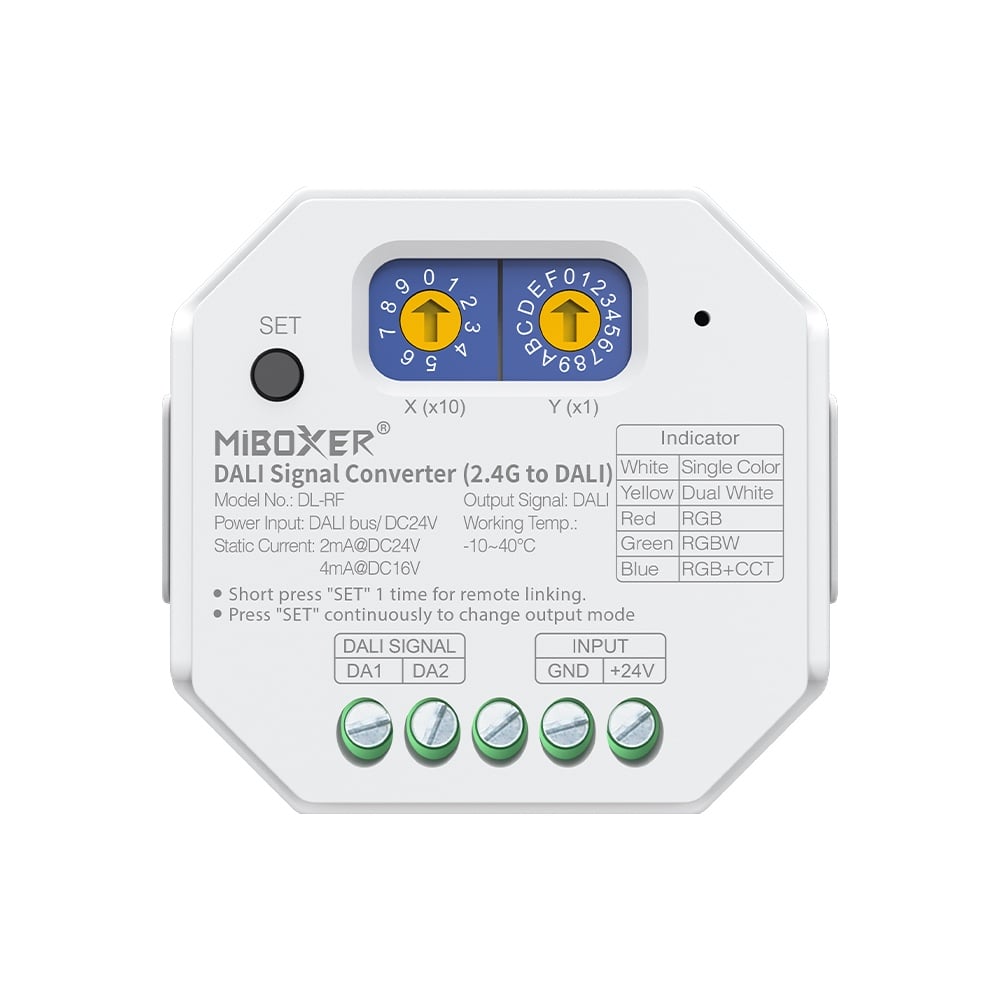
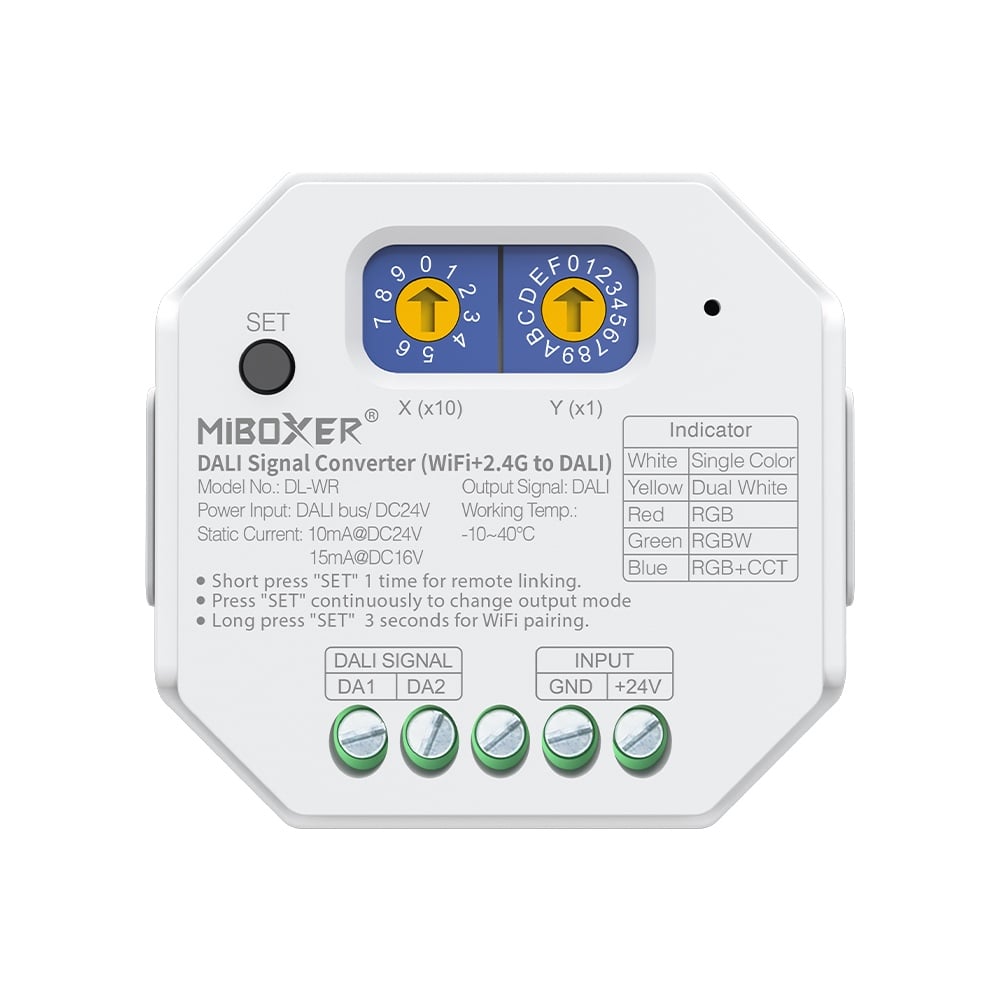
You can control DALI LED strip lights wirelessly by wiring a gateway bridge directly into the DALI bus line. The DL-WR converter translates WiFi commands from the Tuya Smart app and 2.4GHz RF signals into standard DALI broadcast or unicast packets on the wire. If you only need handheld wireless operation without an internet connection, the DL-RF converter bridges MiBoxer 2.4GHz handheld remotes to both DT6 and DT8 devices on the bus. This approach lets you retain a reliable wired architectural backbone while adding mobile or remote overrides without running physical control wires back to the wall box.
A single DL-X DALI LED controller handles up to 20 A total output current across a DC12V to DC24V supply range. The unit provides five separate terminal channels rated at 6A each, but the combined draw across all active channels must stay at or below 20A. On a 24V circuit, that provides a ceiling of 480W total load, which equates to roughly 30 m to 40 m of standard accent tape or about 20 m of dense 24W/m tape. If you exceed 20A, the internal MOSFETs overheat and trigger thermal shutdown. For bigger loads, distribute fixtures across multiple controllers.
Abrupt or stepped dimming usually means your controller is set to a linear dimming curve instead of a logarithmic curve. Human eye perception is non-linear: our eyes are far more sensitive to tiny lumen shifts at the bottom end of the range than at the top. The DL-X controller lets you toggle between logarithmic and linear dimming modes. When set to logarithmic, low-end levels below 10% dim smoothly down to 0.1% without jumping. If the steps persist, verify that your master controller is sending standard 8-bit DALI arc power commands rather than rapid coarse percentage steps.
Yes, you can pull standard DALI bus wires inside the same raceway or multi-core conduit as AC mains lines, provided the control wire insulation is mains-rated. The IEC 62386 standard requires DALI interfaces to provide basic electrical insulation rather than SELV (safety extra-low voltage). This design allows installers to use standard 5-core building wire (Live, Neutral, Earth, DA+, DA-) across long commercial ceiling drops. Keep in mind that while the wiring can share conduit, the bus terminals inside fixture junctions must maintain physical separation from bare mains conductors to comply with local electrical codes.
Connecting rgbw led strip lights to a DALI lighting control network requires setting your DL-X controller to 4-channel RGBW mode and wiring the common positive line to V+ with individual channels to R, G, B, and W. Under DT8 mode, the controller accepts coordinates based on the RGBWAF standard, allowing you to dim brightness and adjust saturation while only taking up one short address on the bus. Pair the receiver with a DP3S touch panel or a programmable DALI master to execute smooth color sweeps or independent warm white task lighting along the same run.