
LED Power Repeater
2 sub-categoriesLTECH LED strip light power repeaters receive the pulse-width modulation (PWM) output from a primary single-color dimmer or CCT/RGB/RGBW controller and replicate that exact control waveform onto additional lighting loads. SuperLightingLED provides a complete range of LTECH PWM light signal amplification hardware designed to extend architectural and commercial LED strip installations far beyond the output limits of a single driver. Within our LTECH power repeater ecosystem, these units eliminate dimmer overload and keep large multi-zone runs synchronized without signal lag.
- Accepts DC input voltages across 5V, 12V, 24V, and up to 48V DC lights.
- Supports load capacities spanning from 5W single-channel runs up to 1152W high-output multi-channel arrays.
- Repeats high-frequency PWM dimming without visible flicker or camera banding.
- Maintains synchronous dimming down to low thresholds across separate electrical circuits.

PWM CV Power amplifier
In led strip light applications, sometimes the output of the led controller may not be enough to drive all your led strips. In this case, you can use a constant voltage power amplifier to amplify the controller's output to ensure that enough power is delivered to all the led strips. And the led light strips are all under the same control system.
These Ltech PWM LED Strip Light Constant Voltage Power Amplifiers with 1CH, 3CH, or 4CH color output for different led types.

PWM CC Power amplifier
These Ltech Constant Current (CC) LED PWM Power Amplifiers can act as PWM to constant current converters, PWM signal input and constant current 350mA/700mA/1050mA or 1400mA/1750mA/2100mA output, to achieve PWM dimming control of different constant current led lamps.
Adding a CC power amplifier allows you to connect a multiple number of constant current LEDs. In theory, an infinite number of PWM constant current power amplifiers can be connected.
Best-selling LED Power Repeater
1–19 of 19 products

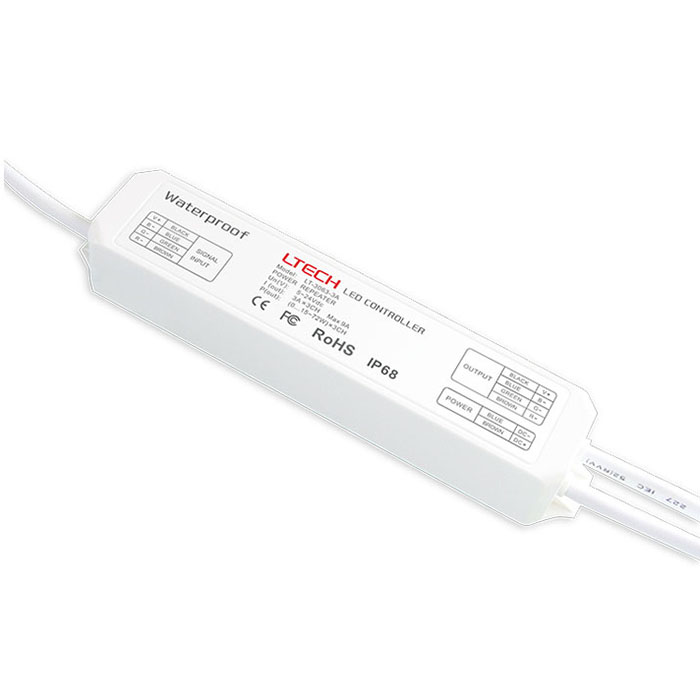
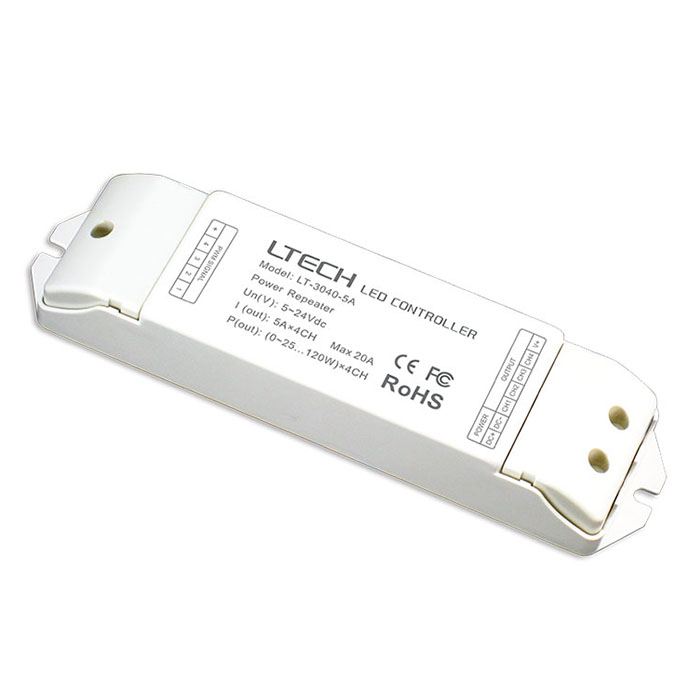
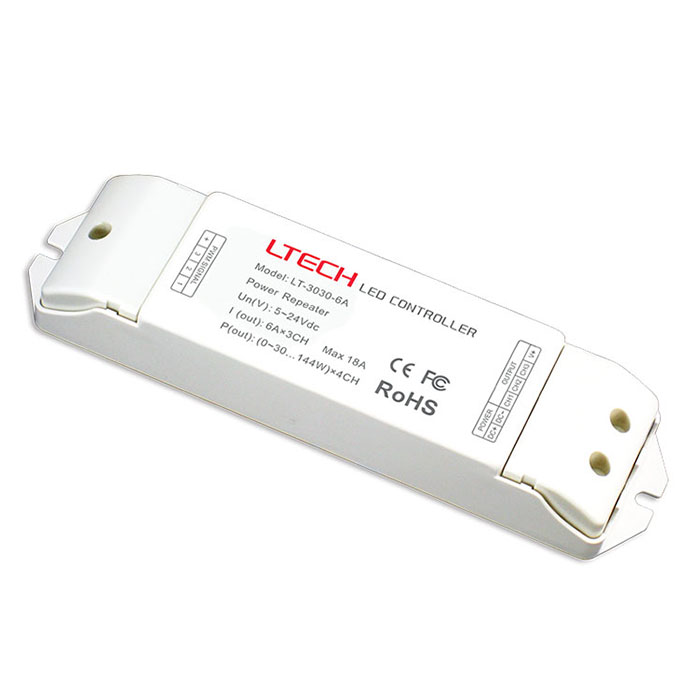


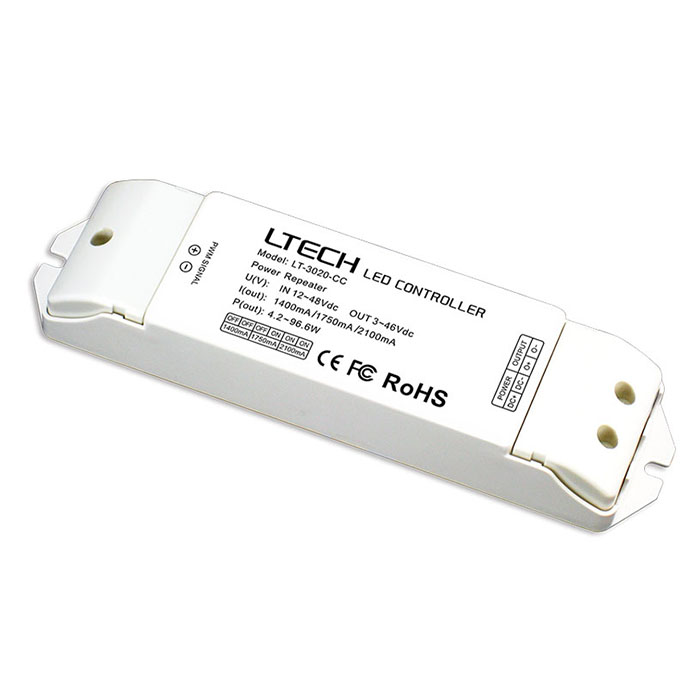


Constant voltage vs constant current repeater LED options
Selecting the right repeater LED model depends entirely on how your downstream luminaires regulate current. Our catalogue divides these into two hardware architectures:
| System Criterion | PWM Constant Voltage Repeater | PWM Constant Current Repeater |
| Sub-category | PWM CV power amplifiers | PWM CC power amplifiers |
| Input / Output Voltage | 5V, 12V, 24V, 36V, 48V DC direct pass | 12V to 48V DC input; 3V to 46V DC forward drive |
| Output Regulation | Fixed voltage, variable current (up to 12A per channel) | Fixed current steps (350mA, 700mA, 1050mA, up to 2100mA) |
| Primary Load | Constant voltage flexible LED strip lights | Series-wired architectural downlights and high-power diodes |
| Channel Configurations | 1, 3, and 4 channel options | 1, 3, and 4 channel options |
Engineered LTECH signal repeaters from SuperLightingLED
Signal reliability separates commercial installations from jobs requiring constant maintenance visits. Every repeater LED module in this category features optoelectronic isolation between the input and output terminals, preventing ground loops and stray voltage spikes from feeding back into your primary master controller.
These industrial LTECH hardware is FCC CE RoHS certified and with a 5-year warranty, housed in ventilated compact casings (such as 135x30x20mm or 148x87x23mm form factors) or DIN-rail screw mountings, with an available IP68 variant for exterior conduit runs.
FAQ About LED Power Repeaters
Direct engineering answers on sizing, wiring, and synchronizing PWM power repeaters across large-scale commercial runs.
An LED power repeater expands the wattage capacity of an LED controller by taking its PWM dimming output and replicating it onto additional runs using dedicated power from an auxiliary supply. Most standard controllers max out at 5A to 8A per channel. If your run demands 25A or 40A total, you cannot wire all that load directly to the controller board without melting terminal blocks or triggering over-current shutdown. An LED power repeater lets you add more LED strip lights indefinitely while keeping every section in identical dimming and color sync.
Every LED power repeater requires a dedicated DC power supply feed, either tapped from the main driver if it has surplus wattage or from a secondary unit positioned right beside the amplifier. A repeater does not generate electricity; it acts as a high-speed electronic switch that modulates incoming DC power according to the controller's PWM signal. A common jobsite mistake is connecting only the signal lines and expecting the repeater to light the load. For wiring diagrams on splitting your feeds, see our guide on connecting LED strips to power.
An LED power repeater can easily drive a 24V LED strip from a 12V controller signal because its PWM input circuit is optically isolated and voltage-independent from DC5V to 24V. The repeater's input terminals read the timing of the PWM pulse, not the voltage level. As long as you wire a 24V power supply into the repeater's power terminals, its output will deliver 24V PWM to your tape light while matching the color changes of the 12V master controller perfectly.
A constant voltage (CV) LED power repeater delivers fixed-voltage PWM for standard tape light, while a constant current (CC) power repeater outputs regulated milliamps for high-power architectural fixtures. Across our 19 live models in this category, CV units supply 12V or 24V up to 5A per channel. Our constant current power repeaters convert that same controller PWM signal into fixed 350mA, 700mA, or 1050mA outputs to run recessed downlights alongside linear cove tape.
You can daisy-chain an LED power repeater in theoretically unlimited numbers, but we advise wiring them in a star or parallel-signal topology once you exceed 10 units. Each repeater routes the PWM pulse through an internal optocoupler, introducing a minor switching delay of several hundred nanoseconds. In a serial chain of 20 or 30 units, those micro-delays accumulate and cause visible chasing lag on rapid strobes or fast color fades. Running dedicated signal pairs from the master controller keeps all repeaters firing simultaneously.
Signal lag occurs when repeaters are wired in a long serial chain where coupler switching delays accumulate, or when input signal lines pick up electrical noise along parallel high-voltage AC conduits. To eliminate lag, change your signal wiring from a series daisy-chain to a home-run star layout directly from the master controller terminals. Also, make sure your low-voltage PWM signal lines maintain at least 15 cm of clearance from 110V or 230V building wiring to prevent induced inductive interference.
Low-end flicker on an LED power repeater almost always stems from a missing common ground or high-frequency capacitance loss on lengthy signal wire runs. When the master controller and the repeater run on separate power supplies, you must tie their negative DC terminals (V-) together unless the repeater uses fully isolated differential optocouplers. Without that shared reference, the repeater reads a fluctuating ground threshold at low duty cycles, causing the output MOSFETs to chatter and flicker below 10% brightness.
Hardwiring an LED power repeater guarantees 100% microsecond synchronization across every lighting section, whereas pairing multiple wireless RF controllers inevitably drifts over time or misses remote commands. In long commercial coves or perimeter architectural runs, even a 50-millisecond wireless packet delay makes smooth color fades and dimming transitions look uneven between adjacent walls.