
DALI Master Controller
10 productsSkyDance DALI Master Controllers are designed to generate DALI digital control commands for managing compatible DALI lighting systems, including DALI dimmable LED drivers, constant-voltage LED controllers, constant-current LED controllers, DALI switches, and other DALI-compatible lighting devices.
Instead of relying on a centralized computer or building automation system for every lighting operation, these DALI master panels and controllers provide convenient local and wireless control through different interfaces, including built-in rotary knobs, touch-sensitive keys, external Push-Dim switches, RF remote controls, Wi-Fi smartphone apps, and Zigbee smart home systems.
The masters communicate with connected devices through standard DALI digital signals, supporting DALI DT6 single-channel dimming and DT8 control types, including tunable white (DT8-TC), RGB, and RGBW, or DT7 switching. With DALI addressing, group control, individual device control, and broadcast commands, SkyDance provides flexible lighting management for different room layouts and lighting configurations.
SkyDance DALI Master Controllers are suitable for residential smart lighting, hotels, offices, conference rooms, retail stores, schools, hospitals, corridors, commercial buildings, and other projects requiring flexible DALI lighting management with convenient local operation, wireless control, and occupancy-based automation.
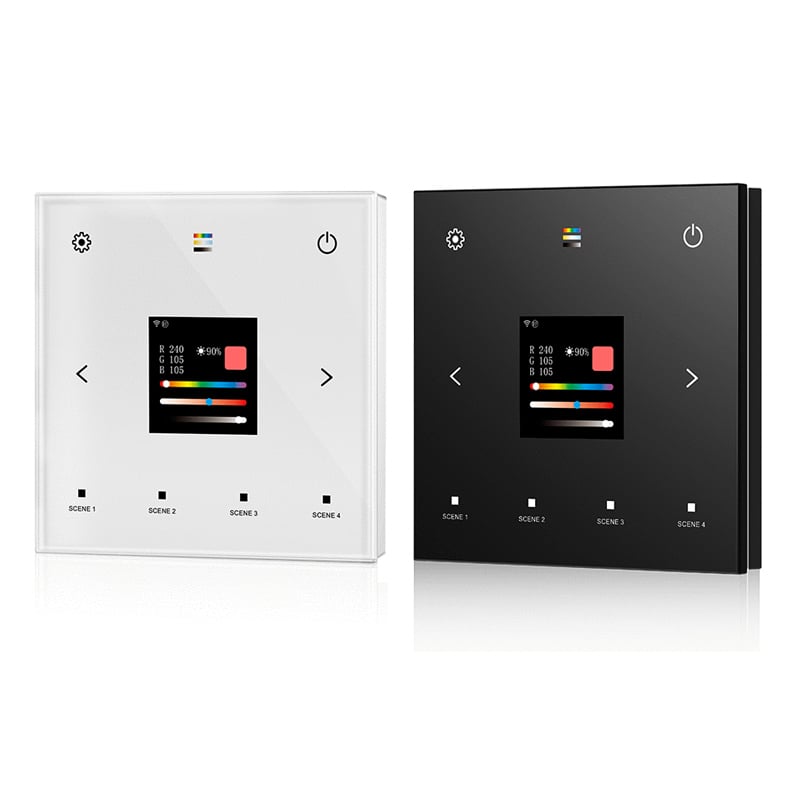

4 Zones LED CCT Wall Light Panels DALI Master for Home TL4-2D

4 Zones LED Controller Touch Panel DALI Master TL4-1D


TD4-S RF LED DALI RGBW Light Touch Wall Panel Controller Master

TD5-4S 4 Zone RF DALI RGB+CCT Wall Master Panel Controller


Multiple DALI Control Interfaces: Rotary, Touch, Push-Dim & Wireless
SkyDance offers different DALI master control interfaces to accommodate different installation and user preferences. Rotary panels provide intuitive brightness, color temperature, and color adjustment through a physical knob, while touch panels offer modern glass interfaces with touch sliders, dedicated control buttons, and preset scene functions.
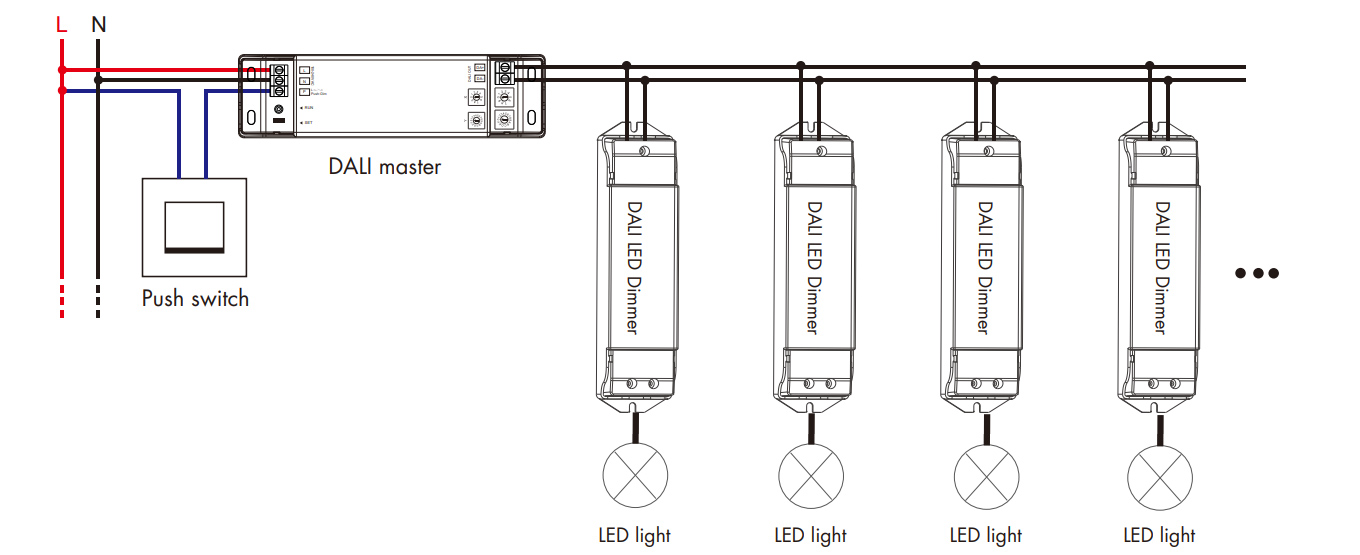
For installations using conventional wall switches, external momentary Push-Dim buttons can also send DALI dimming and switching commands through compatible control modules.
In addition, RF wireless remotes, Wi-Fi app control, and Zigbee smart home connectivity provide alternative ways to operate the same DALI lighting system, depending on the selected controller.
DALI PIR & Daylight Sensor-Based Lighting Automation
For projects requiring automatic lighting operation, SkyDance DALI systems can be combined with DALI-2 PIR and ambient light sensors. The DA-ER sensor detects human movement and measures surrounding illuminance, then reports the corresponding sensor events over the DALI bus.
When connected to a compatible DALI-2 multi-master application controller, these signals can be used to implement occupancy-based lighting, automatic lighting responses, and daylight-dependent control.
This is especially useful for corridors, offices, meeting rooms, hotel common areas, and other spaces where lighting operation needs to respond to room occupancy and ambient light conditions.
FAQ About DALI Master Controller
Direct engineering answers on wiring, addressing, bus power limits, and fixture compatibility for DALI master controllers.
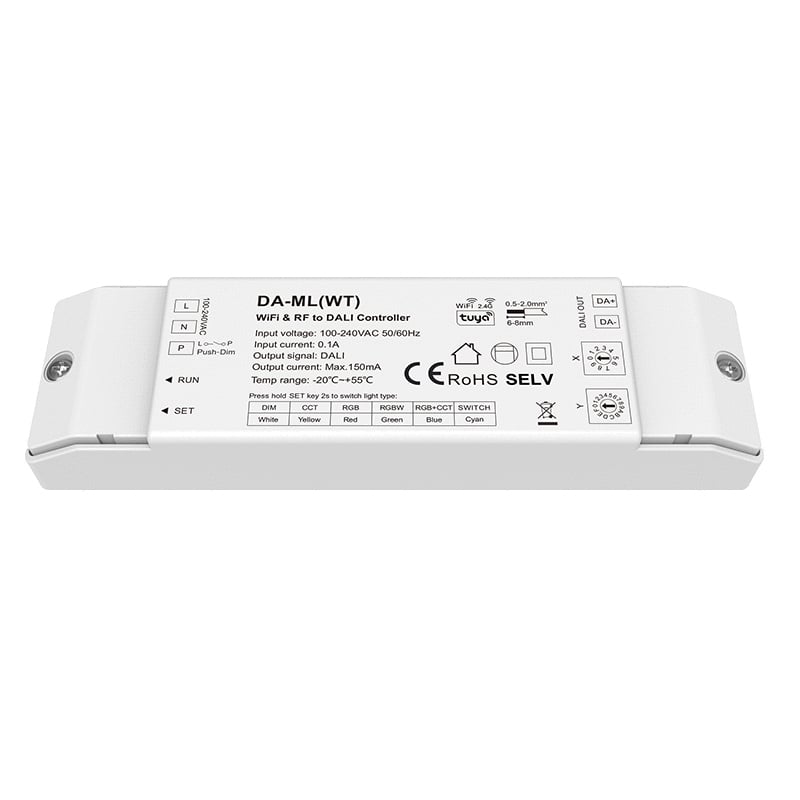
Not every DALI master controller requires a standalone bus power supply, but the DALI bus itself always needs 16V DC nominal power to transmit data. The IEC 62386 standard requires bus voltage between 12V and 20.5V DC with current strictly capped at 250 mA. Some hybrid models, such as our DA-ML(WT) master controller, integrate an active 250 mA bus power supply directly inside the unit, while standard touch panels rely on an external power pack or draw 24V DC auxiliary power.
A standard DALI master controller manages up to 64 short addresses, 16 groups, and 16 scenes on a single line. We list 10 DALI master controller models in this category, with 2 added in 2026 alone, built for installations ranging from single-room touch panels to multi-zone commercial spaces. If your project has more than 64 drivers or ballasts, you need to divide the installation across multiple DALI lines or run broadcast commands across shared control channels.
A DALI master controller can communicate with both DT6 single-color and DT8 multi-channel devices on the exact same two-wire bus without interference. The difference is address consumption: a DT6 installation requires a unique DALI short address for every channel you dim, consuming four addresses for an RGBW run. A DT8-compatible master addresses the color mixing internally inside the driver firmware, controlling tunable white or multi-color LED strip lights using just one address per driver.
When drivers ignore a DALI master controller, the issue is almost always missing bus power, unassigned device addresses, or a short circuit on the data line. Measure DC voltage across the DA terminals with a multimeter; you should see 12V to 20.5V DC idle. If the meter reads 0V, your bus power supply is offline or shorted. If voltage is normal, read our guide on how DALI dimming works to recheck device address assignment and ensure no loose terminal screws.
You can easily link wireless remotes and smartphones to a DALI master controller if the master includes an integrated RF receiver or WiFi bridge. Units like the TD-W and DA-ML(WT) convert incoming 2.4GHz RF signals from handheld remotes or Tuya WiFi commands into standard IEC 62386 bus packets. This gives you wall-switch control, phone automation, and wireless remote convenience simultaneously across all hardwired DALI LED strip lights on that bus line.
A DALI master controller operating in broadcast mode sends identical commands to every connected fixture simultaneously, while addressed mode targets specific short addresses or pre-assigned groups. Broadcast mode requires zero software commissioning, making it practical for simple push-dim units like our DA-P controlling a unified cove or hall of LED strip lights. Addressed mode requires configuration during commissioning but allows independent brightness and scene control over up to 16 distinct zones on one wire pair.
A DALI master controller normally sends a digital off command that dims fixtures to 0%, but the connected LED drivers remain energized in standby, drawing 0.2 W to 0.5 W each. If your project specification requires true zero-standby draw across dozens of fixtures, install DALI AC relays along the mains feed. The master signals the relay over the data line to open the AC contactor once dimming drops to zero, killing phantom power entirely.
You can only run two DALI master controllers on one bus line if both devices are certified multi-master controllers under IEC 62386-103 with collision detection. If two basic single-master controllers transmit commands simultaneously, data packets collide, corrupting the telegrams and causing fixtures to freeze or drop commands. To achieve two-way control in hallways or entries without multi-master hardware, pair a hardwired master with wireless RF remote wall switches that trigger the primary master cleanly.
A DALI master controller is engineered for reliable architectural fades and coordinated scene changes, not high-speed chasing or dynamic color effects. Because the DALI protocol operates at 1200 baud, transmitting commands across multiple addresses takes tens of milliseconds per frame. For gentle day-to-night circadian transitions and smooth multi-zone architectural dimming on LED strip lights, DALI is rock solid; for fast-paced pixel mapping or musical stage strobe effects, choose DMX512 instead.