
CV 0/1-10V Low Voltage Driver
6 productsLTECH Constant Voltage 0/1-10V Low Voltage Dimming Controllers
LTECH CV 0/1-10V Low Voltage Drivers are DC-input 0/1-10V-to-PWM controllers designed to connect conventional constant-voltage LED tape lighting and fixtures to professional 0-10V and 1-10V dimming systems.
These controllers operate after a separate constant-voltage power supply. They receive a 0-10V, 1-10V, or other supported control signal and convert it into PWM output for compatible LED strips and low-voltage fixtures.
A typical installation is: AC Power → DC Constant Voltage Power Supply → LTECH 0/1-10V DC Controller → LED Strip, with the 0/1-10V dimmer or building-control system connected to the controller's dimming input.
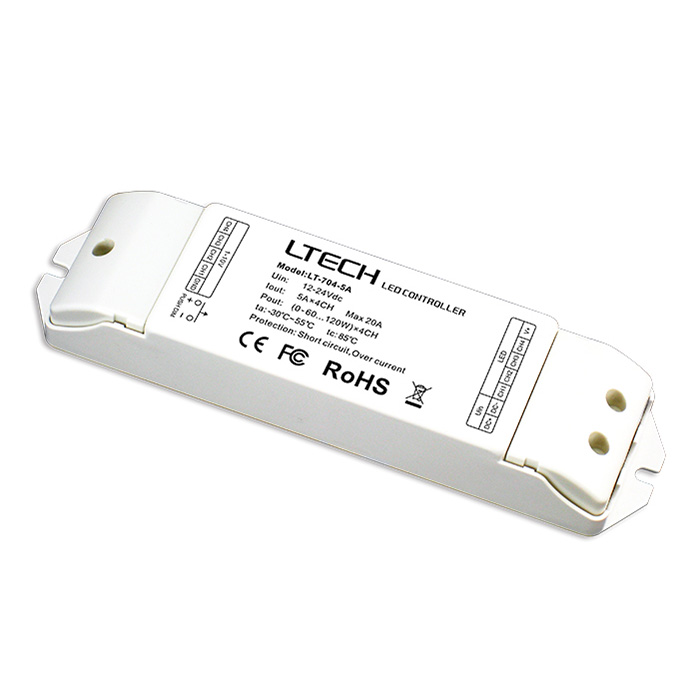
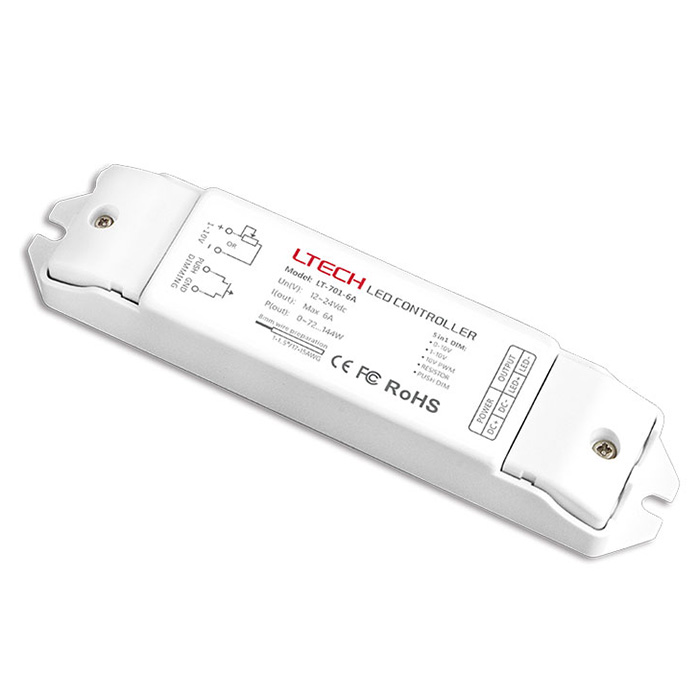
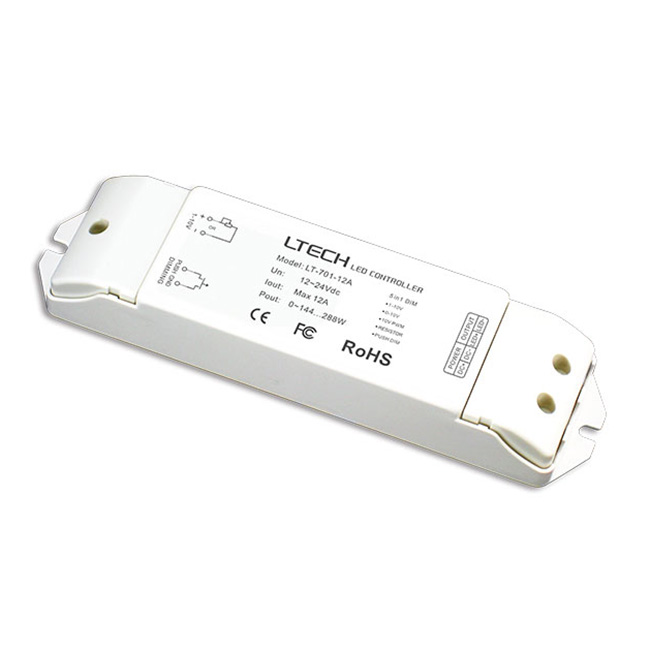
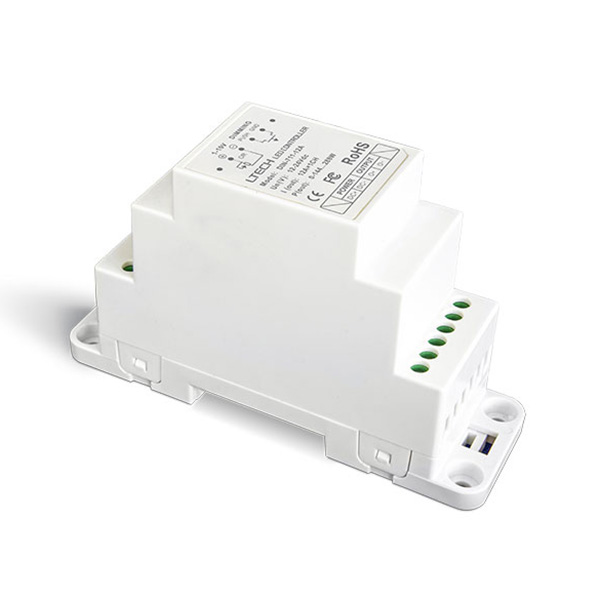


More 0/1-10V Low-Voltage Controllers at SuperLightingLED
In addition to LTECH, SuperLightingLED offers similar DC-input 0/1-10V-to-PWM controllers from professional lighting-control brands including SkyDance and BinColor.
By offering LTECH, SkyDance, BinColor, and other professional control products, SuperLightingLED allows customers to select the most suitable 0-10V solution according to your system architecture.
FAQ About CV 0/1-10V Low Voltage Driver
Direct engineering answers on wiring, load calculations, and control protocol compatibility for our low-voltage 0-10V dimming drivers.
No, a CV 0/1-10V low voltage driver requires a regulated 12V or 24V DC power supply wired ahead of its input terminals. Connecting 110V or 230V AC mains directly to this unit will destroy the internal switching FETs instantly. These drivers sit between an external DC power supply and your LED strip lights, functioning as an in-line PWM dimming module. If you need a single enclosure that takes line voltage AC from the wall and outputs dimmable DC, choose one of our mains-fed CV 0/1-10V dimmable drivers instead.
You can power up to 16 metres of 14.4W/m LED strip lights on a 12A driver at 24V while staying within safe engineering limits. At 24V, a 12A rating gives you 288W total theoretical capacity, which means 230W under an 80% continuous continuous-load rule (230W / 14.4W/m = 15.97 m). At 12V, that same 12A driver yields 144W maximum, supporting about 8 metres of 14.4W/m tape light under that same 80% guideline. Exceeding continuous amperage triggers the driver's built-in thermal overload protection.
Yes, commercial 0-10V wall dimmers from Lutron (such as Diva DVSTV or Nova T) and Leviton (IP710) wire directly to the signal input. These wall dimmers act as current-sinking controls, drawing microamps from the driver's control loop to pull the reference voltage down from 10V to 1V or 0V. Ensure your polarity matches: connect the violet wire from the dimmer to the driver's 0-10V positive terminal, and the gray (or pink) wire to the 0-10V negative terminal.
Wire a normally-open momentary switch directly between the Push-Dim input terminal and the DC negative terminal. A momentary tap (under 0.5 seconds) switches your LED strip lights on or off. A sustained press (longer than 0.5 seconds) ramps the PWM output smoothly up or down between 0.1% and 100%. The driver stores its last dimming state in non-volatile memory, so after a line-power interruption, it returns to the exact light level set before the outage.
Your LED strip lights stay dimly lit when your wall control uses the 1-10V sinking standard rather than true 0-10V sourcing. A 1-10V control leaves roughly 1V on the line at its lowest slider position, holding the output at roughly 0.1% to 1% brightness. To achieve complete shutoff, install a dimmer that contains an integrated micro-switch relay to cut the primary DC feed, or adjust your building automation output channel to drop strictly below 0.6V.
Flashing or buzzing below 10% usually stems from electrical noise coupling onto long, unshielded 0-10V control wires running parallel to AC mains cables. The induced AC ripple corrupts the driver's DC reference voltage, making the PWM output hunt erratically. To fix this, run 0-10V lines in shielded twisted-pair wire (grounding the shield at the control end only), or keep low-voltage control circuits at least 300 mm away from 120V/277V line voltage cables.
No, wiring constant-current fixtures directly to this constant-voltage driver will blow the LED chips almost immediately. Constant-voltage drivers maintain a fixed 12V or 24V rail and regulate light through pulse-width modulation, whereas constant-current fixtures require fixed milliamps (such as 350mA or 700mA) with dynamic voltage tracking. If your fixtures do not contain on-board current-limiting resistors, you need one of our dedicated CC 0/1-10V dimmable drivers instead.