
Wireless Receiver
5 productsLTECH L-BUS wireless receivers are designed to receive compatible 2.4GHz RF commands from the LTECH L-BUS lighting control system, such as E Series and EX Series touch panels or knob panels, F Series or Q Series remotes, and control connected LED lighting accordingly.
These receivers provide a convenient way to add wireless dimming, color adjustment, and multi-zone lighting control to compatible constant-voltage or constant-current LED installations. Always verify the pairing compatibility of the specific receiver, wall panel, or remote before purchasing.
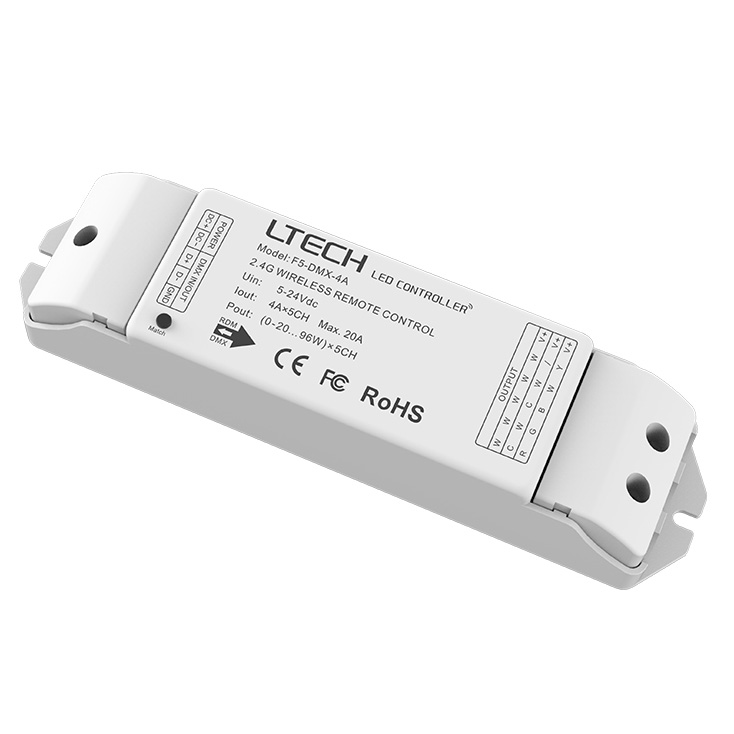
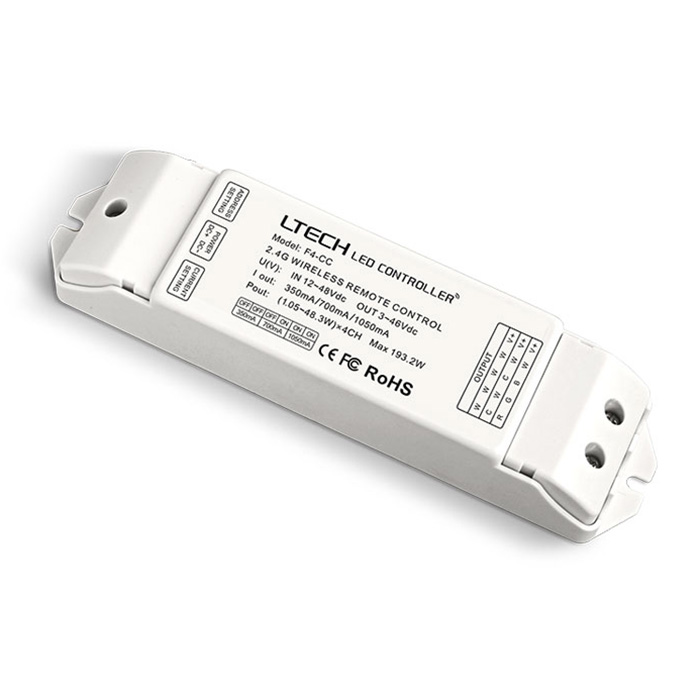
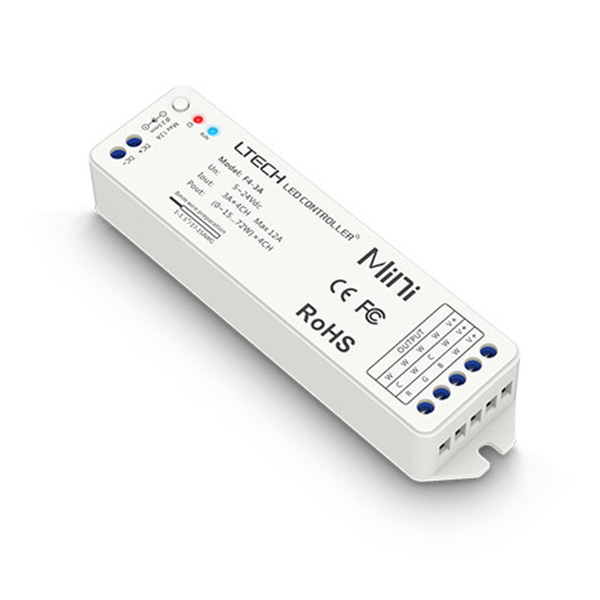
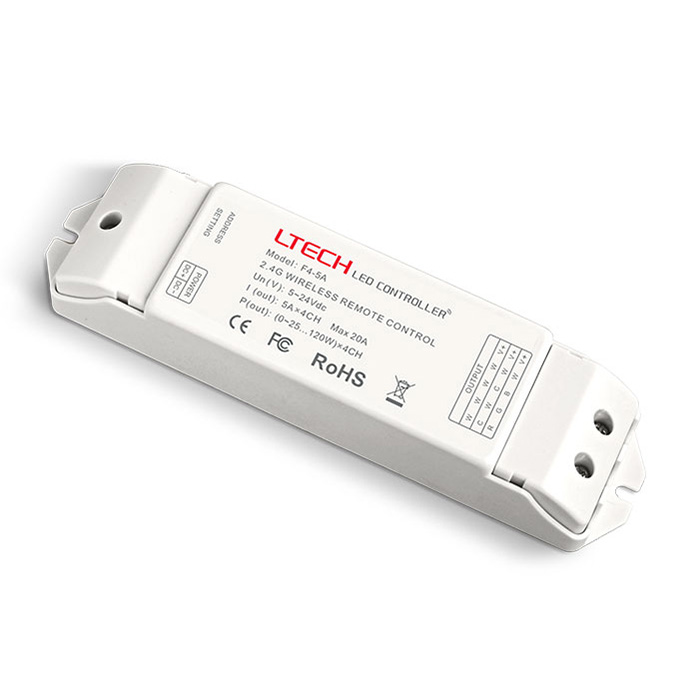

DMX/RF 2.4GHz Wireless LED Driver F4-DMX-5A - 5-24V, 20A Max | Hybrid Control
Constant-Voltage (CV) Wireless Receivers for LED Strips
Constant-voltage receivers are designed for compatible DC-powered LED strips, typically operating at 12V or 24V. They use PWM output to regulate the brightness of connected LED strips and independently control multiple channels where supported.
Depending on the receiver's channel configuration, compatible lighting applications include:
- - Single-color LED strips: Brightness adjustment for our white COB led strip lights, etc.
- - Tunable white (CCT) LED strips: Independent warm-white and cool-white control for 3-wire CCT lights.
- - RGB LED strips: Red, green, and blue color mixing of COB models or SMD models.
- - RGBW LED strips: RGB color mixing with a dedicated white channel. Explore our RGBW lighting solutions.
- - RGBCCT LED strips: RGB colors plus separate warm-white and cool-white channels. Explore our RGB tunable white LED solutions.
Match the receiver's input voltage, output channel count, current rating, and total power capacity to the connected LED strip. A suitable external DC power supply is required.
Constant-Current (CC) Wireless Receivers for LED Fixtures
Constant-current receivers are designed for dimmable LED downlights and other constant-current LED luminaires that require regulated constant-current output rather than a fixed-voltage PWM supply.
Before selecting a constant-current receiver, verify the required output current, operating voltage range, channel configuration, and power rating of the LED fixture. The receiver must match the fixture's electrical requirements; a constant-current receiver is not interchangeable with a constant-voltage LED strip receiver.
Frequently Asked Questions About Wireless Receivers
Direct engineering answers on wiring, load limits, DMX integration, and troubleshooting LT-BUS wireless receivers.
An LT-BUS wireless receiver sits between your DC power supply and your LED strip lights to decode wireless RF commands into low-voltage PWM dimming. It eliminates physical control wiring between the wall switch or handheld remote and your light fixtures. Models like the F4-5A receive 2.4GHz commands from paired remotes or wall panels, then regulate output voltage across 1 to 4 channels to control brightness, CCT tuning, or RGBW color mixing.
Choosing between these two comes down entirely to total amperage: the F4-3A wireless receiver handles 3A per channel (12A total), while the F4-5A supports 5A per channel (20A total). On a 24V system, that means the F4-3A caps out at 288W across 4 channels, whereas the F4-5A delivers up to 480W. If you are powering dense 24V RGBW tape pulling 19W/m, the F4-3A manages about 15m total, while the F4-5A handles 25m before needing an amplifier.
A standard constant voltage wireless receiver cannot drive constant current LEDs, but our 12~48Vdc F4-CC wireless receiver is engineered specifically for that job. Instead of outputting fixed DC voltage, the F4-CC delivers selectable constant current outputs of 350mA, 700mA, or 1050mA across 4 independent channels using DIP switches.
Calculate maximum load by multiplying the receiver channel amp rating by your DC supply voltage, then apply an 80% continuous-load safety margin. For example, a 4-channel 5A wireless receiver on a 24V supply provides 120W per channel (480W total), meaning you should design for no more than 96W per channel (384W total) in sustained runs. Exceeding rated channel amperage trips thermal protection and causes rapid cycling or terminal burnout.
An LT-BUS wireless receiver usually loses signal because it has been installed inside a metal cabinet, behind reinforced concrete, or directly against building steel. While the 2.4GHz RF signal covers up to 30m in open air, enclosing the receiver inside a metal junction box acts as a Faraday shield and drops usable range to under 3m. Pull the receiver into an open ceiling cavity or plastic enclosure, and keep it at least 1m away from high-power Wi-Fi routers.
To sync each wireless receiver, briefly press the physical 'ID Learn' button on the receiver housing, then press the desired zone number on your wall panel within 5 seconds. The connected LED strip lights will blink once to confirm the pairing address. You can pair an unlimited number of receivers to a single zone, allowing you to synchronize perimeter cove lighting and island under-cabinet lighting across an entire open-plan layout without running interconnecting control wiring.
To run lighting loads beyond the receiver's rated capacity, run the receiver PWM outputs into dedicated power repeaters backed by supplementary power supplies. The wireless receiver acts as the primary brain, while the repeater duplicates the PWM dimming signal across additional channels with zero signal delay. This allows you to scale a single control zone across hundreds of feet of continuous LED tape without overloading the primary receiver terminal blocks.