
How to Choose and Install LED Strip Lights?
Setting up LED strip lights comes down to three stages:
- Choose the strip: the waterproof rating for where it goes (IP20 or IP65 indoors, IP67 or IP68 outdoors), the light color, and 90 CRI or higher where colors must look natural.
- Prepare the parts: work out the watts (length × watts per meter), then pick a power supply with the same voltage and at least 20% headroom, a controller for the strip type, matching connectors and, if you want one, an aluminum profile.
- Install: cut only at the cut marks, connect red to + and black to -, test, then fix the strip with adhesive, clips or an aluminum channel.
Each step has its own detailed guide: see the roadmap below.
When we choose the light strip, we will encounter some common problems. There are many kinds of LED lights strips on the market, up to a thousand, with poor quality and uneven grades. We will encounter situations that do not know how to find the right LED lights for our own lighting projects.
As one of the suppliers with the most LED supply categories, SuperLightingLED has always insisted on using quality and trust to communicate with customers and has been cultivating LED strips for 12 years. Currently, customers are all over the world. Our goal is to help customers find the most suitable products.
In response to the diversified needs of customers, we will provide two LED strip light optional ways: self-optional lighting(purchase by yourself without the assistance of others) and recommendation lighting(we recommend suitable products based on the scenario and customer purchasing experience).
Firstly you need to know: What is led strip light?
How to set up LED strip lights: choose, prepare, install
At SuperLightingLED we answer the same questions in the same order every day, so here is that order as one table. Decide each step, then open its guide for the details.
| Stage | Step | What to decide | Read next |
|---|---|---|---|
| Choose | 1. Where it goes | Indoor or outdoor (IP20, IP65, IP67 or IP68), brightness, voltage, length, controller and power supply: the six checks before you buy. | Top 6 considerations before buying LED strip lights |
| Choose | 2. Light color | Warm, pure or cool white, tunable white, or color changing. | What is color temperature? Warm white vs pure white vs cool white |
| Choose | 3. Color quality | 90 CRI or higher when colors must look natural. | What is color rendering index (CRI)? |
| Prepare | 4. Power | Length × the watts per meter printed on the reel = what the strip draws. | LED strip power calculator |
| Prepare | 5. Power supply | Same output voltage as the strip, at least 20% headroom; plug-in adapter, hardwired supply, waterproof supply or battery. | How to choose LED strip light power supply |
| Prepare | 6. Controller | Matches the strip type (single color, CCT, RGB, RGBW, RGBCCT or addressable) and how you want to control it. | How to choose LED strip light controllers |
| Prepare | 7. Connectors | Same pin count (2 to 6 pads) and same width as the strip. | How to choose LED strip light connectors |
| Prepare | 8. Aluminum profile | Protects the strip, spreads the heat and hides the light spots; indoors, or with a waterproof strip outdoors. | Ultimate guide on aluminum profile |
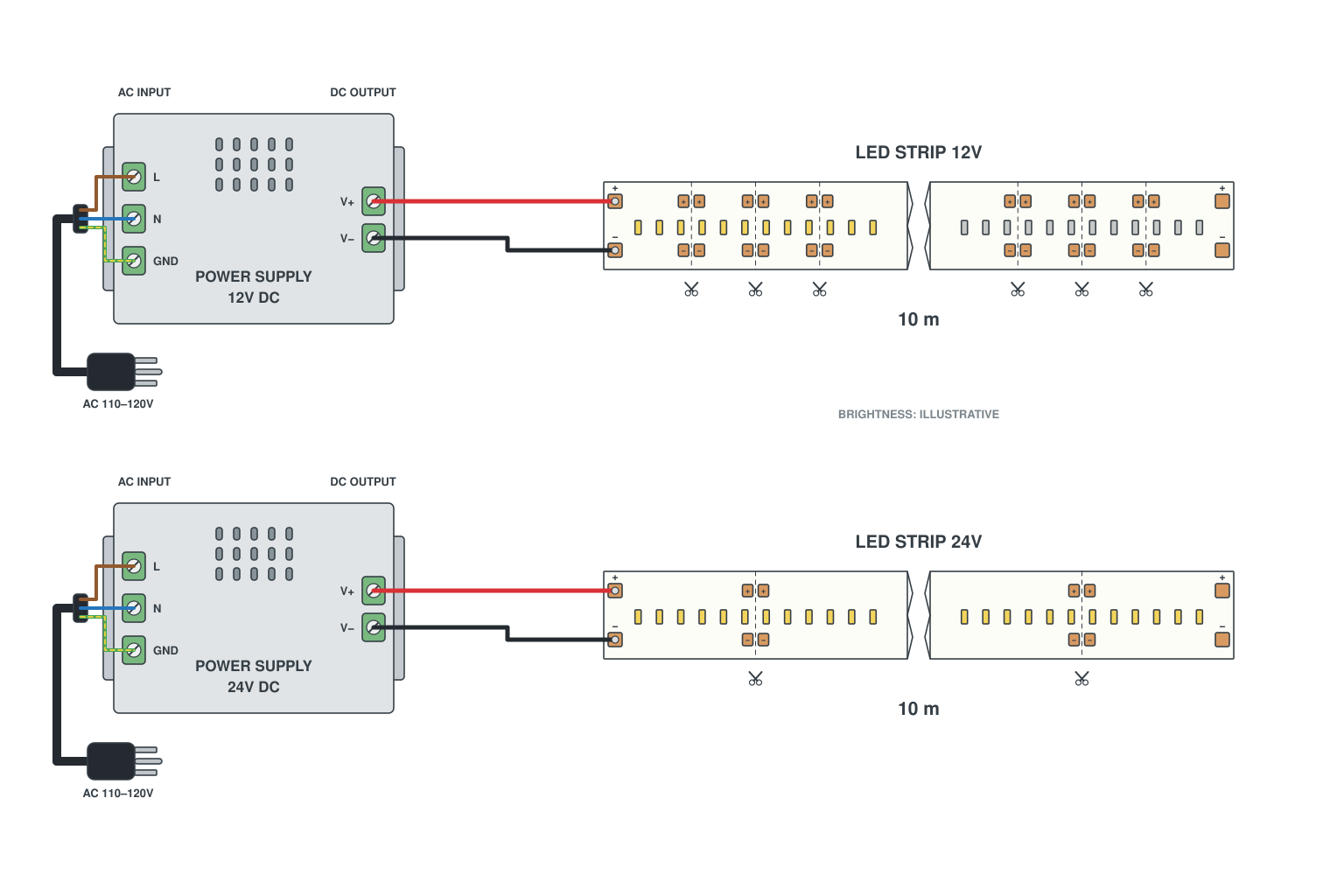
| Install | 9. Cut to length | Only at the cut marks: every 3 LEDs on a 12V strip, every 6 LEDs on a 24V strip. | Can you cut LED light strips? |
| Install | 10. Wire and test | Red wire to +, black to -; plug in only after everything is connected, and test before you stick the strip down. | LED strip wiring diagrams |
| Install | 11. Mount | Adhesive for IP20 and IP65 strips, mounting clips for IP67 and IP68, or an aluminum channel. | How to install LED strip lights |
The rest of this page is our original buying checklist, step 1 in detail: where the strip goes and what it has to do.
 Self-optional Lighting
Non-adjustable static demand
1. Your location
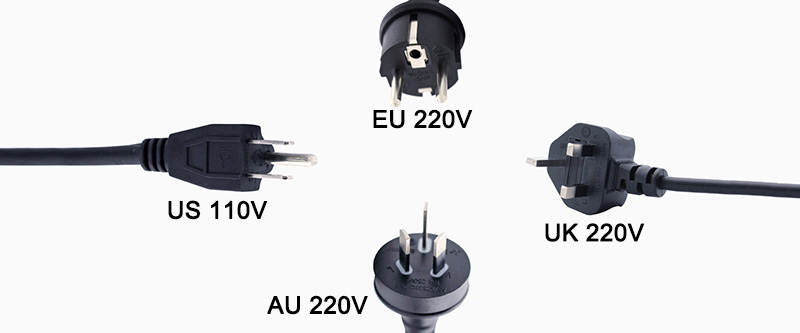
When choosing LED lights, your location will affect the optional of AC plug and the input voltage of the LED power supply. When choosing high-voltage LED strips and controllers, please be cautious about the options.
The voltage in the United States and Canada is AC110V; the voltage in most parts of Europe is AC220V.
2. LED strip light working environment
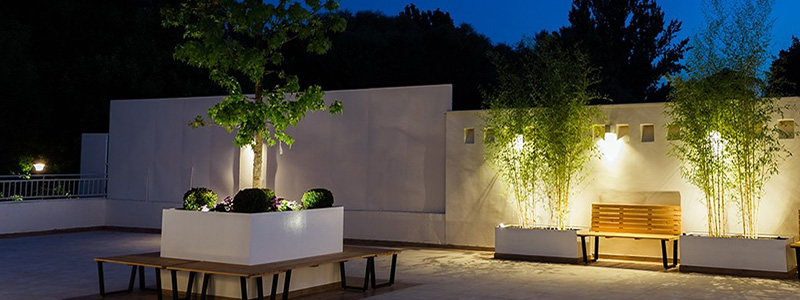
If you will use it in an outdoor environment, use a waterproof IP67 light strip in a rainy climate; in heavy rain weather and the light strip needs to be immersed in water, choose a waterproof IP68 light strip.
If you use it in an indoor environment In a humid climate, choose an IP65 light strip, and in a relatively dry climate, choose a non-waterproof IP20 light strip.
Know the led light strip waterproof rating here.
3. Installation environment of LED strip lights
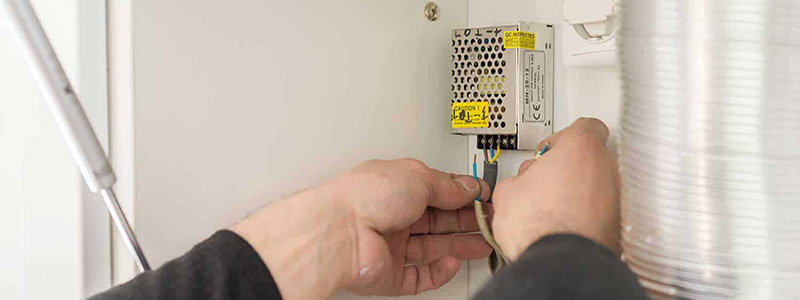
Install the LED light strip in a well-sealed location such as a solid wood table, chair, wood board, etc. The heat dissipation of the light strip is extremely poor.
If you install this type of location, try to choose low-power and low-heat LED strips. LED aluminium profiles and LED neon tubes are used as attachment carriers, which can dissipate more heat.
They can be installed in combination with LED light strips, which can solve the heat dissipation problem well.
The installation space also needs to be carefully considered. In a narrow area, ultra-narrow light strips below 6mm can be satisfied; for ordinary installation environments, 10/12mm is sufficient.
*Knowledge about led aluminum channel and flex led neon lights:
Ultimate Guide on Aluminum Profile for LED Strip Lighting
4. LED tape optional
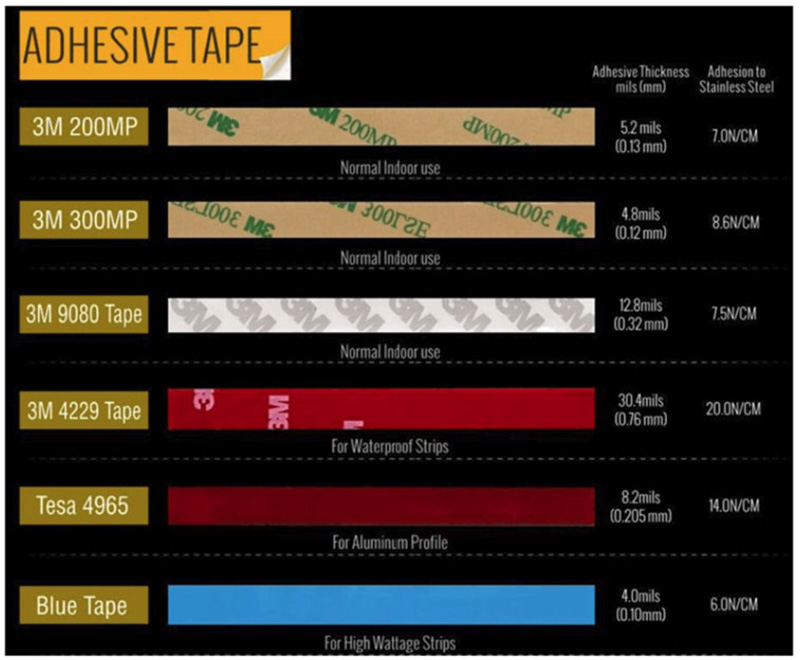
When you buy the LED light strip, the back of the light strip is attached with adhesive, suitable for most ordinary working environments.
If the installation environment is complicated, you need to buy a suitable LED tape by yourself.
The blue adhesive (glass fibre cloth thermal conductive double-sided adhesive) is resistant to high temperature and can be used for high wattage led strip light;
The yellow glue (double-sided adhesive tape) has good durability, high-temperature resistance, strong adhesion, and waterproof, which is used for normal indoor use.
It is suitable for wood, Paints and many plastics and fabrics; red adhesive (dark grey acrylic adhesive) is more viscous, with solid foam, entirely squeezed to achieve a seamless connection with the wall, used for waterproof led strips.
Transparent silicone sealant Organic solvent is neutral, non-corrosive, non-polluting, anti-aging and electrical insulation properties, rubber has good adhesion to metal and most plastics after curing, and has excellent resistance to alternating cold and heat.
5. LED strip length
The length of the LED strip determines the power of the LED, which in turn determines the choice of the LED power supply (the energy used by the LED power supply should be greater than 80% of the power of the LED strip to avoid excessive load).
The length of the light strips we provide is mostly 5m/16.4Ft, which can meet the needs of most customers.
If you are interested in ultra-long light strips, low-voltage ultra-long constant current or high-voltage light strips are a good choice.
If you are interested in ultra-short light strips, 0.5-5m/1.64-16.4Ft custom addressable light strips are a good choice.
Adjustable dynamic demand
1. CRI
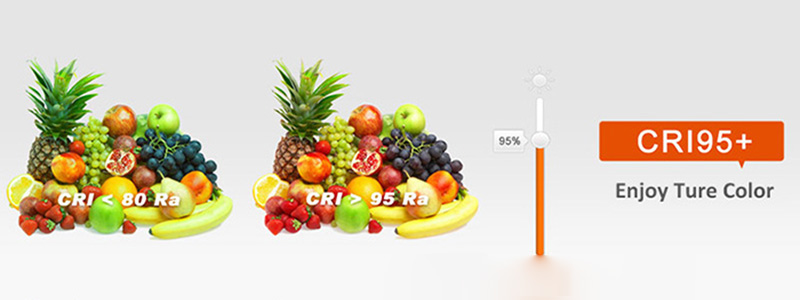
If you will use lighting to absolutely restore the colour of the natural environment, it is necessary to choose a product with a high CRI. Usually, the LED strip with a value of 90CRI or higher can restore the original appearance of the environment.
Single colour led strip light CRI value can reach 98; CCT led strip light CRI value can get 95; CRI value of white light in RGBCCT led strip light can come 85.
2. Lumens
The luminous flux can well reflect the actual lumens of the LED strip. Lumen requirements for different application scenarios are also additional.
When choosing Single Color LED strip light, you can refer to the following lumen ranges:
Accent lighting (Stairs, Swim Pool) recommended lumen selection range is 150-250LM/Ft, 2460-4100LM/16.4Ft;
Nearby working lighting (Cabinet) recommends that the lumen selection range is 175-550LM/Ft, 2870-9020LM/16.4Ft;
Long-distance task lighting (Ceiling) recommended lumen selection range is 350-1200LM/Ft, 5740-19680LM/16.4Ft;
Indirect lighting (Backlight) The recommended range of lumens is 375-1200LM/Ft, 6150-19680LM/16.4Ft;
Sign lighting (Hoarding) suggests that the range of lumen selection is 500-1200LM/Ft, 8200-19680LM/16.4Ft.
3. LED density
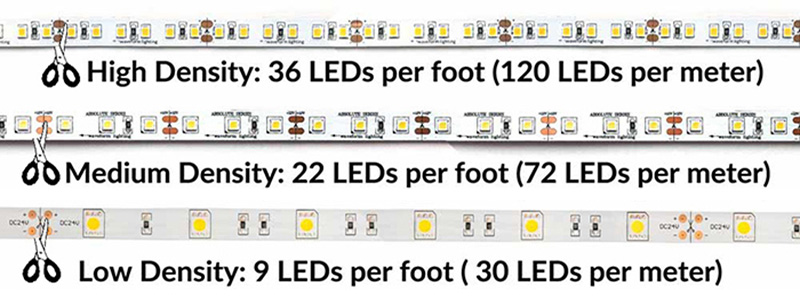
It is generally recognized in the industry that 30-72LEDs/m (<72) is a low-density light strip. Under the same LED conditions, the brightness is lower, and the power is more minor. You can select the plastic case power supply when choosing the LED power supply; 72-120LEDs/m ( <120).
It is a medium-density LED strip with moderate brightness and moderate power. When selecting an LED power supply, the actual capacity of the LED strip is about 100W. A high-power plastic case power supply or MEAN-WELL UL-Listed LED power supply can be considered;
more than 120LEDs /m is a high-density LED strip with high brightness and high power. When choosing an LED power supply, MEAN-WELL UL-Listed LED power supply is recommended.
Outdoor rainy environment, the waterproof LED power supply is recommended, installation space is small, and ultra-narrow LED power supply is recommended.
*About how to choose the right led power supply:
How to calculate power for led strip lights?
How to choose led strip light power supply?
4. LED chip
COB chip on board; high density without light spot, can be used as ultra-narrow light strip, Multiple colours optional/CCT/RGB/RGBW/Addressable RGB.
LED Feature |
LED Chip |
Ultra-narrow and high-density |
SMD2110/SMD2216/SMD3014 |
Multi-row super bright |
SMD2835/SMD3528 |
Single LED super bright |
SMD5630/SMD5730 |
General Basic Model |
SMD5050 |
Side emitting |
SMD020/SMD335 |
5. LED luminous colour
How to choose the right color for your led strip lights? What's the color difference?
Single colour led strip light is mainly used for indoor and outdoor lighting. High CRI and high lumen meet all the needs of environmental lighting.
Multiple colours led strip light (Color changing) static change effect, single colour changeable, to meet interior decoration needs.
Addressable led strip light(Color chasing) dynamic chasing effect, running horses and running water, the indoor atmosphere is contrasted with meeting mood lighting needs.
The perfect combination of LED neon light strip and LED neon tube produces a dynamic effect of 1+1>2, the first choice for sign lighting.

*Click the picture to know what is the white light color temperature.
6. LED voltage
When choosing addressable light strips, the LED voltage is a critical consideration.
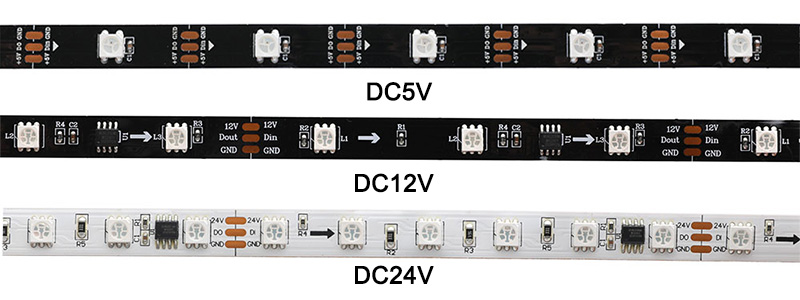
Most DC5V led strip lights are individually addressable. WS2812B/WS2813/APA102/APA107/SK9822/WS2801/LPD8806 are mostly DC5V led strip light, single light can be cut, each 5m power supply;
WS2811/WS2815/WS2818 are mostly DC12V led strip light, three lights can be cut, every 5m Separate power supply, power supply at both ends of 10m;
most of TM1914/GS8206 are DC24V, six lamps can be cut, and each 10m is powered separately. We provide DC5/12/24/36/48V low voltage light strip and AC110/220V high voltage light strip for your choice.
A deeper look at addressable light strips: Ultimate Guide to Choosing the Right Addressable LED Strip.
7. LED light-emitting angle
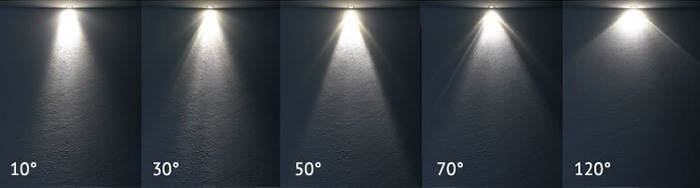
SP (spot): 4-19 degrees
FL (flood): 20-35 degrees
WFL (wide flood): 36-49 degrees
VWFL (very wide flood): 50-120 degrees or more
The light-emitting angle of ordinary LED lights is 120 degrees, and the light-emitting tip is suitable for night lighting.
The light-emitting angle of the COB LED strip can reach 180 degrees. The use of LED strips with LED neon tubes can compensate for the difference in beam angles.
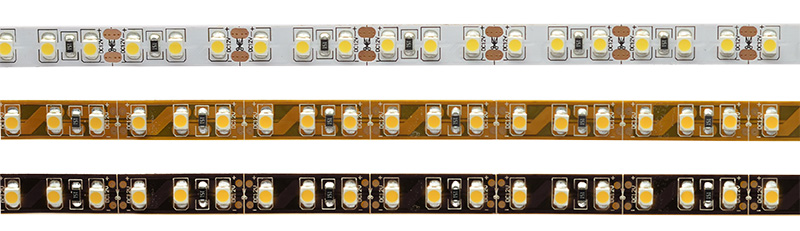
8. LED width and PCB colour
Ultra-narrow strips below 6mm; medium-width strips 6-12mm; high-width strips above 12mm
Depending on the installation environment, it is essential to choose the appropriate size of the LED strip.
If you want to hide your LED light strip in the installation environment, the appropriate colour and size of the light strip can be achieved with the surrounding environment.
*Knowledge about led strip installation for those who want to purchase the led strip:
How to connect two light strips together?
How to wire single color led strip lights?
How to wire tunable white/CCT led strip lights?
How to wire RGB color changing led strip lights?
How to wire RGBCCT led strip lights?
How to wire addressable led strips?
LED strip voltage and power consumption
Two numbers decide most of the parts list: the strip voltage and its watts. Everything on one circuit must be the same voltage: strip, controller and power supply.
| Voltage | Best for | Cut and power feed |
|---|---|---|
| DC5V | Most individually addressable strips (WS2812B, WS2813, APA102, APA107, SK9822, WS2801, LPD8806) | A single LED can be cut; power every 5 m |
| DC12V | Short runs, cars, boats, campers and anything fed from a battery; WS2811, WS2815 and WS2818 addressable strips | Cut every 3 LEDs; up to 5 m from one feed point |
| DC24V | Longer runs: at the same wattage a 24V strip draws half the current, so the far end stays bright; TM1914 and GS8206 addressable strips | Cut every 6 LEDs; up to 10 m from one feed point |
| AC110/220V | Gardens, rooflines and long runs with no low-voltage supply; AC110V in the United States and Canada, AC220V in most of Europe | Cut only at the 50 cm or 100 cm mark; plugs into the mains with no separate power supply |
We also make DC36V and DC48V low voltage strips; for very long runs see ultra-long constant current LED strips or AC110/220V LED strip lights.
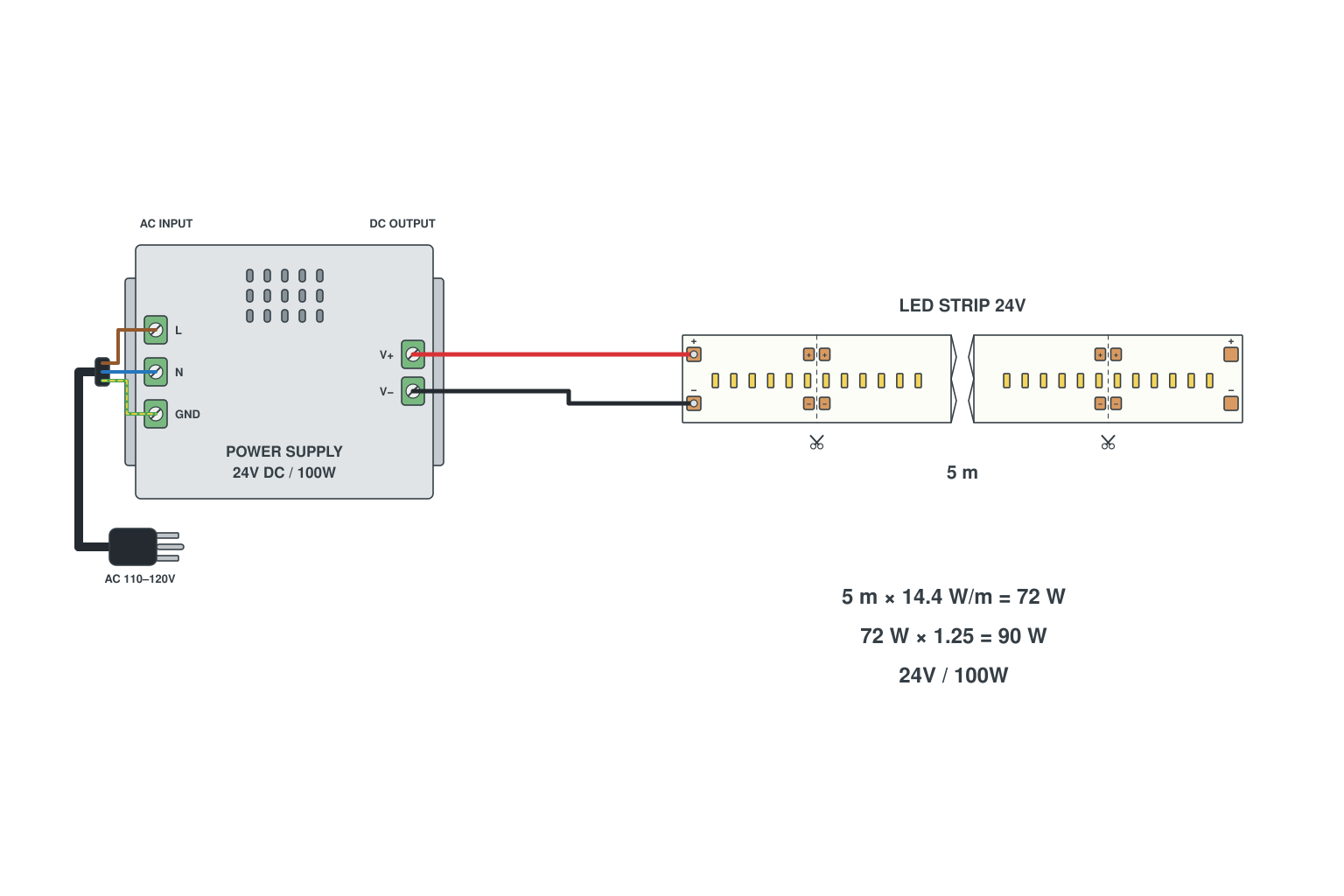
Power consumption is length × watts per meter. A 5 m, 12V strip at 14.4 W/m uses 72 W and draws 6 A, so it needs a 90 W power supply or larger; the same 5 m at 4.8 W/m uses 24 W, and a 30 W supply covers it. Put in your own numbers with our LED strip power calculator.
These diagrams are drawn by the SuperLightingLED engineering team; click one for the full notes in our LED strip wiring diagrams library.
How to choose and install LED strip lights: FAQ
How do I set up LED strip lights?
In three stages. Choose: the waterproof rating for the location (IP20 in a dry room, IP65 in a humid one, IP67 outdoors in the rain, IP68 if it will be under water), the light color, and 90 CRI or higher where colors must look natural. Prepare: work out the watts, then pick a power supply with the same voltage and at least 20% headroom, a controller, connectors and any aluminum profile. Install: cut only at the cut marks, connect red to + and black to -, test, then stick, clip or channel-mount the strip.
What voltage do LED strip lights use?
Low voltage LED strips run on DC5V, 12V, 24V, 36V or 48V, and high voltage strips on AC110V or 220V. 12V and 24V are the most common: 24V runs further from one feed point (up to 10 m, against 5 m for 12V), 12V suits short runs, cars, boats and batteries, and most individually addressable strips are 5V. The power supply must have the same output voltage as the strip.
How much power does a 12V LED strip use?
Multiply the length by the watts per meter printed on the reel. 5 m at 14.4 W/m uses 72 W (6 A at 12V) and needs a 90 W power supply or larger; 5 m at 4.8 W/m uses 24 W, which a 30 W supply covers.
Can LED strip lights run on batteries?
Yes. Choose battery operated LED light strips, or power a 12V LED strip from a 12V lithium battery: it needs no complicated wiring and is easy to carry, which suits picnics and camping. Our 12V lithium batteries carry 36W to 720W of power; the greater the power, the longer the strip works.
How do I install LED strip lights in an aluminum channel?
Peel the adhesive backing and stick the strip into the groove of the aluminum profile, cover it with the PC diffuser, then fit the end caps at both ends; the wire passes through the end cap with a hole to the power supply or controller. Aluminum channel is not waterproof, so outdoors use a waterproof LED strip inside it.
Shop by step
 Single color LED strip lightsStep 1: white and single color strips
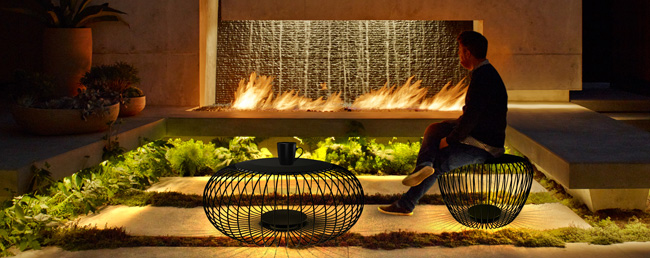 Outdoor LED strip lightsStep 1: waterproof strips for outdoors
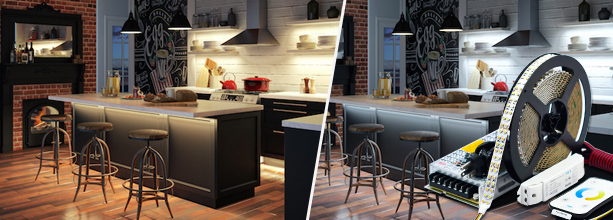 Complete LED strip kitsSkip steps 4 to 7 with a kit
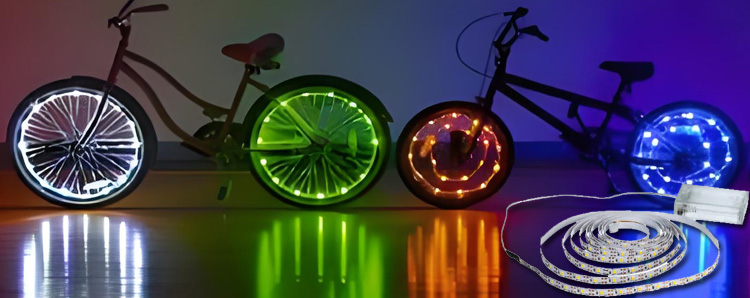 Battery operated LED light stripsNo outlet needed
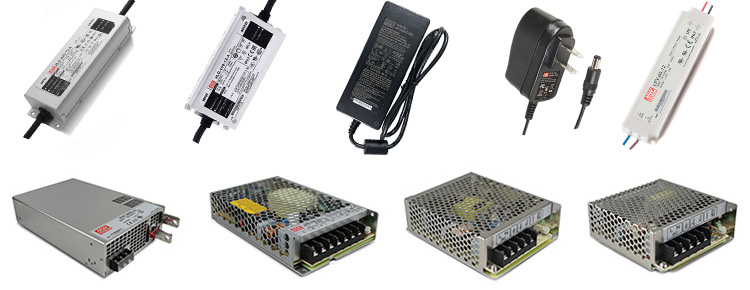 DC12V MW UL-Listed power suppliesStep 5: for 12V LED strips
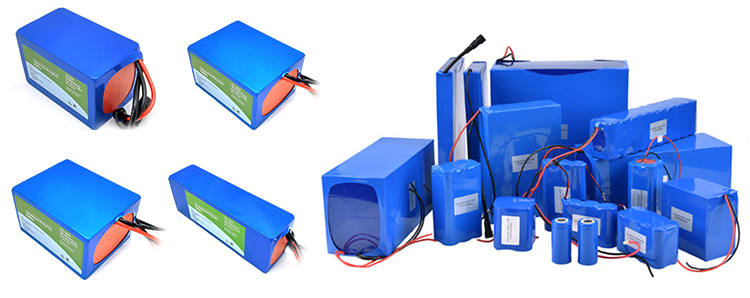 DC12V lithium batteriesStep 5: portable 12V power
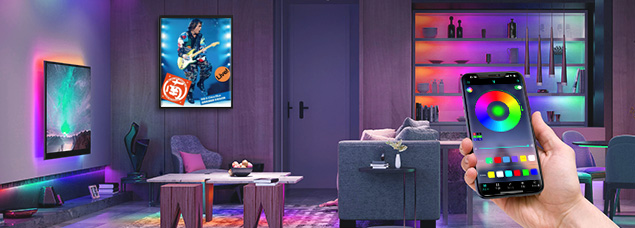 LED smart controller seriesStep 6: dimmers and color controllers
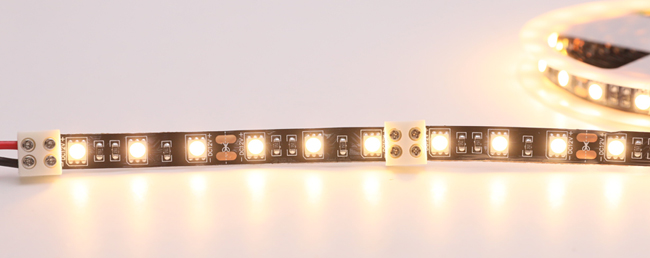 LED light strip accessoriesStep 7: connectors and cables
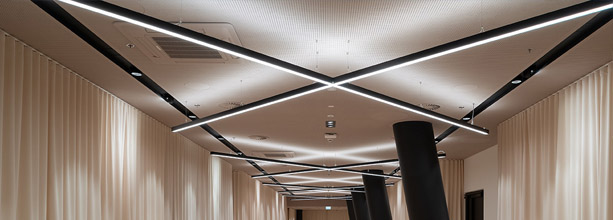 LED aluminum profileStep 8: channels and diffusers
Tell us the scenario, the run lengths and how you want to control the light, and the SuperLightingLED team will recommend the strip, power supply, controller and parts. Standard orders such as accessories and controllers ship within 24–48 hours; LED strip orders follow the production lead time shown on the product page. Contact our team