
How to choose led strip light controllers?
Choose an LED strip controller in three checks:
- Match the strip type. single color: LED dimmer (or 0/1-10V, TRIAC, DALI dimming); tunable white: CCT controller; RGB: RGB controller; RGBW: RGBW controller; RGBCCT: RGBCCT controller; addressable pixel strip: addressable (SPI) controller; 110/220 V strip: high voltage controller.
- Pick how you control it. IR remote (line of sight), RF remote (through walls, multi-zone), WiFi or Bluetooth (phone app), a wall panel, or DMX512 / DALI for large projects.
- Several strips? wire them in parallel if the controller’s current per channel covers them all; otherwise add amplifiers or one RF receiver per strip (see one controller for multiple LED strips).
There is no single “best” LED controller: the best one is the one that matches your strip and the way you want to control it.
LED strip light controller is the essential part to change LED light colors, LED brightness, and turn on or turn off the LED strip lights. One end of the LED controller is connected to the power supply, and the other end is connected to the light strips.
It’s known that the type of LED strip lights is various, so each LED controller is different too. Choosing a right control system can bring you great convenience.
So how to choose the right LED controller for your LED strip lights? I will answer the question in this article. Keep reading to get your answer.
At SuperLightingLED we sell a controller for every type of LED strip we make, from single color dimmers to addressable SPI controllers. Start with the comparison table, then read how to run several strips from one controller.
LED strip controller types compared
| Controller | How you control it | Best for | Works with |
|---|---|---|---|
| IR (infrared) | Infrared remote; needs a clear line of sight, weak through obstacles | Simple remote control when nothing stands between you and the strip | RGB control boxes with IR remote |
| RF (radio frequency) | Radio remote, no aiming, goes through walls; within 30 m | Multi-zone control; strips on both sides of a room or in two rooms without pulling wires | Single color, CCT, RGB, RGBW and RGBCCT RF control systems |
| WiFi | Phone app on a 2.4 GHz network (5 GHz not supported); some work with Amazon Alexa and Google Assistant | App and voice control; one phone runs several controllers of the same model | Single color, CCT, RGB and RGB+CCT versions |
| Bluetooth | Phone app over Bluetooth, no network needed | Phone control where there is no WiFi | RGB strips; SPI Bluetooth controllers for addressable strips |
| Music | Colors follow the music; keep the controller within microphone reach or use a line-in model | Lighting that reacts to music | RGB strips; music controllers for addressable strips |
| DMX512 | Console, computer or DMX wall panel; up to 512 channels, each receiver controlled individually | Stages, shopping malls, large projects | Decoders for single color (1 ch), RGB (3 ch), RGBW (4 ch) and RGB+CCT (5 or 6 ch); DMX-to-SPI for addressable |
| 0/1-10V | Low-voltage analog signal: 10 V brightest, 0 V off; knob or touch panel, 1 zone or 4 zones | Large projects or multiple rooms | Single color strips through a 0-10 V driver or decoder; several drivers can share one panel |
| TRIAC | Phase-cut dimming on the AC side; no signal line, no change to the original wiring | Keeping a wall dimmer; AC control | TRIAC-dimmable drivers; can work with WiFi, RF or 0/1-10V |
| DALI | DALI bus: every light has its own address; a single light or a group is dimmed accurately | Hotels, large stages, offices, family buildings | DALI dimmers or DALI drivers on a bus with its own power supply; up to 64 addresses per line |
| SPI (addressable) | 1/2/3 channel SPI data signal; remote control; up to 31 RGB or RGBW chip types | Chasing and dynamic effects (32 modes) | Addressable pixel LED strips only |
| Sensor | Lights up when you come near, turns off after the hold time; stays off with enough ambient light | Night lighting, stairs | LED strips for night lighting; motion sensor stair light kits |
COB LED strip controller? COB LED strips come in the same color types as SMD strips (white, tunable white, RGB, RGBW, RGBCCT and addressable), so pick the controller the same way; a single color COB strip connects to the supply or dimmer as with any single color LED strip (COB wiring diagram). Shop COB LED strip lights.
One controller for multiple LED strips
Yes, one controller can run several LED strips. The method depends on three things: whether the strips should change together or separately, how far they are from the controller, and whether the controller can carry the total current.
| What you want | Use this | Watch out |
|---|---|---|
| Two reels near the controller, same effect | Parallel wiring from the controller output: a 4-wire splitter cable, or two cables to the same terminals | The controller must carry both: 2 x 5 m of 14.4 W/m at 24 V is 6 A total, 2 A per channel; most controllers are 6 A per channel. At 12 V keep each branch at 5 m; at 24 V each branch can be 10 m. |
| Several short strips from one adapter, all on and off together | A 1-to-2, 1-to-4 or 1-to-8 DC splitter cable, each strip on its own branch | A splitter shares power, not control; keep the total watts within the adapter rating. |
| A long run, or a reel far from the controller | An amplifier every 5–10 m, each with its own supply; the signal passes down the chain | Use an amplifier for any reel that starts more than 3–4 m from the controller, or when the total is above 10 m. |
| Strips in different rooms, together or apart | One RF receiver and supply per strip, all paired to one multi-zone remote | No wire between zones. Remotes come in 4-zone and 8-zone versions; the RF remote works within 30 m, and adjacent RF controllers sync up to 30 m apart. |
| Several addressable (pixel) strips | An SPI signal splitter or amplifier; a multi-channel SPI amplifier gives each section its own output | Never connect several SPI pixel strips to the same output port; the light may flicker. |
These diagrams are drawn by the SuperLightingLED engineering team; click one for the full notes in our LED strip wiring diagrams library.
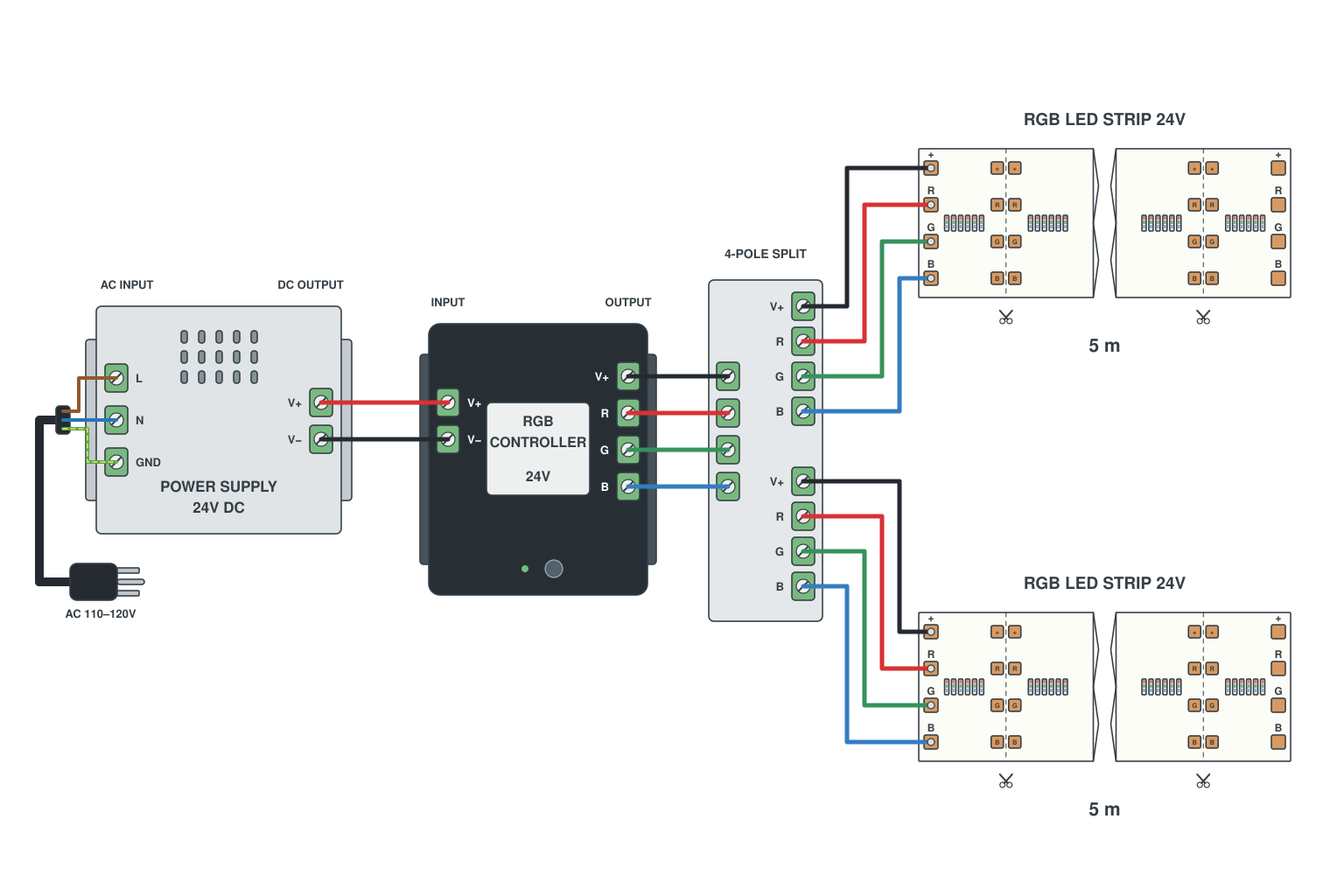
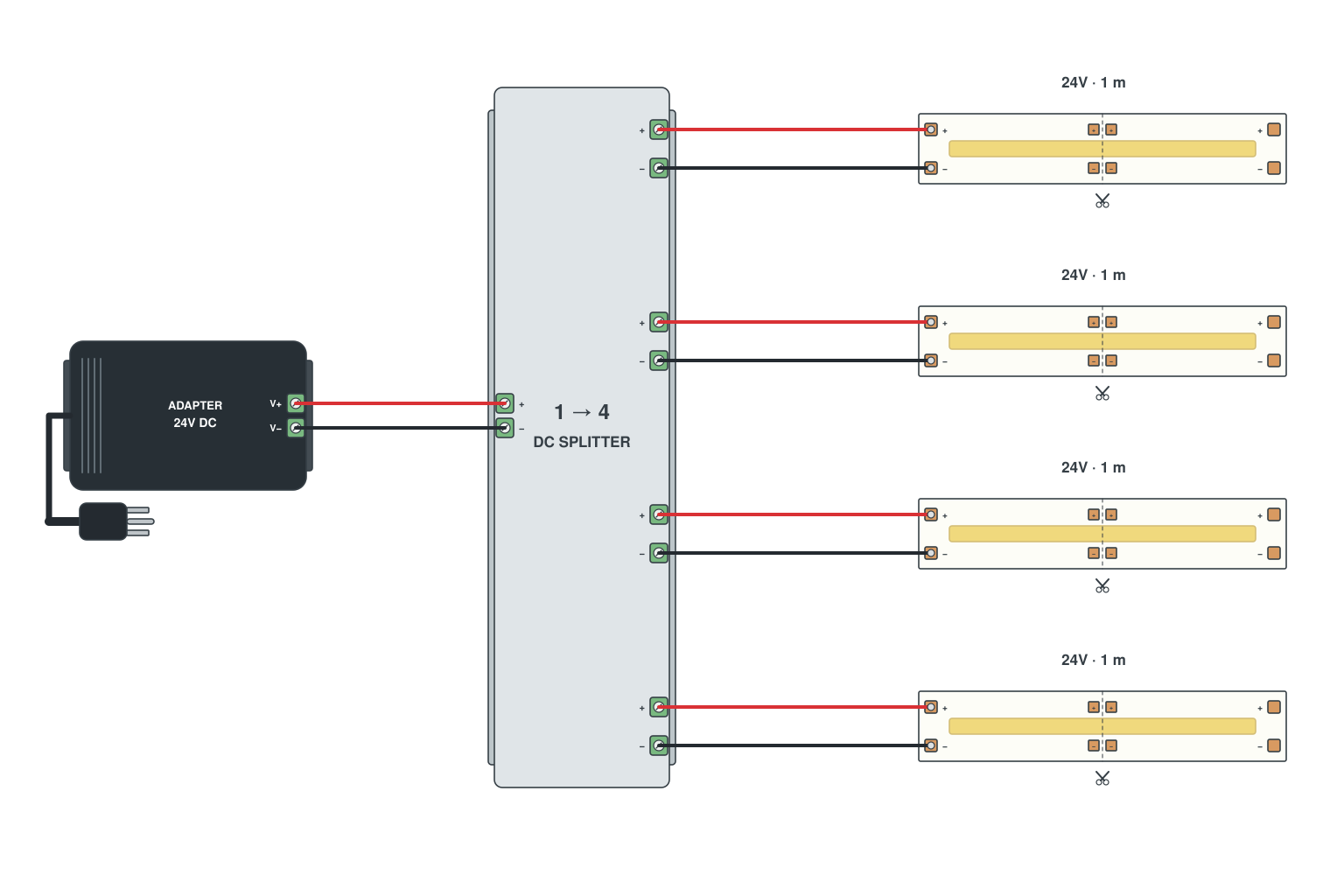
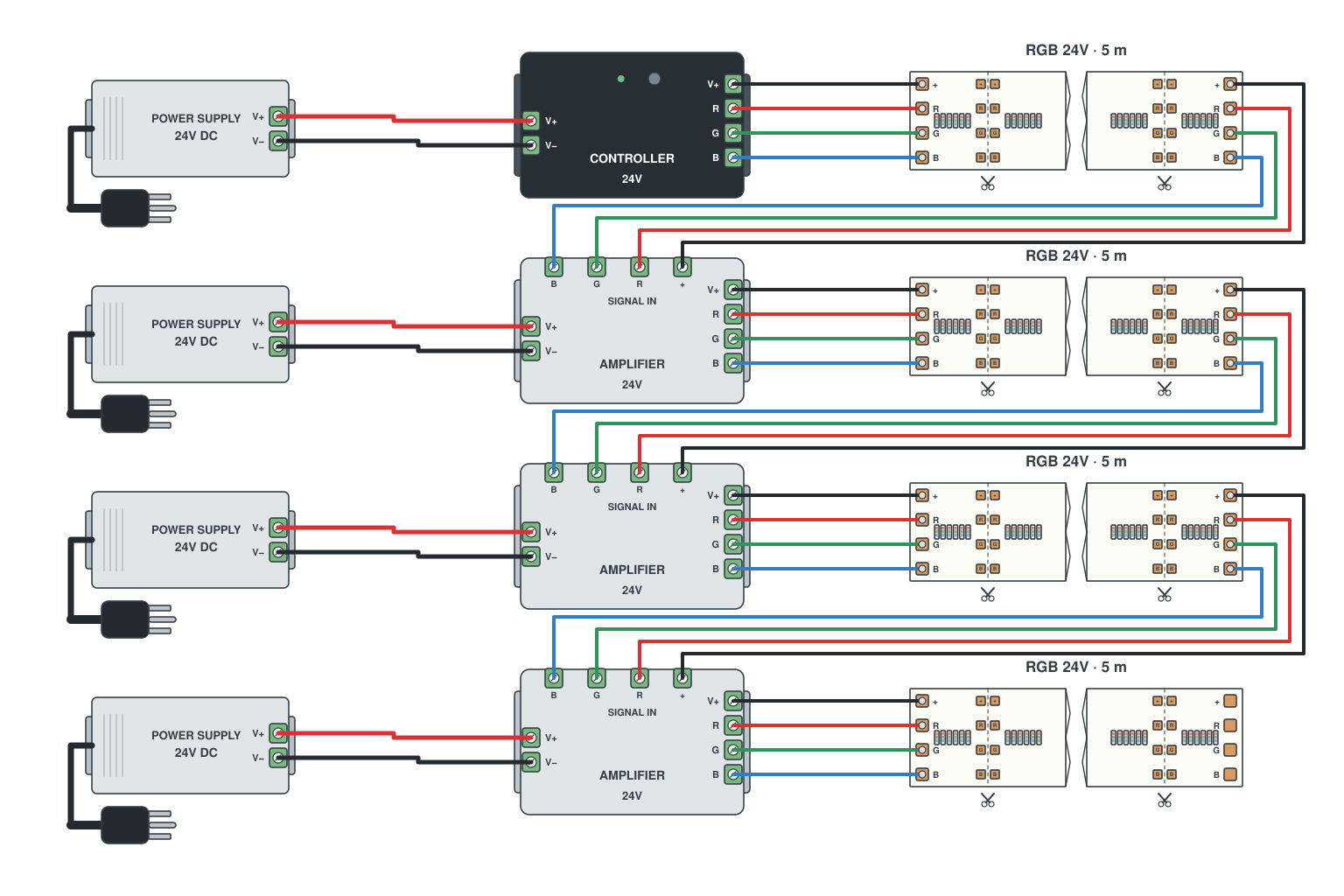
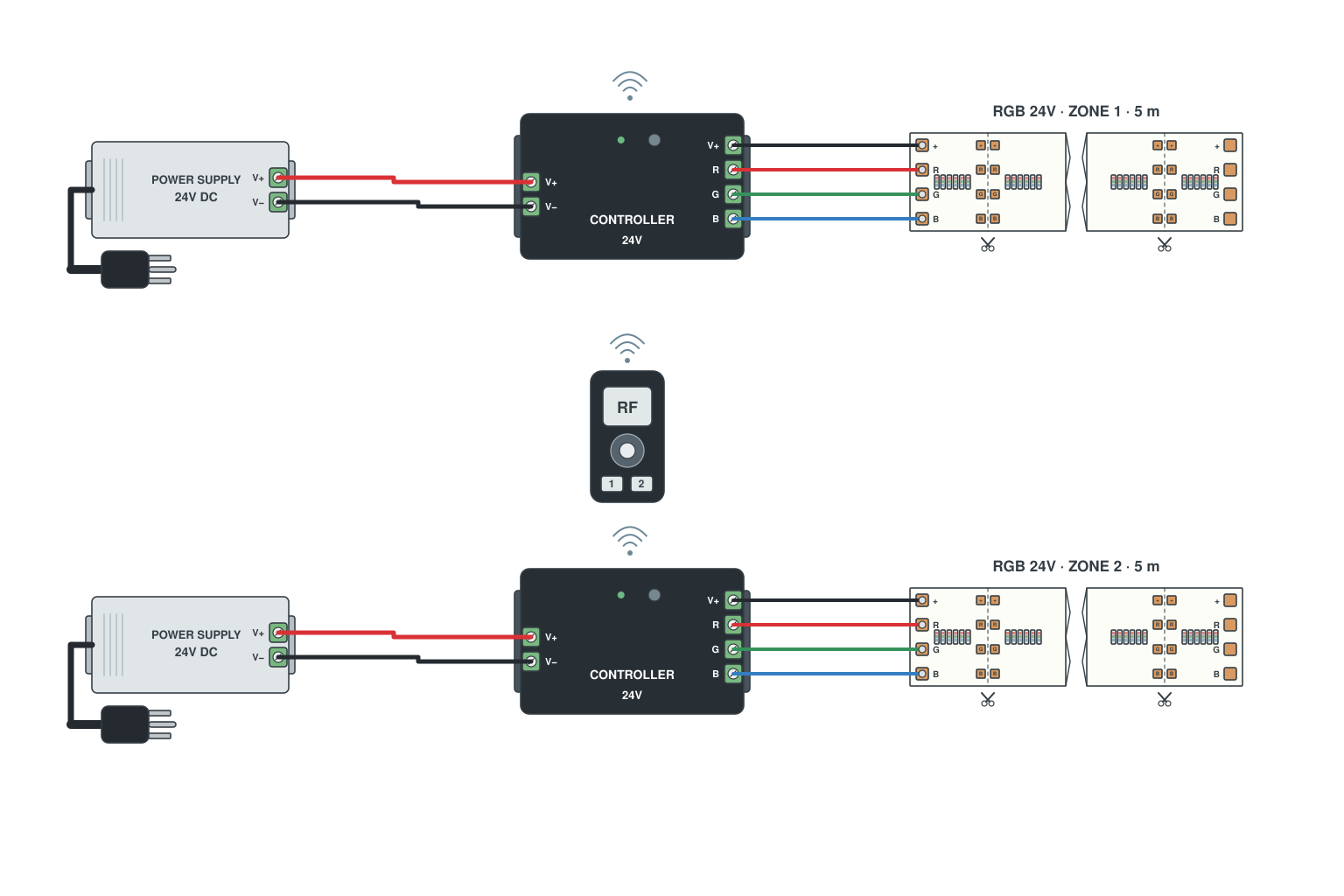
Single color strips work the same way: two strips on one dimmer with an amplifier, several branches from one dimmer, or RF sync with many receivers and one remote. WiFi controllers too: in network mode one phone can control several controllers of the same model. For addressable strips see the SPI multi-channel amplifier.
First, we will list a table for you to start to understand how to choose the right LED light controller for your LED strip.
| LED Strip Lights Type | LED Controller |
| Single color LED strip lights | LED dimmer, 0/1-10V dimming, Triac dimming, DALI dimming |
| CCT tunable LED strips | CCT LED dimmer controller |
| RGB color changing LED lights | RGB LED controller |
| RGBW LED tape lights | RGBW controller |
| RGBCCT LED rope lights | RGBCCT LED light controller |
| Addressable pixel LED lights | Addressable dream color controller |
| High voltage LED light strips | High voltage controller |
This article contains the following parts:
1. Wireless controller → WiFi controller, RF controller, IR controller, Bluetooth controller, music controller
2. Control method → remote control, panel control, smartphone control
3. Single color controller and color changing controller
4. Addressable dream color controller
5. Sensor Series
Wireless controller
If you want to control LED strip lights without walking to the place to turn on or turn off, wireless controller is a good choice. You can control the LED strip lights from a distance.
WiFi(a wireless network communication technology) controller
Connect to wireless network. You can use your smartphone to control LED strip lights.
Download a free app from your mobile phone and you will get various luminous effect, adjusting different level of LED brightness, changing LED colors, and setting up models like music model and voice control.
5 steps to set up LED WIFI controller: Step 1. Connect the WIFI controller to the LED strip light and power supply. Step 2. Scan the QR code on the WIFI controller to download a free application. Step 3. Find “LEDnet...” in your mobile WIFI setting, and connect to it. Step 4. Open the app setting, enter your home password to connect to the router. Note that only 2.4GHz network can be used, 5GHz is not supported. Step 5. Finally, let your phone connect to the same router. |
Now you can control your strip light through the mobile app. In network mode, your smart phone can control multiple LED controllers of the same model.
RF(radio frequency) controller
The radio frequency remote control uses an antenna to send radio wave signals, which can be omnidirectional three-dimensional coverage. Within the control range, remote operation can be carried out without aiming at the control LED device, and it can penetrate obstacles such as walls. It is used mostly in LED strip light controllers.
RF remote can control the RF controller within 30 meters, and the maximum distance between each adjacent RF controller that can automatically synchronize the signal is also 30 meters. Remote control can realize multi-zone control. If you want to install LED light strips on both sides of the room or two adjacent rooms, with the RF controller, you can install two areas independently without pulling wires, making the installation more convenient and having unlimited possible.
In a single zone, one LED strip light changes, other strip lights all change. However, multi-zone not only can change the strip lights at the same time, but also can control each zone individually. Such as, zone 1 is fading mode, and zone 2 is jumping mode.


IR(infrared remote) controller
Infrared remote control uses infrared light to send signals, which has the characteristics of strong directivity and weak ability to cross obstacles. If there are no obstacles in the straight line between you and the light strip, you can easily control it, but if there are any obstacles such as a dog in the middle, you have to wait for it to go away before you can control it.
Bluetooth controller
LED Bluetooth controller can be used by connecting to mobile phone Bluetooth without network.
Remote control, panel control, smartphone control
RF controller and IR controller can be controlled by each remote, RF remote and IR remote. WIFI controller and Bluetooth controller are controlled with mobile phone. Some LED controllers are available with voice control such as Amazon Alexa and Google Assistant.
Panel control includes knob panel and touch panel. Knob panel is a traditional way to control LED brightness of single color LED lights from darkest to brightest. Touch panel is used widely nowadays. And it is smarter than knob panel. You just need to tap the control panel.
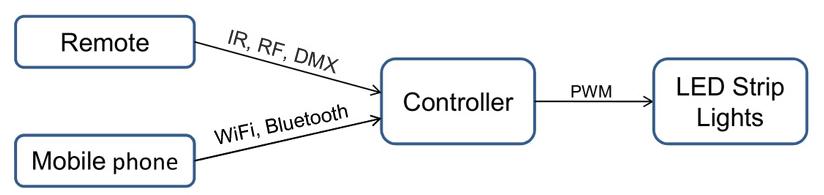
Single color controller and multi-color controller
LED controller includes single color LED dimmer, CCT controller, RGB color changing controller, RGBW LED light controller, and RGBCCT controller. Addressable dream color controller will be mentioned in the next part.
Knowledge about LED color and white light color temperature:
The Color Difference Between Warm White 2700K, 3000K, 4000K, 6000K Pure White and 7000K Cool White
What is CT(LED white light color temperature)?
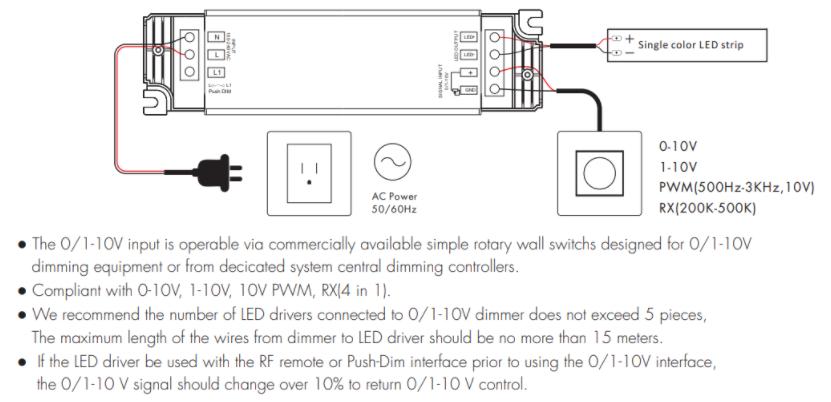
0/1-10V dimmer
0/1-10V is a dimming stable method by low voltage. Low voltage means safe in people’s eyes.
0/1-10V dimming is an analog dimming method, which controls the output current of the power supply by changing the voltage of 0/1-10V to achieve dimming. It is brightest at 10V, and off at 0V. 1V control voltage is approximately 10% brightness, 2V = 20%, 3V = 30% and so on. 1-10V does not have the function of a switch, and the led light cannot be adjusted to the lowest shutdown function.
The 0-10V dimming panel can only control the brightness of the led strip through the rotary knob panel.
The 0/1-10V touch panel can realize the brightness adjustment of a single zone or 4 zones, which is suitable for large projects or multiple rooms in the home.
Triac series
The triac dimming technology does not require a signal line and does not change the original line. It has low cost and is convenient for construction. And it is widely used in AC control.
Triac dimming is a kind of physical dimming. It directly acts on alternating current. Starting from AC phase 0, the input voltage is chopped, and there is no voltage input until the triac is turned on. The principle is to adjust the conduction angle of each half-wave of the alternating current to change the sine waveform, thereby changing the effective value of the alternating current, so as to achieve the purpose of dimming.
Triac panel dimmer includes two types: rotary knob panel and touch panel.
The Triac rotary knob panel adjusts the brightness of the light strip by rotating the button, and you can rotate it to any brightness level you want.
The Triac touch panel can sense your operations with just one touch. In addition to simple brightness adjustment, it also adds other functions such as turning off the led light after 20s or playing dynamic mode.
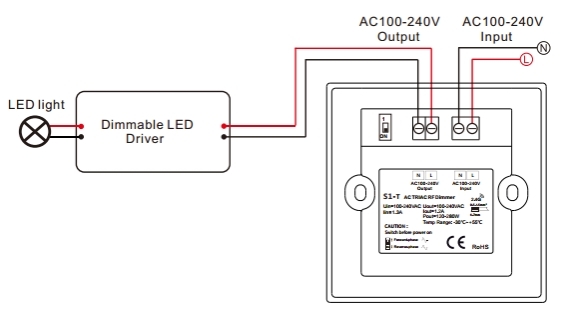
The Triac dimmer can be connected to a push switch to turn on or turn off the led strip and it can work with WIFI, RF, or 0/1-10V.
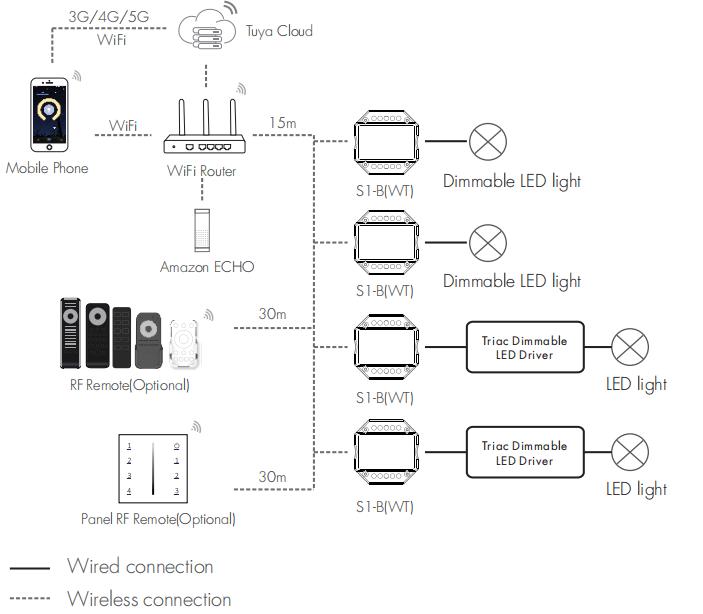
With the Triac dimmer with WIFI or RF function, you can control the led light strip through your mobile phone or RF remote, achieving a more convenient and efficient control method.
The Triac dimmer has a 0/1-10V function, which means that it has a push switch and a 0/1-10V brightness adjustable switch.
DALI(Digital Addressable Lighting Interface) controller
The biggest feature of DALI technology is that a single light has an independent address, and a single light or light group can be accurately dimmed through the DALI system. It is suitable for hotels, large stages, offices, and family buildings.
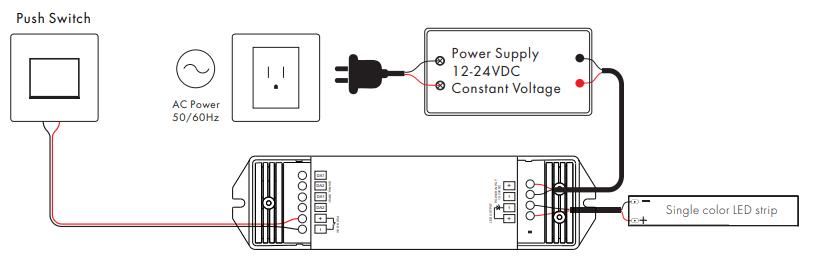
The single color led strip lights can be controlled by the dimmer controller. Want to know the wiring diagram, read: How to wire single color led strip lights?
And it also can be directly powered by LED driver if you think the LED brightness adjustable is not necessary. We have an article about how to connect the LED strip to the power supply, which introducing different connection types between the light strip and the LED transformer.
Color changing LED controller
Do you think the RGBW controller should be used only in RGBW LED strip lights? However, an LED controller is not limited in one LED strip light type. The following diagram tells us three wiring ways of one LED light controller.
An RGBW controller can connect an RGBW LED strip light, or an RGB strip light, or two tunable white strips, or four single color light strips. If your LED strip lights are RGB, an RGBW controller is also suitable for you.
But RGB LED strip lights should be used with RGB remote. Each color mode needs to use the corresponding color mode remote.
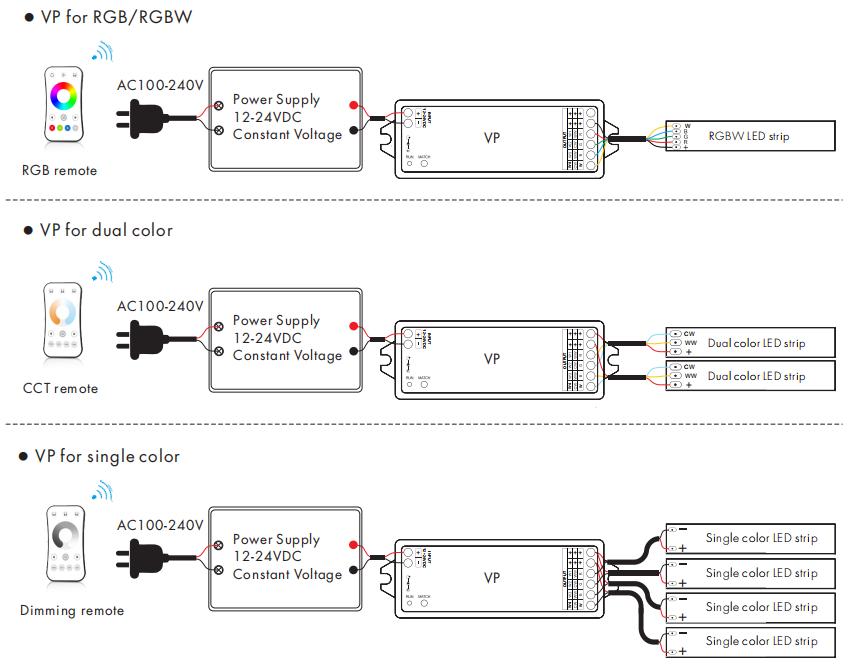
Maybe you want to the color changing LED light strip wiring diagram:
How to wire tunable white/CCT led strip lights?
How to wire RGB color changing led strip lights?
How to wire RGBCCT led strip lights?
Addressable led controller
Addressable LED strip lights should be controlled by addressable controllers. So if your strip lights is addressable, please choose the addressable controller.
Doubt with addressable pixel LED lighting strip: Ultimate Guide to Choosing the Right Addressable LED Strip & How to wire addressable led strips?
The DMX512 controller
DMX outputs standard DMX512 control signals, and can connect multiple DMX lights. And it is controlled by computer. DMX 512 controller can control the brightness and color of up to 512 channels, producing almost unlimited lighting effects. Each DMX receiver can be controlled individually. Therefore, you can control different areas of the same place. It is typically used in stages and shopping malls.
SPI controller
SPI outputs 1/2/3 channel SPI signal. It can compatible with up to 31 RGB or RGBW chip types, and each RGB color order can be set. 32 dynamic change modes are supported, and you will experience a magical color.
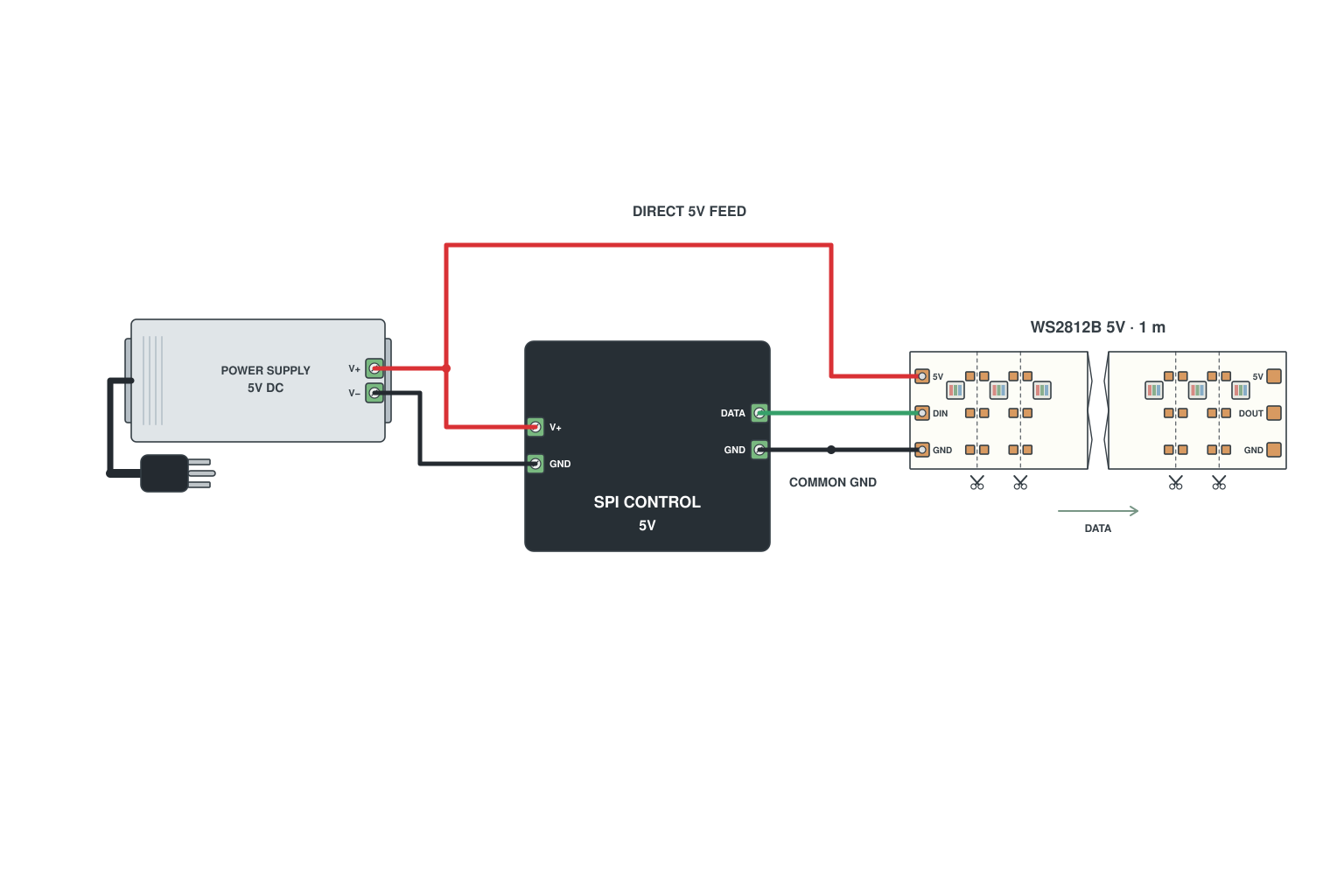
It is not allowed that the SPI controller or decoder connects multiple SPI pixel LED strips to the same output port at the same time. If you do that, the light may flicker. And it need the SPI signal splitter or amplifier to be used to increase signal.
The SPI controller can be adjusted with the remote control. DMX to SPI controller accepts DMX signal input and converts to SPI signal.
SPI vs PWM LED strip controllers
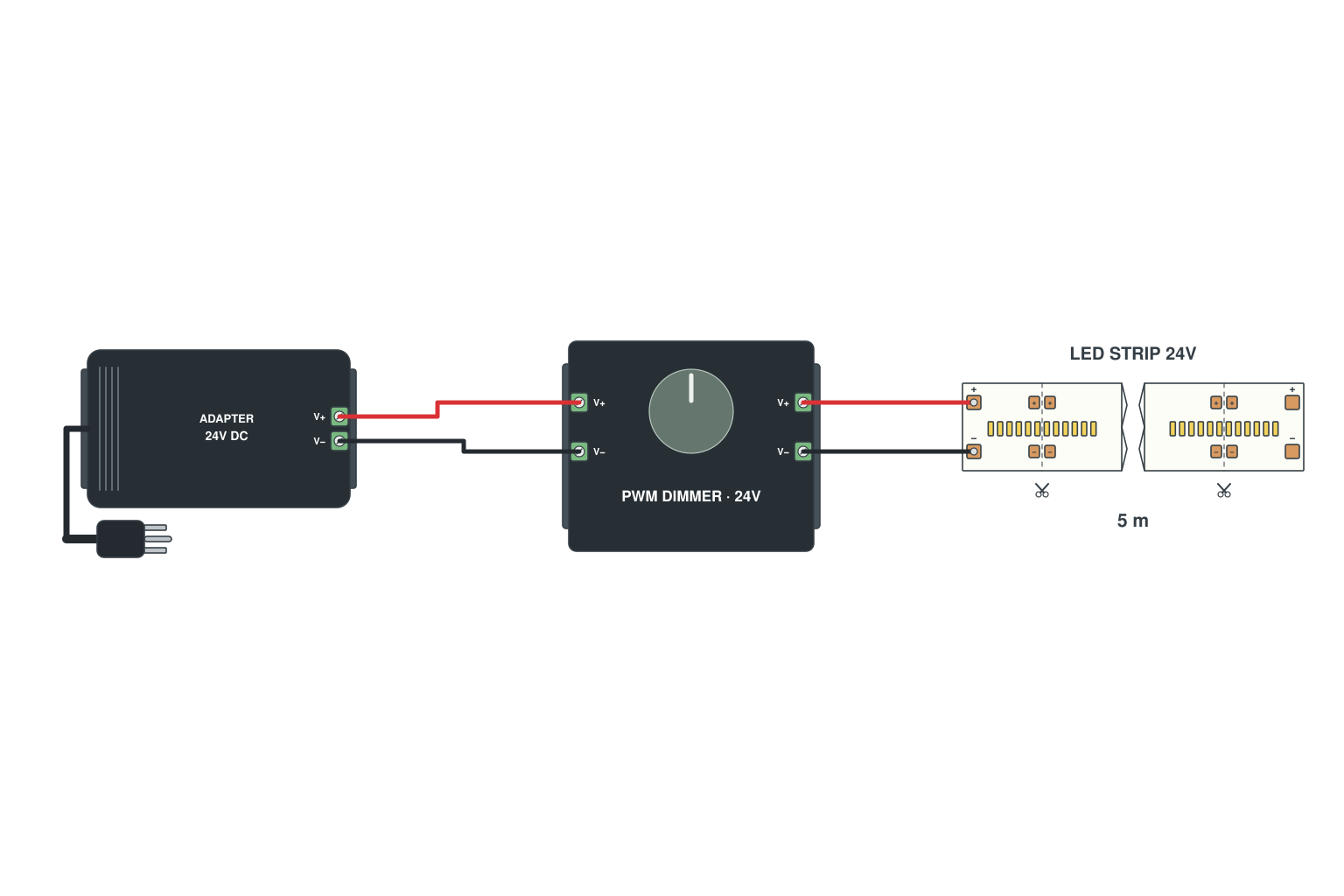
Both sit between the power supply and the strip. The difference is what they send to it: a PWM controller dims whole color channels, an SPI controller sends data to the chips on an addressable strip. That is why addressable LED strips need an addressable controller.
| PWM controller | SPI controller | |
|---|---|---|
| Used for | Single color dimmers, CCT, RGB, RGBW and RGBCCT controllers | Addressable pixel LED strips only |
| What it sends | One common V+; every other pad is a switched negative channel that the controller dims | A 1, 2 or 3 channel SPI data signal; set the chip type (up to 31 RGB or RGBW types) and the RGB color order |
| Wires to the strip | One V+ plus one wire per channel: 2 wires for single color, 3 for CCT, 4 for RGB, 5 for RGBW, 6 for RGBCCT | DATA and GND (plus CLK on dual-signal strips); strip V+ from the supply, one common GND for supply, controller and strip |
| Effects | The whole channel changes together; PWM keeps the color temperature constant while dimming | 32 dynamic change modes; chasing effects |
| Longer runs | Parallel from the output, then an amplifier every 5–10 m | An SPI signal amplifier every 5–10 m, or when the data cable is longer than 3 m |
Most “LED dimmers” are PWM dimmers; TRIAC and 0-10 V are the mains-side alternatives. A DMX512 system can feed either kind: DMX to PWM decoders for ordinary strips, DMX512-SPI decoders for addressable strips.
Sensor series
Sensor controller is greatly suitable for night lighting. Install a LED strip light in your room with sensor controller, and once you near to it, it will light up without operation. After hold time, if you have no movement, the light will turn off. And the sensor does not turn on the light with sufficient ambient light. It’s amazing, isn’t it? If you don’t want to turn on and turn off LED strip lights with remote or mobile phone, try it.
Maybe you are interested in our latest indoor motion sensor LED stair lights kit: How to install LED motion sensor stair lights?
Shop LED strip controllers by type
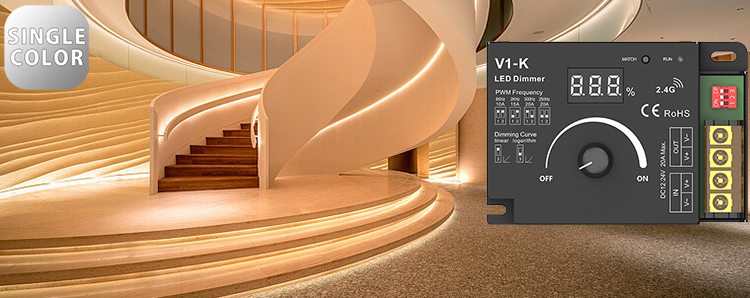 Single color dimmersFor one-color strips
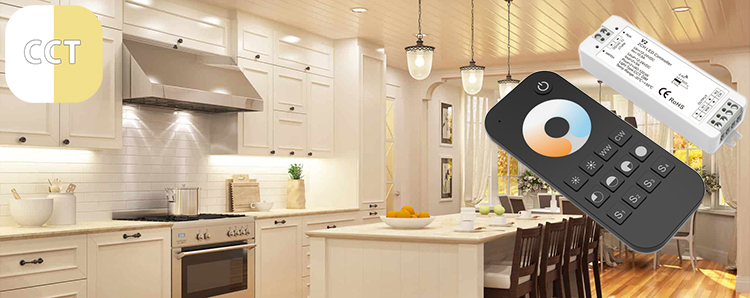 CCT (dual white) controllersTunable white strips
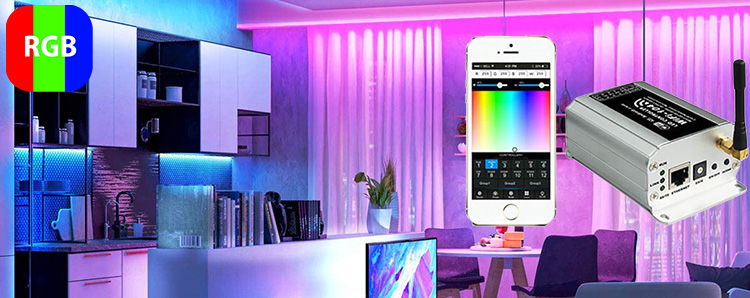 RGB controllersWiFi, RF, IR, music, DMX
 RGBW controllersRGBW strips; also RGB
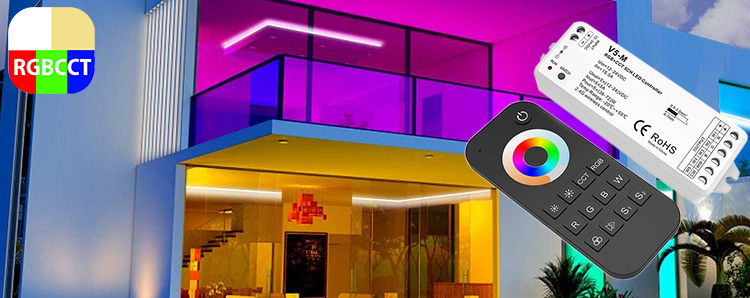 RGB+CCT controllers6-channel strips
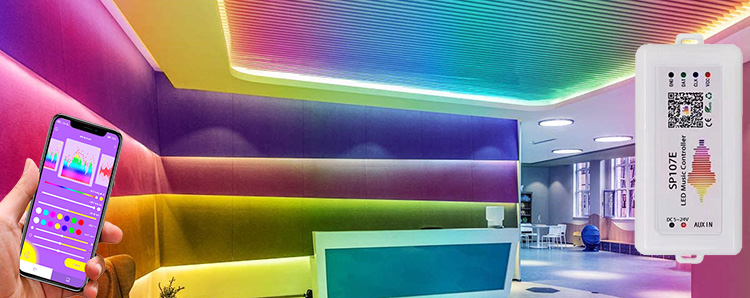 Addressable dream color controllersSPI, music, app, DMX-SPI
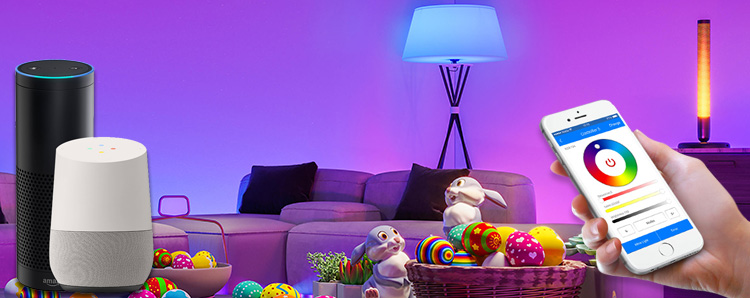 WiFi, Alexa and Google controllersApp and voice control
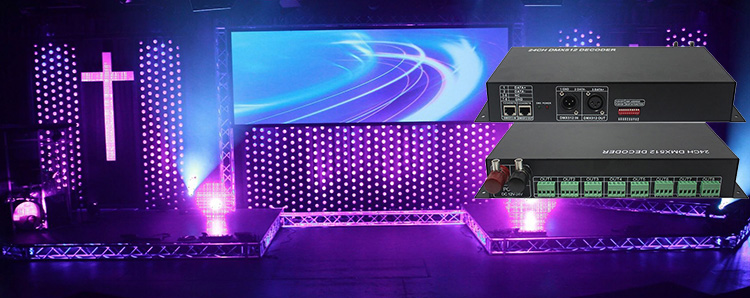 DMX512 decoders and mastersStages and large projects
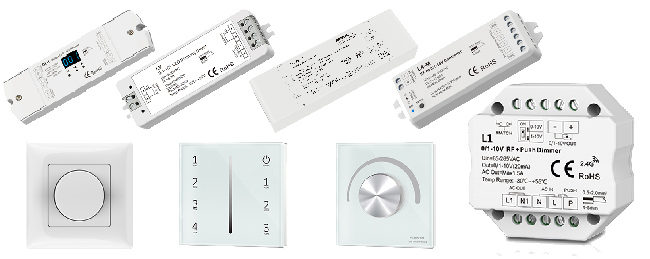 0/1-10V dimmingPanels and drivers
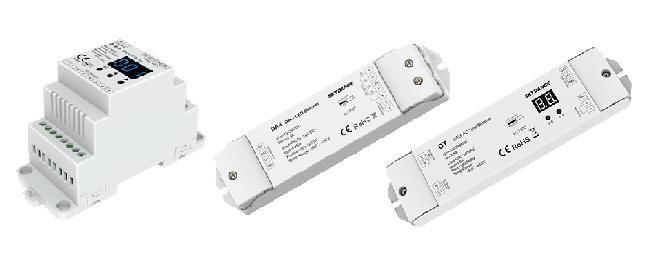 DALI controlAddressable building dimming
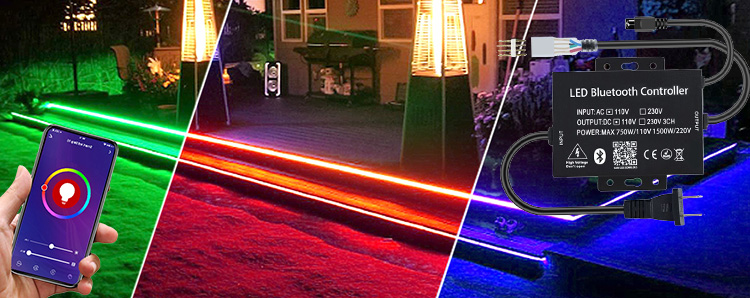 High voltage controllers110/220 V strips
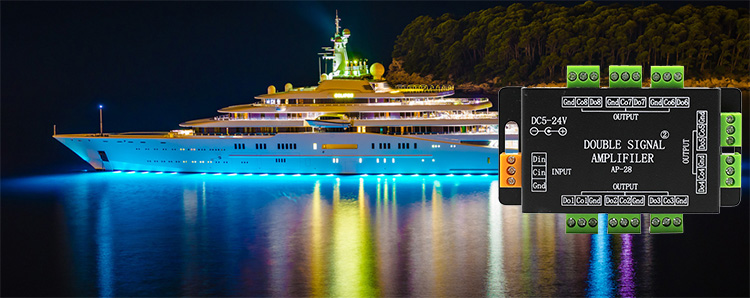 LED power and signal amplifiersRun more strips from one controller
In conclusion
Almost all led strip light controllers can be controlled by remote, if you want to use a mobile phone to control your led strip light, please choose the WIFI controller, Bluetooth controller, or RF led controller. Click into our homepage LED controller types to learn more about each controller product.
LED strip controller FAQ
Can one LED controller run multiple LED strips?
Yes. Wire the strips in parallel to the controller output with a splitter cable, as long as the controller current per channel covers all of them. For long runs or strips far from the controller, add an amplifier with its own power supply; for separate rooms, give each strip its own RF receiver and pair them all to one multi-zone remote.
What is the difference between SPI and PWM LED controllers?
A PWM controller dims whole color channels and is used for single color, CCT, RGB, RGBW and RGBCCT strips. An SPI controller sends a data signal to the chips on an addressable pixel strip, so it can run chasing and dynamic effects. Addressable strips need an addressable controller.
Which LED controller can I control with my phone?
Choose a WiFi controller, a Bluetooth controller, or an RF controller. WiFi controllers use a 2.4 GHz network (5 GHz is not supported); Bluetooth controllers connect to the phone without a network.
Which type of dimming controls each light individually?
DALI: every light has its own address, so a single light or a light group can be dimmed accurately. DMX512 also controls each receiver individually. With WiFi, one phone can control several controllers of the same model.
Can I use an RGBW controller with an RGB LED strip?
Yes. An RGBW controller can connect an RGBW strip, an RGB strip, two tunable white strips or four single color strips. It cannot drive an RGB+CCT strip properly, which has one more channel.
Tell us your strip type, total length and how you want to control it, and the SuperLightingLED team will match the controller, amplifiers and power supply. Standard orders such as accessories and controllers ship within 24–48 hours; LED strip orders follow the production lead time shown on the product page. Contact our team · Browse all LED controllers
Related LED light strip knowledge
Everything you should know before buying LED strip lights:
Is it worth getting led strip lights?
Flexible led strip lights VS rigid led strip lights
Top 6 Considerations Before Buying LED Strip Lights
What you need to know about led strip installation:
How to connect two light strips together?
Ultimate Guide on Aluminum Profile for LED Strip Lighting
How to install led strip lights? What accessories will be needed?