
DALI Control Series
7 sub-categoriesDALI (digital addressable lighting interface) is the international standard lighting control communication protocol, with group dimming, addressing dimming, a variety of scene mode settings, and other powerful dimming functions, through two-way data exchange to monitor and control each device.
At SuperLightingLED, we offer a comprehensive range of SkyDance DALI lighting control products designed to build flexible, scalable, and intelligent lighting control systems for residential, commercial, and architectural applications. As a DALI Alliance (DiiA) member, SkyDance develops DALI-compatible products in accordance with the IEC 62386 standard and DALI-2 certification, providing compatibility with other compliant DALI devices.
Whether you are building a new DALI lighting installation, upgrading an existing 0/1-10V or Triac-controlled lighting system, or combining LED strips, linear fixtures, commercial luminaires, and conventional AC lighting, SuperLightingLED provides a variety of SkyDance DALI products to help configure the right control solution for your project.

DALI Master Controller
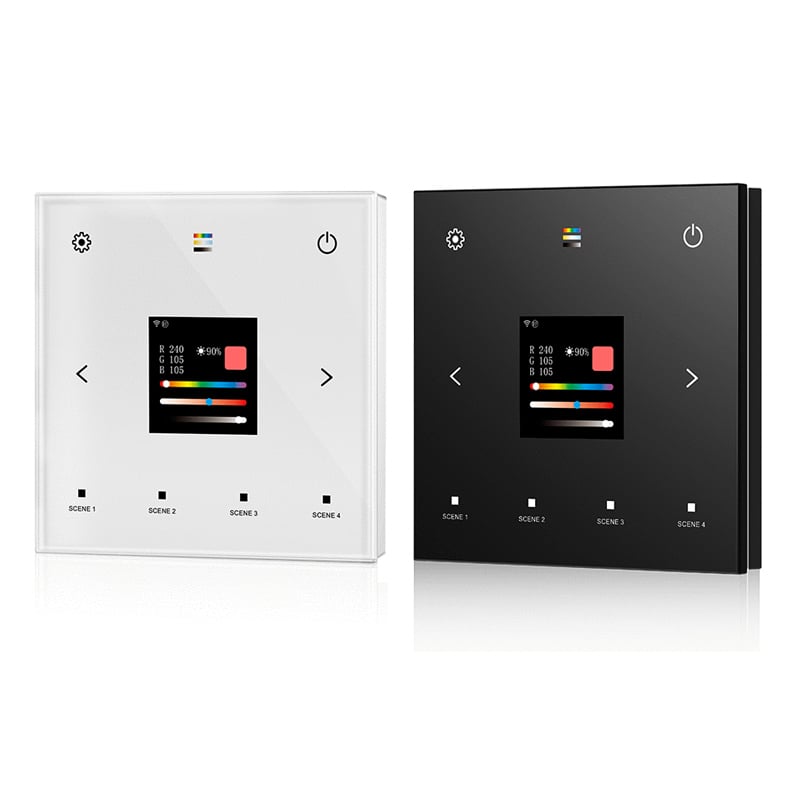
SkyDance DALI Master Controllers are designed to generate DALI digital control commands for managing compatible DALI lighting systems, including DALI dimmable LED drivers, constant-voltage LED controllers, constant-current LED controllers, DALI switches, and other DALI-compatible lighting devices.
Instead of relying on a centralized computer or building automation system for every lighting operation, these DALI master panels and controllers provide convenient local and wireless control through different interfaces, including built-in rotary knobs, touch-sensitive keys, external Push-Dim switches, RF remote controls, Wi-Fi smartphone apps, and Zigbee smart home systems.
The masters communicate with connected devices through standard DALI digital signals, supporting DALI DT6 single-channel dimming and DT8 control types, including tunable white (DT8-TC), RGB, and RGBW, or DT7 switching. With DALI addressing, group control, individual device control, and broadcast commands, SkyDance provides flexible lighting management for different room layouts and lighting configurations.
SkyDance DALI Master Controllers are suitable for residential smart lighting, hotels, offices, conference rooms, retail stores, schools, hospitals, corridors, commercial buildings, and other projects requiring flexible DALI lighting management with convenient local operation, wireless control, and occupancy-based automation.
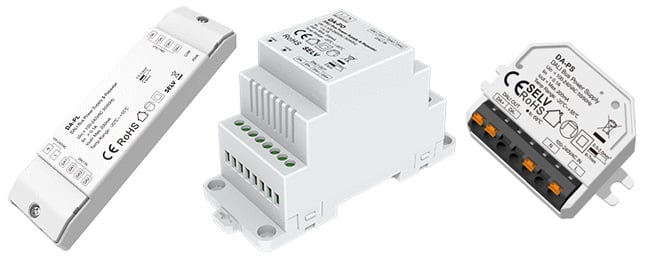
DALI Bus Power & Repeaters
A DALI Bus Power Supply is an essential component of a DALI lighting control network. It provides the low-voltage DC power required to operate the DALI communication bus, allowing DALI master controllers, wall control panels, sensors, dimmers, LED drivers, and other compatible devices to communicate and exchange digital control commands.
Unlike a conventional LED power supply, a DALI bus power supply does not provide operating power to LED strips or lighting fixtures. Instead, it powers the communication network itself, typically delivering a 16V DC bus voltage to maintain reliable DALI signal transmission between connected devices.
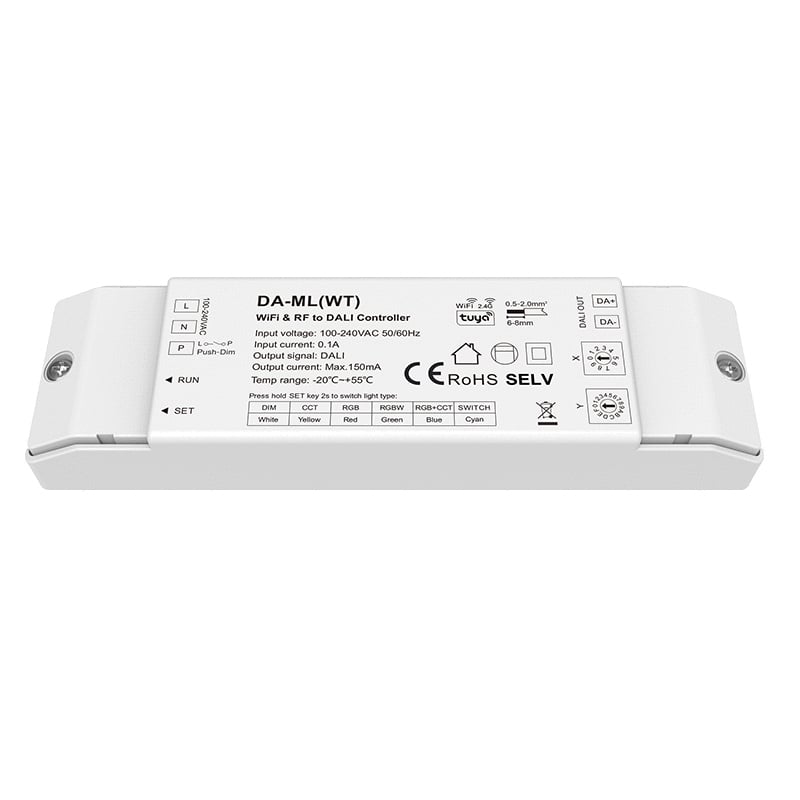
At SuperLightingLED, we offer a range of SkyDance DALI Bus Power Supplies and Repeaters designed for different lighting control system requirements. SkyDance also integrates wireless and smart control technologies into its bus power solutions. Available in RF, Wi-Fi + RF, and Zigbee + RF versions, these smart devices not only provide power to the DALI communication bus but also convert wireless control commands into DALI signals. This allows users to control compatible DALI lighting devices through RF remote controls, smartphone apps, or Zigbee smart home platforms, depending on the model.
In DALI lighting installations with long cable runs, cascaded bus connections, or a large number of devices connected in parallel, a single DALI Bus Power Supply may not provide sufficient current to reliably support the entire communication network. Cable voltage drop and increasing bus load can also affect communication reliability over extended distances. This is where a DALI Bus Power Repeater becomes essential.
By creating a separately powered downstream DALI bus segment, it regenerates and retransmits DALI communication signals while providing additional bus power to the connected devices. This helps distribute the electrical load across multiple bus segments, extend the effective communication distance, and improve signal reliability in larger or more complex DALI installations.

DALI CV Dimmer
SkyDance DALI CV Dimmers are DALI signal-controlled constant-voltage LED controllers designed to integrate low-voltage DC LED strips and lighting fixtures into DALI lighting control systems. Ideal for residential and commercial lighting projects using low-voltage LED strip lights.
Operating with an external DC12–48V constant-voltage power supply, these controllers receive digital commands from a DALI master through the DALI bus and convert them into PWM output signals to regulate the brightness and lighting effects of connected LED loads.
Available in different channel configurations, they support single-color DIM, CCT, RGB, RGBW, and RGB+CCT LED strips, providing flexible DT6/DT8 DALI control for 1-, 2-, 3-, 4-, and 5-channel constant-voltage LED lighting applications.
DT6 models provide single-channel dimming or multi-channel independent control, while compatible DT8 models support integrated control of tunable white, RGB, RGBW, and RGB+CCT lighting. DALI addressing can be automatically assigned by a compatible DALI master or manually configured through DIP switches or digital display buttons.

DALI Constant Current Dimmer
SuperLightingLED offers a full range of genuine SkyDance DALI Constant Current Dimmers, they are DALI signal-controlled LED dimming controllers designed to provide digital lighting control for compatible constant-current LED modules, COB light sources, and constant-current lighting fixtures.
Similar to DALI constant-voltage LED dimmers, these controllers receive digital dimming commands from a DALI master controller through the DALI bus, but instead of producing constant-voltage PWM outputs for LED strips, they deliver regulated multi-channel constant-current outputs to drive and dim connected constant-current LED loads.
Powered by an external DC12–48V constant-voltage power supply, they convert DALI control commands into corresponding output current adjustments, allowing constant-current lighting fixtures to be integrated into centralized DALI lighting control systems.
These DALI Constant Current LED Dimmers/Controllers are suitable for commercial lighting, architectural lighting, hotel projects, retail displays, office lighting, and other installations using multi-channel constant-current LED light sources.

DALI Triac AC Dimmer
At SuperLightingLED, we offer SkyDance DALI Triac/ELV Dimmers designed to bring AC phase-cut dimmable lighting into centralized DALI lighting control systems. Featuring a single DALI address and one AC dimming output channel, these dimmers provide individual lighting control through compatible DALI masters.
SkyDance DALI Triac/ELV Dimmers receive digital dimming commands from a DALI master controller and translate them into corresponding AC phase-cut output, allowing compatible Triac/ELV dimmable LED lamps, AC LED drivers, DC LED controllers, incandescent lights, and halogen lamps to be controlled through the DALI protocol.
By converting DALI brightness and ON/OFF commands into leading-edge (forward-phase) or trailing-edge (reverse-phase) AC dimming control, they enable conventional AC dimmable lighting fixtures to become part of a unified digital lighting management system.
SuperLightingLED's SkyDance DALI Triac/ELV dimming solutions are ideal for commercial buildings, hotels, offices, conference rooms, retail spaces, hospitality projects, and residential installations where existing AC dimmable lighting needs to be integrated into a DALI-controlled environment.
They are particularly useful for lighting designers, electrical contractors, and building automation integrators who want to manage different types of AC phase-cut dimmable lighting through a centralized DALI network without replacing every existing light fixture or its compatible dimmable driver.

DALI AC Light Switch Controller
At SuperLightingLED, we offer SkyDance DALI AC Light Switch Controllers designed to bring conventional AC-powered lighting and electrical loads into centralized DALI lighting control systems. Available in different output channel configurations, these controllers support independent or synchronized switching of one, two, four, or eight AC lighting circuits.
Unlike DALI dimmers, SkyDance DALI AC Light Switch Controllers provide simple ON/OFF switching rather than brightness adjustment. They receive digital switching commands from a DALI master and use built-in AC-rated relays to open or close the connected AC power circuits, allowing standard non-dimmable LED lights, lamps, and other compatible AC electrical loads to be switched through the DALI network without requiring dimmable drivers or specialized lighting fixtures.

DALI 0/1-10V Dimmer
At SuperLightingLED, we offer SkyDance DALI 0/1-10V Dimmers designed to integrate conventional 0-10V and 1-10V dimmable LED drivers and lighting fixtures into centralized DALI lighting control systems.
These dimmers receive digital dimming commands from a DALI master and convert them into corresponding analog 0-10V or 1-10V DC control signals, allowing compatible analog-dimmable drivers to adjust the brightness of connected LED lighting. This provides a practical way to bring existing 0/1-10V lighting equipment into a DALI-controlled environment without replacing every driver with a dedicated DALI model.
When connected to compatible 0/1-10V dimmable constant-voltage or constant-current LED drivers, these DALI to 0/1-10V converters can control a wide range of low-voltage lighting, including single-color LED strips, COB LED strips, linear LED fixtures, LED panels, downlights, and other analog-dimmable luminaires.
SuperLightingLED's SkyDance DALI 0/1-10V Dimmers are particularly valuable for retrofit installations and projects that already use 0-10V or 1-10V dimmable drivers but require centralized DALI scheduling, grouping, scene control, and brightness management.
Best-selling DALI Control Series
1–20 of 44 products




How Does a DALI Lighting Control System Work?
A DALI lighting control system operates through three main types of devices: application controllers, input devices, and control gear. Together, they form a flexible lighting network that allows individual fixtures, lighting groups, and entire zones to be managed through digital commands.
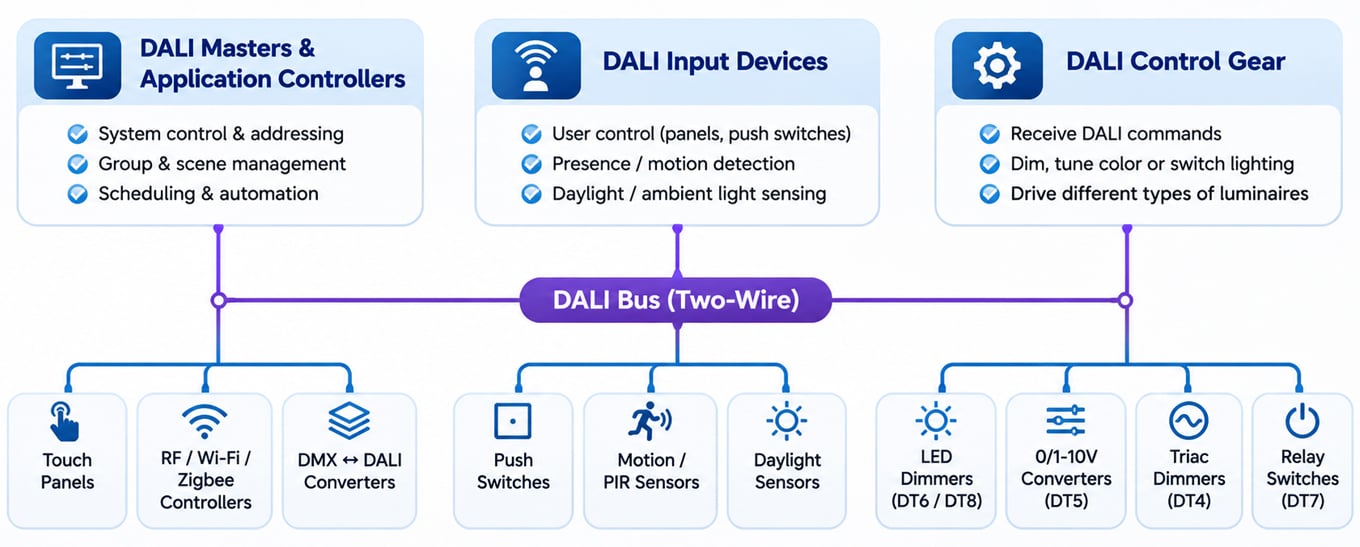
Application Controllers – The Brain of the DALI System | Input Devices – Sensors and User Interfaces | Control Gear – Drivers, Dimmers, and Switching Devices | DALI Bus – Communication Between All Devices |
DALI master controllers and application controllers manage lighting operations by sending commands to connected devices. | DALI input devices collect user commands and environmental information and provide it to the application controller. | DALI control gear receives commands from the application controller and adjusts the connected lighting accordingly. | The DALI bus uses a two-wire communication line to carry digital data and provide power to compatible bus-powered devices. A separate DALI bus power supply is required unless this function is integrated into the compatible device. |
Wall-mounted touch panels, rotary controls, computer-based lighting management systems, or smart wireless interfaces. | Push-button panels, occupancy sensors, motion sensors, and daylight sensors. | DALI LED drivers, constant-voltage and constant-current LED dimmers, 0/1-10V converters, DMX converters, Triac dimmers, and AC relay switches. | The DALI bus does not normally provide the operating power for controllers and lighting fixtures. |
A DALI-2 subnet can support up to 64 control gear addresses and 64 control device addresses. Devices can be assigned individual addresses, organized into lighting groups, and programmed with lighting scenes. This makes DALI particularly suitable for projects requiring independent room control, centralized building management, automated lighting schedules, daylight harvesting, occupancy-based lighting, and tunable white or color-changing effects.
Understanding DALI Device Types: DT4, DT5, DT6, DT7, and DT8
Not all DALI-controlled lighting devices use the same control method. Different DALI Device Types (DT) are defined in the IEC 62386 standard to support different lighting technologies and control functions. Understanding these classifications helps you select compatible DALI drivers, LED dimmers, and switching controllers for your lighting project.
DT6 vs. DT8: Standard Dimming or Advanced Color Control?
The main difference between DT6 and DT8 is how DALI controls the lighting output.
DT6 is designed for conventional single-color LED dimming. It controls the brightness of an LED output through standard DALI dimming commands. For multi-channel DALI LED controllers, individual outputs can be assigned separate DALI addresses, depending on the controller's configuration.
DT8 is designed specifically for color control. Instead of treating every color channel as a completely separate lighting device, compatible DT8 control gear can manage multiple coordinated color outputs through a single DALI short address. This allows brightness and color temperature or color mixing to be controlled together, reducing address consumption and simplifying lighting system configuration.
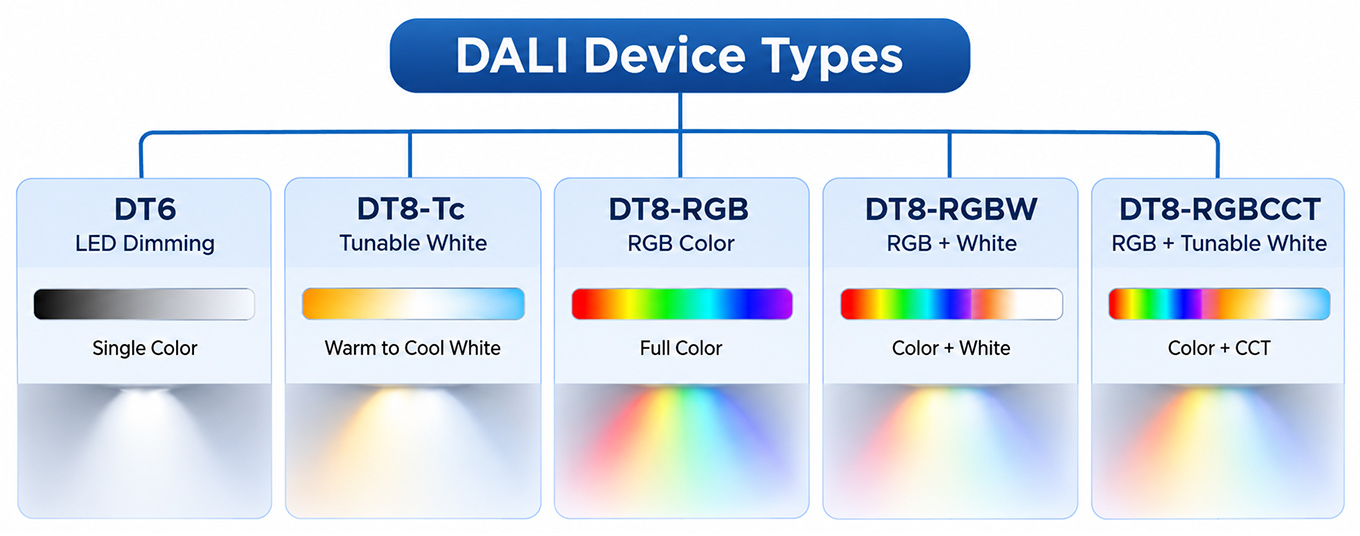
DT8 TC vs. RGB vs. RGBW vs. RGBCCT: Which Color Control Should You Choose?
DT8-TC controls correlated color temperature (CCT), allowing users to adjust lighting from warm white to cool white while also controlling brightness. It is ideal for residential lighting, offices, hotels, hospitality environments, and circadian lighting applications where adjustable white light is preferred.
DT8-RGB controls red, green, and blue channels to generate a wide range of colors. It is suitable for decorative lighting, architectural features, accent lighting, and dynamic color-changing LED strips.
DT8-RGBW combines RGB color mixing with an additional dedicated white LED channel. The independent white channel produces cleaner and more practical white illumination without relying entirely on mixing the three RGB colors. It is suitable for applications requiring both colorful effects and functional white lighting.
DT8-RGBCCT combines RGB color control with two separate white channels: warm white and cool white. It offers independent color-changing effects and adjustable white color temperature, making it suitable for premium residential lighting, entertainment spaces, hospitality environments, and versatile decorative installations.
SkyDance offers selectable DT6 and DT8 lighting modes. Always check the supported modes of the exact model before purchasing.
DT4 vs. DT5 vs. DT7: Three Different Ways to Control Conventional Lighting
Some installations already contain conventional AC lights or analog-dimmable LED drivers. DALI also provides different control gear types for integrating these lighting products into a centralized network.
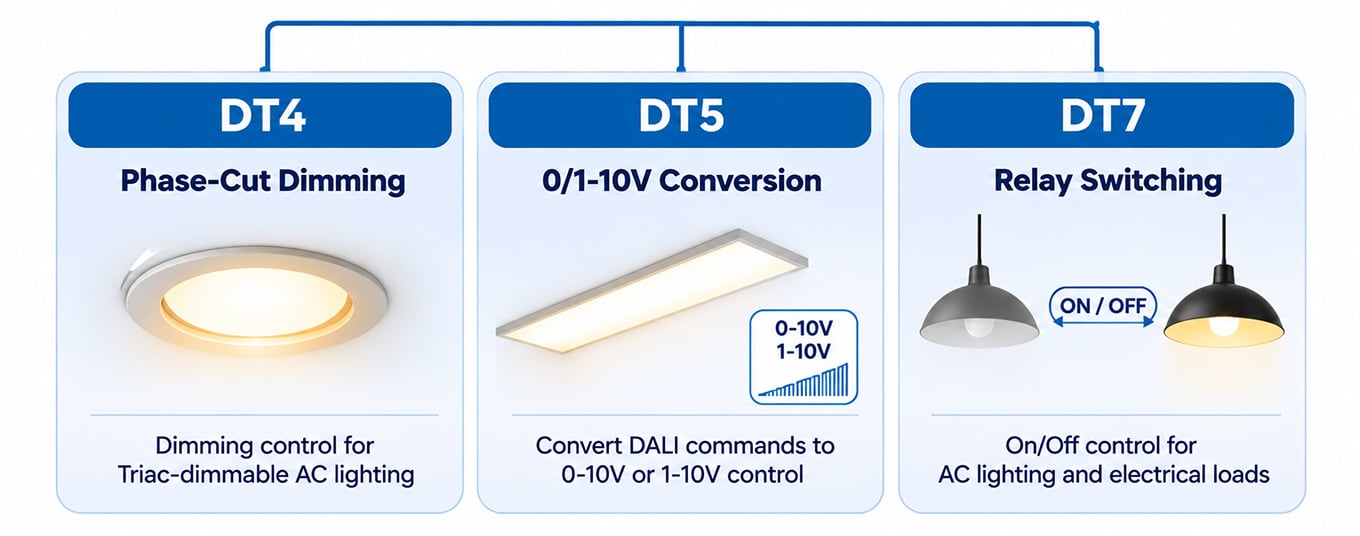
DT4 – AC Phase-Cut Dimming: Converts DALI dimming commands into compatible leading-edge or trailing-edge phase-cut control for AC dimmable lighting. It is used with compatible Triac-dimmable LED lamps and drivers, as well as traditional incandescent and halogen lighting.
DT5 – Analog 0/1-10V Conversion: Converts digital DALI commands into analog 0-10V or 1-10V dimming signals. It is designed for compatible analog-dimmable LED drivers and lighting fixtures.
DT7 – Relay-Based Switching: Uses internal relay contacts to turn connected AC lighting circuits or electrical loads ON and OFF. Unlike DT4 and DT5, DT7 switching does not provide brightness dimming.
Why Choose SuperLightingLED's SkyDance DALI Control System?
Choosing the right DALI control system depends on your lighting loads, driver requirements, communication architecture, and desired control functions. Different manufacturers have different product strengths and system approaches.
At SuperLightingLED, we offer the SkyDance DALI series as a versatile solution for projects that combine LED strip lighting, low-voltage LED fixtures, and conventional lighting within one digital control network.
SkyDance offers a broader and more diversified DALI product ecosystem than MiBoxer Mi-Light DALI Series, covering LED strip control, CV and CC dimming, wireless and smart integration, signal conversion and expansion.
By comparison, LTECH DALI Series places a stronger emphasis on DALI driver development, while Sunricher DALI Series focuses more on professional lighting control and building automation integration.
FAQ About DALI Control Series
Direct answers to common wiring, addressing, and protocol questions across our DALI control lineup.
DALI and DALI-2 hardware run together on the same physical two-wire bus without data collision issues, provided standard timing rules are respected. DALI-2 tightens command timing, introduces multi-master application controller standards, and mandates strict testing under IEC 62386. When you connect legacy DALI control gear alongside newer DALI-2 certified gear like our DA1-S or CXD series drivers, basic dimming commands (0-254 levels), grouping, and recall scene packets operate across both generations normally. Keep in mind that specialized DALI-2 input device events will not be understood by older legacy masters.
Shielded cable is not required by standard IEC 62386 and is often counterproductive because shielding increases line capacitance. Standard DALI lighting control transmits differential data at 1200 baud with a 16V nominal bus level, giving it high immunity to electrical noise. You can run standard 2-core mains-rated PVC cable (such as 1.5 mm² or 14-16 AWG) alongside 100-240V AC line power in the same conduit or tray. The essential restriction is cable length: limit total wire distance between any two devices to 300 m to keep line voltage drop under 2.0V DC.
A single DALI lighting control subnet supports up to 64 short addresses, 16 groups, and 16 scenes. That means you can address 64 separate control gears if each fixture uses one short address. However, multiple drivers can be wired to respond to the same group or broadcast command, and multi-channel devices can share addresses under DT8. If your job exceeds 64 addresses, you do not need to replace the architecture; simply split the project into multiple subnets using separate line controllers or feed into our DALI master controllers that handle multi-bus routing via RF or Ethernet.
A 0V reading on your bus means you have forgotten to install an active bus power supply or a dead short exists between the two control lines. Unlike DMX or 0-10V, DALI light control requires an external bus power supply to pull the signal line up between 9.5V and 22.5V DC (typically 16V DC idle). Without this active power supply (capped at 250 mA per standard), the master and dimmers cannot transmit pulses. Check your circuit with a multimeter: if idle voltage is 0V, ensure an integrated master/power unit like our DA-ML(WT) is powered, or wire an independent bus supply onto the rail.
Yes, you can switch non-dimmable AC exhaust fans, pumps, or standard high-bay drivers using a DALI DT7 relay switch. Units like our 1-channel 10A DALI relay assign a standard DALI address to an electromechanical relay output rather than varying a PWM cycle. The internal dry contacts switch line voltage loads up to 10A or 16A and incorporate zero-cross switching circuitry. This design suppresses the destructive inrush current spikes commonly generated by bulk power supply filter capacitors, preventing relay contact welding.
You can integrate third-party 0-10V or 1-10V fixtures directly into your DALI bus using a DALI-to-0/1-10V signal converter. Devices such as our DALI to 0-10V dimmer take a standard DALI short address (device type DT5) from your master controller and translate digital packets into an analog 0/1-10V sink or source voltage curve. They also integrate a mains-rated dry contact relay to cut AC line power completely at 0% dim command, solving the common standby phantom draw found in conventional 0-10V architectural drivers.
Non-responsive dimmers on a live bus are almost always caused by addressing mismatches, low bus voltage, or loose screw terminals. First, measure across the DA terminals on the slave unit; you should see 12V to 20V DC idle. Next, verify whether the dimmer is locked into manual testing mode or awaiting dynamic address allocation. If your master uses single-address routing while the slave expects group commands, the unit will ignore commands. Many of our digital-display DALI dimmers feature manual buttons and a numeric LED display, allowing you to manually force a test short address (00-63) to verify communication.
You can dim standard mains-voltage incandescent fixtures, halogen lamps, or phase-cut dimmable LED retrofit bulbs by adding a DALI Triac AC dimmer to your bus. Our DALI Triac AC dimmers (DT4) decode digital DALI level commands and execute smooth trailing-edge (reverse phase) or leading-edge MOSFET phase cutting across 100-240V AC line feeds. Units like the DT-D feature an onboard numeric screen so you can set your minimum dimming threshold manually, preventing retrofit LED lamps from flickering or dropping out at the bottom 1% to 10% of their dimming curve.
Low-end flicker usually stems from an incompatible dimming curve selection, low-frequency PWM chopping, or noise coupling from adjacent high-voltage lines. Ensure your DALI master and dimmers are set to logarithmic dimming rather than linear dimming, matching human eye sensitivity according to IEC 62386-102. On secondary driver outputs, verify your dimmer uses high-frequency PWM; our constant voltage DALI dimmers switch above 1 kHz to prevent visible strobe and camera banding down to 0.1% duty cycle. If using phase-cut dimmers, bump up the minimum brightness parameter to keep the lamp above its cut-off threshold.