
DALI Bus Power & Repeaters
2 productsA DALI Bus Power Supply is an essential component of a DALI lighting control network. It provides the low-voltage DC power required to operate the DALI communication bus, allowing DALI master controllers, wall control panels, sensors, dimmers, LED drivers, and other compatible devices to communicate and exchange digital control commands.
Unlike a conventional LED power supply, a DALI bus power supply does not provide operating power to LED strips or lighting fixtures. Instead, it powers the communication network itself, typically delivering a 16V DC bus voltage to maintain reliable DALI signal transmission between connected devices.
At SuperLightingLED, we offer a range of SkyDance DALI Bus Power Supplies and Repeaters designed for different lighting control system requirements. SkyDance also integrates wireless and smart control technologies into its bus power solutions. Available in RF, Wi-Fi + RF, and Zigbee + RF versions, these smart devices not only provide power to the DALI communication bus but also convert wireless control commands into DALI signals. This allows users to control compatible DALI lighting devices through RF remote controls, smartphone apps, or Zigbee smart home platforms, depending on the model.
In DALI lighting installations with long cable runs, cascaded bus connections, or a large number of devices connected in parallel, a single DALI Bus Power Supply may not provide sufficient current to reliably support the entire communication network. Cable voltage drop and increasing bus load can also affect communication reliability over extended distances. This is where a DALI Bus Power Repeater becomes essential.
By creating a separately powered downstream DALI bus segment, it regenerates and retransmits DALI communication signals while providing additional bus power to the connected devices. This helps distribute the electrical load across multiple bus segments, extend the effective communication distance, and improve signal reliability in larger or more complex DALI installations.
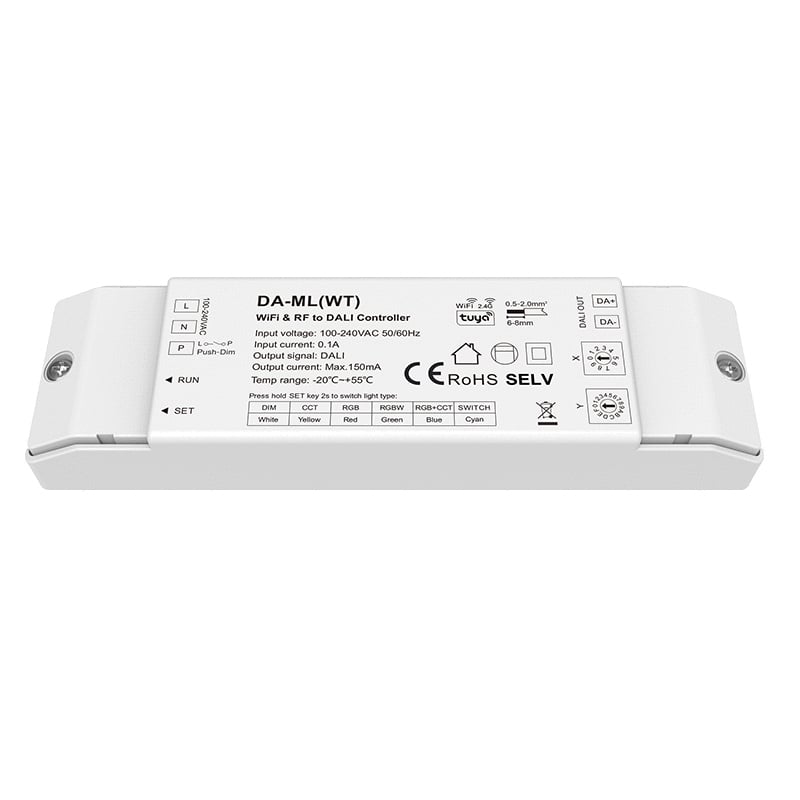

How to Connect a DALI Bus Power Supply to a DALI Lighting System
For a standard DALI network, connect the AC100–240V Line (L) and Neutral (N) wires to the DALI bus power supply's AC input terminals. Then connect its DALI power output terminals to the two-wire DALI communication bus.
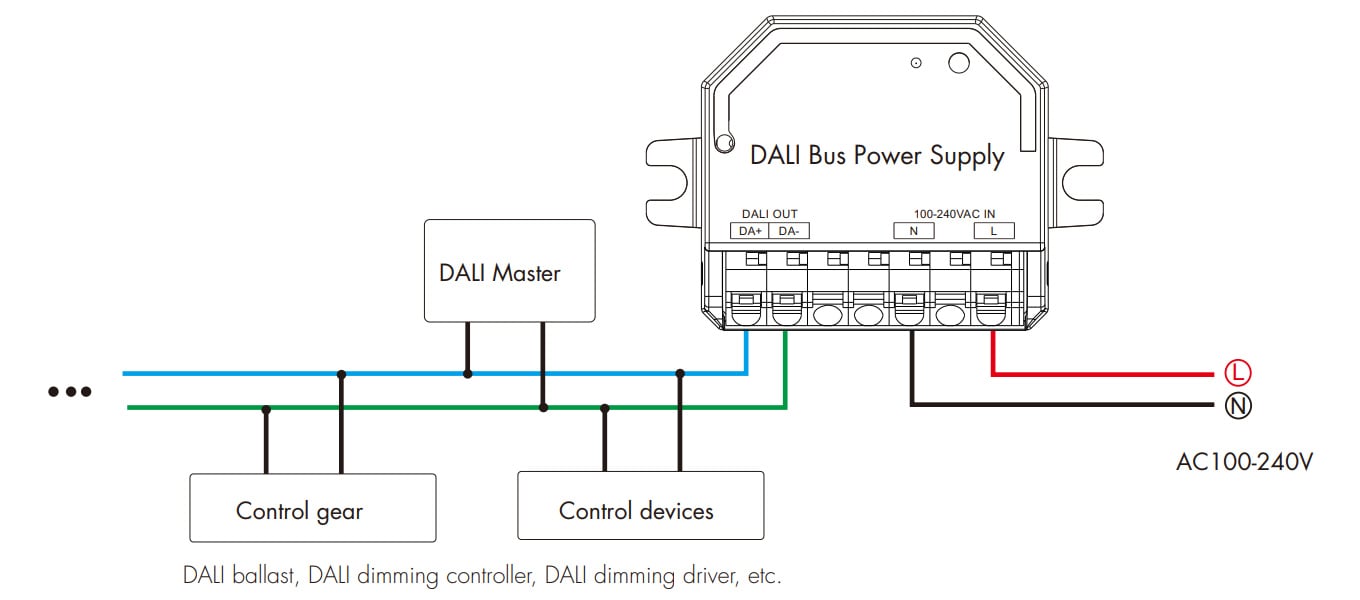
The DALI master controller, DALI control devices such as wall panels and sensors, and DALI control gear such as dimmable LED drivers and DALI dimmers are connected in parallel to the same bus line.
The bus power supply provides the required communication power, while each LED driver or lighting power supply separately receives its operating power from the appropriate AC or DC source.
How to Wire a DALI Power Repeater for Long-Distance and Multi-Branch Lighting Systems
To install a DALI Power Repeater, first connect AC100–240V mains power to the repeater's L and N input terminals. Then connect the existing DALI main bus from the DALI master controller and its bus power supply to the repeater's DALI IN terminals (DA1 and DA2).
The repeater's DALI OUT terminals (DA+ and DA−) connect to the downstream DALI bus, where additional DALI LED drivers, dimmers, control panels, and sensors can be installed.
The repeater regenerates and retransmits DALI communication signals in both directions while supplying power to the downstream bus segment, so no additional DALI bus power supply is required on each repeater output.
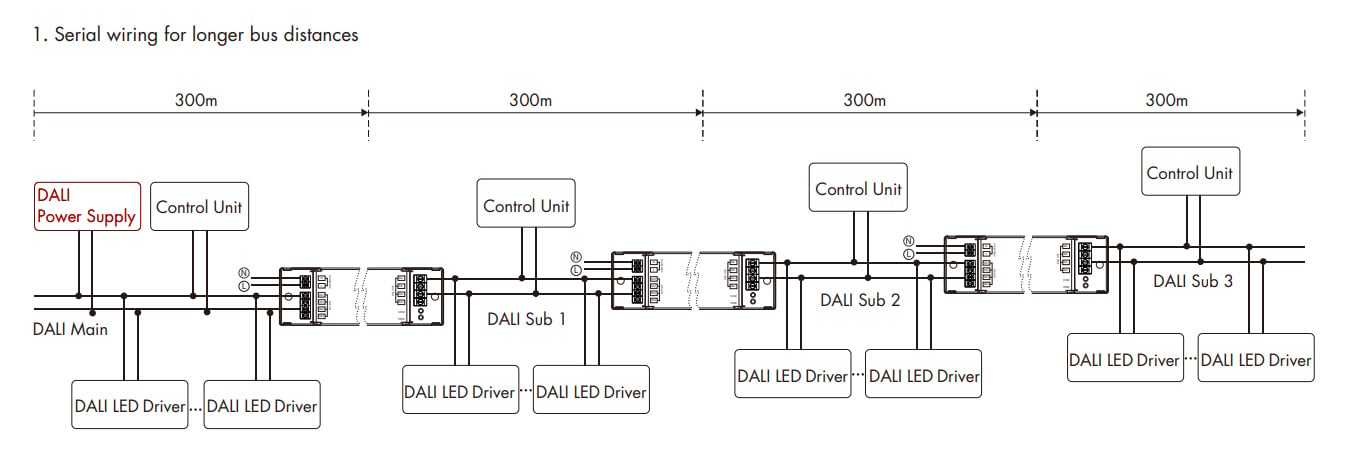
For long-distance installations, multiple DALI power repeaters can be connected in series, with the output of one repeater feeding the input of the next. This creates successive DALI bus segments and extends the communication distance.
Up to three repeaters can be connected in series, allowing the DALI bus distance to extend up to 1,200 meters under the manufacturer's specified installation conditions.
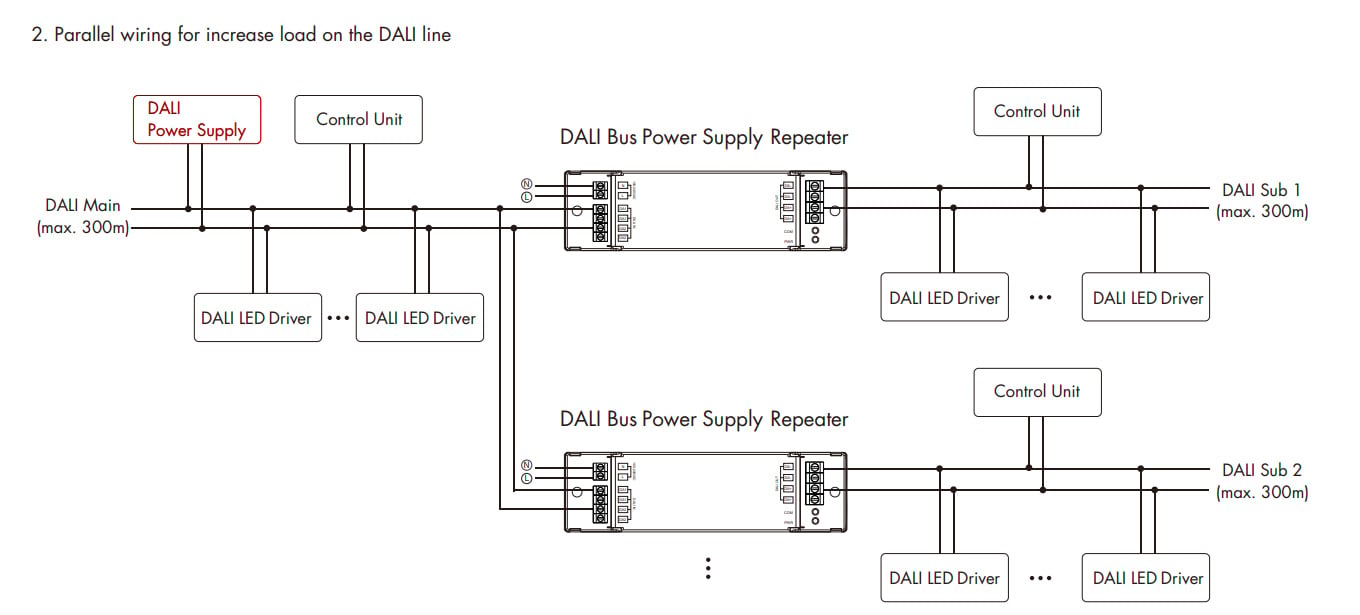
For larger installations with multiple lighting zones or separate wiring branches, repeaters can also be connected in parallel to the main DALI bus, with each repeater supplying and communicating with its own downstream branch. This arrangement helps distribute bus power requirements and supports more flexible DALI network layouts.
FAQ About DALI Bus Power & Repeaters
Direct engineering answers on sizing bus power, running repeaters over long distances, and wiring DALI control networks cleanly.
A DALI bus power supply provides the dedicated 16V DC operating voltage that allows controllers, sensors, and LED drivers to exchange digital data [B104]. Unlike the auxiliary drivers that illuminate an LED strip, this unit does not power lighting fixtures directly. Instead, it maintains the communication bus between 9.5V and 22.5V DC across two signal wires. Without an active bus supply, no DALI commands can travel, leaving dimmers and fixtures completely unresponsive. For a detailed breakdown of the protocol structure, read our DALI dimming guide.
A standard 24V LED driver cannot replace a DALI bus power supply because it lacks current-limiting circuitry and will burn out the communications hardware. Standard 24V DC power supplies deliver constant voltage with high current capacity, which interprets DALI's low-state signal pulses (shorting the bus to 0V) as a dead short. Dedicated DALI bus power units are engineered to cap output current below 250 mA and safely tolerate continuous signal pulsing without tripping overcurrent protection.
Every standard DALI bus power supply is limited to 250 mA by the IEC 62386 standard to safeguard connected transmitters and receivers during data transmission. When a device transmits data, it pulls the bus low by creating an intentional short circuit for 416 microseconds. If the supply delivered several amps, those brief shorts would generate intense heat and destroy the optocouplers inside your wall switches and LED drivers. Standard practice designs the bus around 128 mA to 200 mA, leaving plenty of margin under the 250 mA ceiling.
Choosing a hybrid DALI bus power supply depends on whether your project requires standalone wired control or smartphone automation. A dedicated unit like our DA-PS-L functions strictly as an AC-powered bus supply and signal repeater for traditional wired panels. In contrast, the DA-ML(WT) Wi-Fi and RF controller combines active bus power with 2.4 GHz RF and Tuya Wi-Fi control in one housing. In our catalog, 50% of the models in this category feature integrated Wi-Fi, compared to an average of just 3% across our 44 sibling DALI control models.
You need to install a DALI repeater whenever your total cable length exceeds 300 m or when wire resistance drops bus voltage below 9.5V at the furthest fixture. A repeater isolates the incoming data stream, cleans up signal degradation, and outputs a freshly powered 16V DC bus line to the next branch. This lets you run an additional 300 m run of 1.5 mm² wiring without loading down the primary control circuit.
You cannot wire a secondary DALI bus power supply in parallel if the combined bus current exceeds the 250 mA industry limit. Combining two independent 200 mA supplies puts 400 mA on the wire, which breaches IEC 62386 specifications and risks burning out transmitter transistors. If your fixture count and sensor loads exceed what a single 250 mA supply can deliver, split the installation into separate physical lines using an isolated DALI repeater.
A standard DALI repeater does not increase the 64-address limit on a single master subnet. While the repeater provides a fresh electrical supply to drive another physical leg of lighting gear, the master controller still manages the same 64 short addresses across both sides. Downstream LED drivers either share existing addresses or operate via broadcast commands. If you need more than 64 uniquely addressable channels, you must add a secondary DALI master controller or route through an upstream building management system.
A DALI bus dropping below 12V DC almost always indicates a dead short, a reversed polarity module on a polarized accessory, or excessive current draw. Measure voltage with a digital multimeter directly at the bus power supply terminals with the field wiring disconnected. If the output reads 16V DC at the terminals but collapses once reconnected, one connected LED driver or faulty sensor is dragging down the circuit. Disconnect fixtures in batches of ten until the voltage returns to normal.
Delayed or dropped signals through a DALI repeater usually stem from line capacitance exceeding 400 nF or high-voltage AC induced noise. DALI operates at a slow 1200 baud rate, making it resilient, but routing unshielded bus lines tightly alongside 277V or 480V motor feeds over 50 m can corrupt signal frames. Use twisted-pair 1.5 mm² wiring, maintain at least 150 mm separation from high-voltage conduit, and verify that the repeater's input and output channels are not accidentally looped together.
A single DALI bus power supply easily operates mixed gear, communicating simultaneously with DC dimmers and mains relay modules on one two-wire bus. For instance, you can run low-voltage dimming drivers alongside our DALI AC light switch controllers to toggle fans or non-dimmable architectural lights. Because the bus supply only handles data power, each device draws roughly 2 mA of bus current while drawing its actual operating power from its respective 12V, 24V, or 100–240V AC line.
Use 1.5 mm² (roughly 15 to 16 AWG) two-conductor copper wire for distances up to the maximum standard run of 300 m. If your installation runs under 100 m, 0.75 mm² (18 AWG) wire is acceptable, but the loop resistance must never cause more than a 2.0V drop along the line. DALI communication wiring is polarity-free at the fixtures, meaning you can wire bus terminals without tracking positive or negative leads, though keeping consistent polarity simplifies maintenance on complex sites.