
DMX AC Switch
1 productsSuperLightingLED offers high-performance DMX AC Light Switch Controllers designed for seamless DMX512 relay switching of 100-240V AC lighting loads. The SkyDance DMX AC Switch Series is designed to bring conventional AC-powered lighting and electrical loads into professional DMX512-controlled installations where centralized ON/OFF operation is required instead of brightness dimming.
It receives standard DMX512 control commands and switches the AC power supply to connected lighting circuits, delivering full AC mains power when turned ON and completely interrupting the output when turned OFF.
Unlike DMX Triac dimmers, which regulate brightness through AC phase-cut control, DMX AC switches provide straightforward power switching without modifying the AC waveform. This makes them an ideal solution for controlling non-dimmable LED fixtures, conventional AC lights, decorative lighting, and other compatible mains-powered equipment.

DMX512 AC Switches for Direct On/Off Control of AC Lighting
At SuperLightingLED, we offer SkyDance DMX AC switching solutions for projects that require reliable centralized power control rather than continuous brightness adjustment. Choose a DMX AC Switch when your lighting needs simple ON/OFF operation.
Operating with AC100–240V input and output, the SkyDance DMX AC Switch supports single-channel switching with one DMX512 address, also features RDM communication for remote device configuration, a digital numeric display with push-button address setting, and a standalone manual ON/OFF function that allows connected lighting loads to be operated without a DMX signal.
These features provide flexible control options for both network-based lighting installations and independent switching applications.
DMX512 AC Switch Wiring Diagram and Connection Guide
The DMX512 AC Switch features separate terminals for DMX signal communication and AC power connections, allowing straightforward integration into professional lighting systems.
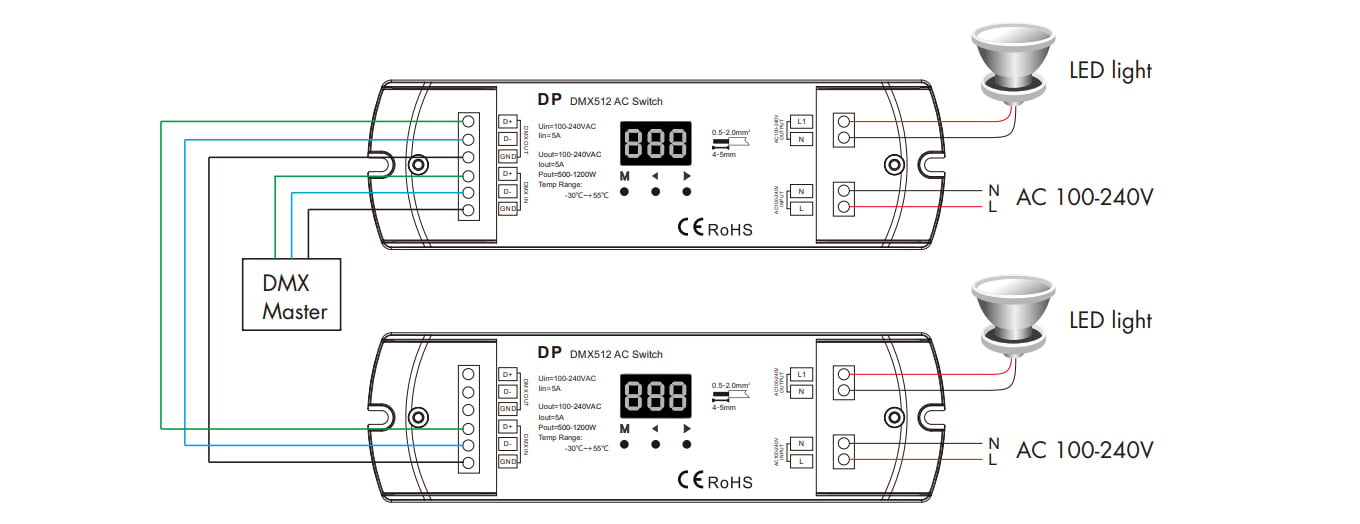
As illustrated in the wiring diagram, connect the DMX master controller's D+, D-, and GND terminals to the corresponding DMX IN terminals on the AC switch. The DMX OUT terminals can be connected to the next DMX decoder or device for daisy-chain signal distribution.
For power connections, connect the AC100-240V mains supply to the AC L and AC N input terminals, then connect the compatible AC lighting fixture to the AC L and AC N output terminals.
Once connected, the DMX console can independently switch the connected lighting load on or off using the assigned DMX address. Each AC switch occupies one DMX channel.
Always disconnect mains power before installation and ensure the connected load stays within the device's rated electrical limits.
FAQ About DMX AC Switch
Direct engineering answers on wiring, load limits, DMX addressing, and relay control for AC line-voltage fixtures and power supplies.
A DMX AC switch operates strictly as an ON/OFF power relay and cannot dim lighting loads. It switches mains line voltage (100–240VAC) fully on or fully off using a digital DMX512 threshold, closing the circuit above DMX value 127 and opening it below 126. If your installation requires smooth line-voltage dimming for mains fixtures, pick one of our DMX Triac dimmers instead of a relay switch. For low-voltage LED strip lights, dimming is handled on the DC secondary side using low-voltage PWM decoders.
A DMX controller for LED lights is the master console or software transmitter that sends digital control packets (values 0 to 255) across an RS-485 serial network. When paired with an AC switch, the controller does not vary voltage—it treats the fixture channel as a binary power trigger. Pushing the fader past 50% (DMX value 128) commands the relay to energize the mains circuit, cutting idle electricity to zero when the lights are programmed off in your lighting cues.
To control LED lights with DMX through an AC switch, you feed mains 100–240VAC into the switch's AC input, wire the switched AC output to your non-dimmable LED power supply, and connect the DMX512 data pair from your console to the signal terminals. Setting the DMX address gives the console control over the mains feed. Sending DMX 255 powers the driver instantly to run your LED strip lights. Read our DMX lighting guide for full diagrams on running DMX control data alongside line-voltage cables.
The fundamental difference is that a DMX AC switch provides clean, unchopped AC sine-wave switching, whereas a Triac dimmer chops the AC waveform using phase cutting. Powering non-dimmable electronic LED drivers through a phase-cut dimmer causes severe driver buzzing, heat buildup, and driver failure within months. A DMX switch uses an internal zero-cross relay to deliver full mains voltage, protecting switching power supplies and non-dimmable ballasts from harmful waveform distortion.
A 5A DMX AC switch handles up to 550W at 110VAC or 1150W at 230VAC on pure resistive loads, but electronic LED power supplies must be derated by 50%. The initial inrush current of LED switching drivers can hit 30A to 50A for several milliseconds while charging internal capacitors. To avoid welding the relay contacts, cap your total connected LED power supply load at roughly 250W at 110V or 500W at 230V per switch. If your installation demands higher loads across multiple breakers, look at our multi-channel AC relay decoders.
A DMX AC switch wires in series with your line (L) and neutral (N) mains supply from a branch circuit breaker (maximum 10A or 16A breaker), sending switched line and neutral out to your fixtures. Ground must bypass the unit directly to the electrical earth bond. DMX data cables (Shield, D-, D+) land on the dedicated signal terminals. Keep line-voltage wires separated by at least 50mm from the low-voltage DMX communication lines inside your junction box to prevent inductive noise from corrupting data packets.
You set the starting address on a DMX switch using the front 3-digit numeric display buttons or remotely through an RDM-compatible controller. Press the button to unlock the digital display, select your numerical address between 001 and 512, and wait 5 seconds for the unit to store the value in memory. Because our unit complies with ANSI E1.20 RDM standards, you can also query and change the DMX address remotely from your console without needing ladder access to the fixture.
When a DMX light switch loses incoming DMX data, its microprocessor holds the last valid received state by default until power is cycled or signal returns. This prevents venue work lights or structural power feeds from shutting down abruptly during lighting console reboots. If your site requires the switch to shut off immediately upon communication loss, you can configure fallback behavior through the numeric button menu in stand-alone mode.
You can use a DMX AC switch to power resistive and light inductive equipment like fog machine heaters, display motors, and small fans, as long as running current stays below 5A. For high-inductance electric motors or large exhaust blowers, inductive kickback during shutoff can create an arc across the relay contacts. On heavy motor circuits, use the DMX switch output to trigger the 120V/230V coil of a dedicated external industrial contactor instead.
A 120-ohm terminating resistor is required across D+ and D- on a DMX light switch only when it sits at the very end of the physical DMX cable run. Without termination, high-frequency serial signals reflect back from the unterminated cable end, causing relay jitter, missed cues, and random switching. If the switch is installed in the middle of a daisy chain, pass the D+, D-, and Shield lines straight through without adding a resistor.