
Trailing-Edge ELV Dimmer
5 productsSuperLightingLED's LeyNew Trailing-Edge ELV Dimmer Series provides reliable AC phase-cut dimming solutions for residential, commercial, hospitality, and architectural lighting projects.
Designed for precise brightness adjustment of compatible AC-powered lighting fixtures, this series combines trailing-edge dimming with RF wireless and DMX512 digital control options.
RF wireless ELV dimmers offer convenient remote brightness adjustment, while DMX512 ELV dimmers enable multi-channel lighting control for professional installations and centralized lighting systems.
Whether for home lighting upgrades, retail displays, hotel lighting, or commercial lighting installations, LeyNew offers practical phase-cut dimming solutions for different control preferences and project requirements.
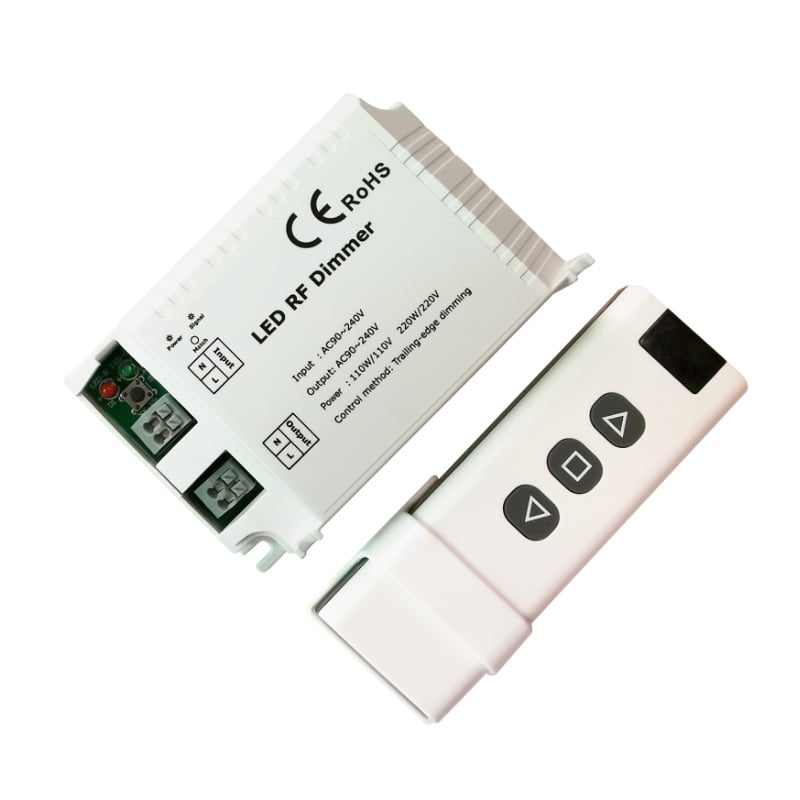
DM014 AC90~2240V Triac Dimmer, 1 Channel Wireless Three-key RF Triac Dimmer


TM11U 1 Channel Touch Triac Dimmer, LED Touch Control Dimming
What Is Trailing-Edge ELV Dimming?
Trailing-Edge Dimming, also known as Reverse-Phase Dimming or ELV (Electronic Low Voltage) Dimming, is an AC phase-cut dimming technology that reduces the power delivered to a lighting load by cutting off the trailing portion of each AC waveform.
Unlike Leading-Edge TRIAC Dimming, which cuts the beginning of the AC waveform, trailing-edge dimming uses electronic switching technology, commonly MOSFET-based circuitry, to provide controlled AC power output.
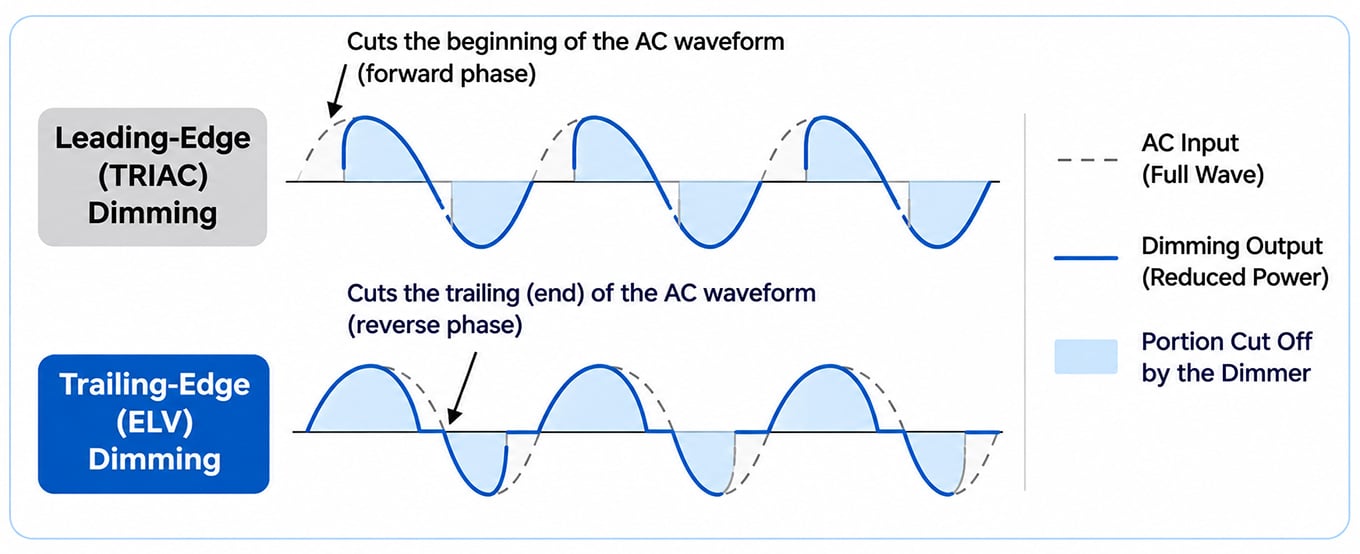
It is particularly suitable for electronic low-voltage transformers and compatible dimmable LED drivers, offering smooth brightness adjustment and reduced operating noise in properly matched lighting systems.
Which LED Lights Are Compatible?
Trailing-edge ELV dimmers are commonly used with dimmable LED bulbs, LED downlights, recessed lights, track lighting fixtures, and other AC-powered LED luminaires specifically rated for reverse-phase dimming. They are also suitable for compatible electronic low-voltage transformers powering 12V or 24V low-voltage lighting fixtures.
For more advanced phase-cut lighting control, explore SuperLightingLED's SkyDance Triac/ELV Control System, featuring expanded control options including RF, Wi-Fi, Zigbee, Bluetooth, DMX512, and DALI integration for residential and professional lighting projects.
FAQ About Trailing-Edge ELV Dimmer
Direct engineering answers on reverse-phase dimming, driver matching, wiring layouts, and eliminating LED buzz on AC line-voltage circuits.
A trailing-edge ELV dimmer turns on smoothly at the zero-crossing of the AC sine wave and cuts the trailing edge of the voltage wave using high-voltage MOSFETs. Standard TRIAC dimmers use forward-phase chopping, which abruptly snaps on mid-cycle and generates massive inrush spikes that cause LED drivers to hum, overheat, or strobe. Trailing-edge reverse-phase control was engineered specifically for electronic low-voltage (ELV) transformers and dimmable electronic LED drivers, which act as capacitive loads. For a deeper breakdown of phase-cut wave mechanics, check out our guide to TRIAC dimming.
Choose a trailing-edge ELV dimmer when retrofitting existing buildings where you only have standard two-wire or three-wire AC romex in the wall box. ELV dimming modulates the line-voltage power wire directly, so it requires zero auxiliary control wiring between the wall switch and the fixture. In contrast, 0-10V dimmers require running a dedicated purple-and-gray low-voltage 2-conductor cable alongside the AC feed. Across our LeyNew LED Dimmer Series of 19 live models, trailing-edge units stand out because 100% of them feature TRIAC phase dimming and 60% run directly on high-voltage AC mains, whereas 0-10V dimmers require compatible commercial ballasts.
Connecting a trailing-edge ELV dimmer to an architectural DMX board requires a phase dimmer equipped with an onboard DMX512 decoding interface. Standard residential wall dimmers speak proprietary RF or simple capacitive touch, but units like our DMX302 3-channel triac dimmer accept standard DMX512 signals directly into terminal blocks and output three isolated channels of high-voltage post-cut phase dimming.
Yes, our wireless trailing-edge ELV dimmer models, such as the DM014 series, incorporate an internal RF receiver operating alongside the high-voltage MOSFET phase-cut circuit. This allows you to place the compact dimmer module inside an electrical junction box or ceiling cavity near the fixture and control dimming, on/off toggling, and preset scenes from up to 30 meters away using a handheld RF remote. Because the RF module modulates AC mains post-cut phase power directly, you get remote dimming control without running control wires down the wall.