
Indirect Cove Lighting Channels
31 products

SuperLightingLED Cove Lighting Ceiling Solutions under architectural aluminum LED profiles. These LED cove lighting fixtures are hidden inside recessed ceilings, tray ceilings, or mounted on the edge of drop ceilings / suspended ceilings, where the light bounces back to soften architectural boundaries and creates a warm and cozy atmosphere in home living rooms, bedrooms, kitchens, etc.
4 Ceiling LED Strip Lighting Solutions
Our Indirect Cove Lighting solutions fall into four architectural strategies:
|
Type
|
Key Differences
|
Focus
|
Typical Models
|
|
Perimeter Ceiling Glow
|
Downward illumination along ceiling edges
|
Spatial expansion in premium residences
|
MS7564, MS7962, AL9570, HGD01, HGD02, HGD04A, QSG-8556, QSG-8556B, HGD5060, QSG-3820, QSG-3825, MS-4533/4533A
|
|
Built-in concealment, knife-edge floating light
|
Seamless minimalism for hotels & luxury interiors
|
QSG-2217, BY-MS, MS-7724, 10030-JX, QSG-12055+
|
|
|
Tray Ceiling
|
Multi-level architectural ceiling forms
|
Visual depth, ambient lighting
|
QSG-4118B-LR, QSG-4118B, QSG-4118C
|
|
Anti-Glare Ceiling Groove
|
Deep cavity + controlled light angle
|
Comfortable illumination, glare reduction
|
MS-13519, HGD03, HGD9035, QSG-10037, AL8350
|
Choose the right cove lighting aluminum profile based on light direction, ceiling structure, and installation style to achieve refined, indirect illumination that supports both architectural aesthetics and human comfort. For the ultimate in personalization, explore our RGBCCT LED Strips. Transform any ceiling into a dynamic canvas of light.

Cove Lighting Adjustable LED Strip Profile For 12mm Tape Light

Waist Line Wall Recessed Lighting Indirect Ceiling Cove LED Strip Profile White

Soft Grazing Indirect Wall Wash LED Strip Mud-in Lighting Extrusion

Drywall Recessed Cove Light Profile MS-HGD03 - Angled Wall Wash LED Trim

White Large 45 Degree LED Wall Wash Light Profile

MS-HGD9035 Dual-Flange Recessed LED Cove Channel - Glare-Free Lighting

LR Series Curved LED Tray Ceiling Lights Profile 4118B-LR

Plaster In Tray Ceiling LED Lighting Profile

Plaster In Up Down Tray Ceiling Lighting LED Channel

Concealed LED Wall Border Profile | Seamless Cove Lighting

Plaster Wall LED Ceiling Perimeter Indirect Lighting Cove Molding

Anti Glare Plaster In Wall Washer LED Profile


Plastered Ceiling Detailed LED Cove Moulding Oblique Lighting Wall Wash

No Glare Drop Ceiling Perimeter Indirect LED Cove Lighting Profile For 20mm LED Strip

Indirect Light Cove Floating Ceiling Lighting LED Strip Profile

Black Cove LED Moulding: Cozy Wall-to-Ceiling Ambient Lighting

Anti Glare Drop Ceiling Perimeter LED Trim Profile Recessed

Flush Plastered Ceiling Cove Molding LED Strip Angled Washing Wall

45 Deg LED Cove Crown Moulding Suspended Gypsum Board Ceiling Edge Trim
Understanding Cove Lighting: Creating Soft, Indirect Illumination for Modern Interiors
SuperLightingLED Indirect Cove Lighting Channels provide a professional solution by combining architectural aluminum profiles with LED strip lighting. These specialized channels are designed to integrate with different ceiling structures, including recessed grooves, suspended ceilings, tray ceilings, and perimeter ceiling designs.
By controlling LED strip position, light direction, and glare protection, these profiles help designers create seamless indirect ceiling illumination while maintaining a clean architectural appearance.
1. Recessed Cove Lighting Built Into the Original Ceiling
For projects where the existing concrete ceiling or finished ceiling structure can be modified, a real recessed groove can be created directly into the ceiling surface.
The LED cove aluminum profile (MS-13519, MS-9537, MS-HGD03, QSG-10037, MS-HGD9035, MS-AL8350) is then embedded inside this groove, creating a built-in strip lighting channel that becomes part of the ceiling architecture.
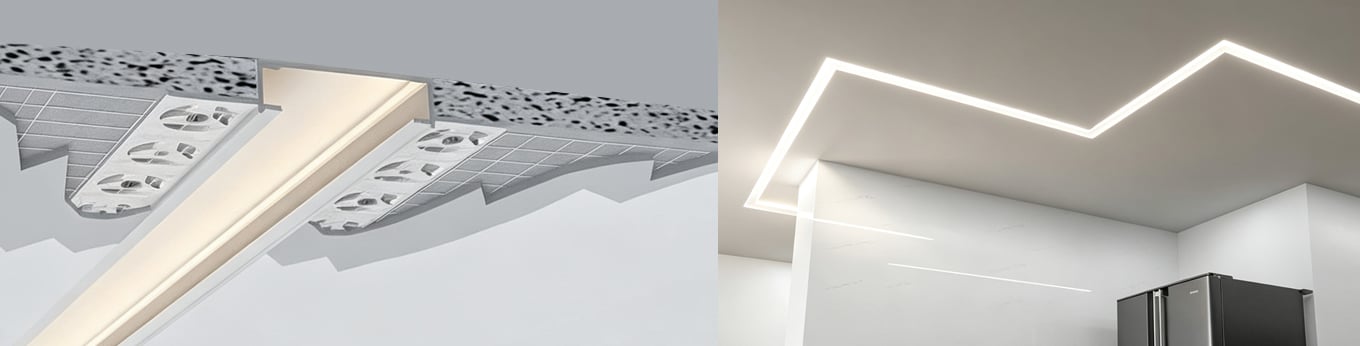
After installation and finishing:
- The aluminum profile is hidden inside the ceiling
- Only the soft reflected light remains visible
- The ceiling appears to float with a continuous light edge
- No exposed fixtures interrupt the design
This installation method provides one of the cleanest architectural lighting effects and is often used in: Luxury residences, High-end villas, Hotels, Galleries, Minimalist interior projects.
The recessed aluminum profile not only creates the correct optical position for indirect lighting but also improves LED strip protection and heat management compared with a simple hidden LED strip installation.
2. Recessed LED Profiles Integrated Into False Ceilings
Instead of hiding the LED profile inside a large cavity, another approach is to directly integrate a recessed LED channel into the false ceiling structure.
During drywall or gypsum board installation, a groove is created, and the LED aluminum channel is installed flush with the ceiling surface.
After finishing:
- The profile edges disappear into the ceiling
- The diffuser becomes a clean linear lighting element
- The ceiling maintains a minimalist appearance
This method is ideal when designers want:
- A thin architectural light line
- Precise lighting patterns
- A modern ceiling design without visible fixtures
Compared with traditional cove lighting, recessed LED channels provide better control of light position and a more refined finish.
3. Cove Lighting Inside False Ceiling Hidden Spaces
Many modern interiors use suspended ceilings or dropped ceilings because they provide space for electrical wiring, ventilation systems, and lighting structures. These hidden ceiling spaces create an ideal environment for indirect cove lighting.
In this application, the LED cove light strip channel (QSG-2217, BY-MS, MS-7724, 10030-JX, QSG-12055+, QSG-5405/5405B/5405C) is installed inside the concealed area around the ceiling perimeter. The light is directed upward or toward the ceiling plane, allowing reflected illumination to spread naturally throughout the room.
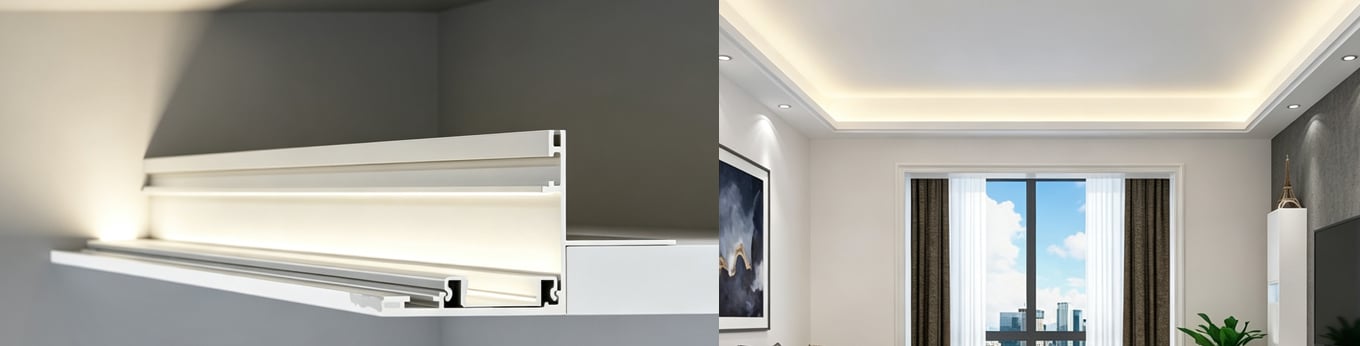
This solution creates:
- A floating ceiling effect
- A larger visual ceiling area
- Soft ambient room lighting
- Reduced direct glare
It is widely used in: Living rooms, Bedrooms, Offices, Restaurants, Hotel spaces.
For suspended ceiling applications, selecting the correct aluminium profile depth and light angle is important because the hidden cavity determines how effectively the light can reflect across the ceiling surface.
4. Floating Ceiling Cove Lighting: Making the Ceiling Appear Suspended
A popular modern architectural design is the floating ceiling effect, where a secondary ceiling layer is installed below the original ceiling.
The gap between the original ceiling and the suspended ceiling creates a visual shadow line. By installing LED profiles around the edge (QSG-4118B-LR/4118B/4118C), designers can make the lower ceiling appear to float.
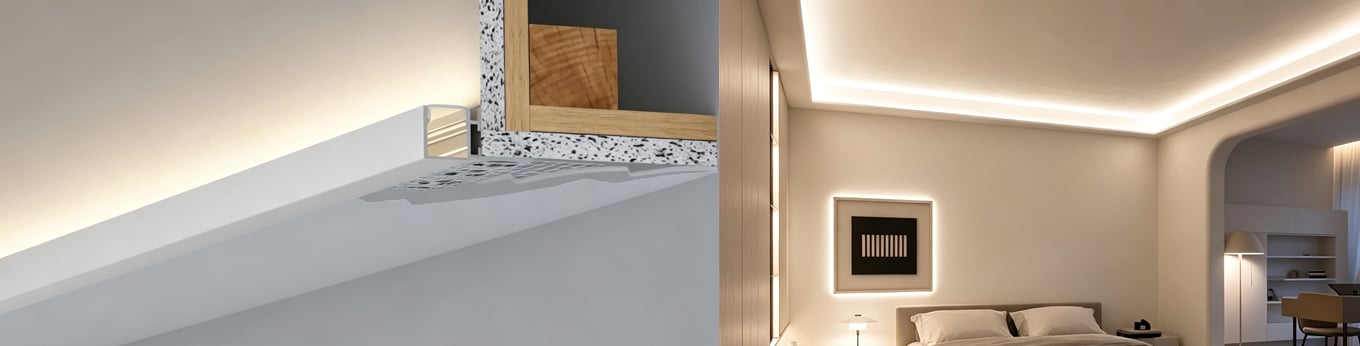
Different aluminum profile designs create different effects:
|
Indirect Floating Ceiling Lighting |
Direct Floating Ceiling Edge Lighting |
|
The LED strip is concealed inside the edge structure and directed upward. |
The LED profile is positioned closer to the visible edge, allowing the light line itself to become part of the ceiling design. |
|
The light reflects onto the original ceiling surface, creating: A soft halo around the ceiling A floating visual effect Comfortable ambient lighting |
This creates: Clear geometric lighting lines Stronger visual definition Modern decorative effects |
|
This approach emphasizes space and atmosphere rather than the light source itself. |
Suitable for: Commercial interiors Showrooms Creative offices Contemporary residential spaces |
5. Downward Cove Lighting at the False Ceiling Edge
Another common cove lighting solution is installing LED aluminum profiles (MS-HGD5060, MS7564, QSG-3820, QSG-3825, MS-HGD02, AL9570, MS7962, MS-4533/4533A, KE101, MS-HGD01, MS-HGD04A, QSG-8556/8556B) at the edge where the false ceiling meets the wall, with light directed downward. Instead of illuminating the ceiling, this method washes the wall surface with soft indirect light.
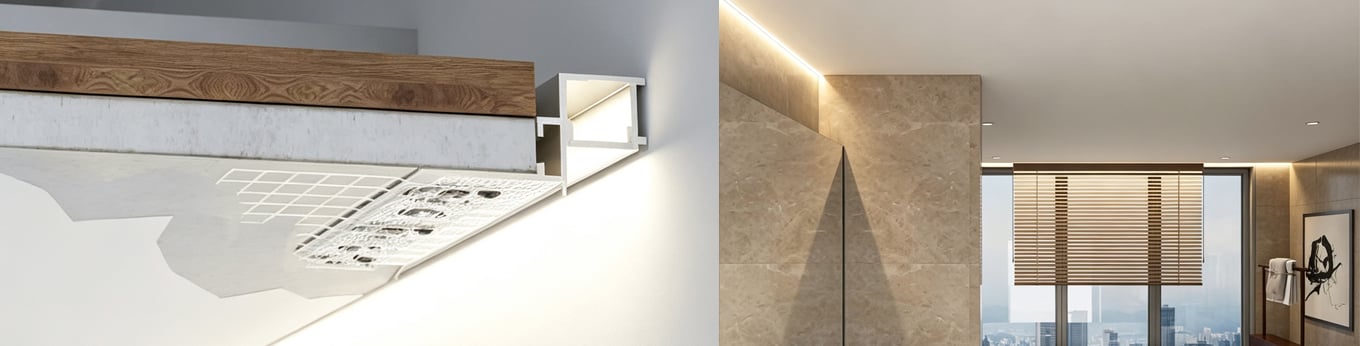
The result is:
- Enhanced wall texture
- Improved spatial depth
- Decorative wall illumination
- Comfortable vertical lighting
This solution works particularly well for: Feature walls, Hotel corridors, Living room walls, Art display areas.
By directing light downward from the ceiling edge, the lighting system becomes part of the architecture while reducing reliance on traditional wall fixtures.
Choosing the Right Cove Lighting Solution for Your Ceiling Structure
Every ceiling structure requires a different LED extrusion profile strategy. SuperLightingLED recommends selecting the cove lighting method based on construction conditions and desired visual effect.
|
Ceiling Structure |
Recommended Solution |
Lighting Effect |
|
Original ceiling with groove |
Recessed cove channel |
Invisible architectural glow |
|
Suspended ceiling with hidden space |
Concealed cove profile |
Floating ceiling effect |
|
Gypsum false ceiling |
Flush recessed LED channel |
Seamless light line |
|
Drop ceiling edge |
Perimeter cove lighting |
Ceiling expansion effect |
|
Ceiling-wall junction |
Downward wall wash profile |
Wall illumination |
Professional LED Cove Lighting Channels for Architectural Projects
Cove lighting is no longer only a decorative ceiling technique. With professional LED aluminum channels, it becomes a complete architectural lighting system that combines:
- Precise light direction
- Improved LED heat dissipation
- Better glare control
- Seamless integration with building structures
- Long-term lighting performance
SuperLightingLED provides multiple indirect cove lighting solutions for recessed ceilings, false ceilings, tray ceilings, and perimeter lighting applications, helping designers transform ordinary ceiling structures into refined architectural lighting environments.
Whether the goal is a floating ceiling, hidden ambient lighting, ceiling expansion effect, or wall washing illumination, the right LED cove channel allows light to become an integrated part of the architecture rather than a separate fixture.
Frequently Asked Questions About Indirect Cove Lighting Channels
Got questions before you buy? I've answered thousands of them over the years. Here are the most common ones for indirect cove lighting.
Cove lighting is a popular form of indirect lighting where you hide the light source, usually an LED strip inside a channel, along a ceiling ledge or in a recess. The light bounces off the ceiling and into the room, creating a soft, diffuse glow without any harsh glare. It’s a great way to make a room feel bigger and more inviting. We have a whole guide on direct vs. indirect light if you want to go deeper.
For the best lighting in a bedroom, you want a warm, comfortable atmosphere. I always recommend a high CRI (95+) LED strip so colors look natural, with a warm color temperature between 2700K and 3000K. For ultimate flexibility, consider our tunable white LED strips that let you adjust the white tone from cozy warm to cool daylight with a remote or wall panel.
Not at all. This is a really common situation. While some profiles are designed to be built into the structure, we have many models designed to be recessed into existing drywall. Profiles have flanges that you can plaster over, letting you create a visual cove or light layer without any major structural changes. It's a clean, architectural look on any flat ceiling.
It's all about the angle and the intent. Indirect cove lighting channels are designed to throw light upwards and outwards, bouncing it off the ceiling for soft, ambient room light. Wall wash channels are engineered with precise optics to direct light straight down a wall, grazing the surface to highlight textures like brick, stone, or wood paneling. If you want to light the wall, not the room, you'll want one of our wall wash models.
The number one mistake in DIY cove lighting is just sticking a bare LED strip on a ledge. It creates ugly hotspots and the strip will fail early without a heatsink. Using an aluminum channel is the key. It keeps the strip straight for a clean line, dissipates heat to make the LEDs last longer, and helps shape the light for a professional, even glow. That's how you get a high-end look.
For a much simpler install, you can use our super-long LED light strips which are designed to run for 20, 30, or even 60 meters from a single driver with no visible dimming.
Yes, we do this every day. A huge portion of what we ship is built-to-spec for a specific project, not just sold in standard lengths. Send our engineering team a sketch or your room dimensions. We'll send you back usually within 12 hours.