
LED CCT Controller
2 sub-categoriesPractical Tunable White Control for Traditional Residential & Commercial Lighting
BinColor CCT LED Controllers are designed to provide practical and intuitive tunable white lighting control for constant voltage (CV) CCT LED strip lights and constant current (CC) CCT LED lighting fixtures. Primarily designed for low-voltage DC12–24V lighting systems, the series offers flexible control options through wireless touch panels, handheld RF remotes, and inline rotary or touch controls.
Ideal for Standalone Lighting Upgrades or Complete Control Setups
BinColor CCT controllers are particularly suitable for traditional residential and commercial color temperature adjustable lighting applications where straightforward, physical lighting control is preferred over app-based or network-dependent systems.
They can be used to build a standalone tunable white lighting setup from the ground up or to expand an existing installation with independent wireless control panels, handheld remotes, or compatible receivers.
Common applications include residential living rooms, bedrooms, kitchens, under-cabinet lighting, hotel rooms, retail spaces, offices, and other environments where adjustable white color temperature helps create different lighting atmospheres throughout the day.
CV CCT Controller
Wireless Remote & Touch Control for Tunable White LED Strips
BinColor Constant Voltage (CV) CCT LED Controllers are designed for DC12–24V tunable white LED strip lights and compatible constant voltage dual-white lighting fixtures. They provide convenient control of warm white and cool white LED channels, allowing users to adjust brightness and color temperature, ON/OFF control, preset lighting scenes, and delayed shutoff. Both single-zone and 4-zone control options are available, allowing users to operate one lighting area or select and control multiple lighting zones independently.
Two Installation & Wiring Options
BinColor CV CCT controllers offer two flexible installation and wiring options to suit different lighting setups:
1. Inline CCT Controller Setup – Direct Wired Control with Optional Remote
Connect the CCT LED strip to an inline rotary dimmer, touch control panel, or push-button controller, and power the system with a compatible AC-to-DC 12V or 24V power supply. This setup provides direct, hands-on control of brightness and color temperature through the connected controller. Also offers compatible wireless remotes as an additional control option, providing greater flexibility without changing the basic wiring setup.
2. Wireless CCT Receiver Setup – RF Remote & Wall Panel Control
Connect the CCT LED strip to a wireless CCT receiver, powered by a compatible AC-to-DC 12V or 24V power supply. The receiver can then be controlled wirelessly using a 433.92MHz RF handheld remote or a hardwired-powered 2.4GHz wireless touch wall panel. Multiple compatible receivers can be paired with the same remote or wall panel, allowing several CCT lighting circuits or areas to operate in sync under one control system.
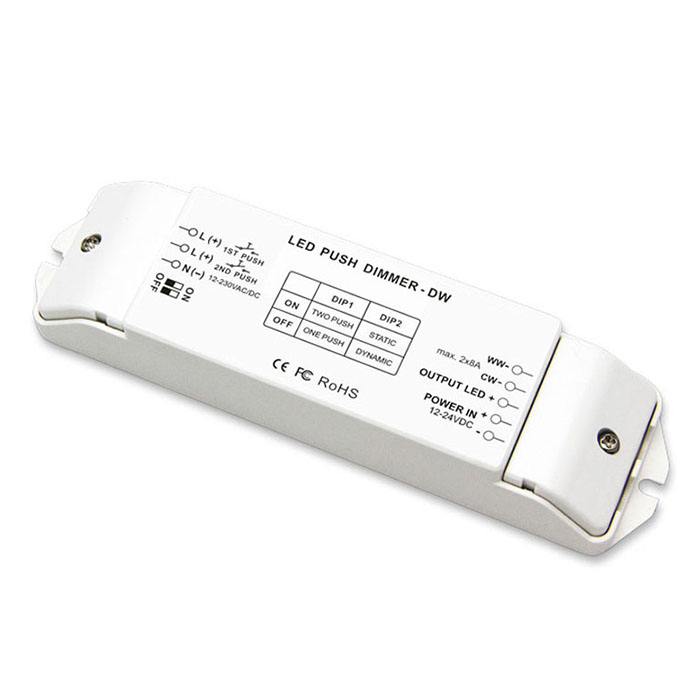
A single BinColor CV CCT controller can support 1–2 WW+CW lighting outputs, making it suitable for controlling one or two tunable white LED strip runs or lighting circuits for residential and commercial lighting systems. They are ideal for bedrooms, living rooms, kitchens, under-cabinet lighting, hotel rooms, retail displays, offices, and other spaces where convenient warm-to-cool white adjustment is needed.
CC CCT Controller
BinColor Constant Current (CC) CCT LED Controllers are designed for tunable white constant current LED fixtures, providing convenient control of warm white and cool white lighting channels.
- - ON/OFF Control: Switch connected constant current CCT fixtures on or off.
- - Brightness Dimming: Adjust light intensity smoothly, with selected models supporting 0–100% dimming and 4096-level grayscale adjustment.
- - Color Temperature Adjustment: Blend warm white and cool white output to create different lighting atmospheres.
- - Preset & DIY Modes: Select built-in lighting effects or save and recall preferred lighting settings on compatible models.
- - Multi-Zone Control: Select and adjust different lighting areas independently using compatible multi-zone touch panels.
Connect the warm white and cool white CC LED fixture channels to a compatible constant current CCT controller, then connect the controller to a suitable DC power supply within its rated input range. The controller regulates the LED output current to provide brightness dimming and color temperature adjustment via buttons, RF remotes, or panel remotes.
The series offers flexible control solutions for residential and commercial tunable white CC lighting systems, from simple single-area installations to multi-zone lighting setups. Always follow the individual model's wiring and power requirements.
Best-selling LED CCT Controller
21–22 of 22 products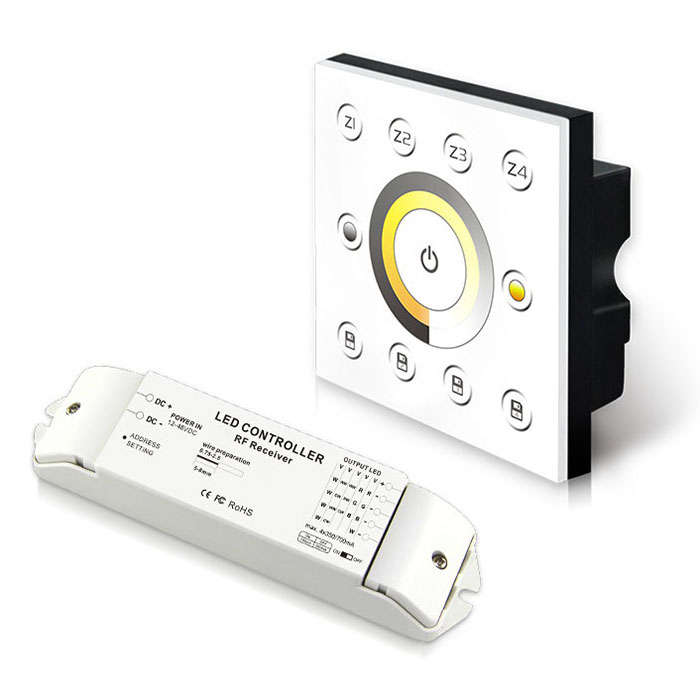
FAQ About LED CCT Controllers
Here are direct answers to the most common questions our engineering desk receives about selecting, wiring, and troubleshooting tunable white CCT controllers.
An LED CCT controller adjusts color temperature by cross-fading two independent DC output channels—one dedicated to warm white LEDs (typically 2700K) and one to cool white LEDs (typically 6500K). Using synchronized pulse-width modulation (PWM), the controller increases the duty cycle on one channel while decreasing it on the other. This alters the blended Kelvin rating smoothly from warm candlelight to crisp daylight while maintaining a consistent overall lumen output across your installation.
Selecting a 12V or 24V CCT LED strip controller depends entirely on the input voltage required by your tunable white LED strip lights. The controller itself does not step voltage up or down; it passes through the DC supply voltage fed into its terminals. For runs under 5 meters, 12V works reliably. For architectural runs longer than 5 meters, choose 24V tape and a matching 24V controller to cut current draw in half and prevent visible color shifts caused by line resistance.
Wire the positive conductor to the positive output terminal on the controller, then terminate the two negative return lines to the corresponding warm and cool negative channels. Tunable white strips use a common anode layout: one positive trace marked + or V+, alongside two separate ground traces marked W (warm) and C (cool). If your channels operate in reverse on the wall panel or remote, simply swap the CW and WW wire positions at the terminal block. Secure your wire runs with reliable 3-pin CCT connectors to prevent loose connections.
You need a constant current LED controller CCT unit when driving dedicated downlights, track heads, or COB fixtures engineered without onboard current-limiting resistors. While standard LED tape runs on constant voltage (12V or 24V DC), constant current fixtures require exact milliamp regulation—such as 350mA or 700mA—up to 48V. Our catalogue lists 19 live models in this CCT line, including dedicated constant current CCT controllers like the T2+R4-CC and BC-313-CC built specifically to prevent thermal runaway in high-power fixtures.
Yes, multi-zone wall panels like the AC-powered P6X or wireless handheld remotes like the T7 can pair with multiple receivers to manage distinct CCT lighting zones. Each zone receiver (such as an R4-2.4G) binds to its designated zone button on the transmitter. You can tune under-cabinet task lighting to 5000K daylight in Zone 1 while dimming ceiling cove lighting to 2700K warm white in Zone 2, or synchronize all zones simultaneously with a single touch.
BinColor 2.4GHz and 433MHz RF receivers (such as the R3 and R4 series) maintain an unobstructed line-of-sight range of 30 meters. Inside residential or commercial buildings, standard drywall partitions drop that reliable range to roughly 15 meters. If you house the receiver inside a grounded steel junction box or behind dense metal framing, the signal attenuates sharply. Keep the receiver antenna exposed outside metal enclosures to maintain responsive, uninterrupted control.
Calculate maximum wattage by multiplying the controller's rated amperage per channel by your power supply's operating voltage, keeping a 20% safety margin. For example, a 12V–24V controller rated at 5A per channel provides 120W per channel at 24V (240W total across warm and cool). To ensure longevity and avoid heat shutdowns, cap your continuous LED strip load at 96W per channel (192W total). If your installation exceeds this threshold, wire a power repeater downstream rather than overloading the primary receiver.
Match the controller interface to the room's physical layout and daily usage patterns. Wall-mounted rotary dials (like the K2) give intuitive, physical tactile adjustments perfect for kitchens and workshop benches. Glass touch panels (like the P2) mount flush in standard switch boxes for clean architectural interiors. Handheld RF remotes (like the T2 and T5) offer flexible wireless adjustment from across the room.
Only connect AC line voltage directly to dedicated AC mains touch panels like the P6X series, which feature integrated AC85–265V transformers designed for direct junction box connection. Standard low-voltage DC receivers (such as the BC-310 or R4) must always sit downstream of an AC-to-DC power supply delivering regulated 12V, 24V, or 48V. Connecting 110V or 230V mains power directly to low-voltage DC terminal blocks will instantly destroy the controller's internal circuitry.