
Wireless Remote Controller
2 sub-categoriesWireless Handheld Remote Control for CV & CC LED Lighting
The BinColor Wireless Remote Controller Series provides convenient handheld RF remote control solutions for constant voltage (CV) LED strips and constant current (CC) LED lighting fixtures. Designed to complement different types of LED lighting control systems, these BinColor wireless remotes allow users to adjust their lighting easily without always having to operate the main controller directly.
Whether your lighting system uses a wireless receiver, an in-wall touch panel, a push-button controller, or a rotary dimmer controller, the handheld remotes can provide an additional way to operate your LED lighting.
Available wireless options include 433.92MHz RF and 2.4GHz RF, depending on the model and control system. Each remote must be matched with a compatible receiver or controller using the corresponding wireless frequency and communication protocol.

Single Zone Control Series
RF Remote & Receiver Systems for CV and CC LED Lighting
The BinColor Wireless Single-Zone Remote Control Series combines handheld RF remotes or wireless touch panel remotes with compatible LED receivers to provide convenient wireless control for single-color DIM, CCT tunable white, RGB, RGBW, RGBCCT constant voltage (CV) LED strips and constant current (CC) LED lighting fixtures.
Handheld RF Remote + Wireless LED Receiver
Pair a handheld RF remote with a compatible CV or CC receiver to wirelessly adjust the connected LED lighting. The receiver connects between the LED power supply and the lighting load, while the handheld remote provides convenient control of brightness, color temperature, colors, and dynamic lighting effects.
Wireless Touch Panel Remote + Wireless LED Receiver
For users who prefer wall-mounted controls, selected models combine a wireless touch panel remote with a matching receiver. The panel provides an intuitive touch interface for everyday lighting adjustment, while communicating with the receiver wirelessly without requiring a physical control cable between them.
A key advantage of BinColor single-zone wireless systems is the ability to pair one compatible remote and controller with 1-4 output lighting loads. This allows multiple LED strip runs, lighting circuits, or fixtures to operate in synchronization, maintaining consistent brightness, color temperature, or color settings throughout the installation.

Multi Zone Control Series
4-Zone RF Control for CV & CC LED Lighting
The BinColor Wireless Multi-Zone Remote Control Series is designed for independent control of multiple LED lighting areas through a single 4-zone wireless remote or touch panel. Each system combines a multi-zone control device with compatible wireless LED receivers, providing flexible solutions for single-color DIM, CCT tunable white, RGB, and RGBW lighting.
Four-Zone Handheld RF Remote + CV Wireless Receiver
Pair a T-series 4-zone handheld remote with a compatible 3-channel or 4-channel constant voltage wireless receiver designed for DC12–24V LED strip lights.
The handheld remote allows users to select one of four lighting zones and adjust the connected LED strips independently. Multiple R3M and R4M receivers can be assigned to different zones, making it possible to control several lighting circuits with one handheld remote.
Four-Zone Wireless Touch Panel + CV / CC Wireless Receiver
For installations that prefer wall-mounted controls, the PX-series touch panels can be paired with compatible four-channel constant voltage or constant current wireless receivers.
- CV Receivers: Control DC12–24V constant voltage LED strips, including DIM, CCT, RGB, and RGBW configurations.
- CC Receivers: Control compatible constant current LED fixtures using rated output current options such as 350mA or 700mA.
The touch panels use 2.4GHz RF communication to control compatible receivers wirelessly. Selected PX-series panels also feature DMX512 output, allowing them to integrate compatible DMX decoders into the same lighting control setup.
Best-selling Wireless Remote Controller
21–40 of 58 products


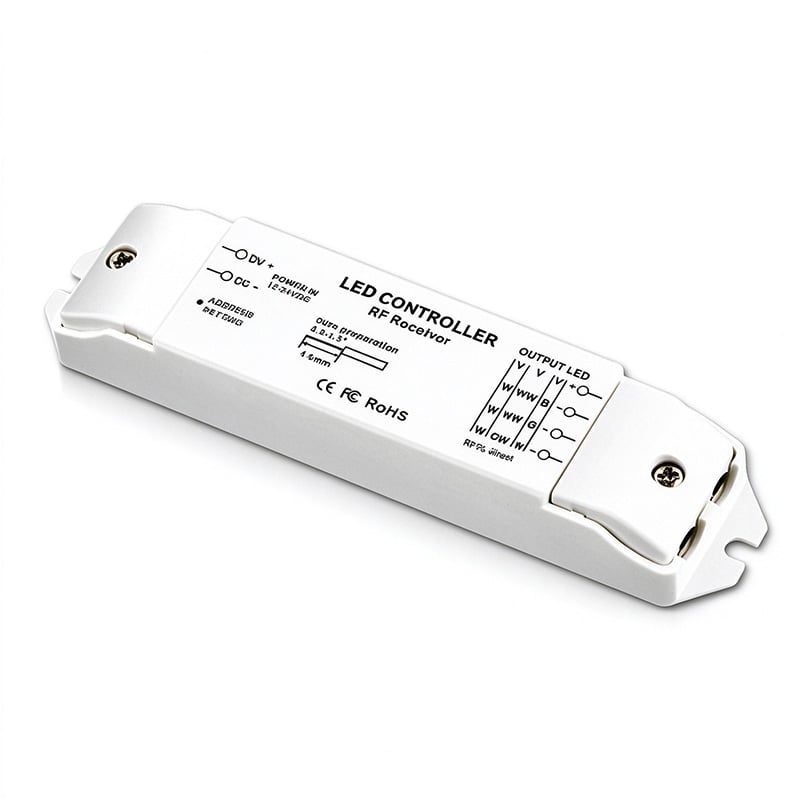
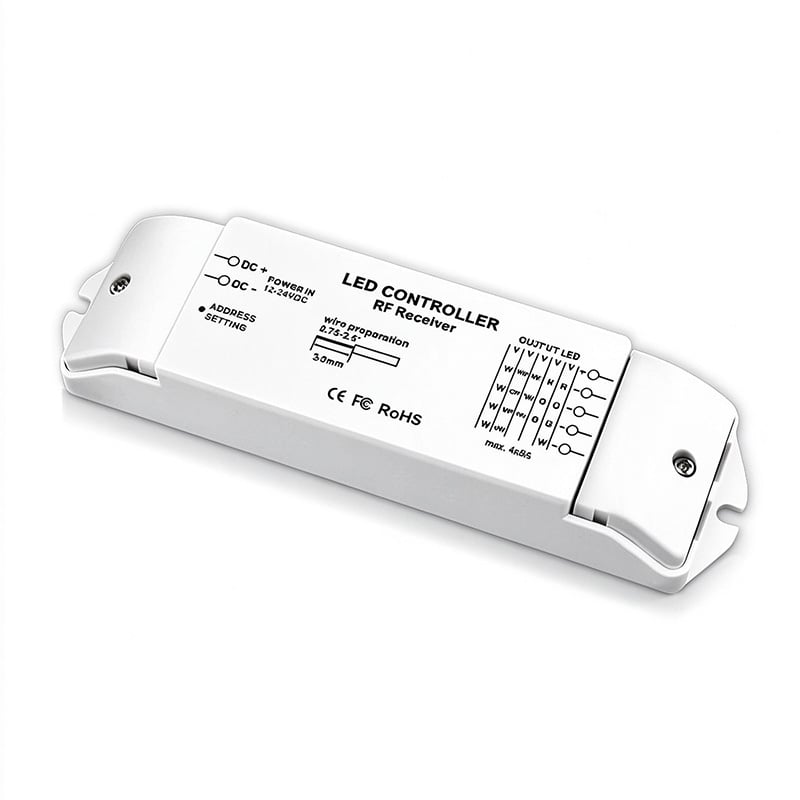


R4-2.4G Wireless 4-Channel LED Light Strip Receiver For PX Panel Remotes

FAQ About Wireless Remote Controllers
Direct answers on pairing, radio frequency range, multi-zone setups, and load wiring from our technical support bench.
Our RF controllers deliver an open-air reception span of 30 m to 50 m, which drops to 10 m to 20 m when cutting through standard drywall and timber framing. If you are running architectural lighting with remote transmitters through reinforced concrete or metal studs, radio waves attenuate rapidly. You do not need line of sight like old infrared units, but avoid mounting the receiver inside a sealed steel electrical enclosure or tucked behind heavy HVAC ducting. Placing the receiver antenna 50 mm clear of surrounding metal surfaces ensures steady reception.
One led lights remote transmitter can control an unlimited number of matching RF receivers simultaneously, provided they are within radio range. For large spaces like hotel lobbies or open-plan retail floors, you can place five or ten receivers across different architectural drops and bind them all to the same zone button. Each receiver interprets the command at the exact same millisecond.
You set up multi-zone led lights with remote transmitters by pairing individual receivers to separate zone keys on models like the T-series or R4M units. Hold the learn key on your living room receiver and press Zone 1 on the remote, then repeat the process in your kitchen cove by pressing the learn key on the second receiver and selecting Zone 2. You get independent color or dimming control for up to four distinct zones, plus a master button that turns all zones off or on together without running cross-room control cabling.
An RF light remote transmits through walls, cabinet doors, and ceilings at 433.92 MHz or 2.4 GHz, whereas an infrared remote requires an unbroken visual line of sight to an optical sensor eye. That means you can conceal an RF receiver completely inside a ceiling coffer, behind baseboards, or inside custom joinery. Infrared controllers stop working the moment you tuck the receiver out of view, and ambient sunlight or TV remotes can trigger false signals. RF gives you clean architectural detailing with zero visible hardware.
Connecting an led with remote receiver requires landing your DC power supply output on the receiver DC+ and DC- input terminals, then connecting your LED strip to the channel screw terminals. For a single-color LED strip, wire the positive lead to V+ and the negative lead to the dimmed negative channel. For RGB or RGBW tape, connect the common positive wire to V+ and land your Red, Green, Blue, and White conductors on their matching negative-switching terminal blocks. Always strip 6 mm to 8 mm of insulation so bare copper seats firmly without touching adjacent screw terminals.
Operating an independent 24V remote light setup in neighboring rooms requires matching each receiver to its own unique digital transmitter address. Our BinColor RF units use 433.92 MHz and 2.4 GHz digital encoding with millions of unique ID codes to prevent cross-talk. If you are outfitting adjacent conference rooms or tenant suites, clear the memory on each receiver by holding the learning button for six seconds until the LED flashes three times, then pair each receiver exclusively to its designated room remote. This stops a neighbor from accidentally dimming your lights through shared partition walls.