
Accent Side Mount Stair Lighting
4 productsInstall lights on the side of stair steps or side walls to extend and accentuate the stairway's step travel path....
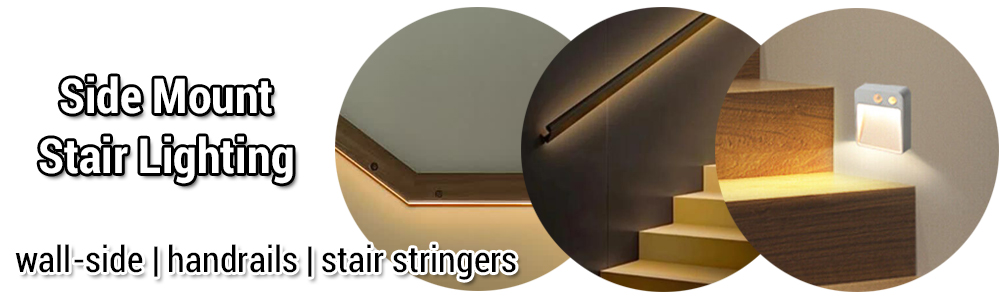
Side-mount stair lighting serves a dual purpose: enhancing safety and creating a sophisticated visual rhythm in your home. By installing lights on the side walls or stringers, you transform a functional staircase into a stunning architectural feature. Most high-quality side-mount stair lights feature IP65 or IP67 waterproofing, making them durable for both indoor elegance and outdoor stairwell safety.
For homeowners, the main dilemma often lies between recessed or surface mount LED fixtures. Recessed stair lights offer a sleek, built-in look but require pre-planning and hole-cutting, whereas surface-mount options provide a "drill-free" solution that is incredibly easy to retrofit. If linear stair side wall lighting or handrail lighting are preferred, it can be directly integrated with stair step lighting if needed, creating a seamless and unified flow of light throughout the entire stairs structure.
Smart Control and Efficient Performance
Modern staircase light designs frequently prioritize PIR motion sensors and sound-light control to ensure illumination only when needed, significantly saving energy. While high-voltage (AC85-265V) stair lights are convenient for direct wiring, low-voltage DC24V stair light systems are often preferred for their safety and compatibility with advanced effects like "running water" white light or chasing RGB colors.
From warm 2700K tones for a cozy ambiance to 6000K for crisp visibility, choosing the right side-mount stair light fixture solves the challenge of balancing aesthetic "wow factor" with practical, glare-free guidance.


3000K Warm White 6000K Bright White Smart LED Stair Lights


Accent Side Mount Stair Lighting FAQ
Your questions about installing and wiring side-mount stair lights, answered by our engineers.
Accent lighting is simply using light to draw attention to a specific feature, instead of just flooding an area with general light. For stairs, an accent side mount stair light creates a visual rhythm, guiding the eye and making the path clear. It turns a basic staircase into a deliberate design element, focusing on safety and style rather than raw brightness.
Neither is 'better' — it just depends on your project. Recessed lights give you that clean, built-in look but require cutting into your wall or stringer, which is easier during a new build. Surface-mount lights are much simpler to retrofit onto an existing staircase since you just run wires and screw the fixture to the surface. No big holes needed.
For most residential jobs, a low voltage (DC24V) side wall stair light system is safer and easier for a DIY install, but you'll need to place an LED driver somewhere to power them. High voltage (AC85-265V) models are simpler to wire into your home's main electrical lines without a separate driver, which can be convenient for electricians. Advanced effects are also more common on DC systems.
A good starting point is to place one light every two or three steps. This provides enough light to be safe. The key is consistency. Also, think about height. Mounting them about 6-8 inches (15-20cm) above the tread of the step is pretty standard and keeps the light focused on your footing.
You need to wire them in parallel. This means each light fixture gets its own direct connection back to the power supply, or you can run a thicker gauge main wire and tap each light off of that. Don't wire them in series (like old Christmas lights). If you do, the voltage will drop with each light, and they'll get progressively dimmer until they don't light up at all.
Generally, no. These are designed as accent and safety lights. They're perfect for navigating the stairs in the dark and adding ambiance, but they aren't meant to replace a main overhead light. They provide enough illumination to see each step clearly, preventing trips, but they won't light up the entire stairwell from top to bottom.
Easy math. Add up the total wattage of all the lights you plan to connect. Your driver's wattage should be at least 20% higher than your total load. So, if you have 10 lights that are 3 watts each (30W total), you'd divide 30W by 0.8 to get 37.5W. You'd need to buy the next size up, probably one of our 40W or 60W DC24V power supplies.
Of course. While we call it a side wall stair light, it's really just a compact, durable fixture. People use them for low-level hallway lighting, lighting up deck perimeters, illuminating toe-kicks in kitchens and bathrooms, or even for some types of sign accent lighting. Anything where you need a small, focused pool of light will work.
They work very well for their intended purpose: lighting up when you approach the stairs. Our smart fixtures like the PIR sensor light are designed to detect the motion of your feet and legs, turning on as you get close and off after you leave. This is great for energy savings and convenience, especially at night. You can find more advanced options in our motion sensor stair kits.