
PWM LED Dimmer
2 sub-categoriesIntuitive Physical Control for Residential and Commercial Lighting
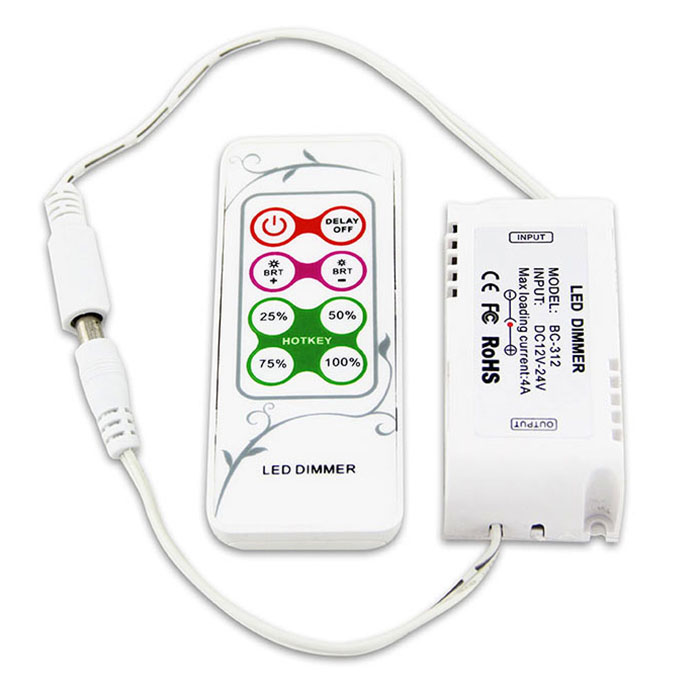
The BinColor PWM LED Dimmer Series provides convenient brightness control for single-color LED strip lights and compatible dimmable LED fixtures. Offering multiple control methods, including wireless remote control, push-button dimming, rotary knob adjustment, and touch-panel control, these dimmers make it easy to adjust lighting brightness through intuitive physical controls.
The series offers a variety of integrated dimmer and controller combinations to suit different installation preferences and lighting configurations:
1. Wireless Remote + Push-Button Dimmers / Standalone Push-Button Dimmers
Combined remote and push-button dimmers allow users to control single-color LED lighting both wirelessly and directly from the dimmer unit. One dimmer can support 1–3 single-color output channels.
2. Wireless Remote + Receiver Systems
An RF wireless remote works with a separate receiver to control 1–4 single-color LED output channels. Depending on the receiver and control configuration, multiple lighting channels can operate together for synchronized dimming or be assigned to separate zones for independent brightness adjustment.
3. Wireless Remote + Rotary / Touch Dimmer Panels
These combinations provide both convenient wireless operation and direct adjustment through a wall-mounted rotary knob or touch panel. They support synchronized dimming of 1–4 single-color output channels. Selected rotary dimmer models also offer adjustable PWM output frequencies up to 8kHz.
4. Touch Panels + Wireless Receivers
This setup combines an intuitive touch wall panel with wireless receivers. A single receiver can support up to 4 single-color output channels, configured for synchronized operation or separate zone control. Compatible touch panels can also be wirelessly paired with multiple receivers, making it possible to control several lighting circuits or expand coverage across different areas.

CV LED Dimmer
BinColor PWM Constant Voltage (CV) LED Dimmers are designed for DC12-24V single-color constant voltage LED strip lights and compatible constant voltage LED lighting fixtures. They use PWM dimming technology to adjust LED brightness smoothly while maintaining a constant voltage supply suitable for the connected lighting products.
Available in various control configurations, including wireless remote control, push-button dimming, rotary knob adjustment, and touch-panel control, these LED strip dimmers offer flexible solutions for different residential and commercial lighting installations.
Depending on the model, you can choose from single-channel or multi-channel dimming options, with synchronized lighting control or independent zone adjustment. They are ideal for LED strip lighting in bedrooms, living rooms, kitchens, cabinets, display areas, and other applications requiring convenient manual brightness control.
Choose a CV dimmer according to your LED lighting voltage, total load current, and required number of control channels.

CC LED Dimmer
BinColor PWM Constant Current (CC) LED Dimmers are designed for dimmable constant current LED fixtures, providing convenient brightness adjustment through PWM control. They are suitable for lighting applications that use constant current LED lighting products and require reliable, straightforward dimming control.
Depending on the model, available control methods include wireless remote control, rotary knob adjustment, and touch-panel control. These options allow users to adjust fixture brightness directly or wirelessly, making it easy to incorporate constant current LED lighting into traditional residential and commercial lighting systems.
Whether you need simple local dimming or more flexible wireless control, BinColor CC PWM dimmers offer practical control solutions for compatible constant current LED fixtures. Select the appropriate dimmer based on the fixture's rated output current, channel configuration, and control requirements.
Best-selling PWM LED Dimmer
21–23 of 23 products

Ideal for Traditional Residential and Commercial Lighting
SuperLightingLED BinColor PWM LED Dimmers are particularly suitable for lighting installations that require simple, reliable, and intuitive manual control rather than app-based or network-dependent operation. Common applications include living rooms, bedrooms, kitchens, hallways, under-cabinet lighting, retail displays, offices, meeting rooms, hotel rooms, and other spaces where users need convenient access to everyday brightness adjustment.
Whether you prefer a handheld RF remote, a simple push-button dimmer, a traditional rotary knob, or a modern touch wall panel, SuperLightingLED BinColor offers flexible PWM dimming solutions for different lighting layouts and control preferences.
FAQ About PWM LED Dimmers
Direct answers to technical questions about pulse-width modulation dimming, wiring limits, frequency selection, and constant voltage versus constant current controls.
An LED strip is pwm dimmable when its brightness is controlled by rapidly switching DC power on and off at full voltage rather than lowering the voltage itself. In analog dimming, reducing DC voltage below the forward voltage threshold causes uneven drop-off, color shift, and premature cut-off around 10% to 20% output. With pulse-width modulation, the LED always runs at its rated 12V or 24V during each 'on' pulse. The controller alters the ratio of on-time to off-time (duty cycle), giving you linear control from 100% down to 0% brightness while keeping color temperature stable across the full spectrum.
Choosing a 24v pwm dimmer comes down to matching your tape's operating voltage, total wattage, and single-zone or multi-zone control needs. Check the amperage rating on the controller terminal block first. For example, a 10A unit running on 24V handles up to 240W of tape, but you should keep continuous load under 192W to leave headroom. If your run uses standard parallel flex tape with built-in resistors, select from our constant voltage dimmers. Pair rotary knobs like the K1 for simple wall-plate operation, or choose an RF receiver pack like the T1+R4 if you need handheld wireless control.
You can wire a pwm dimmer 24v controller directly between a standard non-dimmable DC power supply and your low-voltage LED strip lights. That is the standard wiring method for low-voltage DC dimming. The non-dimmable power supply plugs into your 120V or 230V mains and outputs a steady 24V DC rail into the dimmer's input terminals. The dimmer modulates that DC rail on the output side before it reaches the tape. Do not wire an AC wall dimmer ahead of a non-dimmable driver, as that damages the driver circuitry.
A 24v pwm dimmer rated for 10A can safely handle up to 240W of LED load, though we recommend keeping continuous running load under 192W (the 80% rule). Total capacity equals output voltage multiplied by rated channel amperage. On 12V DC, that same 10A terminal handles 120W; on 24V DC, it handles 240W; and on 48V DC, models like our BC-320-6A handle up to 288W across 6A. When your installation exceeds the controller's rated capacity, do not stack multiple strips onto a single terminal. Add an amplifier to mirror the dimming signal across separate DC feeds.
A constant voltage PWM LED dimmer regulates fixed DC rails like 12V or 24V for standard strip lights, while a constant current dimmer outputs fixed milliamps (such as 350mA or 700mA) for raw LED diodes. Standard tape uses onboard current-limiting resistors, requiring constant voltage. Downlights, spotlights, and bare COB arrays lack onboard resistors and need our constant current dimmers to prevent thermal runaway. Connecting constant voltage tape to a constant current driver will overpower the first section, while connecting bare diodes to a constant voltage rail will destroy them quickly.
A pwm dimmer 24v setup is well suited for bedroom cove lighting because our BinColor units use 4096-step digital scaling for smooth dimming all the way down to 0.1% without stepping jumps. Analog 0-10V dimmers frequently drop out below 10%, cutting off abruptly when you want faint night-light ambience. Pulse-width modulation keeps the current pulses at nominal forward voltage, so phosphor blends remain accurate at 1% output without turning yellowish or shifting color. For cove perimeters, a rotary wall switch like the K1 provides intuitive dial control from resting light to full output.
A PWM LED dimmer does not shorten LED life; in fact, running LEDs at reduced duty cycles lowers junction temperature and extends diode lifespan. Thermal buildup inside the package is the primary cause of phosphor degradation and lumen depreciation over time. When a dimmer reduces duty cycle to 50%, the LED produces half the average thermal energy, allowing the PCB and aluminum channel to dissipate heat more effectively. As long as input voltage does not exceed the tape's design rail (12V, 24V, or 48V), pulse-modulated operation reduces thermal stress.