
RF CCT CC Controller
1 productsThe SkyDance RF CCT CC Controller Series is designed specifically for tunable white constant-current (CC) LED fixtures, providing wireless brightness and color temperature control for dual-white lighting installations. Depending on the current configuration, available output options include 150–500mA and 350–1200mA, allowing the controller to accommodate different constant-current CCT lighting requirements.
A single CC controller supports up to two groups of dual-color CCT lighting through its multi-channel constant-current outputs. Smooth, fine-step brightness adjustment is achieved through PWM dimming, with up to 4096 dimming levels for flicker-free lighting control.
Pair the tunable white CC controller with a compatible SkyDance RF CCT handheld remote or wall-mounted panel remote to adjust the brightness and color temperature of connected constant-current LED fixtures. Multiple CC controllers can synchronize their tunable white lighting operation wirelessly, allowing one compatible CCT remote to operate multiple lighting zones together or manage them as separate zones.
Built-in short-circuit and reverse-polarity protection help protect the controller and connected LED CC fixtures during operation. Each controller is backed by a 5-year warranty, providing added confidence for long-term tunable white constant-current lighting applications.
FAQ About RF CCT CC Controllers
Direct answers to technical questions about wiring, voltage calculation, and fixture compatibility for constant-current tunable white controllers.
An RF CCT CC controller is a constant-current DC-to-DC driver receiver that adjusts the color temperature and brightness of dual-white LED fixtures using 2.4GHz wireless signals. Unlike constant-voltage controllers that output a fixed 12V or 24V rail, a CC controller supplies a tightly regulated current—typically 350mA or 700mA per channel—across a variable DC voltage window. You use it to power bare constant-current LED downlights, tunable white COB spotlights, and specialized dual-channel puck lights that lack internal current-limiting resistors.
Calculate your DC input voltage by adding the maximum total forward voltage (Vf) of your series LED string and adding a 2V to 3V controller drop overhead. For example, if your tunable white fixture has a warm-white circuit with a forward voltage of 36V at 350mA, your DC power supply must deliver at least 38V to 39V DC. If your input voltage is 24V, the controller cannot boost it; the LEDs simply will not illuminate or will strobe under load.
No, an RF CCT CC controller cannot power standard 24V constant-voltage LED strip lights because its output varies voltage to maintain a fixed amperage. Connecting a 24V strip that expects constant voltage will either underpower the tape or cause current runaway that trips the controller. If your project uses standard flexible tape with built-in resistors, choose from our 26 models of RF CCT CV controllers instead.
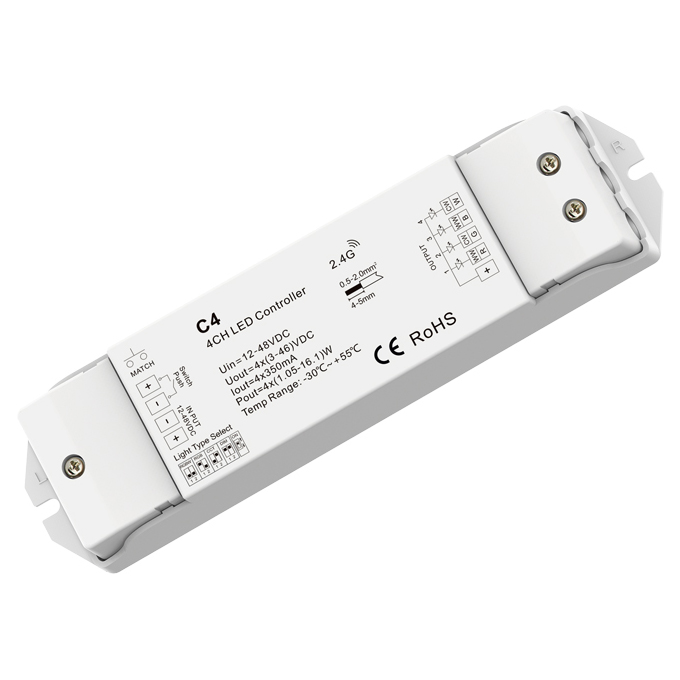
You set the internal DIP switch bank to define whether the 4 output channels operate as two independent tunable white zones or one high-capacity zone. On our 4-channel C4 CC controller, setting the switches to CCT mode assigns Channel 1 and 2 to Warm White and Cool White for Zone 1, and Channels 3 and 4 to Zone 2. When paired with a multi-zone remote, each zone adjusts CCT from 2700K to 6500K independently.
Flashing downlights indicate that the LED string's total forward voltage exceeds the DC input voltage minus the controller's internal drop, triggering open-load or under-voltage protection. For instance, connecting a fixture with a 38V Vf to a 24V power supply causes the circuit to switch on, detect insufficient voltage, shut down, and attempt a restart every second. Verify your fixture's forward voltage spec and swap in a 36V or 48V power supply to give the controller adequate operating room.
An RF CCT CC controller can drive 700mA fixtures if the hardware supports onboard channel bridging or current selection jumpers. On four-channel units set to single CCT mode, you can wire two 350mA channels in parallel to provide a combined 700mA output to one LED circuit, provided the control channels are synchronized in software. Always confirm the fixture's maximum current rating before wiring, because overdriving a 350mA diode with 700mA will cause rapid thermal failure.
An RF CCT CC controller uses 4,096 discrete PWM dimming steps to ensure micro-adjustments in duty cycle, eliminating visible stepping across the low-end dimming curve. Because the switching frequency operates above the shutter speed thresholds of standard video equipment, you avoid the dark rolling bands common on low-frequency dimmers. To understand how PWM curves interact with dual-channel color mixing, review our tunable white lighting guide.
The Push Dim terminal accepts a standard dry-contact momentary wall switch wired between the switch terminal and DC ground. A short press turns the LEDs on or off, a sustained press dims brightness from 1% to 100%, and a double-click shifts the color temperature between warm and cool presets. The controller keeps track of its current state across both the physical push switch and wireless 2.4GHz commands, so neither override disrupts the other.
One RF CCT CC controller can accept pairings from up to 10 wireless remotes, wall touch panels, or WiFi-RF bridges at the same time. To pair a new remote, short-press the controller's match key and immediately tap an on/off or zone button on the remote; the output flashes twice to confirm. To clear all stored pairings after an install error, press and hold the match key for 5 seconds until the status indicator flashes 5 times.