
RF Remote Control
2 sub-categoriesMi Light Remote Control Series. These handheld remotes and wall mount remote controls utilize 2.4GHz wireless RF technology to enable control of LED lights by touch. All are battery powered for simple control and installation.
2.4GHz RF technology enables seamless communication between mi-light remote and LED lights, providing users with an easy and efficient way to adjust brightness, color and other lighting settings.
Note: These remotes need to be compatible with Mi light 2.4GHz series controllers to control the LED lights.
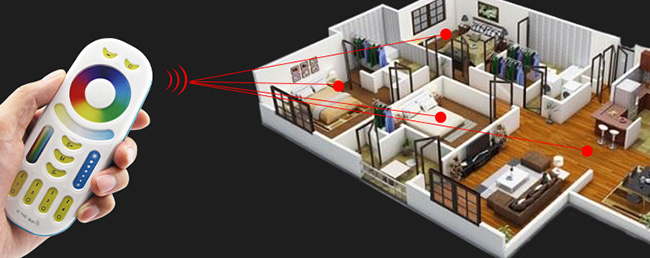
Handheld RF Remote Control
Enjoy convenient wireless lighting control with MiBoxer (Mi-Light) handheld RF remotes. Designed for compatible MiBoxer 2.4GHz RF lighting systems, these battery-powered remotes let you adjust your lights without adding control wiring. Depending on the model, features include intuitive push-button operation, rotary dimming controls, touch-sensitive color selection, and multi-zone control. With a specified wireless control distance of up to 30 meters for compatible models, they are a practical choice for everyday residential lighting and many indoor commercial applications.
Compatible with MiBoxer RF LED Controllers & Lighting Fixtures
MiBoxer handheld RF remotes can be paired with compatible MiBoxer RF LED controllers, including single-color dimmers, CCT tunable white controllers, RGB 4CH controllers, RGBW 5CH controllers, RGB+CCT 6CH controllers, and 5-in-1 multi-mode controllers. Some remotes also support specific SPI addressable LED lighting control systems, so be sure to check the compatibility information for your intended controller.
These remotes can also operate compatible MiBoxer RF-enabled lighting fixtures, including LED bulbs, spotlights, downlights, magnetic track lights, and linear lights.
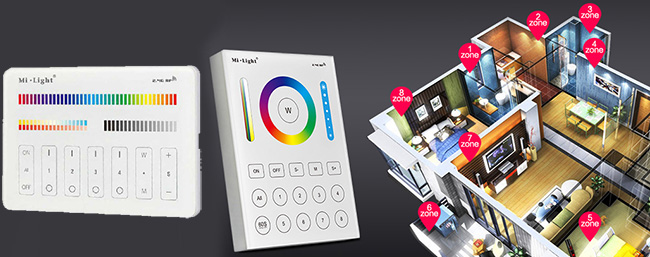
Wall Panel RF Remote Control
Bring convenient, wall-mounted wireless lighting control to your home or commercial space with MiBoxer (Mi-Light) RF wall panels. Combining the familiar accessibility of a traditional wall switch with the flexibility of 2.4GHz RF communication, these panels let you control compatible LED lighting from a designated location without running a dedicated signal cable between the panel and the lighting receiver. Depending on the model, available designs include touch-sensitive panels, push-button switches, and rotary dimming controls, offering different ways to operate your lighting system while maintaining a clean, modern interior.
Compatible with MiBoxer RF Controllers & Wireless LED Lighting
MiBoxer wall panel remotes are designed for compatible MiBoxer wireless LED controllers and compatible MiBoxer lighting fixtures both with supported built-in RF receivers. Depending on the selected model and its supported lighting functions, they can be used with single-color LED strips, tunable white CCT lighting, RGB/RGBW/RGBCCT color-changing lights, and SPI addressable LED systems.
Always confirm that the selected wall-mount LED panel remote supports your specific controller or lighting product.
Best-selling RF Remote Control
61–64 of 64 products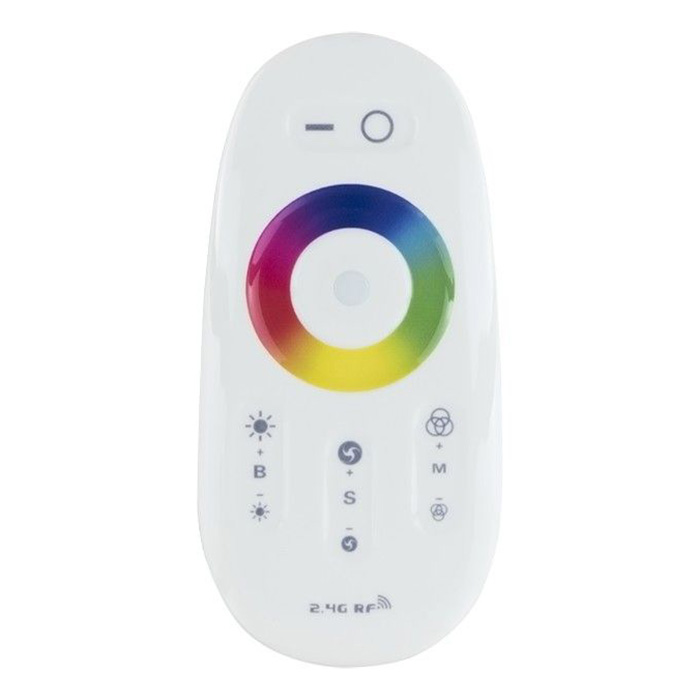
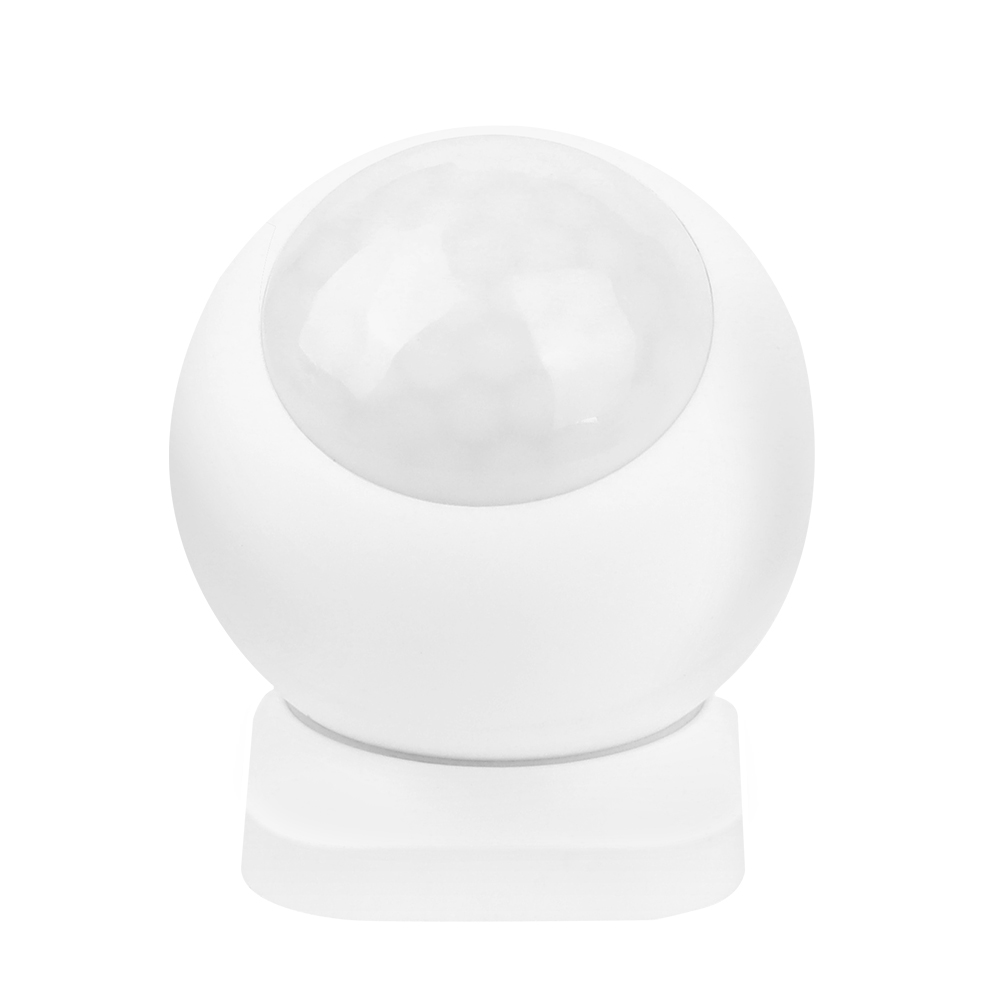

Compatibility with MiBoxer (Mi-Light) Wireless Lighting Systems
MiBoxer (Mi-Light) remote controls are designed to work with compatible MiBoxer wireless LED controllers and receiver-equipped lighting products. They provide convenient wireless control of LED strip lights and other supported lighting fixtures without requiring a direct wired connection between the remote and the controlled device.
Please note that these remotes are not universal LED controllers. Compatibility depends on the specific remote, controller or receiver, and communication protocol. Sharing the same 2.4GHz frequency does not automatically guarantee compatibility with other brands or every MiBoxer product. Before purchasing, verify that your remote is supported by the controller or lighting product you intend to operate.
Check Remote Compatibility, Lighting Modes & Zone Support
Different MiBoxer (Mi-Light) remotes are designed for different lighting applications and control requirements. Depending on the model, supported lighting types may include single-color, tunable white (CCT), RGB, RGBW, RGBCCT, or SPI addressable LED lighting. Some remotes offer simple brightness adjustment, while others provide color selection, color temperature tuning, or multi-zone lighting control.
Before choosing a remote, check its compatible controller models, supported lighting modes, number of control zones, and pairing instructions. A multi-zone remote does not automatically make every connected controller independently controllable by zone; the controller and remote must support the intended configuration. Refer to the individual product specifications and user manual to ensure the remote matches your lighting system.
Convenient Wireless Control for Multi-Zone LED Lighting
From compact handheld remotes to wall-mounted wireless control panels, the MiBoxer (Mi-Light) remote control range offers flexible solutions for everyday lighting management. Depending on the model, users can switch lights on or off, adjust brightness, change colors or color temperature, and control multiple lighting zones from a convenient wireless interface.
2.4GHz RF models offer a specified control distance of up to 30 meters, making them suitable for many residential and indoor commercial lighting applications. Actual wireless performance may vary depending on the installation environment, obstructions, nearby interference, and battery condition. For reliable operation, follow the model-specific pairing instructions, use the recommended batteries, and keep the remote within the effective transmission range of the receiver.
Product spec sheets & downloads
FAQ About RF Remote Control
Direct answers to the most common RF remote control wiring, pairing, range, and multi-zone layout questions we receive on our support desk.
A 2.4 G RF remote control sends omnidirectional radio frequency signals at 2.4 GHz, so you do not need line-of-sight to the receiver. Infrared remotes require an unobstructed direct line to an optical sensor, which fails the moment you hide your power supply inside a cabinet or behind crown moulding. With 2.4 GHz RF, the transmission passes through standard 1/2-inch drywall, wood framing, and glass across a 30 m open-air radius. Just keep in mind that steel enclosures and foil-faced insulation will act as a Faraday cage, attenuating the radio signal by 15 dB or more. If you mount your RF LED controllers inside a metal distribution box, always route the antenna lead outside the cabinet.
A 2.4 G RF remote control will generally not pair with third-party receivers because 2.4 GHz lighting systems use proprietary data framing and GFSK modulation schemes. While brands like SkyDance, LTECH, and MiBoxer all broadcast within the unlicensed 2.400–2.4835 GHz band, their wireless sync timing words and command structures are incompatible. A MiBoxer C5 remote cannot communicate directly with a SkyDance receiver or an off-the-shelf Tuya Zigbee module without a dedicated gateway. If you are retrofitting existing LED strip lights, verify that your remote transmitter and your receiver share the identical 2.4 GHz protocol family before installing hardware.
An RF remote control operates on either a single 3V CR2032 lithium coin cell or two standard 1.5V AAA alkaline batteries. Because these remotes stay in an ultra-low sleep state drawing under 20 microamps until a capacitive touch ring or physical switch is pressed, a set of AAA batteries typically delivers 12 to 24 months of daily residential operation. Rotary models like the K0 and K3S consume slightly more current during active dialing but maintain negligible standby draw. If you notice the transmission indicator LED dimming or operational range dropping below 10 m, swap the cells before troubleshooting your receiver hardware.
When a 2.4 G RF remote drops signal short of its rated 30-meter range, the culprit is usually radio interference or physical shielding rather than a failing battery. Crowded 2.4 GHz Wi-Fi routers operating on channels 1, 6, or 11 can congest the band if your LED strip receiver sits within 1 m of the access point. Solid masonry, wire lath plaster, and steel studs also cut transmission distance down to 8 to 12 m. Fortunately, MiBoxer controllers feature built-in signal auto-transmitting: one receiver will re-broadcast the RF packet to another receiver located within 30 m, effectively extending your control across entire commercial floors without signal boosters.
When an RF remote control commands multiple receivers running dynamic color fades, slight microprocessor clock drift causes individual LED strip sections to drift out of sync over time. Every wireless controller operates on an internal quartz crystal resonator with a tiny manufacturing tolerance of around 20 to 50 parts per million. After 10 to 15 minutes of continuous fade cycles, one LED strip section inevitably cycles a fraction of a second faster than the next. MiBoxer receivers solve this via auto-synchronization: as long as receivers are within 30 m of each other, they synchronize dynamic steps dynamically. If yours drift, ensure one receiver is within 30 m of the next to maintain the mesh link.