
RF RGB Control System
5 sub-categories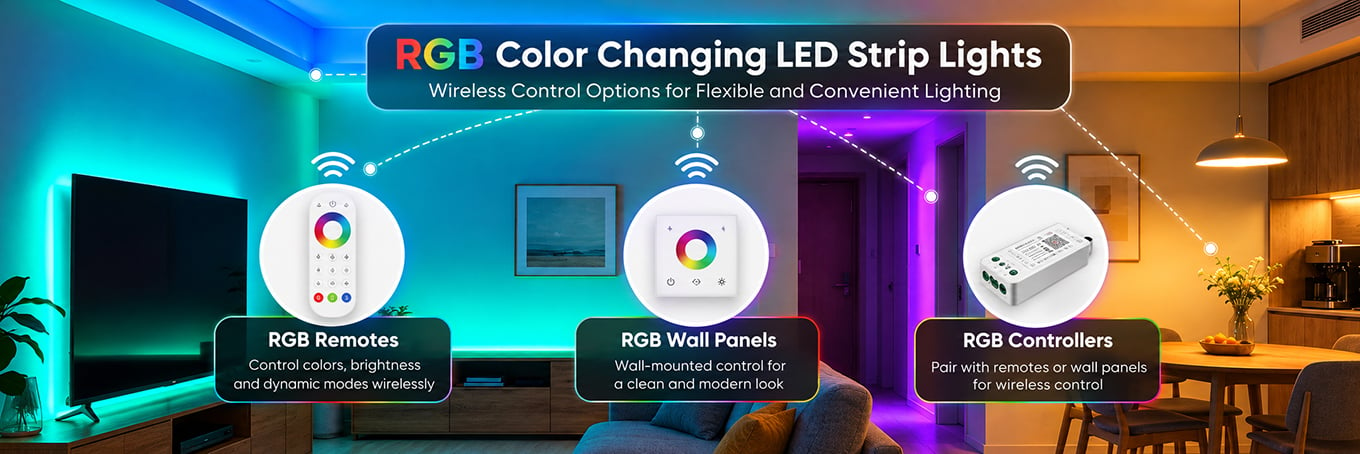
The SkyDance RF RGB Control System is a wireless color control solution designed for both constant-voltage (CV) RGB LED strip lights and constant-current (CC) RGB LED fixtures. Built around 2.4GHz RF wireless communication, the system brings together compatible RGB controllers, wireless handheld remotes, and wall-mounted panel remotes to provide flexible control of different RGB lighting installations. Selected models and compatible smart control devices also combine RF with other wireless technologies, including Wi-Fi, Zigbee, and Bluetooth, offering additional options for smartphone and smart home integration.
Unified Wireless Control for CV and CC RGB Lighting
Whether you are installing constant-voltage RGB LED strips or constant-current RGB fixtures, SkyDance offers wireless RGB control solutions for both lighting types. Pair compatible CV RGB controllers, CC RGB controllers, and RF wall panels with the appropriate SkyDance RGB handheld remotes or wireless panel remotes to manage your connected lighting.
Depending on the RGB controller and remote configuration, you can turn lights on and off, select static colors, adjust brightness, activate dynamic color-changing effects, recall scenes, and organize lighting into different control zones.
Automatic RF Signal Transmission and Extended Wireless Coverage
SkyDance RF RGB controllers and remotes support automatic wireless signal cascading. When an RGB controller receives an RF command, it can automatically forward the signal to other compatible nearby RGB controllers, allowing multiple lighting units to remain synchronized without individual wired control connections.
With a typical RF transmission distance of up to 30 meters between compatible devices under suitable conditions, this cascading function can extend wireless control coverage across larger color-changing lighting installations. Multiple RGB controllers can therefore operate together through a compatible handheld remote or wall panel, making the system suitable for coordinated lighting across multiple rooms and areas.

RF RGB CV Controller
The SkyDance RF RGB CV Controller Series is specifically designed for constant-voltage (CV) RGB LED strip lights and fixtures, offering a variety of voltage options to suit different lighting installations. Depending on the model, available input and output voltage configurations include DC 5–24V, DC 12–24V, DC 12–36V, DC 12–48V, and AC 110–240V.
For more advanced lighting control, smart RF RGB controller models combine 2.4GHz RF with additional wireless technologies such as Wi-Fi, Zigbee, standard Bluetooth, and Casambi Bluetooth Mesh, which can also be operated through their corresponding compatible APPs or smart control systems.
Wireless RGB Light Control with SkyDance RF Remotes and Wall Panels
Pair these RGB controllers with compatible SkyDance RF RGB handheld remotes or RGB wall-mounted panel remotes to conveniently manage your RGB strip lighting wirelessly. Using 2.4GHz RF communication, these RGB LED controllers support wireless operation within a range of up to 30 meters under suitable conditions.
Multi-Remote Pairing and Wireless Controller Synchronization
Each Skydance RF RGB controller can be paired with up to 10 RF remotes/panels, allowing multiple users to operate the same lighting installation from different locations. Multiple RF RGB controllers can also synchronize wirelessly, making it possible to coordinate RGB LED strip lighting across different areas using compatible remotes or wall panels.

RF RGB Remote Control
The SkyDance RF RGB Remote Control Series is specifically designed for compatible SkyDance constant-voltage (CV) RGB controllers and constant-current (CC) RGB controllers, providing convenient handheld wireless control for different RGB LED lighting installations.
With a compatible 2.4GHz RF handheld remote, you can select static RGB colors, adjust brightness and color saturation, switch lights on or off, and explore dynamic color-changing modes with adjustable effect speeds. Depending on the remote model, additional functions include scene selection and multi-zone lighting control, giving you greater flexibility to customize your RGB lighting experience.
SkyDance also offers RF PIR motion-sensing products that can serve as independent wireless control devices for compatible RGB tape lighting systems. When someone passes through the detection area, the sensor can trigger the connected lighting to turn on automatically and switch it off after a preset delay when motion is no longer detected. This is particularly useful for hallways, stairways, entrances, and other areas where lighting is only needed when people are present.
One Remote for Multiple RGB Controllers and Lighting Zones
Within a wireless range of up to 30 meters in unobstructed conditions, a single compatible RF RGB handheld remote can operate one or multiple RF RGB controllers. Choose a single-zone remote to control paired lighting units together, or select a multi-zone model to manage different RGB lighting areas independently.
SkyDance offers 1-zone, 2-zone, 4-zone, and 8-zone remote options to accommodate different installation layouts. Each zone can be paired with multiple compatible controllers, allowing you to synchronize RGB lighting throughout an area or adjust individual zones separately from the same handheld remote.

RF RGB Panel Remote Control
The SkyDance RF RGB Panel Remote Control Series offers independently powered wall-mounted wireless control for compatible SkyDance constant-voltage (CV) and constant-current (CC) RGB controllers. Depending on the model, these RGB LED panels are powered by AC line voltage, low-voltage DC, or batteries. They communicate with compatible RGB controllers through 2.4GHz RF wireless pairing, allowing you to control your RGB LED strip lighting from convenient wall locations without running control wires between the panel and the receiver.
Available in touch-sensitive glass and rotary knob designs, these RF panels provide convenient access to essential RGB lighting functions. You can switch lights on or off, adjust brightness, select static RGB colors, fine-tune color saturation, and customize dynamic color-changing effects and their operating speeds. Zone and scene-selection functions are also available.
Wall-Mounted Wireless RGB Lighting Control
A single SkyDance RF RGB panel remote can be paired with multiple compatible RGB controllers, allowing several RGB LED strips or fixtures to operate together through one wall-mounted control point. Multi-zone panels provide additional flexibility by letting you operate different groups of RGB strip lighting independently or synchronize them when needed.
For automatic lighting applications, SkyDance also offers RF PIR motion-sensing products that work as independent wireless control devices. When motion is detected, the sensor sends a wireless command to activate compatible RGB lighting. Once the area is no longer occupied, the lights can automatically turn off after the configured delay.
**Wireless Remote Installation Notice:** When an RF RGB panel is paired and used as a wireless remote, it functions as a control transmitter and does not directly power or output lighting signals to the LED load. The connected RGB LED strips or fixtures must be driven by a separately installed, compatible SkyDance RF RGB controller.

RF RGB CC Controller
The SkyDance RF RGB CC Controller Series is designed specifically for wireless control of constant-current (CC) RGB LED fixtures. Unlike constant-voltage RGB controllers, these units deliver 150-500mA or 350-1200mA three-channel PWM constant-current output to independently control the red, green, and blue LED channels. With DC 12V, 24V, 36V, and 48V input options, they provide a flexible control solution for different constant-current RGB lighting installations. The CC controller can be configured for RGB operation through its built-in DIP switch, with 4096-level PWM dimming for smooth and precise color and brightness adjustment.
Wireless Pairing with SkyDance RF RGB Remotes
Pair these CC RGB controllers with compatible SkyDance RF RGB handheld remotes or wall-mounted panel remotes to operate your connected constant-current RGB fixtures wirelessly. One controller can accept pairing with up to 10 compatible RF remotes, allowing convenient lighting control from different locations.
Multiple SkyDance RF RGB CC controllers can work together through 2.4GHz RF wireless communication, allowing you to coordinate RGB lighting across different fixtures and areas. Use compatible remotes to operate multiple controllers together or organize them into separate lighting zones for independent color and brightness control.
For added installation flexibility, the CC RGB controller also supports an external Push switch for wired on/off and 0–100% dimming operation. Built-in short-circuit and reverse-polarity protection help safeguard the controller and connected LED fixtures.

RF RGB CV Dimmable LED Driver
1. AC100-240V input, DC12/24V output, 3 channel PWM constant voltage output.
2. Output power 40-150W.
3. Dimming interface: RF Wireless, AC Push-Dim.
4. The same control function as Skydance RF RGB constant voltage controller.
5. Built in 10 dynamic mode, include jump or gradual change style.
6. Over-heat / Over-load / Short circuit protection, recover automatically.
7. 5 Year, 50,000hr warranty.
Best-selling RF RGB Control System
61–74 of 74 products


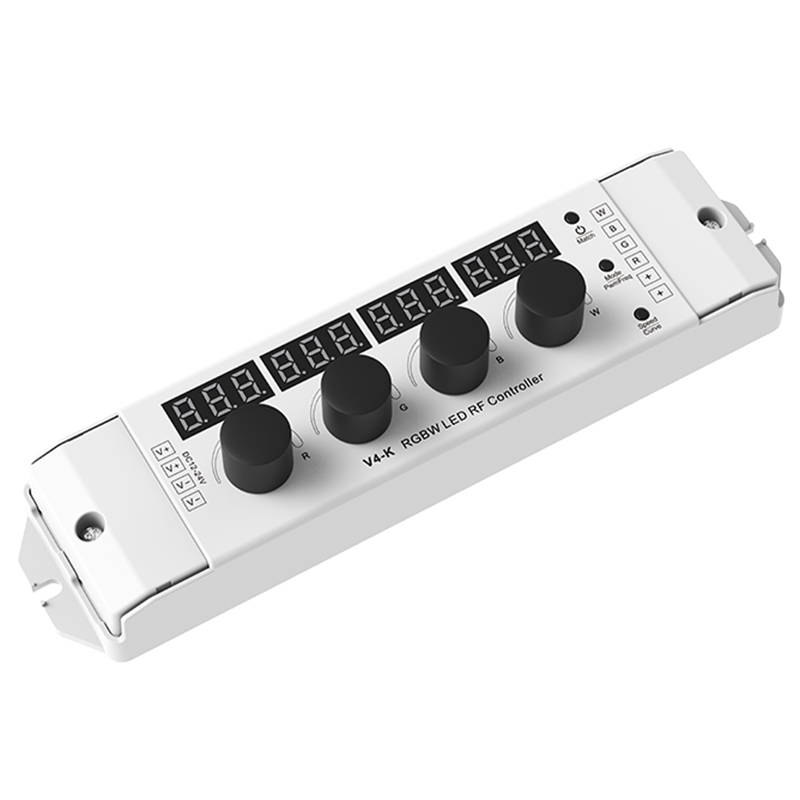


40W 12VDC CV RF&Push-Dim 3CH DIM/CCT/RGB LED Driver PB-40-12-3

FAQ About RF RGB Control Systems
Clear answers on wiring, pairing, signal range, and capacity for 2.4 GHz RF RGB controllers and remotes.
When colors appear swapped on an RGB LED controller, it almost always means the negative channel output wires are crossed at the terminal block. Common-anode strip wiring uses a black or white lead for positive (+), followed by individual negative returns labeled R, G, and B. If your remote button for green turns the strip red, swap the R and G output wires at the receiver terminals. Diodes will not blow from this wiring mix-up, but the color mixing tables will remain backward until corrected.
The maximum length of RGB LED strip lights one RF receiver can drive depends on total amperage rather than reel length. A standard 3-channel receiver rated at 4A per channel delivers 12A total, which translates to 144W at 12V or 288W at 24V. For a typical 24V RGB tape drawing 14.4 W/m, one receiver safely powers roughly 16 meters before hitting its rated threshold. When your run exceeds that load, install power repeaters down the line instead of overloading the controller's internal MOSFET switches.
Unsynchronized dynamic effects between separate RGB LED strip lights happen when receivers are assigned to different zones or sit outside the 30-meter RF mesh hop. When multiple controllers share the same remote zone, each unit automatically forwards the 2.4 GHz signal to the next within 30 meters, keeping color-fade modes synchronized across hundreds of meters. If one room falls out of step, check whether thick concrete partitions or metallic ducting are blocking the signal hop between neighboring receivers.
You do not need two separate power supplies because the RF RGB controller shares the exact same constant voltage DC line as your RGB LED strip lights. The DC power supply connects straight to the DC+ and DC- input terminals on the receiver, which uses a tiny fraction of a watt to operate its internal 2.4 GHz logic board. The controller then switches the incoming voltage through its output terminals via pulse-width modulation, eliminating extra auxiliary power supplies.
Yes, you can cut RGB LED strip lights, but only straight across the marked copper cut pads spaced every 50 mm to 100 mm along the PCB. Cutting between these designated solder pads severs the internal trace circuit and leaves the surrounding segment dark. For permanent, vibration-proof junctions on commercial installs, strip 5 mm of insulation and solder 20 AWG or 18 AWG 4-conductor wire directly to the copper tabs, following our RGB wiring guide for proper polarity alignment.
Connecting an RF RGB controller to an AC wall dimmer will destroy the receiver's microchip because constant-voltage RF controllers require clean, unchopped DC power. Standard TRIAC or ELV wall switches work by clipping the AC sine wave, which causes the controller's switching components to overheat and fail. If you want wall control, keep your AC driver fed with switched, non-dimmed mains power and pair a wireless glass touch panel like the T3-K or TW4 to adjust colors and brightness over 2.4 GHz RF.
The main difference between constant voltage and constant current RF RGB controllers is how they regulate output power to the diodes. Constant voltage models (12V, 24V, or 36V) feed flexible strip lights that already have surface-mount current-limiting resistors soldered along the PCB tape. Constant current units (like 350mA or 700mA outputs) drive architectural downlights, high-power spotlights, or specialized linear fixtures without onboard drivers. Pairing constant voltage strips with a constant current driver will burn out the tape within seconds.
Signal cascading on an RF RGB controller works by automatically rebroadcasting incoming 2.4 GHz RF commands from receiver to receiver. Every matched controller acts as an active signal repeater, extending control range another 30 meters to adjacent units without requiring central antennas or repeaters. This creates an automatic wireless mesh across large open ceilings, long commercial corridors, and perimeter coves, allowing one handheld remote or wall panel to control runs spanning hundreds of meters reliably.