
RF Triac Dimmer Kits
4 productsSkyDance RF TRIAC Dimmer Kits are specifically designed for wireless control of TRIAC-dimmable lighting. Each kit includes either one or four compact TRIAC dimmer modules paired with a handheld touch or button remote control, providing a convenient wireless lighting control solution without the need for a separate wall-mounted dimmer.
The handheld remote allows you to turn connected lights on or off, adjust brightness smoothly, and manage individual zones or multiple lighting groups. Depending on the TRIAC dimmer kit configuration, you can also use preset lighting scenes for quick access to your preferred lighting levels. The touch and button remote options offer intuitive operation for different control preferences.
Compact TRIAC Dimmer Modules for AC Lighting
These mini TRIAC dimmer modules support AC 100–240V input and output, making them suitable for a wide range of compatible dimmable AC lights, incandescent lights, high-voltage Halogen lamps, and TRIAC CC or CV drivers. Supported load capacities range from 150W to 360W. Their compact design makes them easier to integrate into suitable wiring locations and existing AC lighting installations.
The modules also support an external push switch, providing an additional wired control option alongside wireless remote operation. This allows users to control lighting through either the handheld RF remote or a compatible external push switch.
Wi-Fi-enabled models offer additional control through a compatible smartphone app, also support integration with compatible smart home systems, providing greater flexibility for line-voltage lighting control and automation.
**Note:** TRIAC dimming is designed for compatible AC dimmable lighting loads. Always check the dimming method, load type, voltage, and maximum wattage of the selected module before installation to ensure compatibility. Explore more SkyDance TRIAC dimmers.
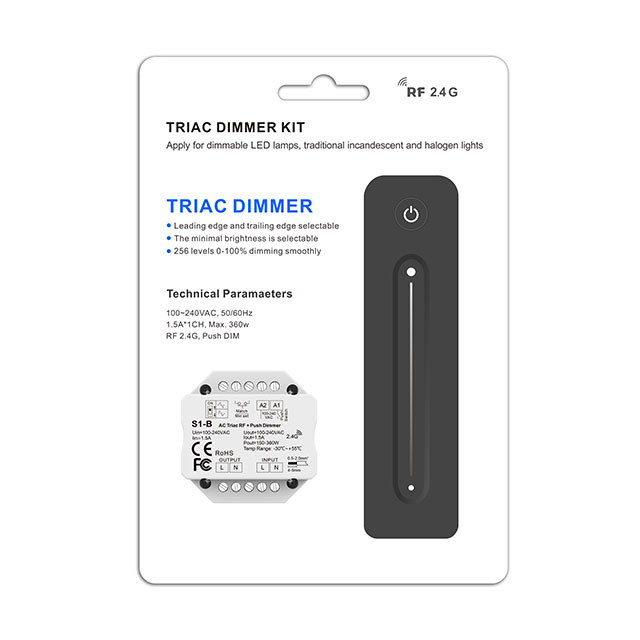
RF AC Triac Dimming Set S1-B+R11: Wall Mounted LED Light Control
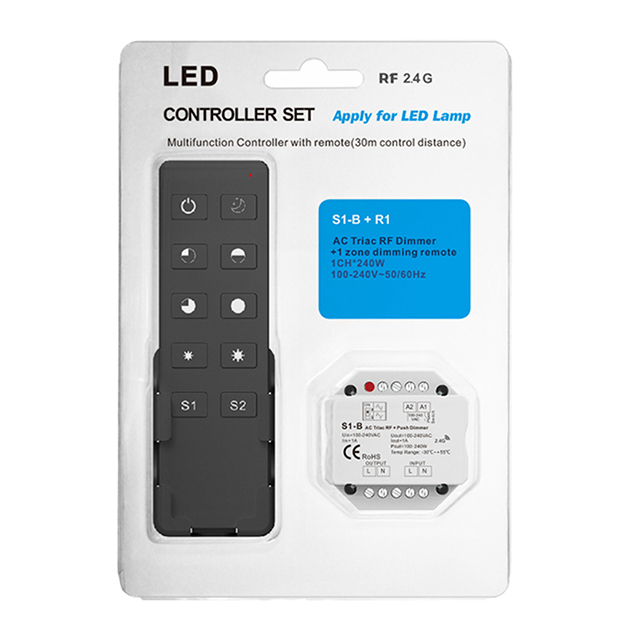
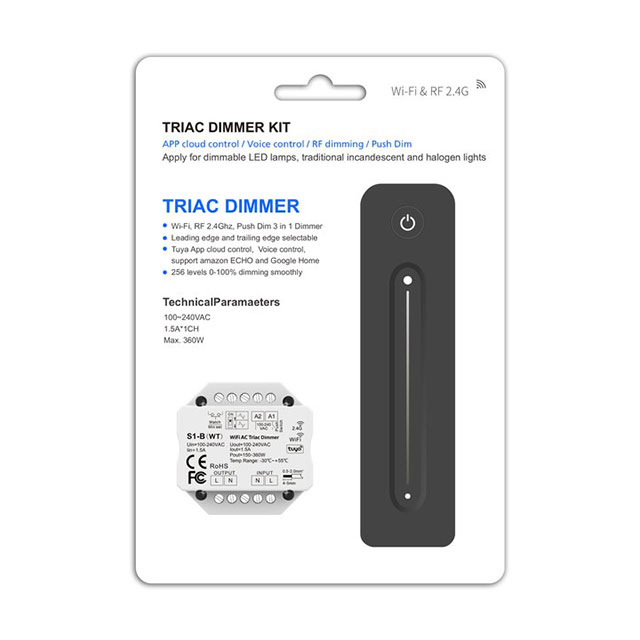
Tuya WiFi AC Triac Dimmer Set S1-B(WT)+R11 | Smart LED Control
FAQ About RF Triac Dimmer Kits
Clear answers from our technical bench on phase-cut dimming, driver pairing, wiring limits, and wireless range.
An RF Triac dimmer kit controls line-voltage AC lighting loads, running directly on AC 100–240V mains power. Unlike low-voltage DC controllers that output 12V or 24V PWM, the S1-B receiver in these kits sits on your line voltage wiring and modulates the AC sine wave using phase-cut dimming. It is built to dim TRIAC-dimmable AC LED drivers, line-voltage LED fixtures, and legacy incandescent or halogen bulbs up to 1.2A. The bundled handheld remote talks to the module over 2.4GHz RF from up to 30 m away, giving you smooth wireless dimming without having to pull control wires back to a wall box.
Every RF Triac dimmer kit in our range carries a 1.2A current ceiling on its receiver. At 120V AC, that translates to a maximum theoretical load of 144W, while at 230V AC it handles up to 288W. For resistive loads like traditional halogen or incandescent lamps, you can run right up to those limits. With capacitive loads like dimmable LED drivers or AC LED bulbs, inrush current is significantly higher, so we advise keeping your continuous load under 150W at 230V or under 100W at 120V to prevent triac thermal shutdown and ensure long-term reliability.
Setting the phase-cut mode on an RF Triac dimmer kit takes five seconds using the dip switch on the face of the S1-B module. Moving the dip switch toggles the internal circuit between leading-edge (forward phase) and trailing-edge (reverse phase, or ELV) dimming. Most modern electronic dimmable LED drivers and dimmable retrofit LED lamps prefer trailing-edge dimming because it avoids the high current spikes that cause audible buzzing. For older magnetic low-voltage transformers or inductive ballasts, set it to leading-edge. For deeper technical details on waveforms, check our TRIAC dimming guide.
Low-end flicker almost always happens because the dimmer's output voltage drops below the minimum operating threshold of the connected LED driver. The S1-B receiver inside our kits includes a physical 'Min Set' button right on the case to eliminate this issue. To calibrate it, dim your lights down to the lowest level where they remain steady and flicker-free, then press the Min Set key for two seconds. The light will flash once to confirm. From that point forward, 1% on your handheld remote stops at your calibrated floor instead of plunging the circuit into unstable dropouts.
Yes, an RF Triac dimmer kit can directly dim 110V to 240V AC LED strip lights as long as the strip is explicitly built with a TRIAC-dimmable internal circuit. Because driverless AC strip lights plug straight into mains voltage, the S1-B module wires in series between the AC breaker and the strip's power connector. Make sure the total wattage of your continuous AC tape run stays within the 1.2A rating (under 120W on 120V systems, or 240W on 230V systems). For runs exceeding that draw, divide the installation across multiple synchronized S1-B receivers.
You can wire any standard momentary push-button switch directly to the 'Push' and 'L' terminals on the receiver module. A short press turns the lights on or off, while a long press smoothly ramps brightness up or down. The receiver shares its internal state between the wired push switch and the RF remote, so adjustments made at the wall update the module instantly without desyncing your handheld controller. This gives you physical wall control for visitors and family members alongside the wireless handheld remote.
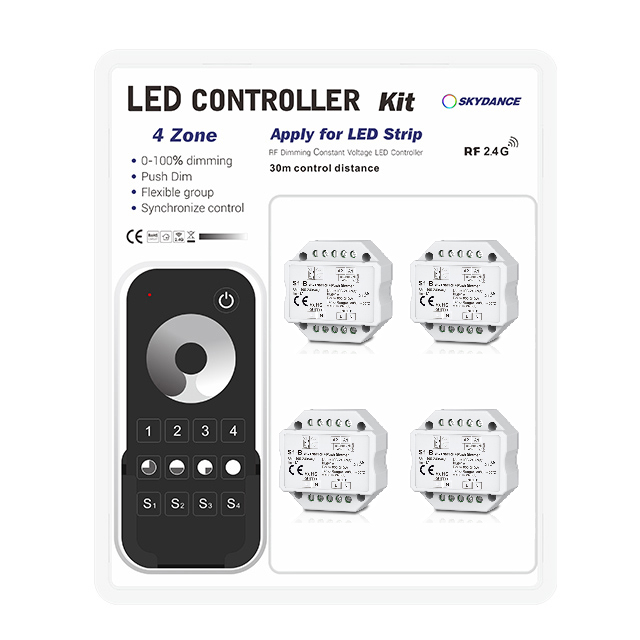
You can manage up to four distinct lighting zones from a single handheld transmitter using the RT6 four-zone kit. That kit pairs four independent S1-B dimmer receivers to one RT6 remote control. During setup, you tap the match key on receiver number one and press Zone 1 on the remote, then repeat for Zones 2 through 4 on the other modules. You can dim each zone separately—such as ceiling coves on Zone 1 and under-cabinet dimmable drivers on Zone 2—or adjust all four simultaneously using the master buttons.
The S1-B receiver measures 52 mm wide, 52 mm long, and 26 mm deep, designed to fit inside standard European 60 mm round wall boxes or deep American single-gang junction boxes. In standard 40 mm deep boxes, space will be tight once you factor in wire nuts and 14 AWG building wire. We recommend using a deep 60 mm back box or tucking the module inside the ceiling junction box directly beside the dimmable LED driver, where there is adequate air volume for heat dissipation.
In our WiFi-enabled S1-B(WT) kit, local RF remote control and wired push dimming continue working completely unaffected if your home internet goes offline. The WiFi chip inside the S1-B(WT) communicates with the Tuya cloud for app and voice commands, but the 2.4GHz RF link to the paired R11 remote runs on direct local peer-to-peer radio. Your handheld remote and physical push buttons will switch and dim the load with zero delay even if your internet router is completely unplugged.
You can wire as many fixtures as you like in parallel, provided their combined steady-state current does not exceed 1.2A and combined wattage stays below 150W at 230V or 100W at 120V. In practical terms, that means you can comfortably run up to ten 10W dimmable LED downlights or two 60W TRIAC-dimmable strip drivers on one receiver. Exceeding ten to twelve individual LED driver loads on a single module is not recommended, because the cumulative inrush currents when switching on can trigger the receiver's internal thermal fuse.