
Sensor Series
4 sub-categories

Within the complete SuperLightingLED™ LED control ecosystem, the Skydance Sensor Series is designed specifically for sensor-based lighting control. By integrating infrared, motion, hand-wave, touch, door, and microwave sensing technologies, these LED controllers and units add hands-free convenience, energy efficiency, and enhanced safety to LED strip lighting in cabinets, ceilings, closets, stairs, and architectural spaces.
How to Choose the Right Sensor Controller for Your LED Strip Lighting?
SuperLightingLED™ offers two flexible ways to add sensor-based control to your LED strip lighting system, allowing you to choose the solution that best fits your project needs.
Option 1: Integrated Sensor Dimmers & Controllers
This type of LED dimmers and controllers features built-in sensing functions such as PIR motion, hand-wave, touch or door detection. Ideal for compact installations where simplicity and quick setup are priorities, such as under-cabinet or closet lighting.
Option 2: Controllers with External Sensor Units
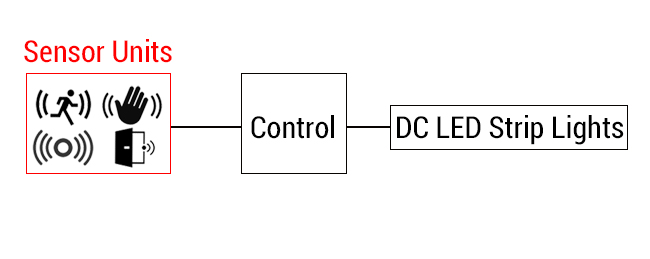
For more customized or advanced LED strip applications, SuperLightingLED™ also offers controllers that support external sensor heads. This approach allows you to place sensors separately from the controller, providing greater flexibility in detection range, mounting position, and application scenarios.

Sensor Dimmer
Dimmable Occupancy Sensor is led detecting lighting control device that combines switching and dimming functions. Occupancy sensor dimmer automatically turns LED lights on and off and adjusts the brightness level based on compatible sensor types in the form of motion detection, hand swipe, touch, or door opening and closing.
You can adjust the light level and color temperature as needed to enhance lighting comfort with a 0%-100% adjustable brightness range. The light can stay on for up to 180 seconds or even 600 seconds after the sensor is triggered. After the human body leaves the room, the light turns off directly or maintains a low level of illumination when necessary. For rooms with plenty of daylight, the included daylight sensor can prevent the lights from being triggered during the day.
Dimming occupancy sensor supported modes:
- Lights always on
- Lights off
- Auto-sensing: lights come on only when sensed, then go off or stay low
Passive infrared PIR sensitivity up to 2-5 meters (6.56-16.4ft), 3-6 meters (9.84-19.7ft), or 4-7 meters (13ft-23ft)
Sensor Switch
Occupancy Sensor Switch is energy efficient, flexible, and requires no manual operation compared to traditional light switches, the built-in sensor allows LED lights to be turned on and off automatically through passive infrared action, microwave signals, hand gestures, door opening and closing, and other operations.
Using passive infrared sensor helps save energy when the room doesn't need to be illuminated all the time, for example, when you walk into the office, the lights are on, and when you walk out, the lights automatically turn off. By installing occupancy sensor light switch in ceiling or wall locations, the detector can correctly detect your presence and react quickly to the lights.
Multiple passive infrared motion sensors can be linked, and when one is triggered it will automatically synchronize to the other sensors in the area, while causing the lights to turn on throughout this area.
- Microwave sensor with high sensitivity and accuracy, suitable for commercial workspaces
- Supports both low voltage and line voltage operation
- Supports 0-10v and PWM lighting systems and dimming

Sensor Remote Control
The SkyDance Sensor Remote Control Series is specifically designed for wireless sensor operation with compatible SkyDance RF controllers and drivers. Unlike conventional sensors that directly switch or power LED lighting, these independent wireless sensors function as remote control transmitters, sending RF signals to paired controllers to trigger lighting actions automatically.
Wireless Sensors for Different Detection Applications
This series offers several sensor remote types to suit different lighting environments and automation needs, including microwave motion sensors, microwave human presence sensors, PIR motion sensors, and multifunction hand-wave and door sensors. Each sensor type provides a different way to trigger lighting based on movement, human presence, hand gestures, or door activity.
To build an automatic lighting setup, connect your LED strip lights to a compatible SkyDance RF controller. Then pair the appropriate sensor remote with the controller. When the sensor detects movement, human presence, a hand-wave gesture, or a door opening or closing, depending on the sensor type, it sends a wireless command to trigger the connected lighting.
This setup allows your LED lighting to respond automatically to everyday activities, making it suitable for applications such as cabinets, closets, hallways, staircases, offices, and other spaces where hands-free or occupancy-based lighting control is preferred.
**Important:** When act as wireless RF control transmitters, these sensors shouldn't have any output for the lighting, and they're only compatible with SkyDance RF controllers and modules.

LED Cabinet Lighting Control Series
The SkyDance LED Cabinet Lighting Control Series is specifically designed for sensor-activated lighting in cabinets, shelves, closets, and other furniture applications. These compact control modules provide up to six synchronized low-voltage output ports for connecting multiple LED strip lighting runs, and support a combined maximum load of up to 60W across all outputs. Depending on the model, they support either single-color LED strips or tunable white CCT LED strips with 2-wire connections.
Flexible Sensor Options for Different Cabinet Lighting Needs
These CV-Series controllers are compatible with a variety of sensor heads (buy separately), allowing you to choose the detection method that best suits your installation. Available options include PIR motion sensors, hand-sweep sensors, door contact sensors, touch sensors, and concealed wood touch sensors.
Whether you want the light strips to turn on when a cabinet door opens, when someone approaches, or when you wave your hand near the sensor, you can select a suitable sensor head for convenient hands-free or touch-activated lighting control.
All connected shelf lighting outputs can respond together to the same sensor trigger, making it easy to illuminate multiple shelves or cabinet sections simultaneously.
RF Remote and Smart Control Options
In addition to sensor-based operation, selected models offer RF wireless remote control, Wi-Fi or Zigbee smart control, allowing you to adjust the lights using a compatible SkyDance RF dimmable handheld remote, dimmable in-wall panel remote for single color lights, and CCT handheld remote, CCT panel remote for tunable white lights, or through Tuya-compatible app control and voice control to integrate cabinet lighting into your smart home routine.
Best-selling Sensor Series
1–20 of 55 products


E1-L+EB/EB(C) 12-48VDC 8A Hand Sweep Sensor LED Dimmer


What Is a Sensor Lighting System?
A sensor lighting system is an intelligent lighting solution that automatically controls LED lights based on human presence, movement, gestures, or environmental changes.
Unlike traditional wall switches, sensor-controlled strip lighting responds instantly to real-world interaction, offering benefits such as reduced energy consumption, improved daily convenience, enhanced safety in low-light environments.
Sensor lighting is especially effective in spaces where hands-free operation or automatic control is preferred.
Types of Sensor Controls in the Skydance Sensor Series
-
Infrared Motion Sensors (PIR)
Detect human infrared radiation and activate lighting when movement is sensed.
Ideal for cabinets, closets, and walk-through areas.
-
Motion Tracking Sensors
Trigger lighting based on movement patterns or direction, providing responsive illumination for dynamic spaces such as hallways or staircases.
-
Hand-Wave & Gesture Sensors
Allow users to turn lights on or off with a simple hand motion.
Perfect for kitchens and workspaces where touch-free control is essential.

-
Door Sensors
Automatically switch lighting on or off when doors or cabinet panels open or close.
Commonly used in wardrobes, display cabinets, and storage units.


-
Microwave Sensors
Use high-frequency signals to detect motion through non-metallic materials, offering higher sensitivity and wider detection coverage.

Typical Applications of Sensor Lighting
-
Cabinet and closet lighting for automatic illumination when doors open
-
Ceiling and corridor lighting for hands-free navigation
-
Night lighting that gently turns on in dark environments
-
Security and safety lighting in stairways, hallways, and entrances
By responding to motion or presence, sensor lighting improves visibility while avoiding unnecessary power usage.
FAQ About SkyDance Sensor Series
Direct engineering answers on wiring, load limits, sensor placement, and cabinet integration for our low-voltage sensor switches and controllers.
An LED strip dimmable sensor like the EB-V(C) or EB-CV(L) handles both on/off switching and stepless PWM dimming through hand gestures. Hold your hand 1 to 6 cm beneath the optical head to ramp brightness smoothly from 10% to 100%, or do a quick wave to switch power. The EB-CV(L) runs at a 2000Hz PWM frequency to prevent visible camera flicker, supporting up to 4A (96W on 24V).
A PIR sensor for LED lights detects moving body heat and requires an unobstructed line of sight, whereas a 10.525GHz microwave sensor penetrates thin non-metallic barriers like wood, glass, and drywall. PIR models like our ER-A recessed head sit flush in cabinetry to monitor open doorways, while microwave units like the EH-M(WZ) can mount completely hidden inside a false ceiling or wardrobe soffit.
An integrated ambient light sensor measures ambient daylight in lux and blocks movement triggers whenever room lighting exceeds the set threshold. Controllers such as the EV-R and E1-RS keep your 12V or 24V LED strip lights completely dark until ambient illumination drops below roughly 10 to 30 lux, saving power in sunny rooms and staircases.
Wire an LED strip dimmable sensor on the DC low-voltage side, placed directly between the constant voltage power supply output and your LED strip lights. Never place these low-voltage sensors on the 110V/230V AC line feeding your driver. Connect DC+ and DC- from your 12V or 24V driver to the sensor input terminals, then wire your LED strip to the output side, paying close attention to polarity.
Optical door sensors false-trigger when high-gloss cabinet interiors reflect infrared light back into the detector receiver. Our ED-V(C) and ED-CV(D) switches rely on beam interruption within an 8 to 10 cm sensing window. If dark wood absorbs the beam or a high-gloss white finish bounces it erratically, place a small piece of matte white tape opposite the sensor head to give the infrared receiver a clean reflection.
Controllers like our ES32-V and ES24 use dual PIR sensors mounted at the top and bottom risers to detect entry direction and fire each step sequentially. The controller runs 5V to 24V constant voltage LED strip lights across up to 32 individual channels at 1A per step. When a person steps onto the bottom tread, step one illuminates, followed by step two and three in a smooth cascade. Check our stair light installation guide for exact sensor riser heights and wiring schematics.
Yes, the ES-V controller manages dual-color 3-wire tunable white LED strip lights from 12V to 48V using external sensor inputs. Across the 54 live models in our sensor series, we stock dedicated CCT-compatible sensor receivers that dim brightness and preserve your chosen color temperature balance. You can connect PIR motion heads, door sensors, or EB-C hand sweep heads to the same controller, adjusting single-color or dual-white strips with zero flicker.
Capacitive touch dimmer heads like the EC-A work through non-metallic surfaces, but maximum material thickness is strictly limited to 3mm to 5mm. If you mount a touch sensor behind 20mm quartz, marble, or solid oak, it will not register fingertip capacitance. For thick solid surfaces, core drill a 10mm pocket from the underside to leave a 2mm veneer face, or switch to an infrared hand-sweep sensor head flush-mounted with the cabinet frame.
Yes, you can parallel multiple door sensor switches to control one long run of cabinet LED strip lights using a synchronous distribution hub. In a four-door wardrobe run, wiring multiple ED-V(C) or ED-CV(D) heads to a master unit from our cabinet lighting controllers turns on the interior LED strip lights whenever any single door opens. The lights fade off smoothly over 1 second only after all doors are fully shut.