
How to choose high quality LED Strip Lights?
Judge an LED strip by its specification, not by its photo. Before you order, check six things:
- Voltage: the strip, the controller and the power supply are all 12V or all 24V.
- Watts per meter: size the power supply so the strip uses no more than 80% of it.
- LED chip and LEDs per meter: a denser strip gives a more even line of light and more lumens.
- CRI: above 80 for homes and hotels, Ra 90–100 for shops, galleries and color checking.
- Color temperature in Kelvin: compare the number, not the name, and buy one job from one batch.
- IP rating: IP20 or IP65 indoors, IP67 or IP68 outdoors.
How do you tell a good LED strip from a poor one? At SuperLightingLED our answer is always the same: read the numbers. Every figure that decides how a strip will look and how long it will last is on the product page. This guide gathers the checks from our buying guides, wiring library and warranty terms into one table, and shows where to find each number.
LED strip quality checklist: what to check before you buy
Work down the table before you add a strip to the cart. Field names can differ slightly from one product page to the next; the product data sheet (PDF) under “Downloads” on each product page repeats the same details for printing.
| What to check | Why it matters | Where to see it on our product page |
|---|---|---|
| Working voltage | The strip, controller and power supply must all be the same voltage: a 24V adapter on a 12V strip burns it out. | The “Select Operating Voltage” option, and “Input Voltage(V)” in the “Product Specification”. The voltage is also marked on the strip itself. |
| Watts per meter | Total power = watts per meter × length. The strip should use no more than 80% of the power supply; a supply sized below the strip wattage overheats and switches itself off. | “Working Power” in the Product Specification. The wattage is not marked on the strip, so check it here. |
| LED chip and density | Density is the number of LEDs on the strip. Each SMD LED lights a 120-degree angle, so the denser the strip, the more uniform the light. Our buying guide calls 30–72 LEDs low density, 72–120 medium and above 120 high. | “LED Quantity” and “LED Chip” or “LED Strip Type” in the Product Specification, and usually in the product name. |
| Lumens (brightness) | Lumens per meter = lumens per LED × LEDs per meter. Each chip type has approximate lumens, but individual strips differ, and high density with high lumens needs more power and more heat dissipation. | “Lamp Luminous Flux(lm)” in the Product Specification where it is listed, or the product data sheet. |
| CRI (Ra) | How truly colors look under the light; sunlight is 100. Above 80 protects eyesight; Ra 90–100 is excellent color rendering. The higher the CRI, the lower the brightness. | “CRI (Ra>)” in the Product Specification. |
| Color temperature | Measured in Kelvin: the lower the number, the warmer the white. Names differ between guides, so compare the Kelvin value. LED strips have light decay, so buy all reels for one space from the same batch. | The “Select Light Color” option, for example Warm White(3000K), and “Light Color” or “Color Temperature” in the Product Specification. |
| Cut marks and pads | Cut only on the marked line: every 3 LEDs on a 12V strip, every 6 LEDs on 24V; on a 5V strip the cutting unit is one LED. The copper pads either side are the connection points, marked + and -. | “Dimension” or “Cut Length” in the Product Specification, for example “every 3/6 PCS LED can be cut”. |
| Run length and voltage drop | Fed from one end, a 12V strip stays even up to 5 m and a 24V strip up to 10 m. Beyond that the far end dims and white turns yellow: add feed points, or choose a constant current strip, which has no voltage drop over long distances. | The “Select Length” option. For long runs, see our ultra-long constant current LED strips. |
| IP rating | IP20 and IP65 strips are used indoors, IP67 and IP68 outdoors; a swimming pool needs IP68. Waterproof strips are 2–3 mm wider and thicker than the bare IP20 strip. | The “Select Waterproof Rating” option and “Water Proof” in the Product Specification. |
| Warranty | Our warranty page: “Warranty length follows the certification the product carries, not the price you paid.” UL / ETL certified products: 3 years; selected brand products: 5 years; all other products: 1 year. | “Warranty” in the Product Specification or a “Select Warranty” option where shown; full terms on our warranty page. |
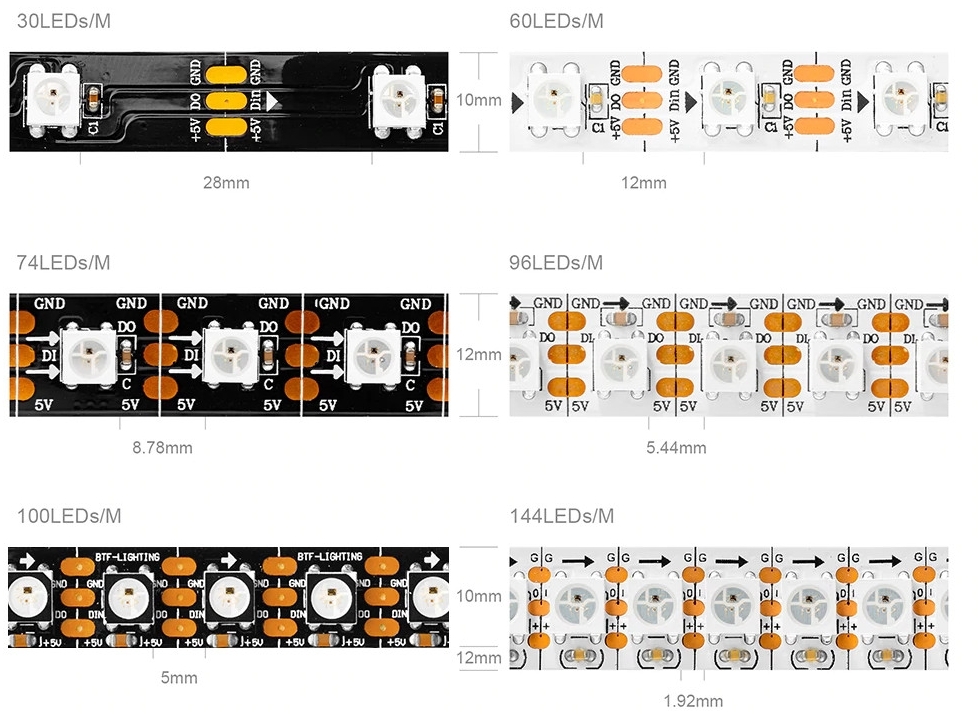
Want the background to each row? The IP ratings, LED chips and voltages are explained in top 6 considerations before buying LED strip lights, and how an LED strip works in everything you need to know before buying LED strip lights.
Reading the numbers: a worked example
Take the example from our wiring library, a 5 m, 24V strip rated at 14.4 W per meter:
- Strip power: 5 m × 14.4 W/m = 72 W.
- Power supply: add 20–30% headroom so the supply is not running flat out: 72 W × 1.25 = 90 W, so choose a 100 W supply.
- Current: 90 W ÷ 24 V = 3.75 A. The controller and the wire must carry that current too.
- Feed cable: 60 W is 5 A at 12 V but only 2.5 A at 24 V, so 24 V allows about four times the cable length on the same wire gauge. Thin cable drops volts before the strip even starts, and warm white turns yellow.
Try your own figures in our LED strip power calculator. If a seller cannot tell you the watts per meter, you cannot size the power supply at all.
Cut marks, 12V vs 24V, power supply and cable: four diagrams
Drawn by the SuperLightingLED engineering team; wire colors follow our house convention (red V+, black V-/GND). Click a diagram for the full notes in our LED strip wiring diagrams library.
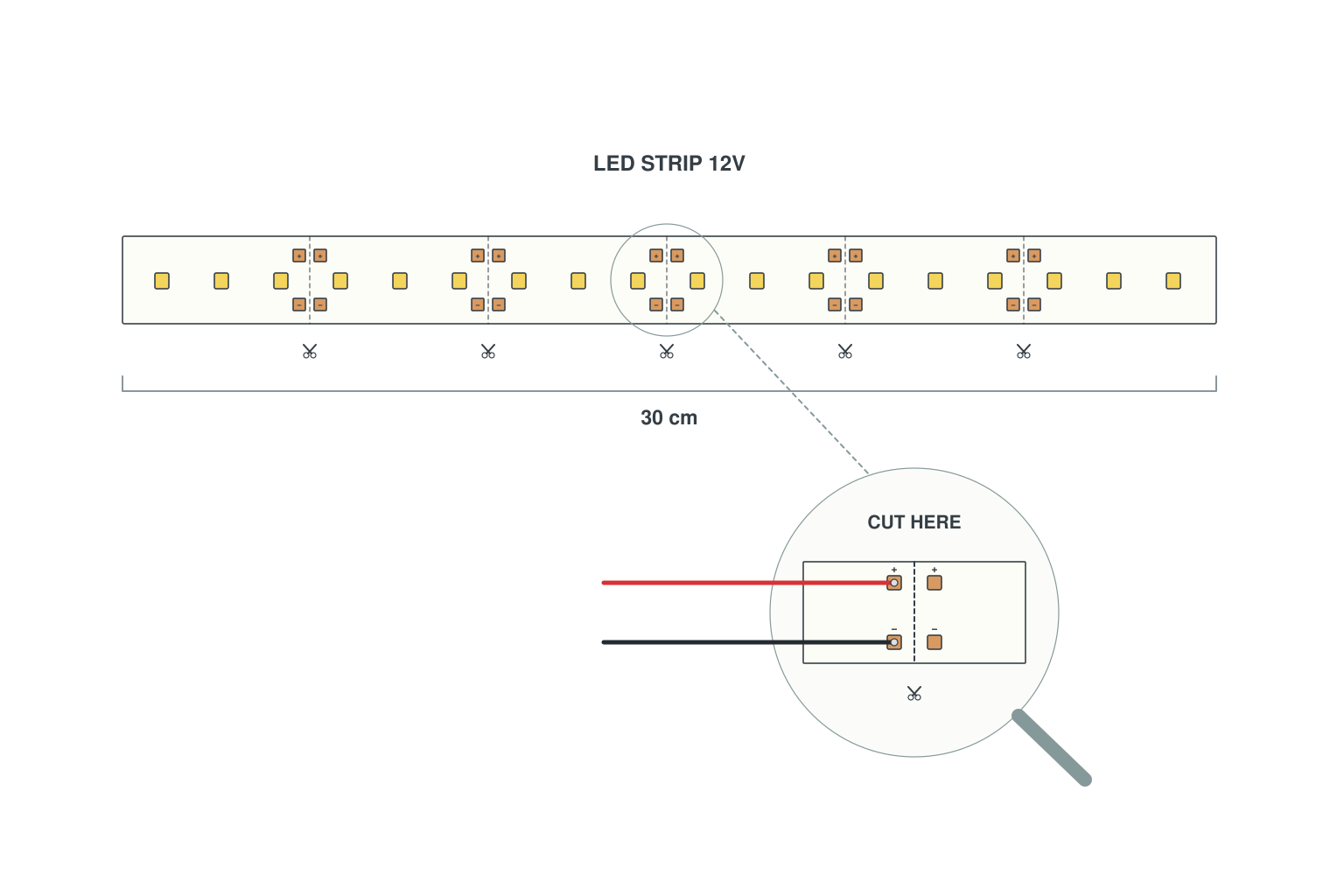
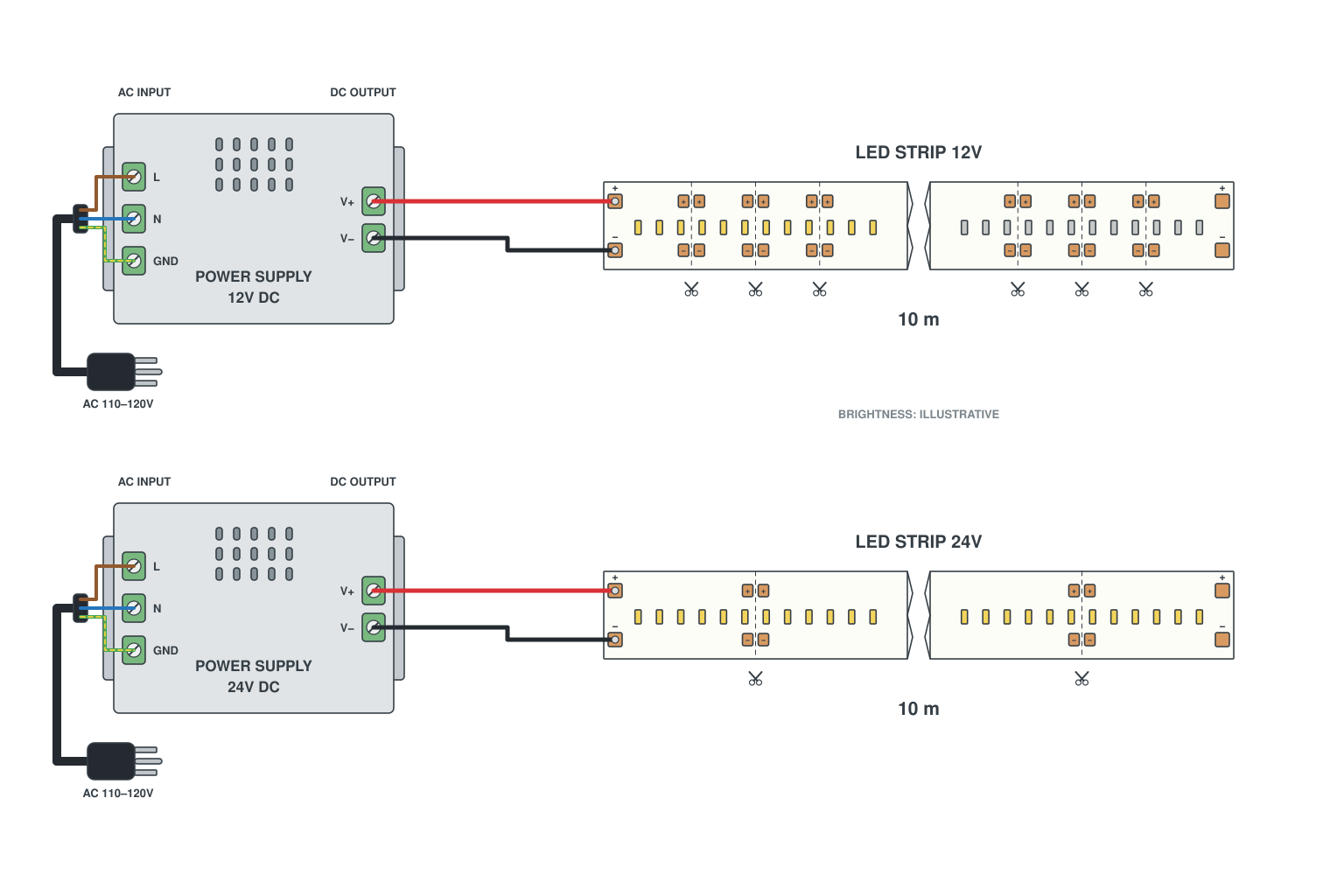
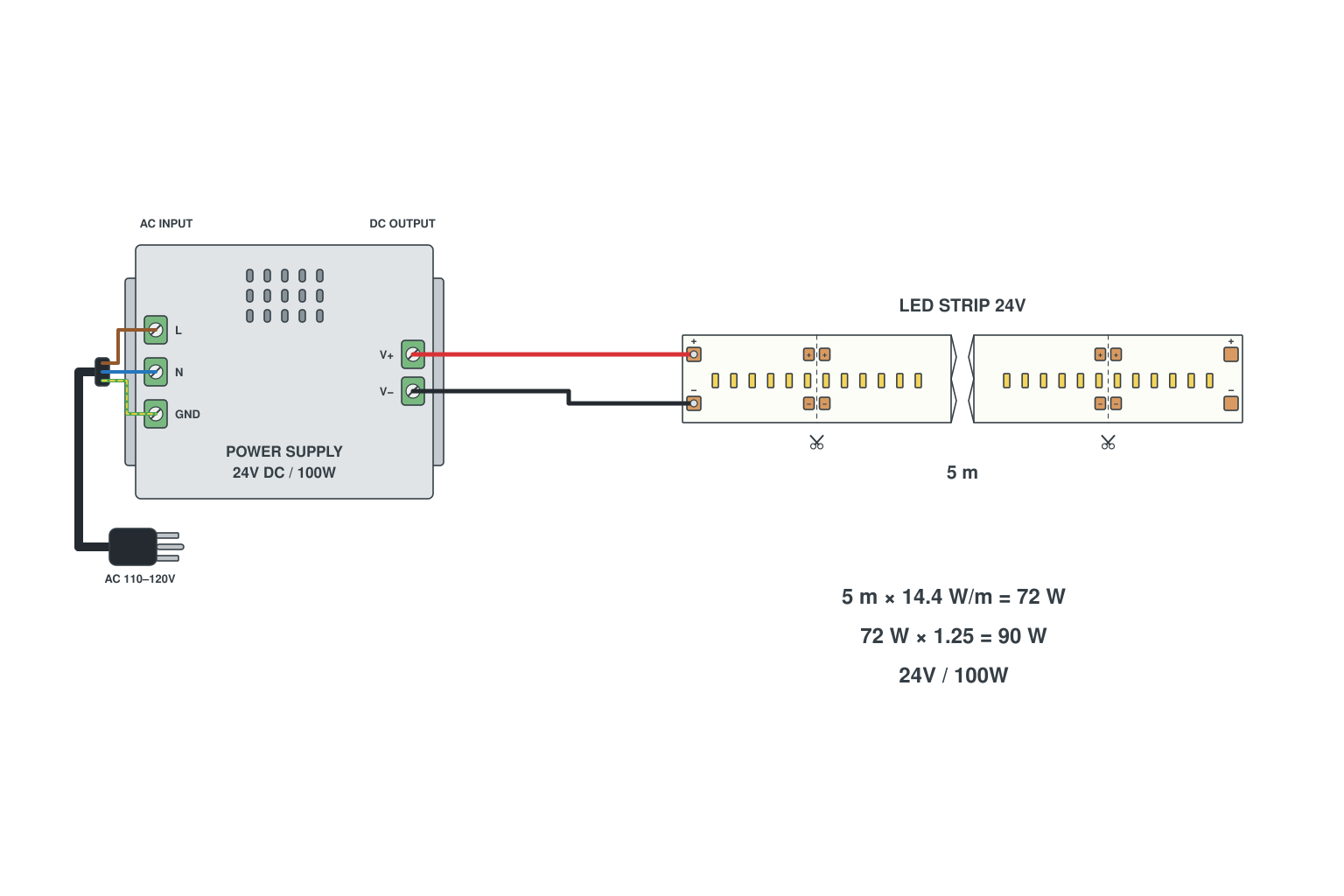
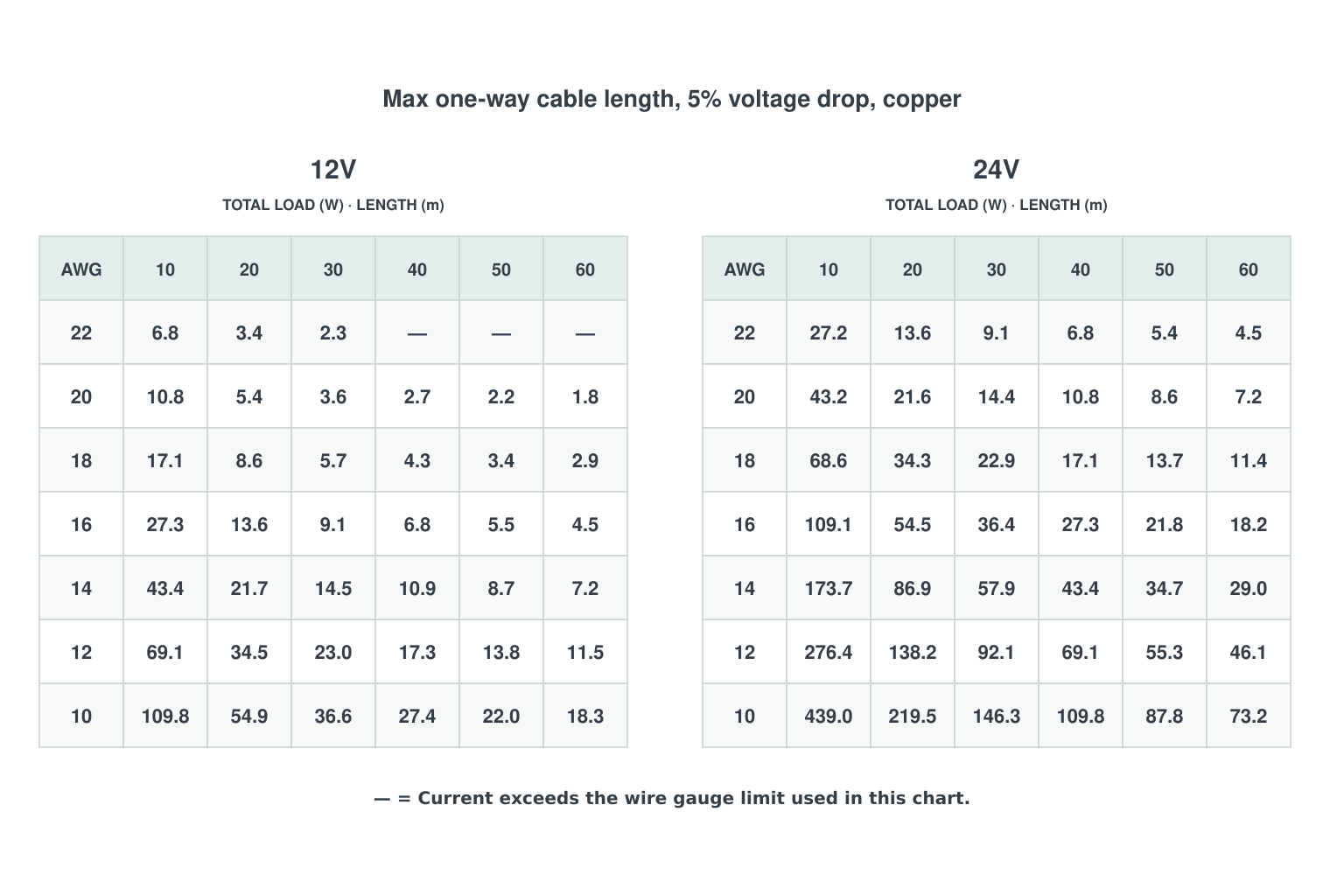
Wiring a plain white strip step by step: how to wire single color LED strip lights.
Light quality: CRI and color temperature
Two numbers decide whether the light itself looks right. Each has its own guide on our site; here are the short versions.
CRI: how true the colors look
CRI compares the color of an object under the light with its color under a reference light source. Sunlight is defined as 100, and LED strips can now reach CRI 95. For homes and hotels choose above 80; for shops, restaurants, galleries and color checking choose Ra 90–100. Red goods such as meat also need a high R9 value. Higher CRI costs some brightness: CRI 85 is the common balance, and for CRI 90 with high brightness our CRI guide suggests constant current LED strips. Full guide: what is color rendering index.
Color temperature: how warm or cool the white is
Warm white is 2800K–3200K, neutral white 4000K–5000K, daylight white 6000K–6500K and cool white 7000K–9000K. LED strips have light decay: a 6000K strip may read 4500K a few months later, so reels bought at different times can look different side by side. Full guides: what is color temperature and warm white vs pure white vs cool white.
If your job is one continuous run, say so on the order. In the words of our warranty page: “We ship a project from one batch whenever you tell us it is one continuous run”
What our warranty covers, and what it does not
Quality also means knowing what happens if something fails. From our warranty page:
Covered: free replacement or refund
- “Dead or flickering LEDs out of the box”
- “Colour or CCT clearly outside the ordered specification”
- “Water ingress on a fixture used within its rated IP class”
- “Wrong item, wrong length or wrong option shipped by us”
Not covered: treated as installation damage
- “Wrong voltage, or a LED driver without enough headroom for the load”
- “Cutting outside the marked cut points, or re-soldering by hand”
- “Running a fixture outside its rated environment”
Each line in the second list matches a row in the checklist above. Technical support is listed as lifetime: “Wiring questions, voltage-drop maths, LED driver sizing, LED controller pairing, replacement-part sourcing. No expiry date, no fee.”
LED strip quality FAQ
How can I tell if an LED strip is good quality?
Check the specification rather than the photo: the voltage, watts per meter, LEDs per meter, CRI, color temperature in Kelvin and IP rating should all be listed. Then check they match your project: the same voltage as your power supply, a supply with at least 20% headroom, and an IP rating that suits the place.
What CRI should a good LED strip have?
Above 80 for everyday lighting, which also protects eyesight. Choose Ra 90 to 100 where colors must look accurate, such as shops, restaurants, galleries and color checking. LED strips can now reach CRI 95.
Are more LEDs per meter better?
A denser strip gives more uniform light and more lumens, but it needs more power and more heat dissipation. High density suits main lighting or a large area; for a small space without high brightness needs, low or medium density is enough.
Is a 24V LED strip better than a 12V one?
Not better, different. At the same wattage a 24V strip draws half the current, so one feed point reaches 10 m instead of 5 m. A 12V strip cuts every 3 LEDs instead of 6 and suits short runs, boats, campers and battery power.
How long do LED strip lights last?
The service life of LED strip lights can reach 50,000 hours. That figure is measured at L70, when light output has faded to 70%, in a laboratory at about 25°C; heat and daily running hours change it in a real installation.
LED strips and parts to compare
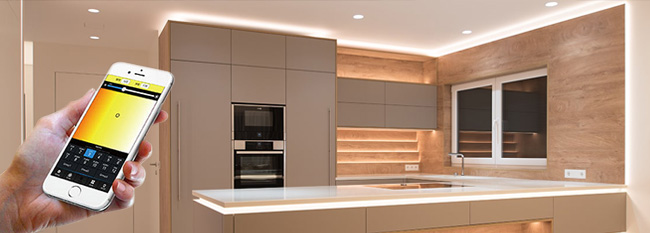 Single color LED strip lightsEvery white and single color strip
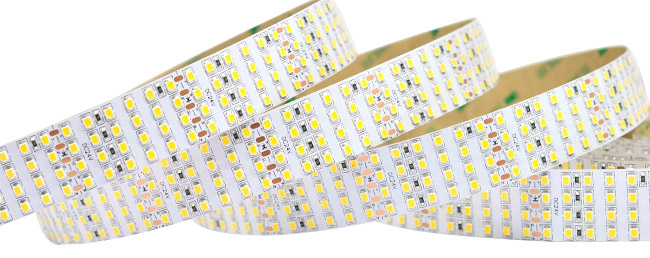 2835 SMD flexible LED strip lights14–16 lm per LED in our chip table
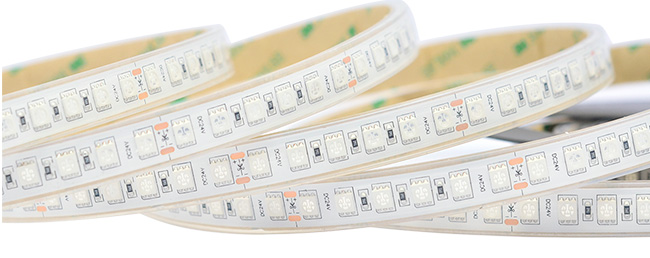 5050 SMD flexible LED strip lights20–22 lm per LED in our chip table
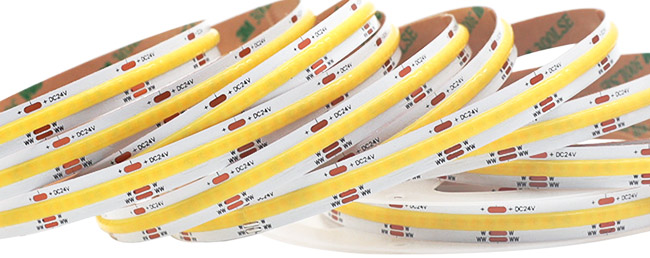 Flexible COB LED strip lightsNarrower pads: use COB connectors
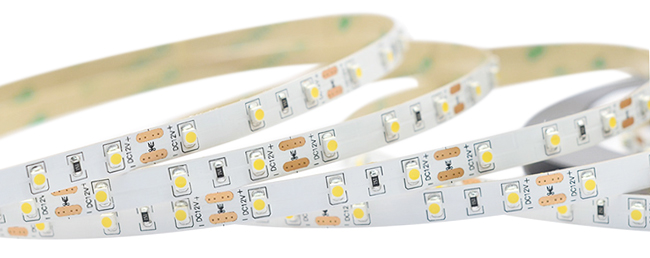 Full spectrum LED light stripsCheck the CRI (Ra) on each product page
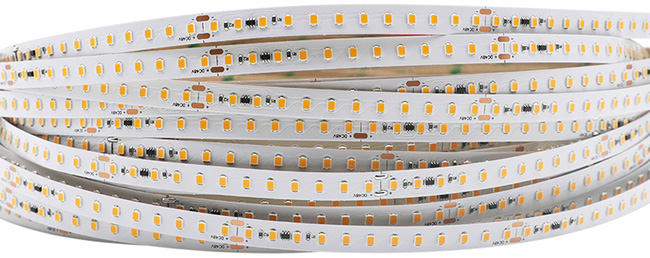 Ultra-long constant current LED strips10 m to 50 m runs without voltage drop
 Outdoor LED strip lightsIP67 and IP68 for outdoor use
 DC24V MW UL-listed power suppliesFor 24V LED strips
Send us the length, the voltage you have and where the strip will go, and the SuperLightingLED team will check the specification with you before you buy. Standard orders such as accessories and controllers ship within 24–48 hours; LED strip orders follow the production lead time shown on the product page. Contact our team