
Line Voltage Triac Dimmer Switch
2 productsThe Triac dimmer switch panel adopts trailing-edge phase cut dimming technology, enabling smooth dimming from 0% to 100%. The Triac light dimmer works with Triac dimmable LED lights, halogen lamps, and conventional incandescent lamps.
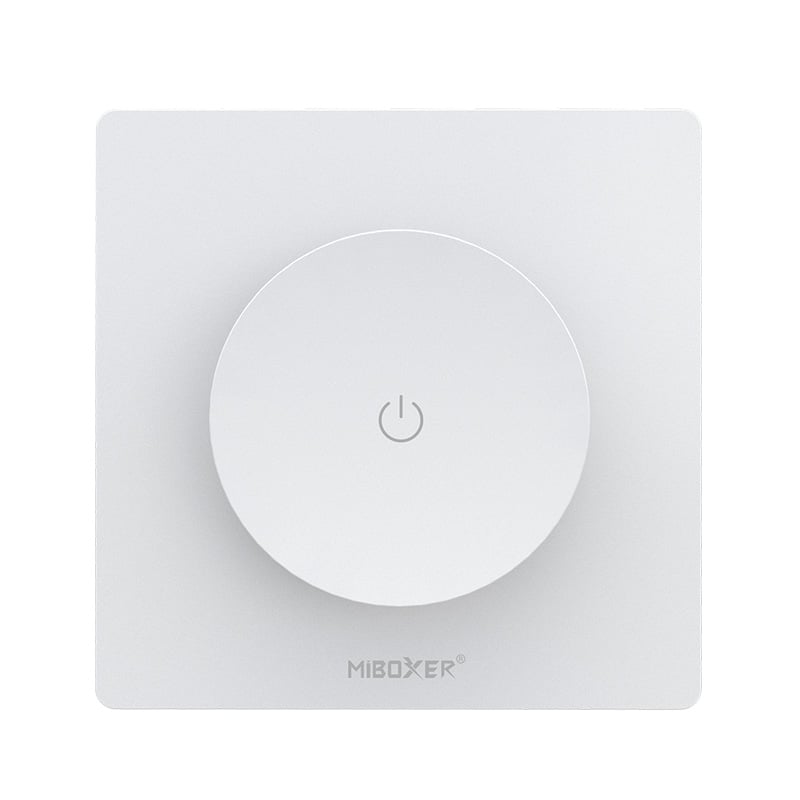
Utilizing Zigbee, WiFi technology, the Triac wall dimmer support Tuya smartphone app and voice assistant control to achieve smart control over traditional incandescent light and AC Triac LED lights.Users can directly adjust brightness through the touch panel or the rotary knob, which is simple to operate.
Besides, the Triac LED dimmer supports RF remote control. When controlled by the same remote, the LED Triac dimmer switch transmits signal from remote automatically to another dimmer, thereby synchronizing the working mode with other dimmer.

FAQ About Line Voltage Triac Dimmer Switch
Direct engineering answers on wiring, load thresholds, and smart control for line voltage phase-cut dimming.
A line voltage triac dimmer switch cuts slices out of the incoming AC mains sine wave (100–240V AC) to throttle electrical power directly to a connected load. Our MiBoxer line-voltage rotary units use trailing-edge reverse phase control (ELV), which turns the current on smoothly at zero-crossing and chops the falling flank. That makes line voltage dimming far quieter than older leading-edge magnetic switches, eliminating the inductive kickback that causes audible buzz in solid-state LED circuits. You wire it directly on the line side ahead of mains-voltage lamps or a phase-cut dimmable driver.
Only if the driver or fixture is explicitly rated as triac dimmable—connecting a standard non-dimmable driver to a line voltage dimmer burns out the internal rectification diodes within months. For 12V or 24V tape systems, you must install an AC-dimmable phase-cut power supply between the dimmer and the tape. If your luminaire runs non-dimmable ballasts, you cannot dim it with phase-cut controls; use a relay switch instead.
Wiring a 120v triac dimmer straight to bare DC LED tape will destroy the diodes instantly with high-voltage alternating current. A line voltage dimmer switch always mounts on the high-voltage AC mains side (100–130V AC), feeding a dedicated triac-dimmable AC-to-DC transformer, which then outputs safe DC12V or DC24V to your tape. If you want direct low-voltage PWM control without an intermediate phase-dimmable driver, wire an ordinary non-dimmable power brick to an inline receiver from our single color dimmers instead.
A triac dimmer 220v in our catalog supports up to 300W of LED load, calculated strictly from its 1.36A continuous thermal threshold (1.36A × 220V = 299.2W). Because LED drivers pull brief inrush current spikes between 10A and 30A at turn-on, we enforce a 20% safety de-rating factor on all driver circuits. That means you should cap your steady-state connected LED driver load at 240W on a 220V circuit, or 120W on 110V circuits, to keep the internal MOSFET heatsink below 65°C.
Our TRI-K1 line voltage dimmer switch requires both AC Live (L) and AC Neutral (N) wired directly to its screw terminals (AC 100–240V input) to energize its internal wireless transceiver and zero-cross logic. Installing it on an old two-wire switch loop that lacks a neutral line will not work—the switch panel simply will not power up. If you are retrofitting an older switch box that only has switched hot and line hot, you must pull a neutral conductor to the gang box.
You do not need a secondary wall plate or external rheostat because the dimmer panel itself serves as the master line voltage switch and controller in one unit. With the TRI-K1, pressing the knob toggles the load on or off while turning it adjusts brightness. If you install our SWL line voltage switch, you gain on/off power automation over non-dimmable fixtures via physical push key, 2.4GHz RF remote, or Tuya smartphone app over Bluetooth and 2.4GHz WiFi networks.
The best dimmer switch for multi-zone balance is one with automatic RF signal retransmission, such as our MiBoxer TRI-K1. When two or more units are mapped to the same 2.4GHz handheld remote, each wall panel acts as an RF repeater, relaying commands to adjacent panels within a 30m line-of-sight radius. This eliminates phase-angle drift between independent lighting zones in large open-plan spaces, hotel lobbies, and restaurant dining rooms without requiring you to run low-voltage control cabling between switch boxes.