
RF RGBW CV Controller
27 productsSkydance wireless RGBW series includes 4 channels controller, remote control, panel controllers&remote and dimmable LED driver. Through product different collocation to achieve light on/off control, brightness adjustment, static color, dynamic effect,group partition, scene, timing, sensor and other intelligent control functions.
1. The RGBW (4 channel) controller can be matched with all remote controls (including hand-held remote, panel remote, desktop remoteof dimming, CCT, RGB, RGBW and RGB+CCT).
2. Adopt 2.4G wireless technology, the remote control distance is 30 meters, the controller has the cascade function, through the signal forwarding between the controllers can reach hundreds of meters of control distance.
3. One controller can be matched with up to 10 remote controls. A controller can match in the same remote control of different zones, to achieve flexible grouping function.
4. A remote control can control single or multiple zones, each zone can be matched with an infinite number of controllers.
5. All controllers on the same zone are automatically synchronized.
6. Multiple RGB/RGBW(2 and 1) remote controls are common to RGB and RGBW controllers.
7. The RGBW series includes 4 channel constant voltage controller, 4 channel constant current controller, RGBW remote control, RGBW panel, RGBW constant voltage dimmable LED driver, WiFi-RF converter and 4 channel power repeater, etc.
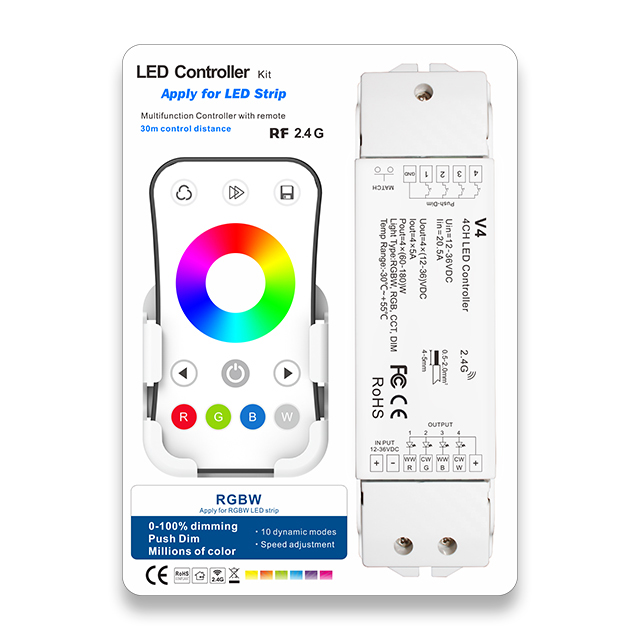
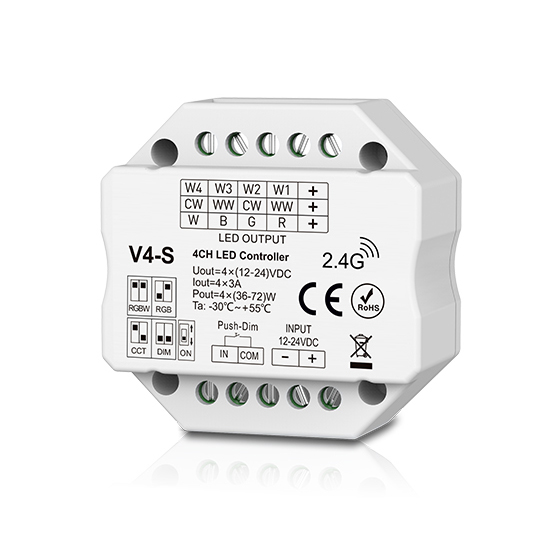
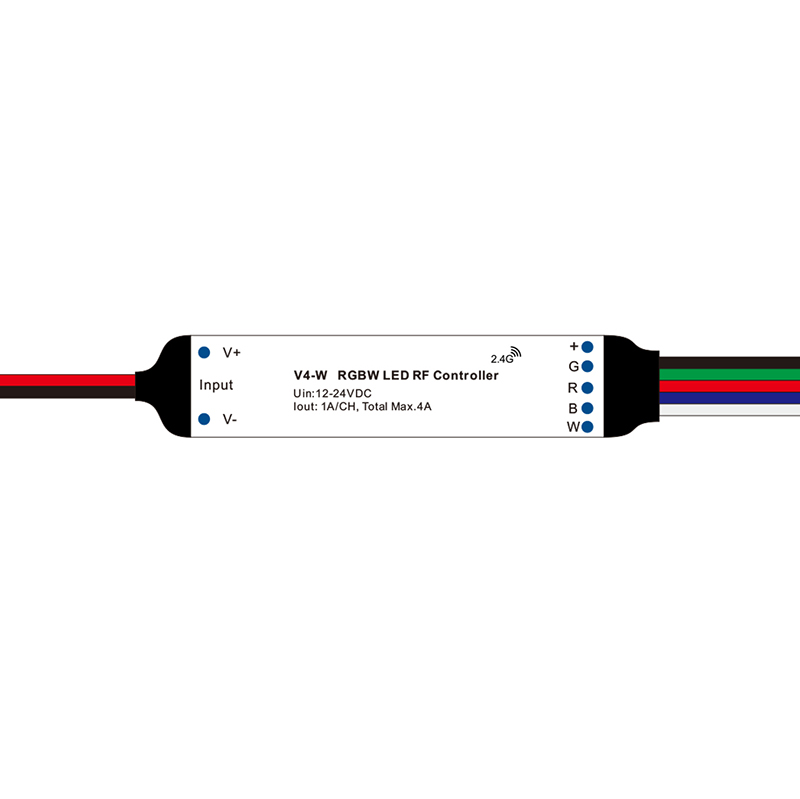
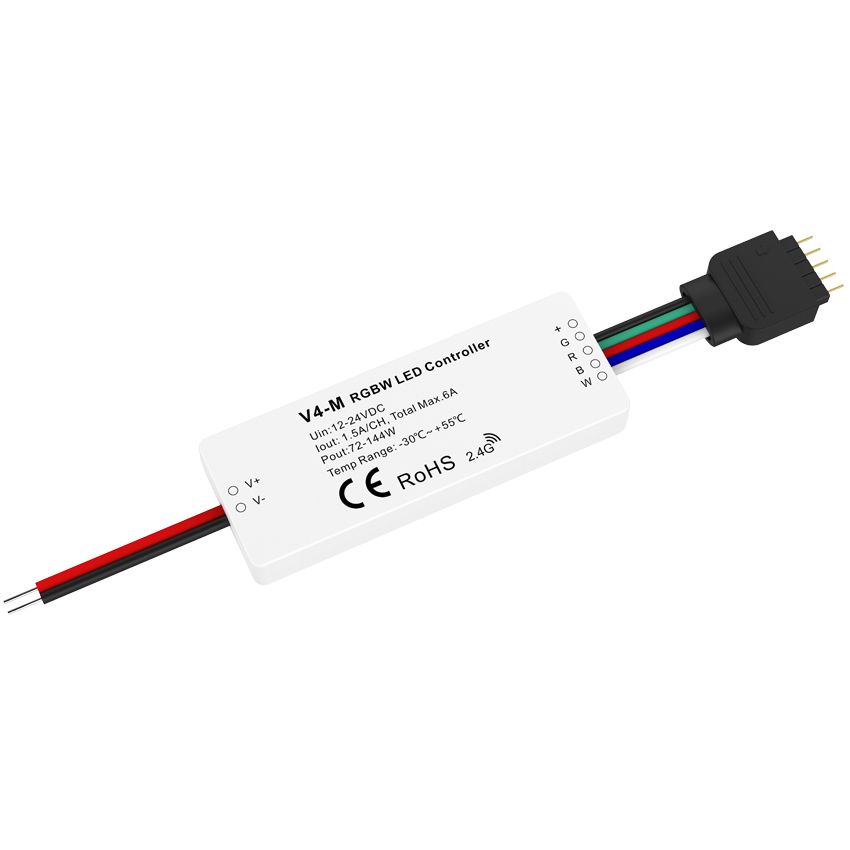
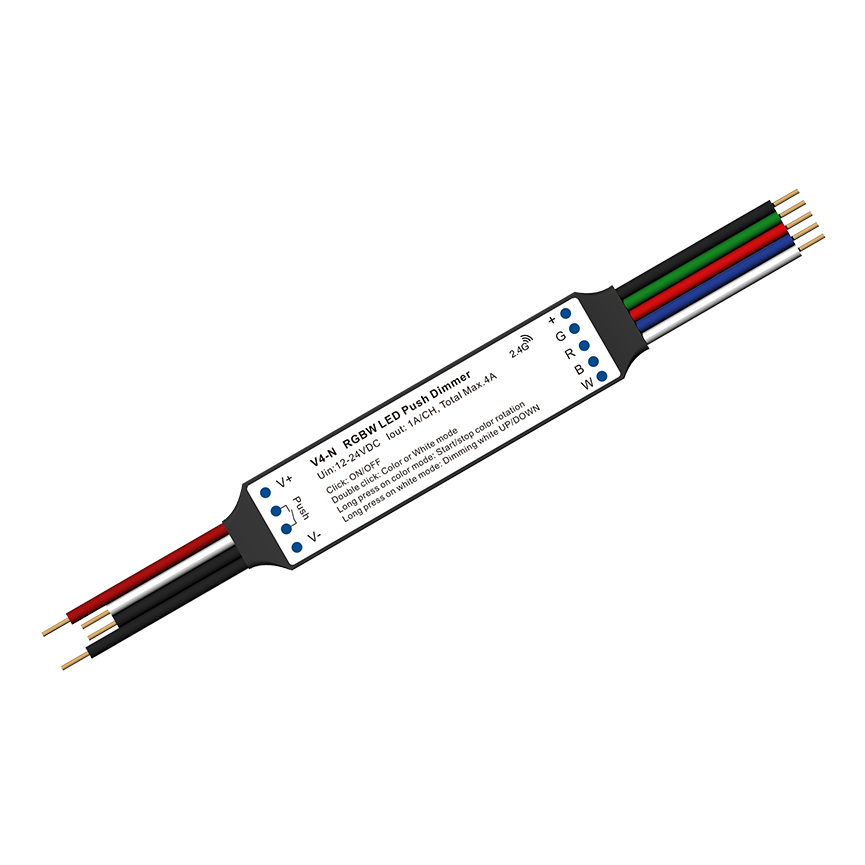
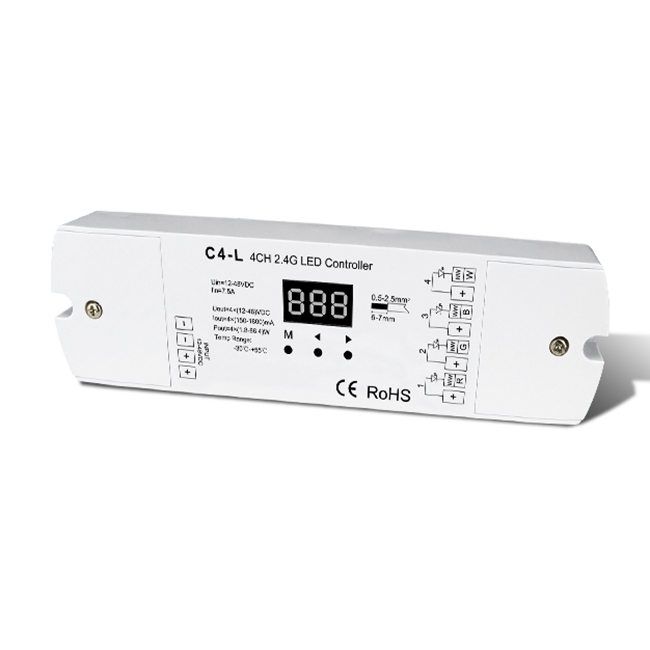
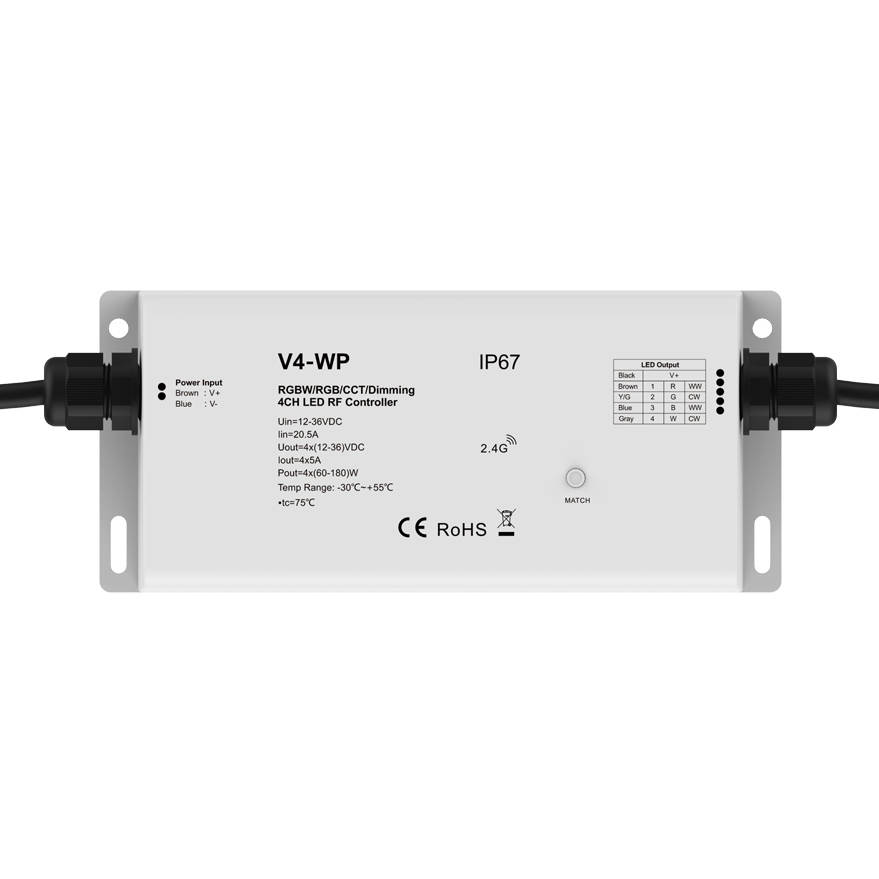
RF RGBW CV Controller: Your Questions Answered
Got questions about setting up your RGBW lighting control? I've been answering these for 12 years. Here are the most common things people ask right before they buy.
An RGB controller has three channels for Red, Green, and Blue. An RF RGBW controller has a fourth channel just for a white LED. This gives you a much cleaner, dedicated white light instead of the muddy, bluish-white you get from mixing R, G, and B. It's a huge upgrade for any area where you'll want actual white light, like a kitchen or workspace, and it's why most new projects use RGBW LED strip lights.
Yes, absolutely. Our SkyDance RF RGBW CV controllers are designed for this. You can use the 'zoning' feature on the remote to pair it with multiple controllers. You can put them all in one zone to sync up perfectly, or assign them to different zones—like Zone 1 for the kitchen, Zone 2 for the living room—and control them independently from a single remote.
That depends on the controller's amperage rating and your power supply's wattage, not the number of strips. You need to calculate the total power draw of your strips. For example, a 5-meter strip at 14.4W/m is 72W. On a 24V system, that's 3A. A common 5A/channel controller can handle that easily. Overloading the controller is a fire hazard and the most common mistake we see in a failed residential LED lighting installation.
Nine times out of ten, it's just a timing issue during the pairing sequence. Most RF RGBW controllers require you to press the 'Match' or 'Learning' key on the receiver, and then press the desired button on the remote within about 5 seconds. If it fails, power cycle the controller—unplug it for 10 seconds—and try again the moment it powers back on. Also, it sounds simple, but always check the battery in the remote first.
It all comes down to how you want to use your lights. Simple RF is rock-solid for direct control with a remote within about 30 meters. If you want app control on your phone, scheduling, or voice commands with Alexa or Google Home, you need a model with WiFi or Bluetooth. If you're building a larger smart home system, a Zigbee controller integrates directly with hubs like Philips Hue, SmartThings, or Casambi for seamless control.
This is a key feature for any large LED lighting installation. Each SkyDance RF RGBW CV controller acts as a signal repeater for the others. As long as your controllers are within 30 meters of each other, they'll automatically forward the remote's signal to the next one in the chain. This lets you synchronize a huge number of controllers over hundreds of meters without running a single data wire between them.
It's possible, but flickering is almost always a power supply issue. Either the power supply is overloaded because you've connected too much LED strip, or it's a lower-quality driver that can't provide a stable voltage. Before you replace the RF RGBW controller, try connecting just a small, one-foot section of the strip to it. If the flickering stops, your power supply is the problem.
Yes, you can. An RF RGBW CV controller will work perfectly for a 3-channel RGB strip. You just connect the R, G, and B wires from your strip to the corresponding R, G, and B output terminals on the controller and leave the 'W' terminal empty. The controller will function just like a standard RGB controller. It's a good way to future-proof your setup in case you upgrade to RGBW strips later.
Only if you buy a specifically waterproof model. Standard controllers are IP20-rated, which is for dry, indoor locations only. For any outdoor or damp application like soffit lighting installation, bathrooms, or landscape features, you must use an IP67-rated controller like our V4-WPS waterproof model. It's fully sealed against dust and moisture, which prevents the internal components from corroding and failing.
A 4-channel RF RGBW controller is for strips with Red, Green, Blue, and a single White channel. A 5-channel controller, often called an RGB+CCT or RGBWW controller, has outputs for Red, Green, Blue, plus *two* white channels: one Warm White and one Cool White. This lets you blend the two whites to create any color temperature you want, in addition to all the RGB colors. Our guide explains more about the different types of RGB strips.
Yes, we do this constantly for commercial projects and OEM clients. If you need a batch of RF RGBW CV controllers pre-paired to specific remotes and zones, or if your project requires a custom lead wire length, connector type, or a complete wiring harness to accelerate your on-site office lighting installation, just send us your requirements. A sketch on a napkin is fine. An engineer will spec it out and send a full quote, usually same-day, with no obligation to order.
Yes. The RF RGBW CV controller sits between your main power supply and your LED strips. The power supply (e.g., 24V DC) connects to the controller's input terminals. The controller then takes that power and uses Pulse-Width Modulation (PWM) to precisely manage the brightness and color of the LED strips connected to its output terminals. You can't control the strips without it.
'Constant Voltage' means the controller is made for LED strips that need a stable, fixed voltage—usually 12V or 24V DC—to work correctly. The controller dims the lights by chopping this voltage on and off extremely quickly (that's PWM), not by actually lowering the voltage. This is the standard for virtually all flexible LED tape. The alternative, 'Constant Current' (CC), is used for single high-power LEDs, not strips.
You have a couple of great options. The easiest is to use the auto-transmitting feature: just place another SkyDance controller within 30m of the last one, and it will relay the signal automatically. For true long-range or internet-based control, use a WiFi-RF converter. This device joins your WiFi network and translates commands from a phone app into RF signals that any of our controllers can understand, effectively giving you unlimited range. Our full guide on how to choose LED controllers covers these scenarios.