
RGB 4CH Controller Series
28 productsRGB LED Strip Controllers manufactured by MiBoxer (Mi-Light) are equipped with a variety of wireless technologies like RF 2.4GHz, WiFi, and Zigbee to freely control your RGB LED strip and build your presonal colorful smart home lighting. Multiple controllers can synchronize lighting effects within an effective distance.
The MiBoxer (Mi-Light) RGB 4CH Controller Series provides flexible color and brightness control for compatible constant-voltage RGB LED strips and lighting fixtures. Designed for common-anode RGB lighting systems, these controllers feature a four-wire output connection consisting of one shared positive terminal and three dedicated color channels: red (R), green (G), and blue (B). By adjusting the three color outputs independently, users can create a wide range of colors, customize brightness levels, and achieve dynamic lighting effects.
Depending on the model, the series supports different DC operating voltages, including 12V, 24V, and other specified voltage options such as 48V, with varying output current ratings to accommodate different lighting loads.
Whether used for residential accent lighting, decorative installations, retail displays, or commercial ambient lighting, MiBoxer RGB controllers offer a convenient way to manage colorful LED strip lighting through compatible control systems.
Before purchasing, check each model's voltage requirements, maximum total current, per-channel output limits, and compatible remote or smart control options to ensure the right match for your RGB LED lighting project. Compatible with MiBoxer Mi-Light RGB remotes only.

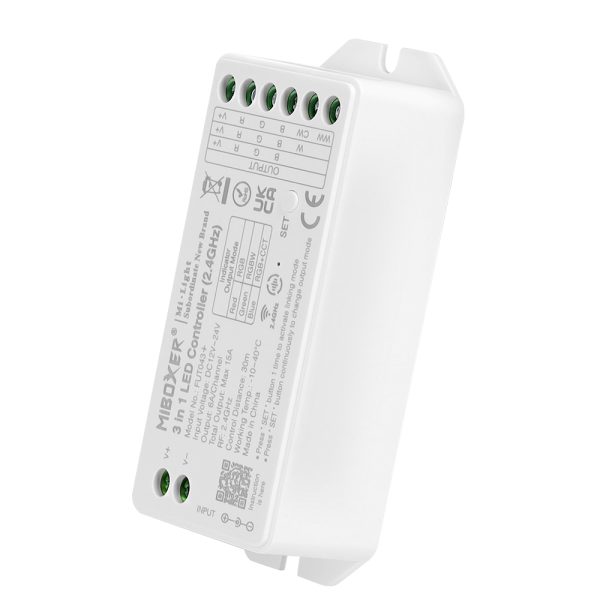
FUT043+ RGB/RGBW/CCT LED Strip Controller - 3-in-1 Smart Control

2.4G Rainbow Remote (RGB+CCT) S2 | Smart LED Lighting Control

FUT037M Upgraded 4-Zone RGB LED Strip Controller - 2.4GHz

Rgb Led Controller (20a) Fut037p - High Current Output - Shop Now!

Mi-Light RF2.4G Waterproof RGB LED Controller FUT037S-P

FAQ About RGB 4CH Controller Series
Direct technical answers on wiring, load sizing, wireless protocols, and troubleshooting 4-channel RGB controllers from our bench engineering desk.
A 4-channel rgb led light controller regulates color and output by pulse-width modulating three independent ground lines against one shared positive rail. In common-anode led rgb lights, the DC positive line (marked + or +12V/+24V) delivers steady voltage to all red, green, and blue emitters simultaneously. The controller then switches each cathode line (R, G, B) to ground thousands of times per second. By altering the duty cycle on each channel from 0% to 100%, the unit mixes the three primary wavelengths into any target hue. When you drop the overall brightness, the controller narrows the on-pulse duration across all three active channels without altering DC drive voltage.
You control multi-room rgb led lighting by assigning each wireless receiver to a dedicated zone number on your handheld remote or wall panel. MiBoxer 2.4GHz RF hardware uses distinct device IDs paired via an 8-byte handshake. To set up an independent zone, connect power to the controller, tap the desired Zone ON button three times within 3 seconds of power-up, and watch the connected LED strip lights blink three times to lock. Controllers grouped into Zone 1 respond only to Zone 1 commands, while Zone 2 runs different colors or dynamic sequences without interference, even when running on the same 2.400–2.4835 GHz frequency band throughout the home.
When installing rgb led lighting that draws more current than a controller's rated maximum, you split the load across a dedicated pwm power repeater. For example, our FUT037S+ handles up to 12A total (6A per channel). If your installation runs 20 m of 24V RGB tape pulling 18A (432W), feeding everything straight off one receiver will trip internal over-current protection or overheat the PCB traces. Instead, wire the first 10 m run directly to the controller, and feed the R, G, B, and V+ signals into an amplifier. Run a separate heavy-gauge DC feeder line from the power supply to the amplifier, which regenerates identical PWM pulses for the remaining 10 m run with zero delay.
Crossed output lines cause color inversion on an rgb led light, meaning the R and G return conductors are swapped at the controller terminal block. Because common-anode strips share positive voltage, landing the green conductor into the red terminal makes the controller switch red diodes whenever the wireless signal calls for green. Kill DC power to the driver, loosen the terminal screws on pins 2 and 3, swap the red and green wire leads, and re-tighten. If you are troubleshooting multi-conductor extensions across junction boxes, review our rgb wiring tutorial to trace your color-coded conductor legs properly.
A 4-channel controller produces white on rgb lights by driving red, green, and blue emitters to 100% simultaneously, creating mixed composite white. Because this mix lacks dedicated phosphor-converted white diodes, the beam exhibits an uneven spectral balance that leans violet or pink, with a poor Color Rendering Index under 50 Ra. If your space demands clean task illumination or warm ambient glow alongside color effects, step up to our rgbw led strip lights. Those tapes incorporate a dedicated 2700K–6500K fourth diode with 90+ CRI, powered through a dedicated 5-channel controller so color and true white remain completely independent.
Low-end flicker on led rgb lights typically stems from voltage drop along thin gauge input wire or RF packet collisions from nearby 2.4GHz routers. If input wire gauge between the power supply and receiver is too thin, high PWM switching pulses trigger sharp voltage dips below the controller's brownout threshold. If the flicker coincides with wireless network traffic, reposition the receiver at least 1.5 m away from high-output Wi-Fi access points to protect the 2.4GHz RF antenna from continuous signal swamp.
MiBoxer 4-channel receivers feature automatic signal repeating and synchronization, meaning one receiver forwards commands to another receiver located within 30 m. Each powered unit acts as an RF relay node on the 2.4GHz frequency, so long as both units are matched to the same remote zone and spaced within line-of-sight range. In addition, an internal clock pulse synchronizes dynamic color fade modes across all grouped devices. Even across a 150 m hotel corridor with five controllers in series, dynamic chasing and fading run in uniform lockstep without individual data cables interconnecting the receiver boxes.