
Far Red Light 730nm LED Strip
12 productsSuperLightingLED specializes in manufacturing professional photobiomodulation red-wavelength LED strips, enabling you to effortlessly customize home phototherapy rooms and equipment while optimizing the growth of indoor ornamental plants. Our 730nm far-red light strips utilize LED chips with superior spectral performance, precisely locking the spectral peak at 730.5nm~732.6nm while strictly controlling the half-width to within ±(19nm~20.3nm), which ensures highly concentrated and pure light wave output from 710nm to 750nm. This means the vast majority of energy is efficiently concentrated within the therapeutic window centered at 730nm, effectively eliminating stray light interference to deliver a precise and highly effective photobiostimulation efficacy.
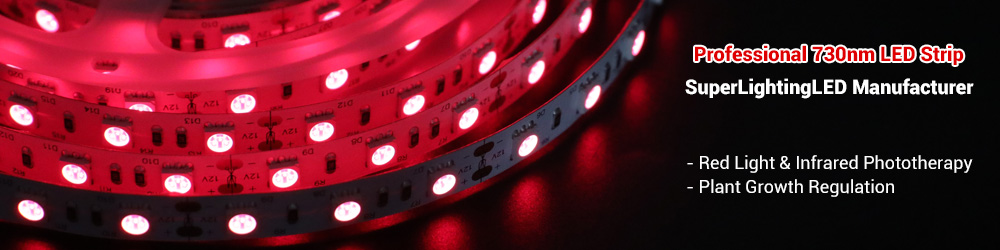
What Does 730nm Red Light Look Like?
In the visible light spectrum, the wavelength of red light ranges from about 620nm to 750nm. Compared to 660nm bright deep red light, 730nm far red light is closer to the boundary of infrared light. In 730nm strip with SMD 2835 and 5050 as the 730nm LED light source, the 730 nm light shows a red color and is directly visible. Due to the human eye's low sensitivity to long wavelengths, the visible red illumination range of 730 nm red light is smaller compared to the common 620-630 nm red light, which is concentrated near the strip.
We offer a wide range of protection levels and light densities of hyper red 730 nm led strips to suit different environments and needs of plant growth rooms. View our products today.

450nm+660nm+730nm Tri-Spectrum Tunable Red Blue LED Grow Light Strip

Ultra Bright 3-in-1 Infrared Red Blue Light Therapy LED Strip

Ultimate Uniform 8mm 730nm Far Red Flowering Accelerator LED Flex Light Strip

Low Density Bio Red 730 nm LED Strip Light

Standard 5050 LED Far Red 730nm Light Strip

Uniform SMD3528 Deep Red 660nm Far Red 730nm Vivid Red 635nm Light LED Strip

DC12/24V 730nm 780nm SMD2835 Red Light Therapy LED Strip

Hyper Red 730nm LED Double Density Tape Light

SMD2835 High Bright 810nm/830nm/780nm Near Infrared 730nm/660nm/635nm Red LED Tape Light

Eco 2835 Infrared 850nm/940nm/830nm/810nm/780nm Red 730nm/660nm/635nm LED Strip

60LEDs/m 3528 940nm/850nm/830nm/810nm/780nm Infrared & 730nm/660nm/635nm Red LED Strip Light

SMD3528 Double Row 850nm/830nm/810nm/780nm Infrared 730nm/660nm/635nm Red IR LED Strip
730nm Red Light Therapy
730nm far-red light is a unique wavelength in phototherapy, typically combined with other red or infrared wavelengths to achieve synergistic effects.
♦ 730nm + 660nm (Classic Golden Combination): Hair growth and regrowth; stimulates cells to produce more collagen and elastin for skin rejuvenation and anti-aging; muscle recovery, wound healing, and tissue repair; pain management and anti-inflammation.
♦ 730nm + 850nm / 810nm (Far-Red + Near-Infrared): Primarily delivers potent anti-inflammatory effects, pain relief, and promotes deep tissue repair; used for chronic pain, arthritis, brain health (e.g., brain fog, post-traumatic recovery), and deep muscle injury treatment.
♦ 730nm + 660nm + 850nm (Red + Near-Infrared): Simultaneously covers shallow, medium, and deep tissue requirements.
♦ 730nm + 450nm (Red + Blue): Antibacterial, inhibits Propionibacterium acnes to treat acne; further promotes repair and healing of damaged skin, reducing erythema and acne scars.
The Role of 730nm Light for Plants
Red light at 730 nm wavelength can be absorbed by plants and plays an important role in plant growth. Far red 730nm led grow light penetrates deep into the plant canopy and effectively promotes the plant's shade avoidance response, allowing the plant to elongate its stems while regulating the flowering cycle.
Supplementing plants with 730nm far-red light rays also enhance photosynthesis and increase plant biomass, which in turn enhances plant resilience and helps plants to grow better under various environmental conditions, especially beneficial for ornamental flowers.
Peak Wavelength 730.5nm 5050 LED Test Report PDF730.5nm LED spec74 KB
Peak Wavelength 731.5nm 5050 LED Test Report PDF730nm LED SPEC1.4 MB
Peak Wavelength 732.6nm 2835 LED Test Report PDF730nm 2835 LED Spec2.9 MB
Frequently Asked Questions About 730nm Far-Red LED Strips
Got a question about using 730nm light for your plants or therapy setup? You've come to the right place. Here are the answers we give customers every day.
That 730nm far-red light acts as a powerful signal for plants, telling them the day is over. Used for 10-15 minutes after your main lights go out, a 730nm LED strip can accelerate the transition from vegetative growth to flowering. It's a trigger, basically, that helps manage the plant's internal clock and can shorten your flowering cycle.
You're right, it's not quite infrared, but it's very close. 730nm is considered 'far-red' light, sitting right on the edge of the visible spectrum before you get into true near-infrared lights like 850nm. Your eyes are not very sensitive to it, which is why a 730nm LED looks much dimmer than a 660nm deep red LED of the same power. But for plants and human cells, that wavelength is very potent.
Almost always use it with other wavelengths, especially 660nm deep red. The combination of 660nm and 730nm light creates a synergistic effect called the 'Emerson Effect,' which can significantly boost the rate of photosynthesis. For the most complete solution, our tri-spectrum horticulture strips combine 450nm blue, 660nm red, and 730nm far-red on one board.
There's no single perfect number, as it depends on the intensity of your 730nm LED strip and the plant type. A good starting point is typically 12 to 18 inches (30-45 cm) above the plant canopy. For higher-density strips, you might increase that distance to 24 inches to get a wider, more even spread. The key is to provide coverage without causing light stress.
They use the same foundational technology, but serve different purposes. A pre-built therapy lamp or panel is a plug-and-play consumer product. Our 730nm LED strips are professional components for building your own custom-sized panels, retrofitting a sauna, or creating unique setups. You get more control and can cover a larger area for less money, but you'll need to handle the wiring and power yourself.
That's a classic case of voltage drop, and it's the most common issue with any long LED strip run. The farther electricity travels down the copper PCB, the more voltage is lost. For our 730nm strips, we recommend using 24V for any run over 5 meters (16.4 ft). For longer runs, you'll need to inject power from both ends or use a new power feed. We explain it all in our voltage drop guide.
Yes, absolutely. Heat is the number one killer of LEDs, and the channel isn't just for looks—it's a critical heatsink. Without a channel to dissipate heat, the LED chips will overheat, causing their brightness to degrade much faster and significantly shortening their lifespan. For any high-density or long-duration application, aluminum LED channels are not optional.
It's a simple calculation. Check the product page for 'Watts per meter'. Multiply that number by the total length of your strip in meters (in this case, 5). Then, add a 20% safety margin. So, if the strip is 10W/meter, you'll need (10W x 5m) * 1.2 = 60 Watts. A 24V 60W power supply would be the minimum requirement.
They provide two different signals for plants. 660nm deep red light is a primary driver of photosynthesis—it's like the fuel for growth. 730nm far-red light, on the other hand, is more of a hormonal trigger that regulates flowering and shade-avoidance responses. The best horticulture setups use both. Think of 660nm as the gas pedal and 730nm as the gear shift.
Our 730nm LEDs are rated for L70 at 50,000 hours. That doesn't mean they'll burn out, but rather that after about 50,000 hours of use, they will likely be at 70% of their original brightness. This lifespan is entirely dependent on proper heat management. If you run the strip without a heatsink, you can expect that number to drop dramatically.
For almost any project, 24V is the better choice. A 24V system allows you to run double the length of a 730nm LED strip for the same amount of voltage drop as a 12V system. This means longer, more consistent runs, less wiring complexity, and smaller-gauge wires. We generally only recommend 12V for very short runs or in specific vehicle or battery-powered applications where 12V is the native voltage.
Yes, we build custom LED lighting solutions like this every day. A huge portion of what we ship is built to a customer's drawing and never appears on the site. Just send us a sketch or a description of what you need—the exact length, the desired IP rating (like IP67 for high humidity), and any specific connector or wire lead requirements. An engineer will send back a complete parts list and quote, usually within 12 hours. There's no fee for the consultation and no obligation to order.