
Single Zone Control Series
41 productsRF Remote & Receiver Systems for CV and CC LED Lighting
The BinColor Wireless Single-Zone Remote Control Series combines handheld RF remotes or wireless touch panel remotes with compatible LED receivers to provide convenient wireless control for single-color DIM, CCT tunable white, RGB, RGBW, RGBCCT constant voltage (CV) LED strips and constant current (CC) LED lighting fixtures.
Handheld RF Remote + Wireless LED Receiver
Pair a handheld RF remote with a compatible CV or CC receiver to wirelessly adjust the connected LED lighting. The receiver connects between the LED power supply and the lighting load, while the handheld remote provides convenient control of brightness, color temperature, colors, and dynamic lighting effects.
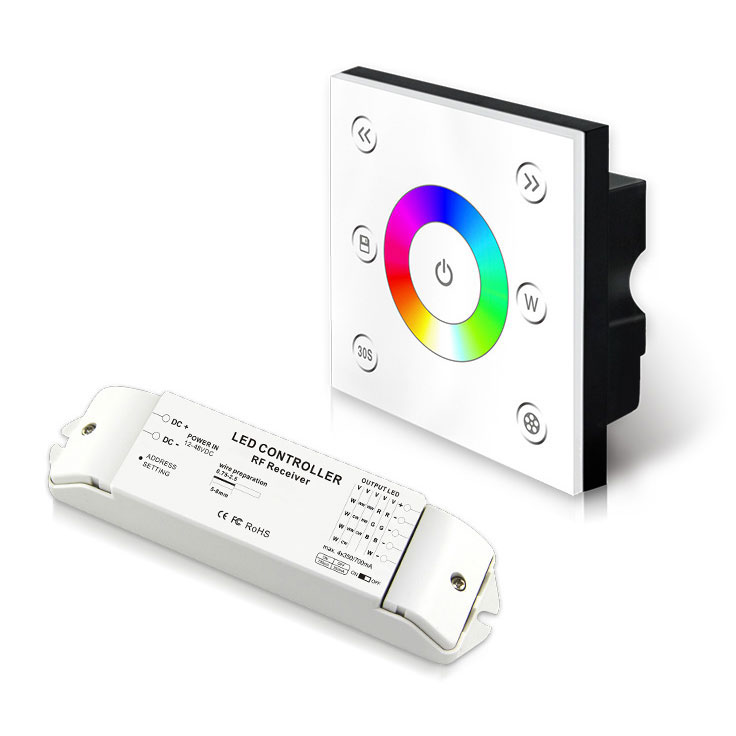
Wireless Touch Panel Remote + Wireless LED Receiver
For users who prefer wall-mounted controls, selected models combine a wireless touch panel remote with a matching receiver. The panel provides an intuitive touch interface for everyday lighting adjustment, while communicating with the receiver wirelessly without requiring a physical control cable between them.
A key advantage of BinColor single-zone wireless systems is the ability to pair one compatible remote and controller with 1-4 output lighting loads. This allows multiple LED strip runs, lighting circuits, or fixtures to operate in synchronization, maintaining consistent brightness, color temperature, or color settings throughout the installation.
Frequently Asked Questions About Single Zone Control Series
Direct answers from our bench on wiring, load limits, RF pairing, and hardware selection for BinColor single-zone LED systems.
A single zone controller for LED strip lights operates one designated lighting circuit where every connected LED tape light responds simultaneously to dimming, color changes, and power commands. Unlike multi-zone systems that split rooms into independently addressable channels, a single-zone receiver treats all connected loads as a unified group. You pair one handheld radio-frequency remote or wall switch to one or multiple matched receivers, and every run adjusts in unison. For straightforward spaces like an under-cabinet kitchen run, a single cove ceiling, or an architectural display case, a single-zone setup avoids accidental zone switching and keeps the wiring simple.
Choosing between constant voltage and constant current for a single zone controller for LED strip lights depends entirely on whether your lighting uses internal current-limiting resistors or raw LED emitter arrays. Standard flexible LED strip lights require constant voltage (CV) at 12V or 24V DC, whereas high-power LED spotlights, architectural pucks, and downlights require regulated constant current (CC) such as 350mA or 700mA to prevent thermal runaway.
To control RGB LED strip lights with a single zone controller, connect the 4-pin common-anode tape directly to the output terminals labeled V+, R, G, and B on your receiver. The DC power supply feeds into the controller DC input terminals (+ and -), matching your strip's operational voltage at 12V or 24V. Once wired, your handheld T3 remote transmits over 433MHz or 2.4GHz RF to adjust static color mixes, brightness levels, and dynamic cycle modes without requiring line-of-sight aiming. If your run length exceeds 10m on 24V and draws more than the receiver's 4A per channel limit, insert RGB and RGBW power repeaters to extend your signal cleanly without dropping voltage.
Yes, you can control single-color LED strip lights through DMX using single-zone wall panels like our P1X+R4-2.4G that generate a true USITT DMX512 signal alongside wireless RF. In this configuration, the panel sends DMX channel 1 brightness data over an RS-485 shielded twisted-pair line to external decoders, or wirelessly to matched R4-2.4G receivers. We stock 8 single-zone models with integrated DMX output specifically for projects bridging standalone rooms into larger theatrical consoles or building automation setups.
Alexa cannot communicate directly with standalone 433MHz or proprietary 2.4GHz BinColor single-zone receivers without an intermediary bridge. Because BinColor RF operates on private industrial radio protocols for instant sub-10ms latency and high penetration, it lacks native 802.11b/g/n Wi-Fi handshakes. To use Alexa voice control, you can feed the AC line of the LED power supply through a smart Wi-Fi relay, or integrate a dry-contact smart relay module across the push-dim terminals on compatible receivers like the BC-420RF. When mains power restores, our single-zone receivers retain their last programmed brightness and color state via non-volatile EEPROM memory.
Wiring dual-white tunable LED strip lights requires a 3-wire connection: connect the common positive line to V+, the warm-white negative line to WW (channel 1), and the cool-white negative line to CW (channel 2) on your receiver. Models such as the T2+R4 and T5+R4 dynamically balance the PWM duty cycles between the two channels while keeping total lumen output stable. As you slide from 2700K to 6500K across the remote touch wheel, the controller proportionally lowers one channel while raising the other. For complete circuit layout diagrams and load calculations across color-tuning systems, check our detailed guide to choosing LED controllers.