
0~10V Dimmer
6 productsSuperLightingLED's LeyNew 0-10V Dimmer Series provides reliable and precise brightness control for residential, commercial, and architectural LED lighting projects. The series includes 0-10V touch wall panels and 0-10V wireless dimmers that generate analog dimming signals, as well as 0-10V dimmer controllers that receive these signals and regulate the PWM output to control connected single-color LED strips and other compatible LED lighting loads. These 0-10V dimming products make it easier to integrate centralized wall control into modern LED strip lighting systems.


DM015 AC90~240V 1 Channel Wireless Remote Control 0-10V Waterproof Dimmer


TM120U 0-10V 1 Channel Touch Panel Dimmer, LED Hight Voltage Controller


0-10V Touch Wall Panels And Controllers – Analog Dimming Signal Output
LeyNew 0-10V Touch Wall Panels and Remote Dimming Controllers are designed to generate 0-10V analog dimming signals for centralized brightness control in residential, commercial, and architectural lighting projects.
The 0-10V touch wall panels provide convenient in-wall control, allowing users to adjust lighting brightness directly from a wall-mounted interface, while the 0-10V remote dimming controllers offer flexible wireless operation for adjusting 0-10V output signals.
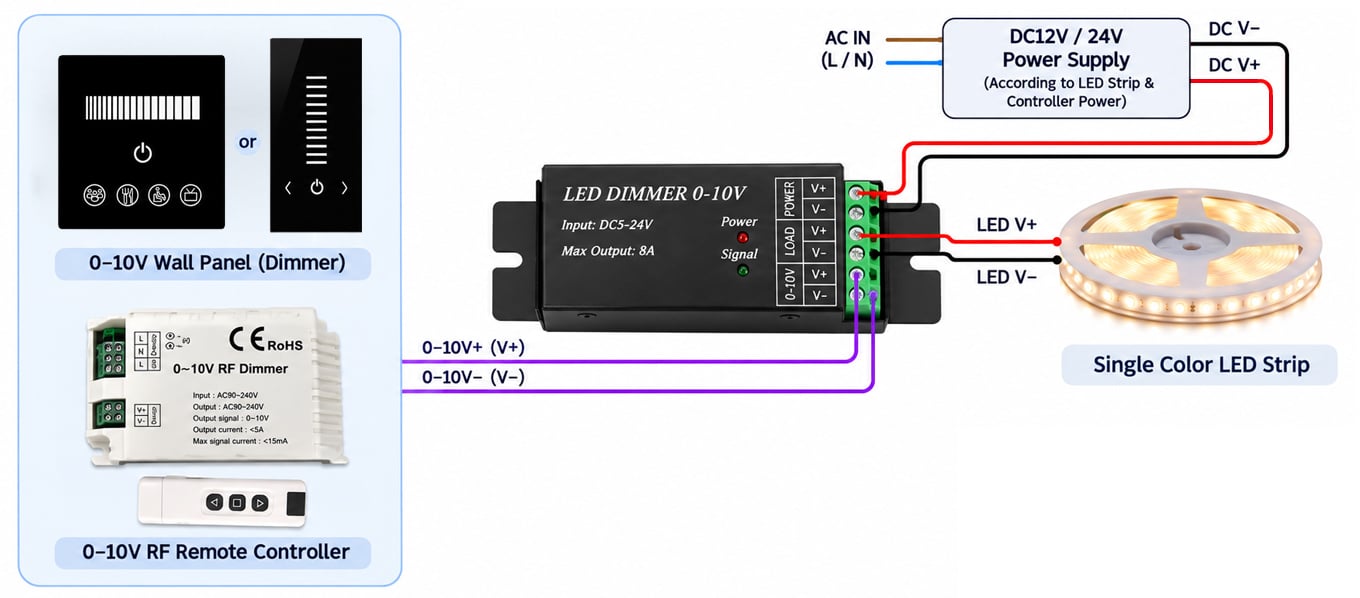
These master controllers work with compatible 0-10V dimmer controllers and 0-10V drivers, making them suitable for integrated lighting control systems that require convenient, precise, and smooth dimming adjustment.
0-10V LED Dimmer Controllers – Signal Input for Single-Color LED Strips
LeyNew 0-10V LED Dimmer Controllers are designed to receive external 0-10V analog dimming signals and convert them into corresponding PWM (Pulse Width Modulation) output for brightness regulation of connected single-color LED strips.
Acting as the signal-receiving and load-controlling component in a 0-10V dimming system, these controllers use an independent DC power supply to drive the LED load while adjusting its brightness according to the incoming dimming level.
Compatible models support different DC operating voltages and output capacities, providing flexible integration with single-color LED strips for residential, commercial, cabinet, accent, and architectural lighting.
By pairing a 0-10V signal-input dimmer controller with a compatible 0-10V wall panel, users can build a practical lighting control system with centralized brightness adjustment.
Looking for more advanced 0-10V and 1-10V dimming solutions? Explore SuperLightingLED's SkyDance 0/1-10V Control System for expanded control options, smart lighting integration, and more versatile dimming configurations for demanding lighting projects.
FAQ About 0-10V Dimmer Systems
Direct answers to common technical, wiring, and installation questions about 0-10V LED dimmers and controllers.
The maximum fixture count on a single 0-10V led dimmer depends entirely on the controller sinking current capacity and the AC switch relay rating. A standard 0-10V control terminal typically sinks up to 20 mA, and since most dimmable 0-10v drivers leak roughly 0.5 mA to 1.5 mA into the control bus, you can reliably parallel 15 to 30 drivers on one signal line. If your wall unit also switches AC line power, keep the total inrush load under the relay's rated amperage, usually 5A to 10A.
Yes, our DM015 and TM016 0-10v led dimmer models integrate wireless RF receivers alongside their physical wall interfaces so you can command fixtures from across the room. The DM015 AC90-240V module pairs with handheld RF transmitters to smoothly regulate the 0-10V output port without needing line-of-sight pointing. That gives you traditional wall-plate dimming for code compliance while offering remote zone switching and preset light scenes up to 20 meters away.
Our TM120U 0-10V dimmer uses a standard US single-gang dimensions (120 x 74 mm) designed to drop directly into standard commercial junction boxes and mud rings. For European rectangular or round 86-type boxes, we stock the TM120E footprint to avoid drywall modifications. Both variants feature sleek capacitive glass panels and require a neutral wire connection to power the internal logic chip and the low-voltage 0-10V output terminal.