
RF DIM Remote Control
20 productsThe SkyDance RF DIM Remote Control Series is designed specifically for the SkyDance RF DIM Control System, providing wireless handheld control for compatible single-color constant-voltage (CV) and constant-current (CC) LED dimming controllers and dimmable LED drivers. These 2.4GHz RF remotes allow users to conveniently control compatible LED strip lights and LED fixtures without needing direct access to the connected controller or driver, powered by coin-cell batteries or AAA batteries.
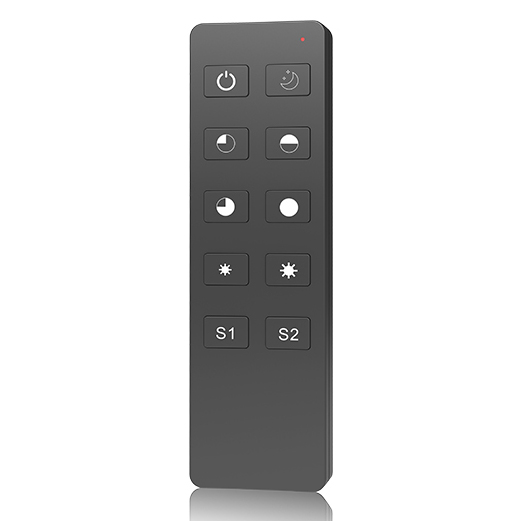
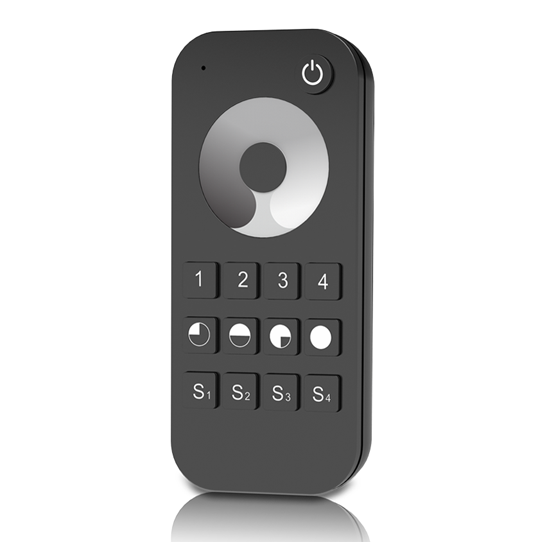
Users can operate the remote by touching the corresponding areas on touch-sensitive models or pressing the designated buttons on button-style models. Depending on the remote type, supported functions include turning lights on and off, adjusting brightness, activating night-light mode, recalling lighting scenes, and selecting individual lighting zones. Single-zone, 4-zone, and 8-zone remotes are available to suit different installation and control requirements. The specified wireless control range is typically up to 30 meters under suitable conditions, while compatible receiver-to-receiver signal forwarding can extend coverage in larger installations.
One SkyDance RF DIM remote can control multiple SkyDance wireless dimming receivers, allowing several LED strips or fixtures to operate together or in separate zones, depending on the remote configuration. Likewise, one compatible SkyDance RF DIM controller or dimmable LED driver can be paired with multiple remotes, allowing lighting to be controlled from different locations.
For example, the same lighting installation can be operated using a handheld remote in one area and another compatible remote in a different area. The supported number of receivers per remote and remotes per receiver depends on the specific model. Please refer to the product specifications and pairing instructions for the exact limits.






FAQ About RF DIM Remote Control
Direct engineering answers on pairing, range, zoning, battery life, and controller compatibility for 2.4GHz single-color LED dimming remotes.
An RF DIM remote control cannot wire directly to LED strip lights because it is strictly a wireless transmitter, not a DC power supply or load switch. It broadcasts a 2.4GHz radio frequency signal to a matched constant-voltage RF dimming receiver, which then sits between your 12V, 24V, or 48V power supply and the LED tape to regulate brightness via pulse-width modulation (PWM). Attempting to wire lights directly to a handheld remote is impossible since the remote carries only a 3V coin cell or AAA batteries for its internal radio circuit.
Choosing an RF dimmer remote control depends entirely on whether your layout needs synchronized dimming or independent circuit control across separate physical areas. A 1-zone remote like the R1 or RT1 broadcasts to all matched receivers at once, making it practical for a single perimeter ceiling cove or unified kitchen run. If you want independent dimming for kitchen toe-kicks, island pendants, and under-cabinet LED strip lights from one pocket transmitter, step up to a 4-zone unit like the RS1 or an 8-zone model like the RT8, both of which let you adjust zones separately or unify them with a master switch.
Yes, a single 2.4G RF remote can pair with an unlimited quantity of compatible SkyDance 2.4GHz receivers and dimmable drivers within its 30-meter radio range. In a large open warehouse or high-ceiling hospitality atrium where you have ten separate 24V power drops, you can match all ten controllers to Zone 1 on a single remote. Every receiver detects the command simultaneously, giving you unified dimming across multiple power feeds without pulling hundreds of feet of low-voltage control sync wiring between drivers.
An LED controller with RF remote control typically lags or drops commands when the receiver antenna is trapped inside a conductive metal enclosure. While 2.4GHz radio waves travel up to 30 meters through drywall and timber framing, mounting a receiver inside a closed steel junction box or behind heavy foil-faced HVAC insulation reduces effective reception distance to under 3 meters. Weak batteries also drop transmission power below the 2.6V threshold; swapping an old CR2032 or pulling the receiver antenna out into free air almost always restores instant response.
These remotes run on either a single 3V CR2032 lithium coin cell or two standard 1.5V AAA alkaline cells, depending on the enclosure thickness. Ultra-slim button remotes such as the R1-1, RU4, and RS6 use a CR2032, while touch-wheel models like the RT1 and RT8 take AAA batteries to support higher instantaneous capacitive sensing current. Because standby quiescent draw is under 2 microamps, a fresh battery lasts between 12 and 18 months under typical household duty cycles of 15 to 20 button presses per day.
Automatic signal re-transmission extends the functional range of your setup well beyond the nominal 30-meter line-of-sight limit of the handheld remote. Every compatible SkyDance dimming receiver acts as a signal repeater: upon receiving an RF command, it automatically relays the instruction to any other matched receiver situated within 30 meters. As explained in our guide on LED strip lights with remote, daisy-chaining receivers across large residential or retail perimeters allows a single remote press to cascade reliably across 100 meters or more without adding external signal boosters.
Physical button remotes like the RK4-1, R1-1, or RU4 are significantly more practical for bedside nightstands because you can feel and operate the tactile keys in total darkness without looking at the faceplate. Touch-wheel models require active visual contact to place your finger accurately on the slider ring, and capacitive sensors can occasionally misread inputs if your fingers are damp. Many button-based models also include one-touch shortcut keys for 25%, 50%, 75%, and 100% brightness, letting you drop straight to a dim accent level at night without scrubbing through full output.