
LED Cabinet Lighting Control Series
6 productsUse these products to help you build perfect cabinet lighting to illuminate the interior of cabinets, above the cabinets, or under the cabinets.
A LED cabinet lighting system requires the use of a variety of products, including LED light strips, LED drivers, aluminum channels and diffuser covers, and control devices such as dimmers or sensors. By carefully selecting and combining these components, you can create a custom lighting solution that meets your specific needs.


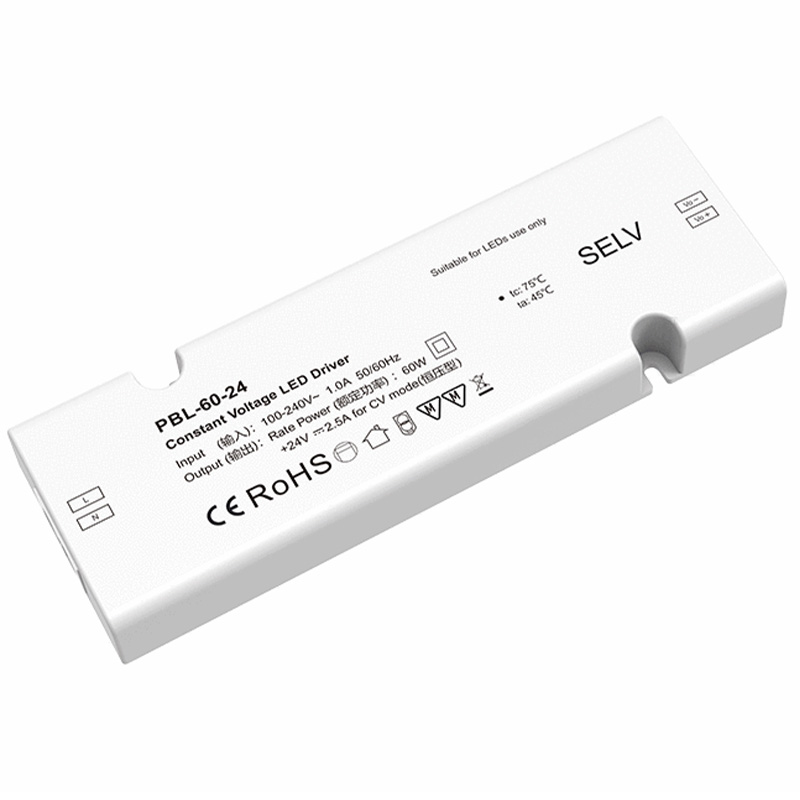
PBL-60-24 60W 100 to 240VAC Constant Voltage SELV LED Driver

PBL-60-12 60W 12V 1CH Constant Voltage LED Cabinet Light Driver
FAQ About LED Cabinet Lighting Control Series
Clear answers from our technical desk on wiring, power calculations, sensor pairing, and multi-shelf control for cabinet installations.
A multi-shelf cabinet with led lights turns on seamlessly when you feed all shelf leads into a centralized 6-channel junction box like the CV0 or CV1. Each output port receives identical voltage and dimming signals in parallel. That means your under-shelf runs, vertical face accents, and interior cubbies dim and switch at the exact same moment from one trigger source.
Our 6-channel cabinet led lighting units accept low-voltage sensor heads including the ER PIR motion sensor, EB hand sweep sensor, ED door contact switch, EC touch sensor, and EW concealed wood touch sensor. These sensor heads connect straight to the controller input port using standard low-voltage harnesses. The controller reads the sensor trigger and applies the on, off, or smooth dimming action across all connected shelf outputs.
To size your power supply for cabinet led lights, add the rated wattage of every shelf run together and add a 20% safety margin. If you have six cabinet shelves each running 0.8 m of 9.6 W/m LED strip, your raw load is 46.08 W (6 × 0.8 m × 9.6 W/m). Adding a 20% headroom margin requires at least 55.3 W, making a 60W constant voltage driver like our PBL-60-12 or PBL-60-24 the right match.
The cleanest location for in cabinet lighting control gear is atop the upper cabinetry behind the crown moulding or inside an adjacent pantry access panel. Placing the driver above the millwork keeps line-voltage AC out of reach while letting you drop low-voltage class 2 DC cabling down cabinet service chases. For step-by-step wire routing methods, check our above-cabinet lighting guide.
Controlling dual-white tape requires a 2-channel CCT controller such as the 12V CV2, paired with tunable white strips and a 3-wire harness (common positive, warm white negative, and cool white negative). The CV2 controller balances current between the 2700K and 6500K channels across its six synchronized output ports, letting you adjust color temperature and brightness simultaneously using a matched CCT RF remote.
Connecting the CV1(WT) hub to your 2.4 GHz home network allows Alexa and Google Assistant to control cabinet lighting by voice for on/off toggling and brightness adjustment. The Tuya chip inside the CV1(WT) bridges the local PWM dimming circuit to cloud routines. If your home internet drops, the CV1(WT) still responds instantly to paired 2.4G RF handheld remotes and direct sensor inputs.
Single-color tape light is the standard LED for cabinet light installations running off the CV1, which provides six dimmable 12V outputs controlled together. With our catalog stocking 6 live models in this specialized category—three of which are dedicated 12V units—this range deliberately focuses on low-voltage cabinet cabinetry where 12V represents 50% of the lineup compared to 0% in general sensor switches.
Yes, you can wire multiple ED door contact switches to coordinate a cabinet lighting led system across a multi-door wardrobe or pantry credenza. When using normally-closed door switches wired in parallel, opening any single cabinet door triggers the controller to illuminate all six connected shelves immediately. The lights stay on until the last open door is pushed completely shut.