
0/1-10V DC Dimming Driver
7 productsSkyDance 0/1-10V DC Dimming Driver Series is designed to convert standard 0-10V or 1-10V analog dimming signals into PWM constant voltage outputs for low-voltage LED strip lighting systems.
Operating with an external DC 12–36V or DC 12–48V power supply, these dimming drivers/controllers receive brightness control signals from compatible 0/1-10V wall dimmers, rotary panels, or smart modules, then regulate the LED output through PWM dimming.
Available in 1-channel, 2-channel, and 4-channel 0/1-10V output configurations, the series accommodates different LED strip lighting applications:
- 1-Channel DIM Dimming: Provides single-channel PWM output for smooth brightness adjustment of single-color LED strips.
- 2-Channel CCT Dimming: The LV2 model offers two independent 0/1-10V signal inputs and two PWM outputs for tunable white LED strips. It can be configured for two separate single-white dimming, or for one CCT adjustment.
- 4-Channel Independent Dimming: The L4-L model provides four independent analog signal inputs and four PWM constant voltage outputs, allowing four single-color LED strips or lighting zones to be dimmed separately.
Advanced Dimming Performance: Compatible with active and passive 0-10V / 1-10V dimmers, these DC drivers/controllers provide smooth 0–100% brightness adjustment with logarithmic or linear dimming curves, selectable PWM frequencies from 500Hz to 16kHz, and external Push-Dim control or 2.4G RF remote control for additional flexibility, depending on the model.
Ideal for residential LED strip lighting, commercial accent lighting, architectural installations, cove lighting, and multi-zone lighting systems, SuperLightingLED SkyDance 0/1-10V DC dimming drivers provide a practical way to integrate low-voltage DC LED strips into professional analog dimming systems.

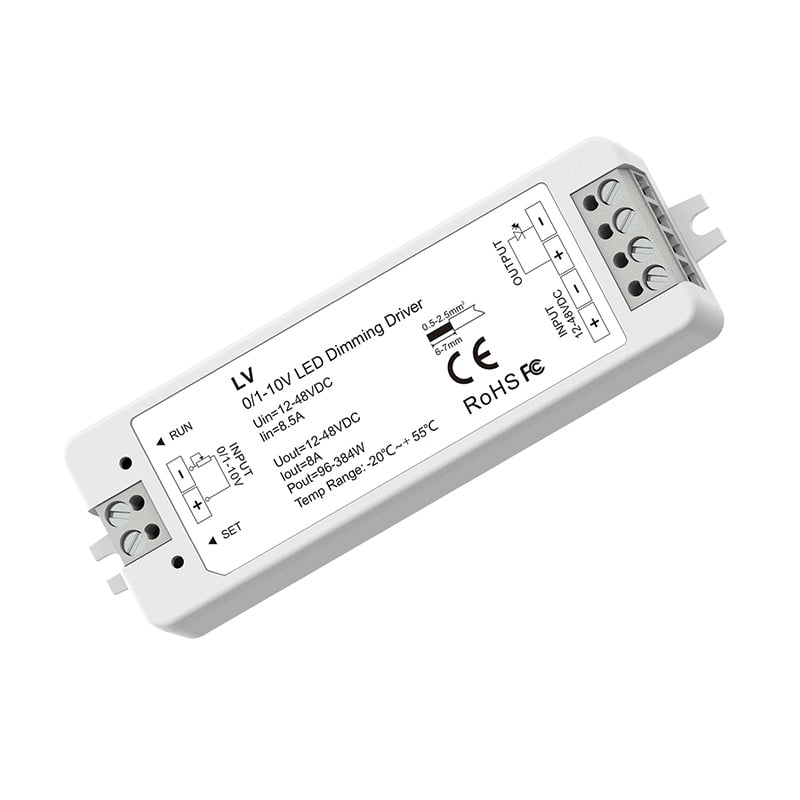

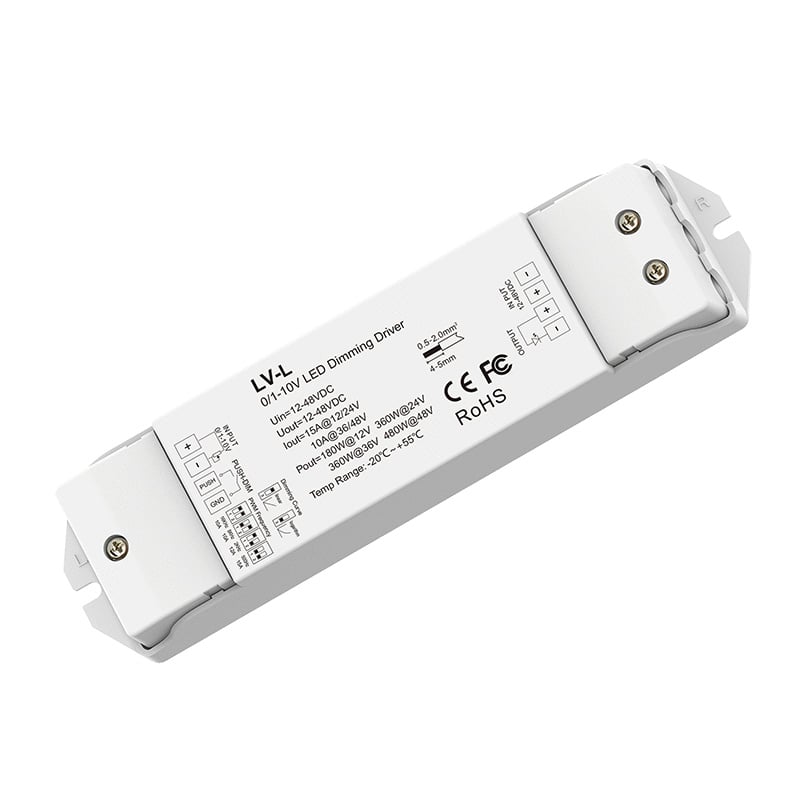
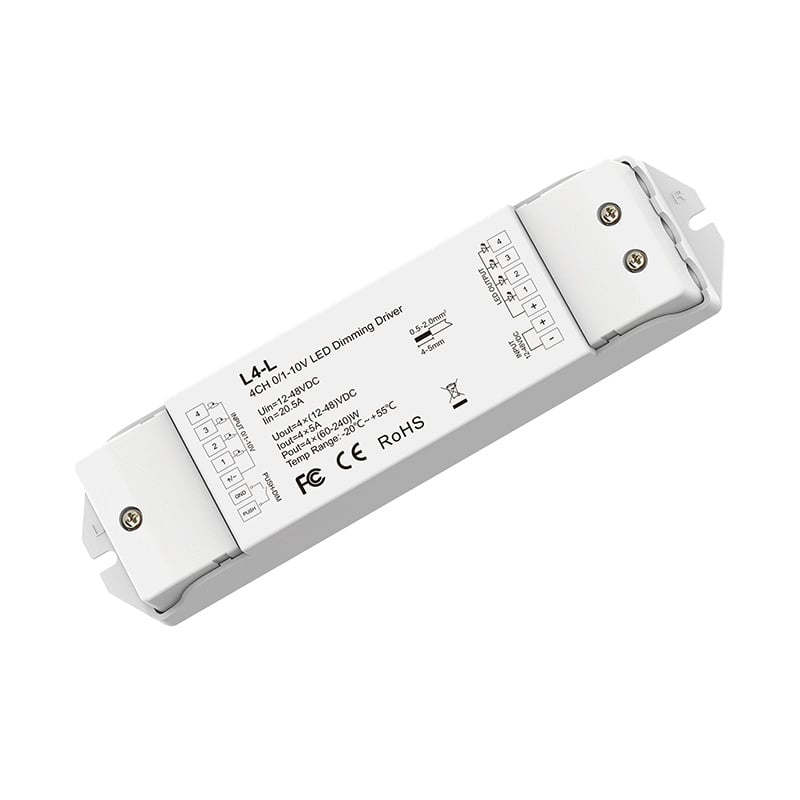


How to Wire a Low-Voltage LED Strip 0/1-10V Driver
SkyDance low-voltage 0/1-10V DC dimming drivers require an external DC constant voltage power supply and a compatible analog dimming signal source. The DC power input supplies operating power to the driver and LED strips, while the separate 0/1-10V control input determines the PWM dimming level.
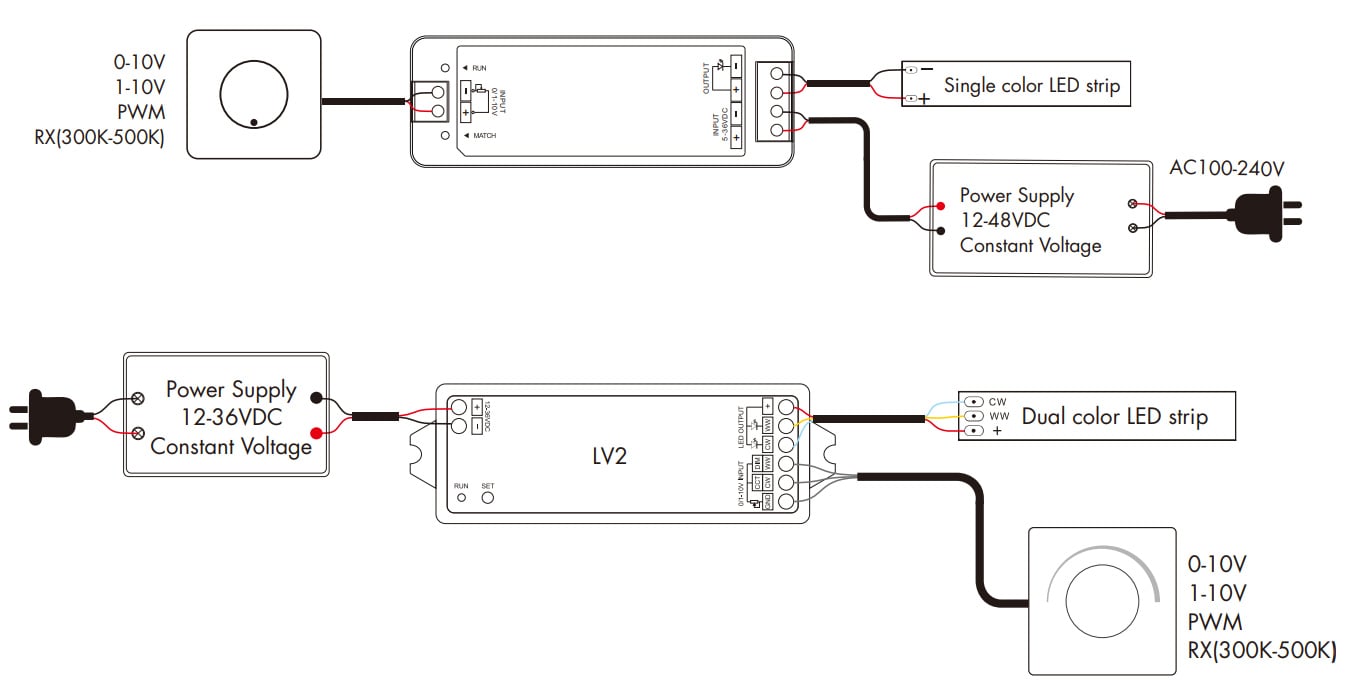
1. Connect the DC Power Supply
Connect an external DC constant voltage power supply to the 0/1-10V DC driver's DC input terminals. The external DC power supply must match the LED strip's rated voltage, while the driver's output current and total power capacity must be selected according to the connected LED load.
2. Connect the 0/1-10V Signal Controller
Connect a compatible 0-10V or 1-10V master controller to the driver's analog signal input terminals. Follow the designated DIM+ / DIM- and GND terminal markings shown in the model-specific wiring diagram. The control signal adjusts the PWM output duty cycle, allowing the connected LED strip to dim smoothly from minimum to maximum brightness.
3. Connect the LED Strip Output
Connect the constant voltage LED strip to the DC 0/1-10V driver's PWM output terminals, observing the correct voltage and polarity.
- Check the driver's maximum current per channel and total output power before connecting the LED load.
- Use a power supply with sufficient capacity for the combined LED strip load, allowing appropriate operating margin.
- Where multiple 0/1-10V to LED strip light drivers share one analog dimming signal source, follow the manufacturer's recommended device count and cable length limitations.
This configuration is ideal for installations where a suitable low-voltage DC power supply already exists or where the power supply needs to be selected separately according to the LED strip's voltage and power requirements.
FAQ About 0/1-10V DC Dimming Driver
Direct engineering answers on wiring, load limits, and compatibility for low-voltage 0/1-10V DC dimming drivers.
A 0 10v dimming led driver takes a steady DC voltage input (usually 12V, 24V, 36V, or 48V) and translates a low-voltage analog control signal into a high-frequency PWM output for constant-voltage lighting. Unlike AC-line dimmable supplies, this unit does not plug directly into 120V or 230V mains; it sits between an external power supply and your tape light. As the incoming signal shifts between 0V (or 1V) and 10V, the internal microprocessor scales the output duty cycle from 0% to 100% across 4,096 smooth steps.
Yes, our 0 10v led driver modules feature an auto-detecting control port that works with both active voltage sources and passive resistance dimmers. An active controller or commercial building automation system injects an external 0-10V voltage directly into the terminals. A passive potentiometer or 1-10V wall station relies on the driver to source approximately 0.6mA of internal current, which the dimmer then sinks down to regulate brightness. You can wire either type to the signal terminals without flipping DIP switches.
A 0 10v dimming driver using a logarithmic dimming curve matches how the human eye perceives light changes, preventing the sudden drop-offs common with cheap linear controls. Because human vision is far more sensitive to tiny lumen shifts in dark environments, a linear dimmer appears to drop 70% of its brightness in the bottom third of the slider travel. A logarithmic curve spreads that lower range across 4,096 PWM steps, giving you an even, natural progression from 1% accent lighting up to 100% full output.
Every DC driver carries a hard current rating—like 12A on single-channel models or 5A per channel on 4-channel units—and loading past that threshold will trip the internal thermal shutdown. When your total installation exceeds that limit, do not overload the terminal blocks; split the run and expand your capacity using power repeaters. The repeater reads the PWM output from your primary driver and duplicates it across supplemental LED circuits seamlessly, allowing virtually unlimited runs from a single wall control.
Yes, many models in this category feature dedicated Push-Dim terminals alongside standard 0/1-10V ports, allowing simple momentary wall switches to handle full dimming duties. A short tap on the button toggles your LED tape on or off, while holding the button ramps the brightness smoothly between 0% and 100%. The internal memory retains your last brightness setting even after mains power is disconnected, which makes it ideal for residential bedrooms, home offices, and hospitality headboard lighting.