
CV Controller
28 productsPWM Color Control for RGB, RGBW & RGBCCT LED Strip Lights
BinColor Constant Voltage (CV) RGB/RGBW/RGBCCT Controllers are designed for common-anode color-changing LED strip lights, using PWM (Pulse Width Modulation) technology to independently regulate each color channel and create a wide range of lighting colors and effects.
The CV series offers more than one way to interact with your lighting. Users can make direct adjustments through onboard buttons, rotary knobs, or touch controls, or use compatible RF handheld remotes and wireless wall panels for convenient remote operation. Some also combine manual and wireless controls in one system, giving users greater flexibility in how they operate their color-changing LED strips.
Choose a controller according to your LED strip configuration:
- RGB LED Strips: Three-channel PWM output for independent red, green, and blue color mixing.
- RGBW LED Strips: Four-channel control with an additional dedicated white LED channel, allowing color-changing effects and independent white illumination.
- RGBCCT LED Strips: Support RGB color control together with adjustable warm and cool white output.
Depending on the model, users can select colors, adjust overall brightness, control individual color channels, and choose preset dynamic effects.
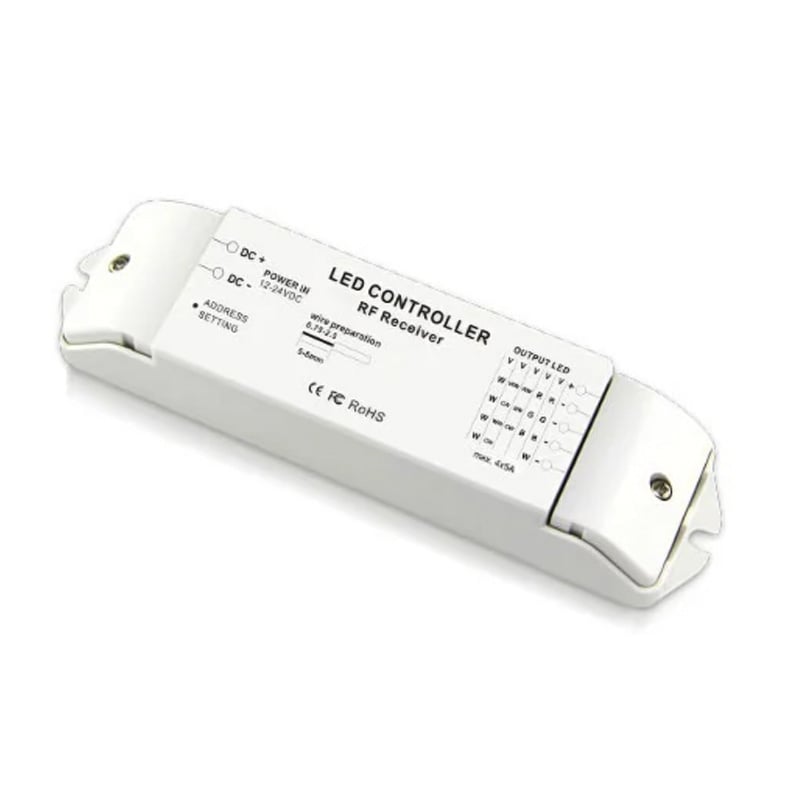
BinColor R4-2.4G Wireless 4-Channel LED Light Strip Receiver For PX Panel Remotes


BC-380-6A RGB Controller 5-36V - DIY Programmable LED Modes | 8A/CH

DC5V-24V RGB LED Controller BC-390 - 4096 Levels, 36 Modes

FAQ About CV Controllers
Direct answers to common wiring, voltage matching, and load calculation questions on constant voltage LED strip controllers.
A CV controller for LED strip lights regulates brightness and color mixing by rapidly switching the negative output channels to ground using high-frequency Pulse-Width Modulation (PWM) while maintaining a fixed DC voltage. In constant voltage systems, the positive supply rail (+12V, +24V, or +36V) connects directly to the common anode of the LED strip light. The controller sits between the power supply and the tape, cycling each red, green, blue, or white channel on and off thousands of times per second. Because the voltage amplitude never changes, your LEDs maintain consistent forward current and color temperature across the entire dimming curve without chromatic shift.
Maximum amperage on a CV controller for LED strip lights depends on the output MOSFET ratings, typically ranging from 3A per channel on compact receivers to 5A per channel on heavy-duty units. For example, the BC-354 handles 5A per channel across 4 channels—giving you 20A total capacity (240W at 12V or 480W at 24V). As an engineering safety margin, we recommend capping continuous loads at 80% of rated capacity (4A per channel on a 5A-rated output). If your lighting layout pulls more than that, do not push the controller; split the load using an external RGBW signal amplifier.
Inverted colors on a CV controller for LED strip lights almost always mean the negative channel wires are swapped at the output screw terminals. If your LED strip lights show blue when you select red on the interface, the blue negative lead is screwed into the red terminal block. Turn off the DC power supply, double-check the printed silkscreen on your strip light PCB (which often reads +/R/G/B or +/G/R/B depending on factory batch), and align each colored wire to the corresponding terminal label on the controller.
Standard CV controllers max out at 24V DC, but specific wide-voltage models like the BC-355RF operate across an auto-adapting DC 12V to 48V range. Most of our 28 models are engineered for 12V and 24V runs, but when commercial projects require 48V to eliminate voltage drop over 20-meter linear cove runs, a 48V-capable CV unit handles up to 5A per channel safely. Always verify that your DC power supply voltage strictly matches your LED strip rating before powering the unit.
Audible buzzing from a CV controller for LED strip lights during low-level dimming occurs when the PWM switching frequency resonates with ceramic capacitors or inductors inside the DC power supply. To eliminate the whine, maintain a physical separation of at least 30 cm (12 inches) between the CV controller and the driver. Alternatively, switch to an industrial-grade power supply with potted internal components or select a controller with a PWM frequency above 8 kHz, which sits beyond the range of human hearing.
Permanent output channel failure on a CV controller for LED strip lights is almost always caused by a momentary dead short across the low-voltage output terminals. When positive and negative copper pads touch while energized—frequently during installation trimming—the instantaneous current spike exceeds the controller's internal MOSFET threshold in microseconds, fusing the transistor permanently open or closed. Always disconnect AC mains power before cutting, soldering, or terminating LED tape wires to protect the solid-state switching components.