
RF CCT CV Controller
27 productsThe SkyDance RF CCT CV Controller Series is specifically designed for wireless dimming and color temperature adjustment of DC12-24V, DC12-36V, or DC12-48V constant-voltage (CV) tunable white LED strip lights. Featuring 2.4GHz RF wireless technology, these light controllers connect your dual-white LED strips with compatible SkyDance RF CCT handheld remotes or wall-mounted panel remotes, giving you convenient control over brightness, color temperature, lighting scenes, and individual zones. Some models also combine RF with Wi-Fi, Zigbee, or Bluetooth connectivity, offering additional smart APP control options.
The Skydance RF CCT pairing system supports flexible one-to-many and many-to-one configurations. One remote can operate multiple controllers, while one controller can be paired with multiple remotes or wall panels. And multiple CCT controllers can synchronize their lighting operation wirelessly within a range of up to 30 meters under suitable conditions.
Not every installation requires a separate remote. Models equipped with built-in buttons or rotary knobs can also be operated directly on the controller itself, allowing you to adjust the color temperature lighting without pairing an external remote or wall panel.
Confirm the CCT Output Mode Before Use
Some multi-function LED strip controllers combine CCT lighting control with other color modes in a single unit. When connecting a tunable white LED strip, make sure the controller is configured to the correct CCT output mode before operation.
Using an incorrect output mode may cause the warm white and cool white channels to operate improperly, resulting in unexpected light colors or no illumination at all. Always check the controller's mode settings and product instructions to ensure they match your LED strip's CCT wiring configuration.


T2(IT) 4CH*3A LED Tunable White Touch Panel Controller

WT1-M WiFi LED Controller - Tuya, Alexa, Apple Home Smart CCT Dimmer


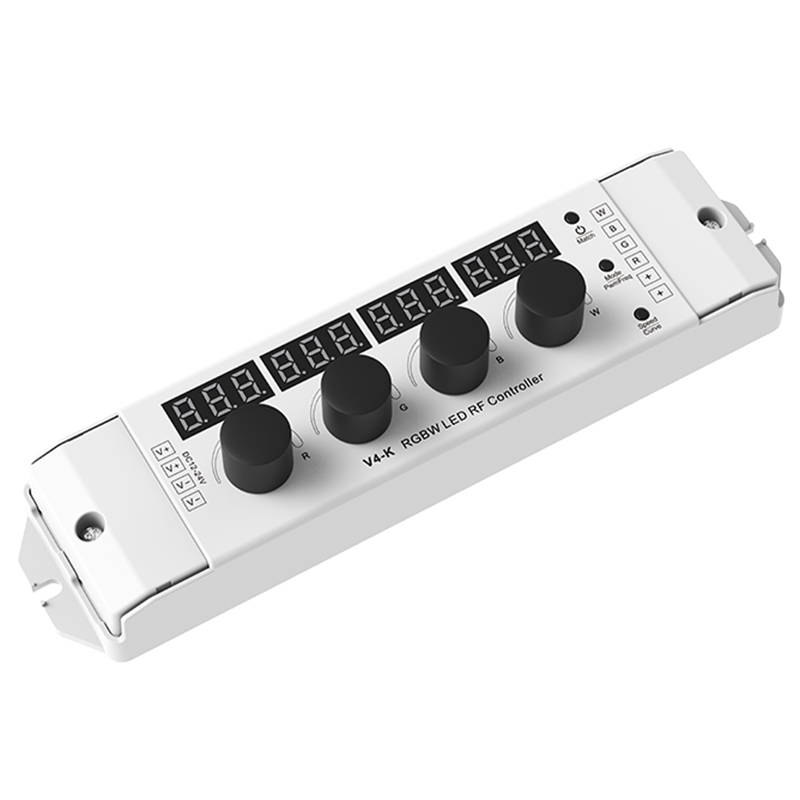
V2-K 4CH*4A 12-24VDC Color Temperature LED Knob Controller
Frequently Asked Questions About RF CCT CV Controllers
Direct technical answers from our engineering desk on wiring, load limits, and wireless setup for constant-voltage tunable white LED systems.
An RF CCT CV controller is a low-voltage receiver that sits between your constant-voltage DC power supply and your tunable white LED strip lights to manage both brightness and color temperature. It takes a steady DC voltage—typically 12V, 24V, or 48V—and rapidly pulses the negative channels using pulse-width modulation (PWM) across 4096 dimming steps. When you adjust the color wheel or dial on a paired 2.4GHz wireless remote or wall panel, the controller shifts the duty cycle balance between the warm-white and cool-white channels without altering the supply voltage.
Your RF CCT CV controller amperage must exceed the combined peak draw of both white channels on your LED strip lights by at least 20%. For example, our compact V2 receiver handles 5A per channel (10A total, or 240W at 24V), which covers roughly 10 to 12 meters of standard 19.2W/m dual-white tape. If you run heavier architectural runs, stepping up to our V2-X high-current controller gives you 15A per channel across 12-36V DC, letting you power up to 360W at 24V without adding external power boosters.
Most standard RF CCT CV controller units are built for 3-wire common-anode tape, but dedicated dual-wire models exist for reversing-polarity LED strip lights. A standard 3-wire strip uses a shared positive terminal with separate negative returns for warm and cool white. If your tape has only two copper pads (+ and -) and swaps color by flipping DC polarity, a standard V2 receiver will not work; you need a specialized polarity-reversing model like the V2-S or V2-S(WZ), which handles up to 10A across 12-36V DC.
Yes, nearly all of our 2-channel receivers feature dedicated push-dim terminals that work simultaneously with 2.4GHz wireless remotes. You wire a standard normally-open momentary wall switch directly between the push terminal and DC negative or positive, depending on the wiring diagram on the housing. A quick tap toggles the LED strip on or off, a sustained press dims brightness smoothly, and a double-click shifts color temperature between warm white and cool white, giving you local hardwired control if the handheld remote is misplaced.
Each RF CCT CV controller includes an integrated signal-forwarding chip that automatically relays radio commands to any neighbouring controller within 30 meters. When your handheld remote or wall panel sends an RF command to the first receiver, that unit executes the change and re-transmits the data packet to the next unit in line. This daisy-chain mesh lets you synchronize dozens of controllers across hotel lobbies, continuous retail coves, or entire floorplates spanning hundreds of meters without running dedicated low-voltage data cables.
A faint residual glow on one channel usually points to an incorrect common terminal connection or a floating ground loop through a metal mounting profile. If the shared positive wire from the LED strip is accidentally clamped into a negative channel terminal, current back-feeds through the internal MOSFET bypass diode. Shut off mains power, disconnect the output leads, and verify with a multimeter that your common positive tape lead lands squarely on the V+ terminal, with warm-white and cool-white strictly landing on CH1 and CH2.
In this RF CCT CV controller range, your choice comes down to which ecosystem or wireless protocol your space already uses. If you only want reliable handheld remotes or touch panels with zero network configuration, choose standard RF units like the V2. If you need app automation via smart assistants, select the Zigbee WZ1 or Tuya WiFi WT1. For commercial architectural projects demanding BLE mesh and automated daylight harvesting without a central gateway, select Casambi models like the CB1 or CB5.
Color discrepancies between zones usually occur when mixing different controller firmware revisions, unequal wire lengths, or different LED strip manufacturing batches. Review our tunable white engineering guide to understand how voltage drop across uneven DC cable runs alters the actual voltage reaching the warm-white versus cool-white phosphor traces. If line resistance drops 1.5V on one run, its brightness and blended Kelvin balance will noticeably drift compared to an identical run receiving full 24V. Balance your wire gauges and re-pair all receivers to one master remote channel.