
RF DIM CV Controller
41 productsSkyDance RF DIM CV Controllers are designed primarily for dimmable single-color LED strip lighting, including static-white and fixed-color LED strips. Connect compatible LED strips to the appropriate RF dimming controller, and then use a compatible SkyDance RF dimming remote to adjust brightness and recall supported lighting settings.
The product range includes controllers for different LED strip voltage requirements, with model options for DC 5V, DC 5–24V, DC 5–36V, DC 12–24V, and DC 12–48V, as well as dedicated AC 100–240V dimmers for compatible high-voltage LED strips. Always select a controller that matches the voltage and electrical requirements of your LED strip.
Choose the Right SkyDance RF DIM Controller Type
SkyDance offers several types of single-color LED dimming controllers to suit different installation preferences and control methods.
1. RF Dimming Controllers with Push-Dim Support
These controllers regulate the brightness of compatible single-color LED strips through a connected push-button switch or a compatible SkyDance RF dimming remote, depending on the model. They are suitable for installations where users want convenient local push-button dimming alongside wireless remote control.
2. RF Rotary Knob Dimming Controllers
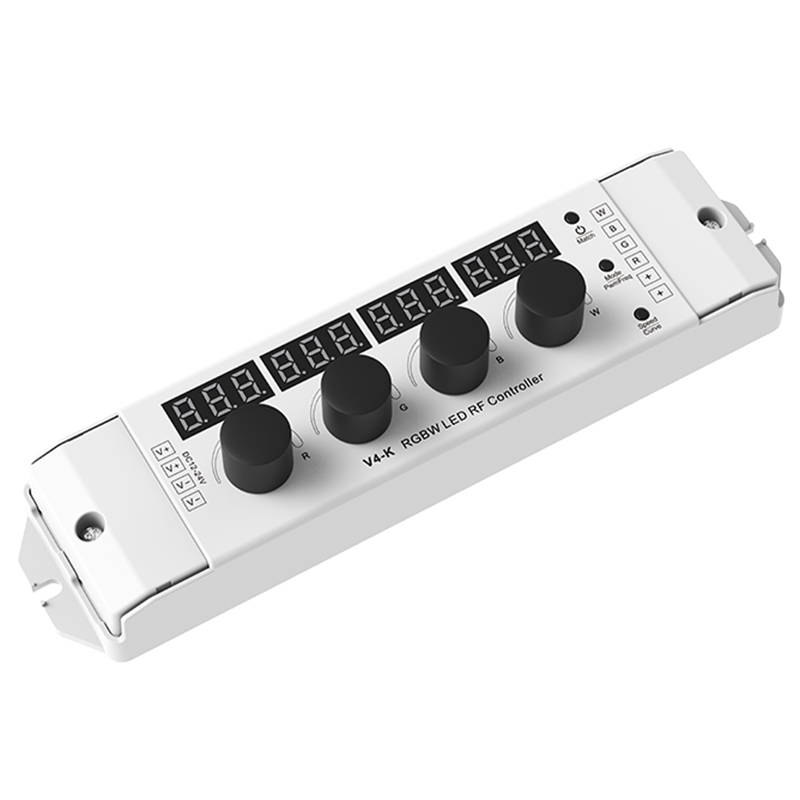
Rotary dimming controllers provide direct brightness adjustment through a knob on the controller itself. They can also pair with a compatible SkyDance RF remote, allowing users to adjust lighting wirelessly. Some models, such as the V1-B, feature a digital display for convenient status and setting reference.
3. RF Button Dimming Controllers
Button-style controllers allow users to adjust brightness using the physical buttons on the controller. They also support wireless operation through a matching SkyDance RF remote, combining direct on-device control with convenient handheld dimming.
4. RF Touch or Rotary Wall Panels
Touch and rotary wall panels provide a convenient wall-mounted interface for single-color LED strip dimming. These panels are hardwired to the compatible LED strip and its power connection, allowing them to control the lighting directly. They can also be wirelessly paired with additional compatible SkyDance RF handheld or panel remotes for convenient control from other locations.
5. Smart Control Dimming Controllers
For users who want more than conventional RF dimming, SkyDance also offers smart lighting controllers across the RF & Tuya Wi-Fi, Zigbee, and Bluetooth series. Through a WiFi, Bluetooth, or Zigbee system, these controllers combine smart app control with compatible RF remote operation, providing additional options for controlling single-color LED strips and other supported lighting loads.
6. RF Dimming Controllers with Smart Motion or Human Presence Sensors
SkyDance also offers RF dimming controllers with built-in microwave motion or human presence sensors, combining automatic sensor-activated lighting with convenient wireless dimming control. When movement or human presence is detected, compatible models can automatically switch the lights on or adjust lighting according to the configured sensing mode. Some also support adjustable detection distance, hold time, daylight thresholds, and multi-stage dimming.
In addition to automatic sensor control, these RF dimming sensor controllers can be paired with compatible SkyDance RF remotes, allowing users to manually switch lights on or off, adjust brightness, and control supported lighting functions. This combination of sensor automation and RF remote operation is ideal for corridors, stairways, closets, bedrooms, and other spaces where convenient hands-free lighting and manual dimming are both useful.
Find the Right Wireless LED Dimming Controller
Whether you prefer push-button dimming, sensor dimming, a built-in rotary knob, physical control buttons, a wall-mounted touch or rotary panel, or APP control, SkyDance RF DIM controllers offer different ways to adjust the brightness of compatible single-color LED lighting. Choose the control style and voltage specification that best match your LED strip and installation requirements.
FAQ About RF DIM CV Controllers
Direct answers to the most common technical, wiring, and pairing questions about SkyDance constant-voltage RF dimmers.
An RF DIM CV controller sits between your DC power supply and your single-color LED strip lights, receiving 2.4GHz wireless radio commands to regulate brightness via pulse-width modulation (PWM). Unlike AC wall dimmers that chop line voltage before the transformer, a constant-voltage (CV) controller takes smoothed 5V, 12V, 24V, 36V, or 48V DC power and rapidly switches the ground rail on and off thousands of times per second. That gives you flicker-free 0% to 100% dimming without altering the DC output voltage or shifting the color temperature of your LEDs.
An RF DIM CV controller is limited strictly by its maximum output amperage multiplied by your operating DC voltage. A standard 15A unit like the V1-L can deliver up to 180W on a 12V circuit, 360W on 24V, and 720W on 48V. To keep the terminal blocks cool during continuous 100% duty cycles, we advise sizing your total tape load to 80% of the controller's rated capacity. When your layout exceeds that amperage, you do not need a second remote setup; simply tap the controller's output into a power repeater to mirror the dimming signal across another power supply feed.
Every standard SkyDance RF DIM CV controller with push-dim terminals allows you to connect an ordinary momentary push switch while simultaneously pairing with up to 10 wireless RF remotes or battery wall panels. A quick tap on the momentary wall switch toggles power on or off, while holding it down ramps brightness smoothly from 1% to 100% and reverses on the next long press. The controller remembers its last brightness setting across power outages, so flipping a physical master switch brings your single-color LED tape right back to your chosen light level.
A standard indoor RF DIM CV controller carries an IP20 rating and will fail rapidly from condensation, board corrosion, or moisture ingress if installed in damp locations. For outdoor soffits, landscape accents, or bathroom niches, select an outdoor model like the V1-WPM or V4-WPS. These versions are fully potted with high-grade thermal silicone inside an IP67 weatherproof housing and feature sealed cable glands. They handle driving rain and relative humidity from -30°C to +55°C while maintaining full 30-metre wireless RF reception through non-metallic enclosures.
The wiring order must always be AC mains into the power supply, DC output into the controller, and controller output directly to your LED strip lights. Never place an RF DIM CV controller between the wall mains and an AC transformer; supplying 120V or 240V AC to a low-voltage DC terminal will destroy the circuitry instantly. Keep the DC wire run between the power supply and the controller under 3 metres using 14 AWG or 16 AWG stranded copper to avoid line loss before the dimming stage. If your installation layout requires long cable runs, check our guide to choosing LED controllers for sizing rules.
SkyDance 2.4GHz RF DIM CV controllers incorporate automatic radio re-transmission and step synchronization across every matched unit. When a controller receives an RF signal from a handheld remote, it executes the command and immediately relays that transmission to any adjacent controller within a 30-metre radius. This daisy-chains wireless coverage across large open ceilings or long hallways up to hundreds of metres. Because all paired receivers update their internal clock cycles simultaneously, multi-zone installations dim up and down in unison with no visible delay between separate runs.
SkyDance RF DIM CV controllers feature built-in hardware protection against reverse polarity, short circuits, output overloads, and thermal overheating. If a pair of output wires touches during trim work or drywall installation, the onboard sensing circuitry shuts down the MOSFET gate drive within microseconds, preventing silicon meltdown. Once you remove the short or reduce the overloaded tape length, the controller automatically resets to normal operation without requiring a manual fuse replacement or physical power cycle.