
Black LED Neon Silicone Diffuser
43 productsFlexible silicone led diffuser with black neon finish for led strip lights. LED light strips installed in the black neon light tube will get a uniform and soft led light effect. The black led strip housing provides a decorative effect to your neon lighting and echoes your decor style. Silicone material has good flexibility, can be bent to design various shapes, suitable for led neon signs decorations, decorative lines, wall decor, and home decor. The silicone led channel system provides an IP67 and even IP68 waterproof rating for the inside led light strip by sealing the strip ends with glue, which can be used for outdoor and underwater lighting. Threading LED Strips into Neon Sleeves: DIY Tips & What Not to Do
Introducing Our 2025 Innovation: Patterned Black Neon LED Flex Profiles – Where Light Meets Art
Elevate your space with the next generation of decorative neon tape lights. Each led neon flex channel has an elegant or honeycomb pattern on its surface, creating a mesmerizing interplay of light and shadow while reducing glare.
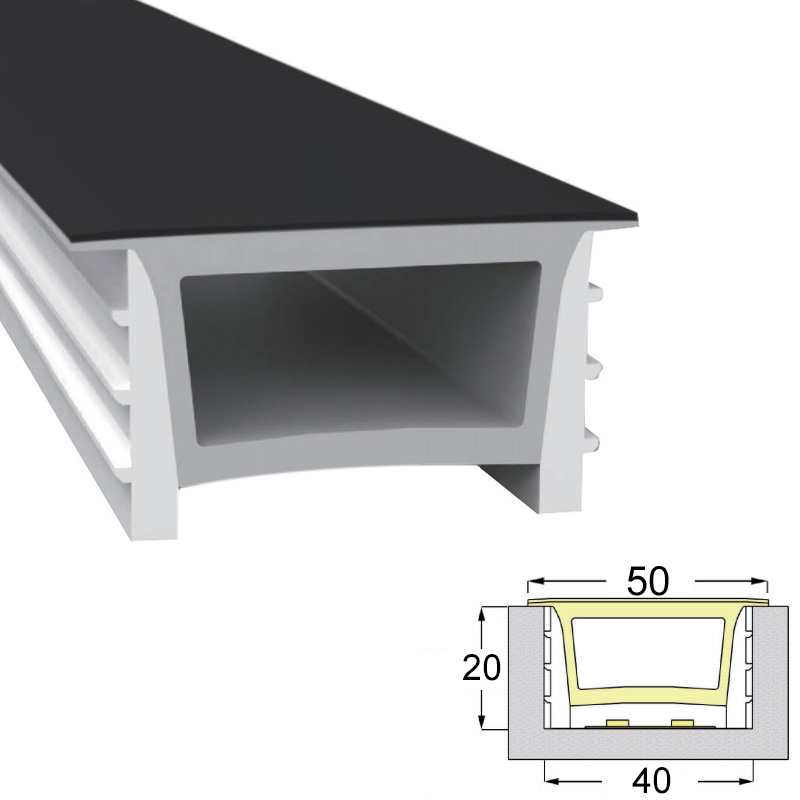
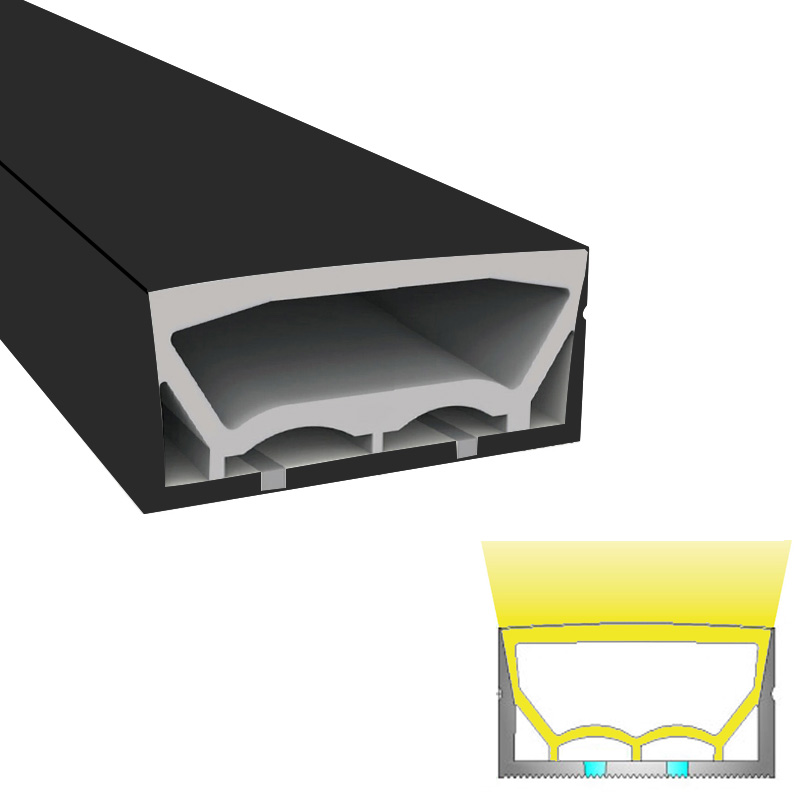
50x25mm Black Silicone LED Neon Tube - Dotless IP67 for 2x12mm Strips
Frequently Asked Questions About Black LED Neon Silicone Diffusers
Your questions about our black silicone diffusers, answered by an engineer. Here's what you need to know before you buy.
It will reduce the brightness more than a milky-white diffuser does, that's a fact of physics. The black pigment absorbs some light to get that deep, unlit look. To compensate, you just need to use a brighter, higher-density LED strip inside. We typically recommend a strip with at least 120 LEDs per meter, and for the best effect, a COB strip will give you a flawless, super-bright line of light with no hotspots at all.
What our black LED light diffusers do is absorb stray light and shape the output, providing a true black look when off and a clean, linear light when on.
Designers use black LED light diffusers to create sharp, dramatic architectural lines that blend into dark surfaces or create contrast on light ones. When turned off, they look like a deliberate, minimalist black trim. When you turn them on, they produce a perfectly uniform line of light. They're popular for retail displays, modern home accents, home theaters, and anywhere you want the light fixture itself to be a design element.
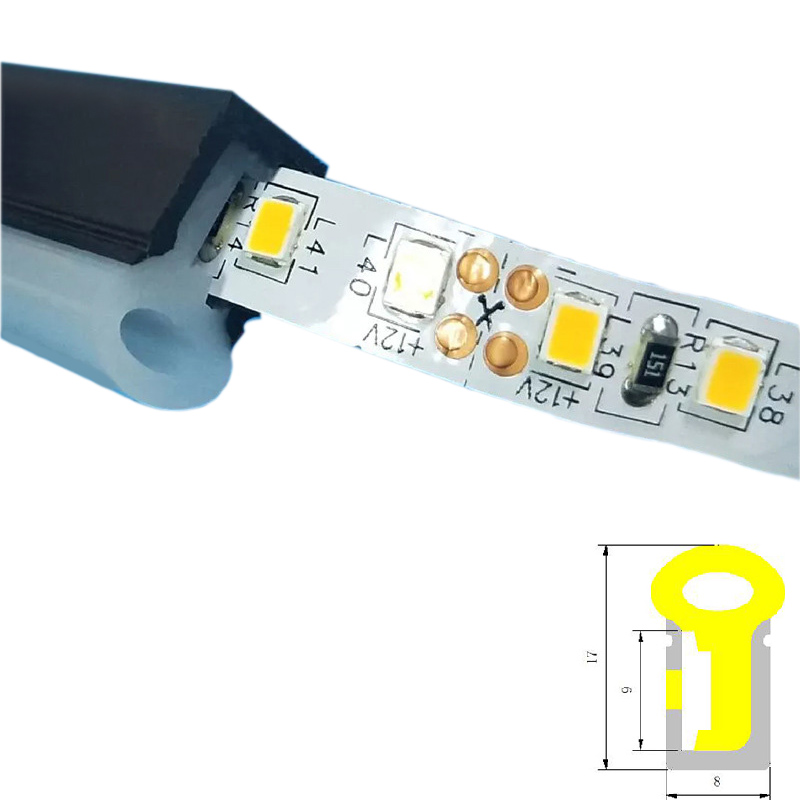
The key is using the right LED strip. Don't use a low-density strip (like 30 or 60 LEDs/meter) or you'll see faint spots and be disappointed with the brightness. For the best black light effect, you need high-density tape, ideally a dotless COB strip. Also, make sure the strip's PCB width matches the diffuser's internal dimension so it sits straight and fires directly into the silicone for the most even diffusion.
The honeycomb or patterned surface on some of our black neon flex profiles acts like a micro-louvre. It breaks up the flat, single-source light emission you get from a standard diffuser. This scatters the light at more angles and slightly shields the direct view of the illuminated core, which your eyes perceive as a softer light with significantly less glare. It's functional and adds a high-tech decorative look even when the light is off.
Yes, their flexibility is the main reason to use them. However, each profile has a minimum bending radius that depends on its size and whether it's a top-bend or side-bend model. A 'side-emitting' or side-bend profile can make much tighter turns on its plane than a top-bend version can. Check the product spec sheet for the exact number, but for intricate shapes and lettering, you'll almost always want a side emitting silicone diffuser.
The silicone tube itself is fully waterproof, but the ends are where water gets in. To get a proper IP67 rating, you need to seal it correctly. After you've threaded the LED strip inside and soldered your wires, you inject a generous amount of clear or black silicone sealant into both the front cap and the wired end cap. Make sure the sealant fully encapsulates the wires and strip ends, then let it cure completely before installing.
It's all about which way the light comes out relative to how it bends. A top-emitting diffuser shoots light straight out from the flat top surface; it bends up and down. A side-emitting diffuser shoots light out from the narrower edge; it's designed to bend left and right. For making shapes on a flat wall, you'd use a side-emitter. For following a curved ceiling cove, you'd use a top-emitter. Using the right one is critical for getting your intended shape.
You'll likely be unhappy with the result. First, the output will be dim because the black silicone absorbs more light than a white diffuser. Second, and more importantly, you will probably see the individual LED dots, which defeats the purpose of getting a smooth, neon-like line. This is the single most common mistake we see. Always pair these black diffusers with a high-density tape or, even better for a perfect glow.
They don't produce heat themselves, they just house the LED strip which does. The silicone is an excellent thermal insulator, so it's important not to overpower the LED strip inside. As for fading, we use high-grade, UV-stabilized silicone. Unlike cheaper PVC or plastic, it won't turn yellow or brittle when exposed to sunlight, which is why it's the standard material for outdoor-rated architectural lighting.
It depends on if you need curves. If your design is all straight lines—think recessed ceiling slots or under-cabinet lighting—use black aluminum channels. They offer better heat sinking and a very rigid, crisp look. But if you need to bend the light around a curve, follow an archway, or create a custom shape, a black silicone diffuser is the only way to go. It gives you that same sleek black aesthetic with total flexibility.
You'll need a diffuser with an internal width that's specified for a 10mm PCB. Don't try to force a 10mm strip into a diffuser made for an 8mm strip; it will wrinkle and create hot spots. Likewise, putting it in a channel for a 12mm strip will let it sit crooked. Each product page lists the compatible PCB width. We have dozens of 10mm silicone diffuser options, so just filter for that size to see all the profiles that will be a perfect fit.
Yes, absolutely. A huge portion of the diffusers we ship are cut to project-specific lengths. Just send us your requirements—even a simple sketch is fine. An engineer will spec out the cuts, the right end caps, and can even recommend the best LED strip for the job. We'll send back a complete parts list and quote, usually within 12 hours. There's no fee for this service. We can even pre-install the strip for a true plug-and-play solution.