
0/1-10V to Triac ELV Converter
2 productsSkyDance 0/1-10V to Triac/ELV Converters are designed to convert standard 0-10V or 1-10V analog dimming signals into AC Triac/ELV phase-cut dimming output, supporting both leading-edge (forward-phase) and trailing-edge (reverse-phase) dimming methods.
By connecting these converters between a centralized 0/1-10V lighting control system and compatible AC Triac/ELV dimmable lighting loads, users can integrate AC-powered dimmable LED lights, lamps, and LED drivers into a unified 0/1-10V control network.
This makes it possible to manage different types of lighting equipment through the same centralized analog dimming system without replacing existing AC dimmable fixtures in residential, commercial, and architectural lighting.
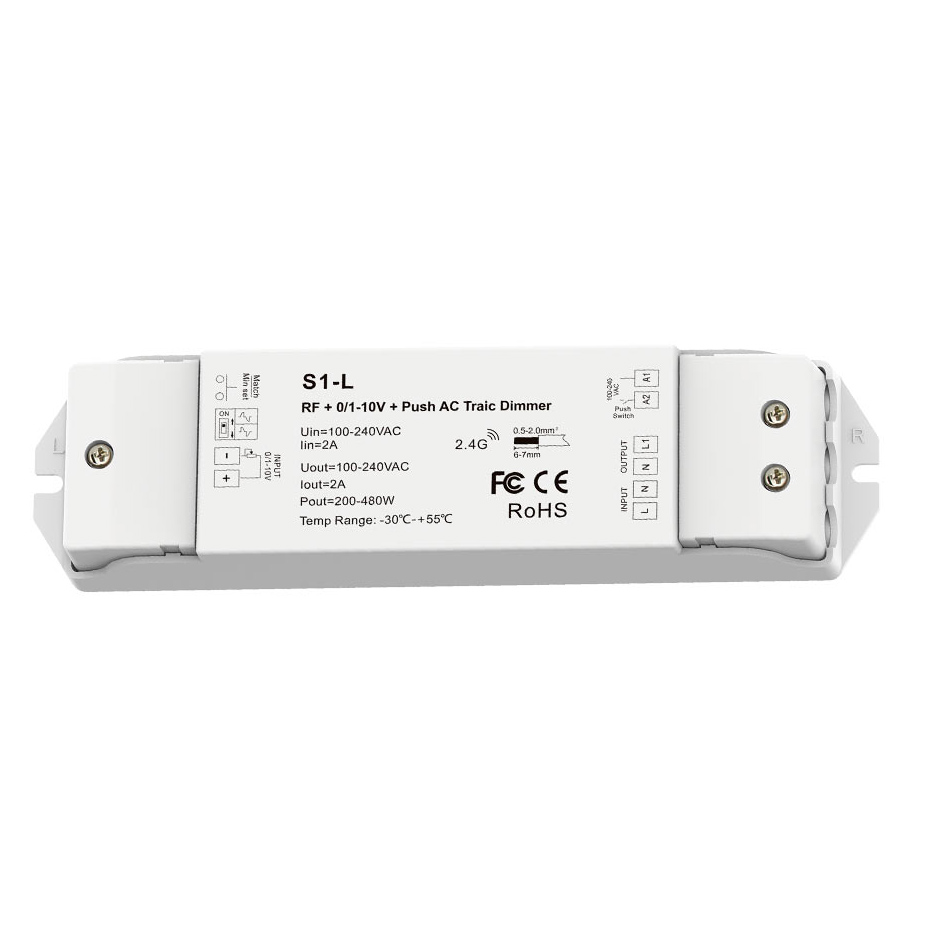
S1-L models also incorporate 2.4GHz RF wireless control and an external Push-Dim interface, offering additional flexibility beyond conventional wired 0/1-10V control. Users can adjust lighting brightness through compatible handheld RF remotes or wireless wall panel remotes, while compatible Wi-Fi smart control solutions can provide smartphone app operation and convenient remote lighting adjustment.

FAQ About 0/1-10V to Triac ELV Converters
Direct engineering answers on bridging 0-10V control networks with line-voltage AC phase-cut dimmable lighting.
A 0/1-10V to Triac ELV converter translates an analog 0-10V or 1-10V control voltage into line-voltage AC phase-cut output to dim mains-powered lighting fixtures. It sits between an analog controller (like an architectural wall station or building management system) and phase-dimmable loads. Instead of replacing existing Triac or ELV downlights and pulling low-voltage control lines to every single fixture, you install this converter inline. It allows centralized 0-10V control systems to smoothly dim line-voltage LED bulbs, AC halogen fixtures, or phase-cut dimmable drivers on 100-240V AC lines.
Yes, our 0/1-10V to Triac ELV converters support both reverse-phase (trailing-edge / ELV) and forward-phase (Triac) dimming modes. You select the phase-cut method using a dip switch on the casing before powering the circuit. Trailing-edge is the standard choice for modern dimmable LED lamps and electronic drivers because it eliminates the sharp voltage turn-on spikes that produce audible buzzing and thermal stress. If you are retrofitting older magnetic transformers, you flip the switch to forward-phase. For an in-depth breakdown of wave-chopping mechanics, read our guide on TRIAC and ELV dimming.
Maximum load on a 0/1-10V to Triac ELV converter depends strictly on the model and whether your load is resistive or capacitive. The S1-L is rated for 2A continuous, which handles up to 200W of LED lighting at 110V AC or 400W at 230V AC (and up to 480W for incandescent). For heavier multi-fixture runs, our SK1 handles up to 6A, delivering up to 600W of LED load at 110V or 1,200W at 230V. Because LED drivers produce large initial inrush currents, always keep total connected driver wattage at or below 80% of the converter's rated capacity.
A dimmer 1-10v circuit cannot switch mains power completely off by itself, whereas a 0-10V control signal drops output to zero. When a 1-10V signal hits its 1V minimum, the connected converter dims to its lowest floor (typically 1% or 10%), requiring an AC relay or switch to cut mains power completely. With a 0-10V signal, dropping below 0.7V triggers the converter's internal circuit to shut off output automatically. Our converters accept both signal types without manual recalibration, but 1-10V systems will need a mains disconnect for a true zero-power state.
You connect the analog signal pair from your 0 10v led controller directly to the converter's signal terminals while feeding AC line and neutral into the mains input ports. Polarity matters on the low-voltage control loop: land 0/1-10V positive on the `+` port and negative/ground on the `-` port. Reversing those two signal wires causes the unit to sit at 100% full output and ignore dimmer commands. The output terminals feed straight to your phase-dimmable fixtures. No external power supply is needed because the converter powers its internal logic directly from mains AC.
Yes, if you select our SK1 DMX and 1-10V phase-cut dimmer, which incorporates DMX512/RDM and 1-10V analog input into a single 6A AC phase dimmer. While sibling categories on our shelf have 0% DMX compatibility, half the models in this category feature integrated DMX512 decoding. You select your control mode on the digital display: operate it as a 1-10V interface for daily architectural lighting, or set it to DMX mode for stage and event consoles. It provides 256-level smooth phase dimming across commercial automation and theatrical control networks.
Yes, a 0/1-10V to Triac ELV converter is one of the most reliable ways to integrate 120V or 230V AC mains LED strip lights into a building automation system. Direct line-voltage LED strip lights run off AC mains rectifiers rather than low-voltage transformers, meaning they cannot take low-voltage DC PWM signals. By feeding the AC power through this converter, your centralized 0-10V control system smoothly modulates the AC phase angle going to the strip. Just confirm the AC LED strip light is explicitly rated as phase-cut dimmable and matches your local mains voltage.
Yes, the S1-L converter accepts concurrent inputs from 0/1-10V lines, 2.4GHz RF wireless remotes, and momentary push-switches. The inputs operate on a 'last command takes priority' basis: if the building automation system sets the room to 50%, an occupant can adjust the brightness locally using a handheld RF remote or wireless wall panel. However, once the 0-10V signal wire changes voltage, the converter immediately updates to match the new analog level. This provides conference rooms and hospitality spaces with centralized automation alongside local wireless wall control without requiring dual-controller wiring.