
DMX Controlled 5-In-1 Led Strip
3 products
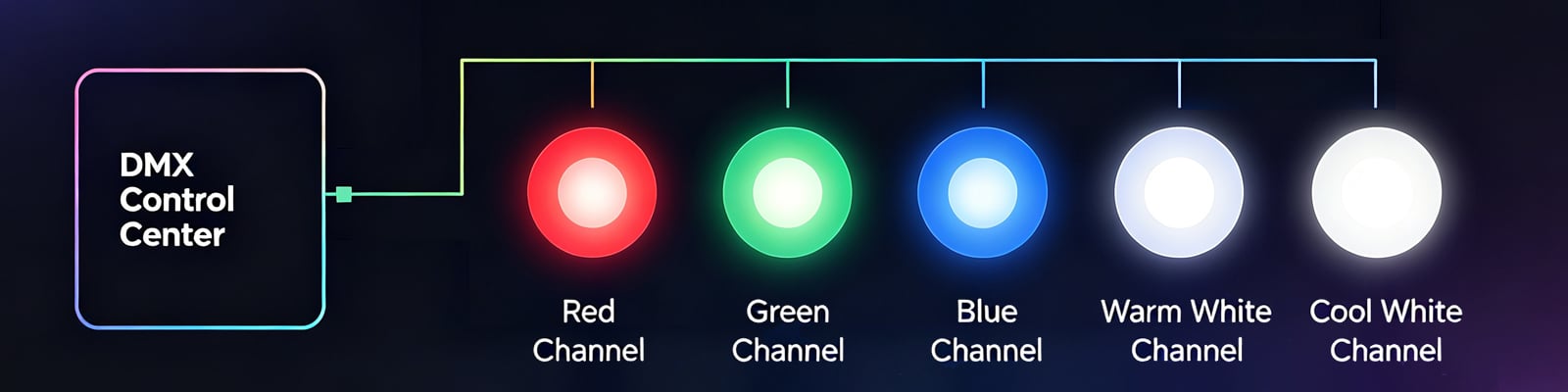
DMX 5-in-1 LED Strip combines the RGB color channels (red, green, blue) with the CCT (tunable white) channels to independently adjust the color temperature (warm to cool white) and color via the DMX512 protocol. Color and color temperature stacked or used individually make these 5-in-1 RGB tunable white DMX controlled led strips an all-in-one tool for addressable programmable lighting design. This flexible combination allows you to switch freely according to the needs of the scene, from soft warm light to cold technological white light, with RGB dazzling color gradient, to create an immersive visual experience.
DMX512 vs. SPI vs. PWM RGBCCT Control
These DMX512 RGBCCT (RGB + Tunable White) LED strips and fixtures integrate seamlessly into your existing DMX control network without requiring additional protocol converters.
While SPI RGBCCT lights also feature addressable ICs for dynamic pixel tracking, their standalone programming flexibility is slightly more constrained compared to DMX protocols. Because SPI control systems operate on an independent architecture, integrating them into a master DMX environment requires a dedicated SPI-to-DMX decoder.
PWM RGBCCT represents the foundational method for achieving dynamic RGB colors paired with adjustable white color temperatures. Driven directly via constant-voltage PWM dimming controllers, these non-addressable RGBCCT light strips require a PWM-to-SPI decoder to join an SPI network, or a DMX-to-PWM decoder to connect to a master DMX control system.

D5-W72 RGB+CCT LED Wall Washer Light - DMX512 & RDM Control
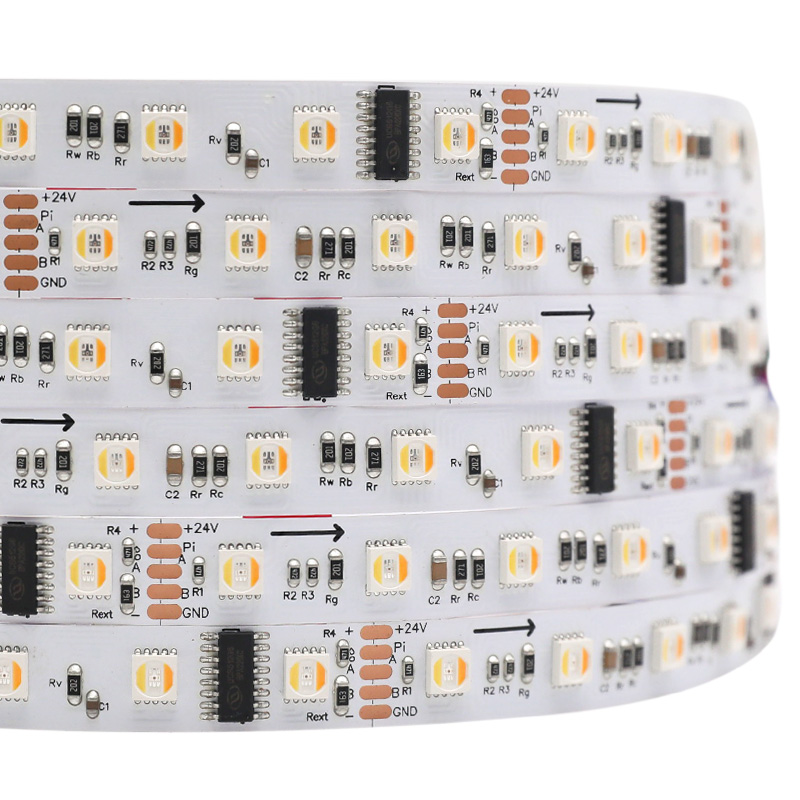
24V DMX 5in1 Addressable RGBCCT LED Strip Light, 60LEDs/m
Frequently Asked Questions About DMX 5-in-1 LED Strips
Your project is specific. Your questions should be too. Here are the answers we give our customers most often before they spec a DMX job.
A DMX controlled 5-in-1 LED strip puts five colors—Red, Green, Blue, a Warm White, and a Cool White—onto a single LED chip. This means you get much smoother color mixing and can create pastels or precise white temperatures that an RGBW strip just can't produce. The biggest difference is the DMX512 control protocol, which gives you professional-grade, reliable control over every segment, instead of relying on a simple RF remote. It's the standard for theatrical and architectural lighting for a reason.
Each controllable segment of a DMX 5-in-1 rgbcct light strip uses 5 channels: one for red, one for green, one for blue, one for warm white, and one for cool white. So, a 5-meter strip with 10 addressable segments will consume 50 DMX channels in your universe (10 segments x 5 channels). Forgetting this is a common mistake that leads people to buy a controller that can't handle their project. Always calculate your total channel count before you buy.
For dmx direct control rgbcct lights, you need a dedicated DMX512 controller. Don't try to use a standard SPI or PWM controller. Your choice depends on the scale of your project. For simple scenes, a standalone wall panel or simple console works great. For complex, synchronized shows, you'll want software on a PC or Mac (like QLC+ or Madrix) connected to a USB-to-DMX interface. We stock a wide range of DMX master consoles that are tested with our strips.
For creating perfectly blended colors, a single 5-in-1 DMX rgb tunable white strip is definitely better. When you have separate RGB and CCT strips, you can get color shadowing and uneven hotspots, especially in a tight channel. The 5-in-1 chip mixes the light right at the source, giving you a smooth, uniform output. It also simplifies wiring since you're only running one strip instead of two.
RDM stands for Remote Device Management, and it's a protocol that runs on top of DMX. It lets your controller "talk back" to the lights. This means you can do things like remotely set DMX addresses, check the device's temperature, or identify a faulty fixture without having to climb a ladder. While not essential for every setup, it's a huge time-saver in large, hard-to-reach installations. Some of our fixtures, like the D5-W72 Wall Washer, are RDM-enabled.
Unlike some DMX fixtures with dip switches, our DMX strips typically have their addresses programmed by a dedicated DMX address writer or through the controller itself. Each addressable segment gets a starting address, and the strip automatically assigns the next consecutive addresses for the other colors in that segment. For example, if you set the first segment to address 1, it will occupy addresses 1, 2, 3, 4, and 5. The next segment will automatically start at address 6. Our technical guide explains DMX control in more depth.
You choose DMX when reliability and standardization are critical. DMX512 is an industry-standard protocol used in professional lighting for decades. It's robust, less susceptible to noise, and allows for much longer cable runs (hundreds of meters). SPI protocols like WS2812B are great for hobbyist projects but can be finicky, with tight timing requirements and very short data transmission distances. For a commercial installation, an architectural feature, or any project that just has to work every time, DMX is the professional choice.
Absolutely. That's the main advantage of an rgbcct light strip over RGB or RGBW. Because it has dedicated warm white and cool white LEDs, you can produce a very high-quality, high-CRI white light and tune it anywhere from about 2700K (warm incandescent) to 6500K (cool daylight). You're not trying to fake white by mixing red, green, and blue. You get true, tunable white light and millions of saturated colors all from the same fixture.
Yes, we do this all the time. A huge part of our business is building lighting to fit a specific drawing. You can specify the exact length you need, the type of waterproof rating (from IP65 to IP68 submersible), and we'll factory-solder the lead wires and any connectors you need. Just send our engineers a sketch or a description of what you're building. We'll send back a complete parts list and quote, usually the same business day, with no fee or obligation to order.
Yes, that's one of the main strengths of the DMX512 protocol. As long as the other fixtures also speak standard DMX512, you can chain them all together on the same data line, regardless of the brand. Just make sure your controller has enough channels to handle everything in your universe. Your SuperLightingLED strip, a moving head from another company, and a DMX fog machine can all run off the same console and work together in a synchronized show.