
Top 6 Considerations Before Buying LED Strip Lights
Before buying LED strip lights, check six things:
- Where it goes → IP rating. IP20 or IP65 indoors, IP67 or IP68 outdoors, and IP68 for a swimming pool.
- Brightness → density and chip. the LED chip and the number of LEDs per meter; lumen per meter = lumen per LED × LEDs per meter.
- Voltage. 12V and 24V are the most common. 24V runs further (no voltage drop in 8–10 m), 12V is also used in cars and boats, 5V cuts most accurately.
- Length. reels are typically 5 m/16.4 ft; strips can be cut and connected, but only strips of the same specification.
- Controller. a dimmer for single color and dual white strips, a controller with at least as many channels as the strip for color changing.
- Power supply. same output voltage as the strip, and the 80% rule for the wattage.
At SuperLightingLED we sell LED strips for every one of these choices, so we see the same six questions before almost every order. Start with the checklist below, or jump to the part you are unsure about.
How to choose the best LED strip lights?
Before buying LED strip lights, there are many factors that you need to consider, such as led light brightness, waterproof grade, working voltage, etc. Maybe you only know a certain point or part of the answer.
How to choose the best LED strip light based on the only information available? This is the main purpose of this article, to answer your doubts when you start with LED light strips.
Before buying LED strip lights, please ask yourself : 1. Where do I want to place the LED strip lights? Indoor or outdoor? Non-waterproof or waterproof? → IP20 vs IP65 vs IP67 vs IP68 2. How much LED brightness do I need? → LED density, LED lumen, difference between SMD LEDs 3. The working voltage is available? → 5V vs 12V vs 24V, AC vs DC, led voltage drop 4. How long is the LED strip light suitable for my project? → Lighting strip length 5. Do I need an LED light controller to adjust the LED color and brightness? → LED controller 6. How to power the LED strip lights? → LED power supply |
What to look for when buying LED strip lights: a 6-point checklist
The six questions above in one table: what to check on the product page, where to shop, and the guide that explains each one.
| Consideration | What to check on the product page | Where to shop | Guide |
|---|---|---|---|
| 1. Where will it go? | The IP rating: IP20 or IP65 for indoors, IP67 or IP68 for outdoors; IP68 if it goes in a swimming pool. | Outdoor LED strip lights IP67 water resistant IP68 for pools | IP65 vs IP67 vs IP68 |
| 2. How bright? | The LED chip (SMD 2835, SMD 5050, COB…) and the LEDs per meter; the lumens in the specifications. | Brightest LED tape light COB LED strips Multi-row LED strips | Color temperature Warm vs pure vs cool white Color rendering index (CRI) |
| 3. Which voltage? | 5V, 12V, 24V, 36V/48V constant current, or AC 110/220V. The controller and the power supply must be the same voltage as the strip. | 12 volt color changing strips Constant current LED strips AC110/220V LED strips | 12V vs 24V LED strip lights |
| 4. How long? | The reel length (typically 5 m/16.4 ft; some strips come in 0.5 m, 1 m and 2 m) and where the cut marks are. | Ultra-long constant current LED strips | Can you cut LED strips? How to connect LED strips |
| 5. Controller? | The color type (single color, dual white, RGB, RGBW, RGBCCT, addressable) and the number of channels; the controller needs at least as many channels as the strip. | LED smart controller series Single color dimmers | How to choose LED controllers Choosing an addressable LED strip |
| 6. Power? | The watts per meter printed on the reel. Supply output voltage = strip voltage; wattage within the 80% rule; waterproof or rainproof supply outdoors. | LED power supplies DC24V waterproof supplies | How to choose a power supply How to calculate power |
Then plan the install: an aluminum profile hides the dots and helps the strip shed heat, and our LED strip installation guide covers the mounting. Every sub-section below goes deeper into one row of the table.
1. Where do I want to place the LED strip lights?
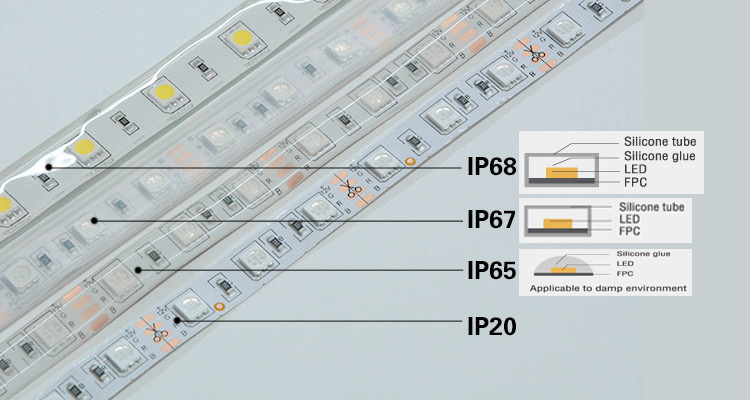
The place where the led rope light is used determines the waterproof level of the light strip. Generally speaking, IP20 and IP65 led strip lights are used indoors, IP67 and IP68 led strip lights are used outdoors.
For those who see the waterproof rating for the first time, IP20, IP65, IP67, and IP68 are a little strange. What do they mean?
IP means ingress protection. The first number in IPXX indicates the level of dustproof and foreign body intrusion prevention of the led tape light, which is represented by 0 to 6. The second number indicates the moisture-proof and air-tightness of the led strip to prevent water penetration, which is represented by 0 to 8. The higher the number level, the stronger the protection.
| Dustproofing Level | Waterproofing Level | |
| 0 | No Protection | No Protection |
| 1 | Prevents large solids from entering | Unaffected by water droplets dripping onto the outer covering |
| 2 | Prevents medium-sized solids from entering | Unaffected by water droplets dripping onto the outer covering when the outer covering tilts at 15 degrees |
| 3 | Prevents small solids from entering | Prevents splashing water from seeping in |
| 4 | Prevents solids larger than 1mm from entering | Prevents sprayed water from seeping in |
| 5 | Prevents harmful dust from accumulating | No damage whatsoever if you wash it with water |
| 6 | Completely prevents dust from entering | Prevents big waves from seeping in |
| 7 | Can be used to resist penetration by water for short periods of time | |
| 8 | Soaks for a long time under a certain amount of pressure |
►IP20 is non-waterproof. The flexible printed circuit board of the rope lights is naked and can not touch the water. And you need to be careful that do not to damage the led strip light parts, otherwise, it will cause a short circuit.
If you plan to install LED strip lights in the bedroom, living room, cabinet, kitchen, or stair, you can choose IP20 led strip lights.
►The IP65 led strip has a layer of glue to cover the parts. It is an upgraded version of IP20. It is splash-proof and can be used in humid environments, but cannot be immersed in water and is not suitable for outdoor use.
In places where indoor tape lights will be splashed by water, such as kitchens or bathrooms, IP65 led light strips should be selected.
►IP67 led strip uses a silicone sleeve or heat shrink tube to encapsulate, which is suitable for outdoor environments. Note that the IP67 light strip cannot be soaked in water. The waterproof rating of the led neon lights we are familiar with is also IP67.
►IP68 is the highest waterproof grade of led strip lights, the light strip is completely sealed by the material, is available for outdoor use, and can be placed in hot and cold environments. If you want to make your swimming pool more cool with led strips, it must be an IP68 light strip.
Note: The waterproof LED strip lights is wider and thicker than the naked IP20 PCB width and height by 2-3mm.
Related: What are led neon lights?
IP65 vs IP67 vs IP68 LED strip lights
The same four ratings side by side. Protection and use come from this guide; the cutting and sealing notes come from our LED strip wiring diagrams library (cards C12, C13 and C6).
| Rating | Protection | Where to use it | Cutting and sealing |
|---|---|---|---|
| IP20 | Non-waterproof: the flexible PCB is naked and cannot touch water. 2 = prevents medium-sized solids from entering; 0 = no protection against water. | Indoors: bedroom, living room, cabinet, kitchen or stair. | Cut only at the cut mark. |
| IP65 | A layer of glue covers the parts; splash-proof. 6 = completely prevents dust from entering; 5 = no damage if you wash it with water. | Humid indoor places splashed by water, such as kitchens or bathrooms. Cannot be immersed in water; not suitable for outdoor use. | Silicone coat: cut at the mark with scissors, peel the coating off the last pad. |
| IP67 | Silicone sleeve or heat shrink tube. 7 = resists penetration by water for short periods of time. Cannot be soaked in water. | Outdoor environments. LED neon lights are also IP67. | Silicone sleeve: cut, slide the sleeve back to expose the pads. Connect with an IP67 clip and seal it with the silicone cap or heat-shrink. |
| IP68 | Completely sealed by the material. 8 = soaks for a long time under a certain amount of pressure. | Outdoors, hot and cold environments; a swimming pool must use an IP68 LED strip. | Filled tube: cut, then re-seal the new end with the end cap and silicone; silicone-sleeved IP68 strips can be re-sealed on site with the sealing kit. |
IP65 vs IP67: IP65 is splash-proof: fine for bathrooms and covered outdoor spots, but for anything exposed to the weather choose IP67, and IP68 when the strip may sit in water. Remember that every waterproof strip is 2–3 mm wider and thicker than the bare IP20 PCB, so check the profile or channel size before you order. Every cut on a waterproof LED strip is a new joint that has to be sealed.
Things to consider before buying LED strip lights for outdoors
There is no single “best waterproof outdoor LED strip light”: the best one is the one whose rating, joints and power supply all suit the place. Our checklist for outdoor jobs:
- The strip. IP67 for outdoor runs in the rain, IP68 for pools or anything that may sit in water. Shop IP67 water resistant LED strips, IP68 LED strip lights for pools or waterproof COB LED strips.
- The joints. a “waterproof” strip is only as waterproof as its joints. Use IP67/IP68 male-female plug connectors with the O-ring seated, and leave a drip loop so water runs away from the connector (IP68 connectors).
- The ends. slide the end cap on, fill it with neutral-cure silicone and let it cure before rain. Put connectors and the driver inside an IP65 junction box, mounted above the strip so cables slope away from it.
- The power supply. a waterproof power supply or rainproof power supply. A waterproof IP67 driver has sealed cables at both ends; keep the plug end dry (card B4).
- The controller and kit. Outdoor waterproof LED controllers, or a complete weatherproof LED strip light kit.
These diagrams are drawn by the SuperLightingLED engineering team (C5 comes from our wiring guides on the blog); click one for the full notes in our LED strip wiring diagrams library.
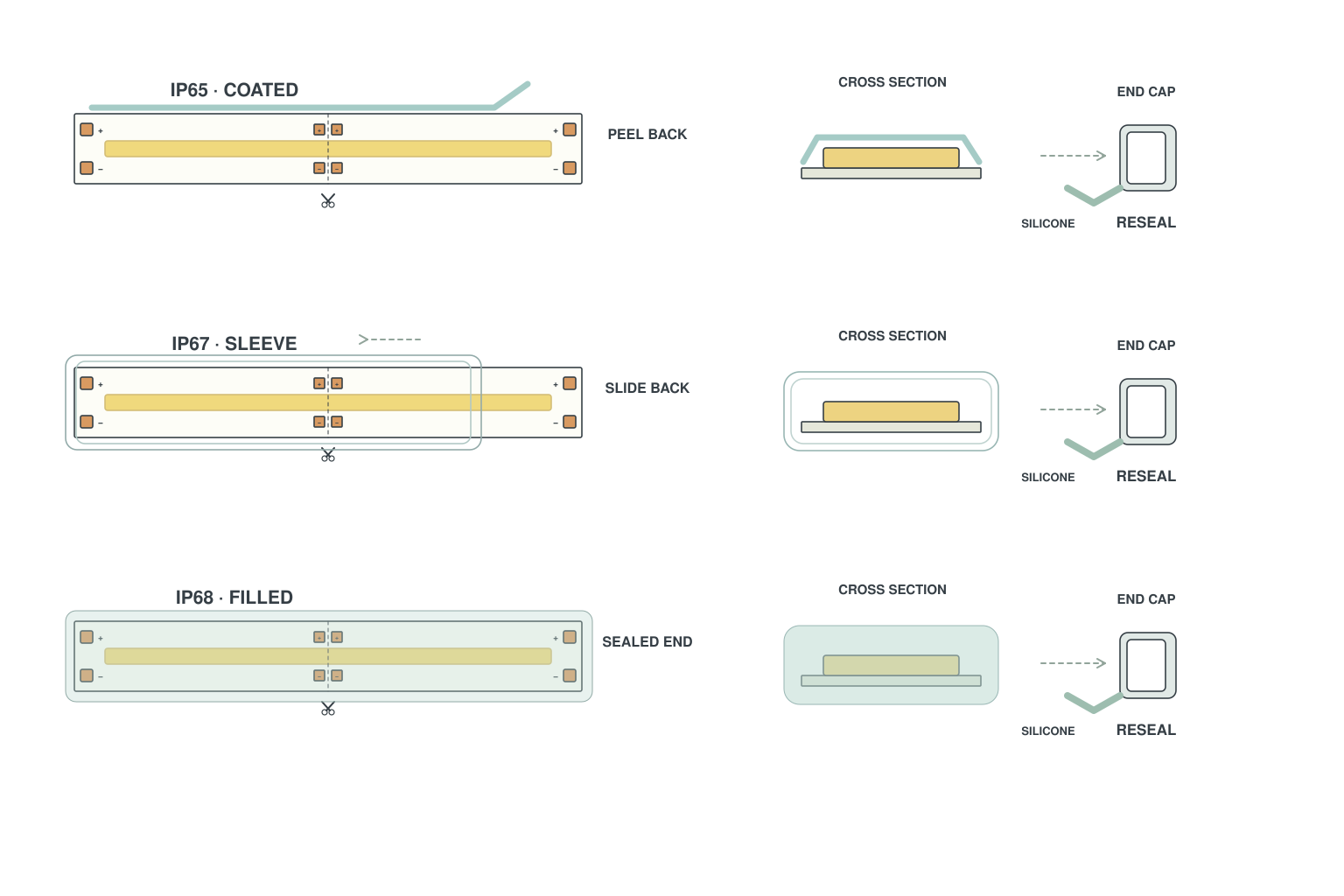
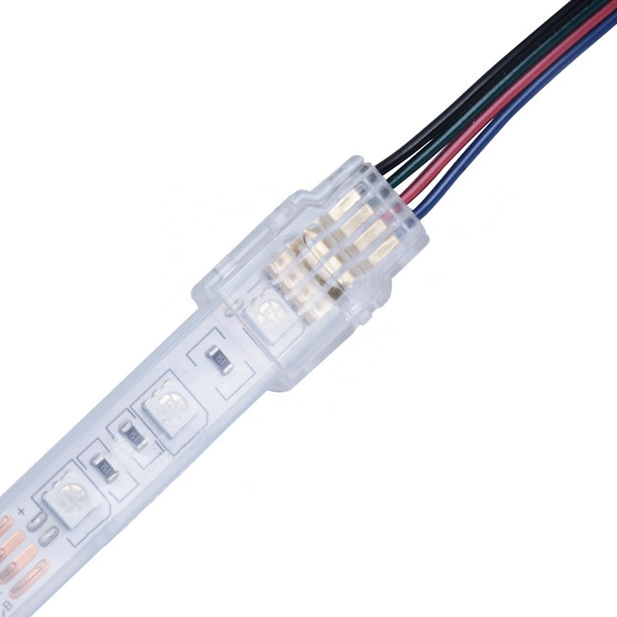
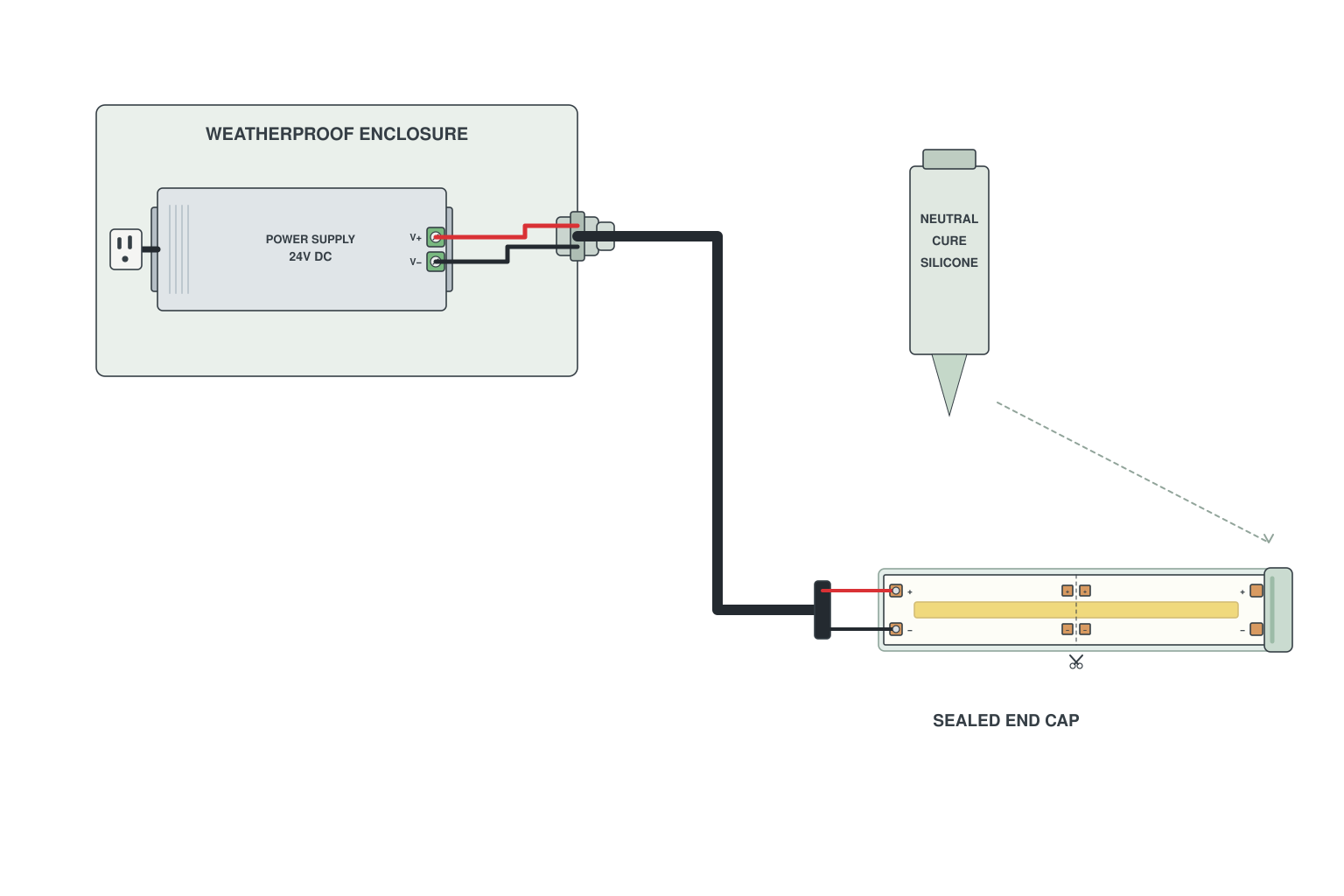
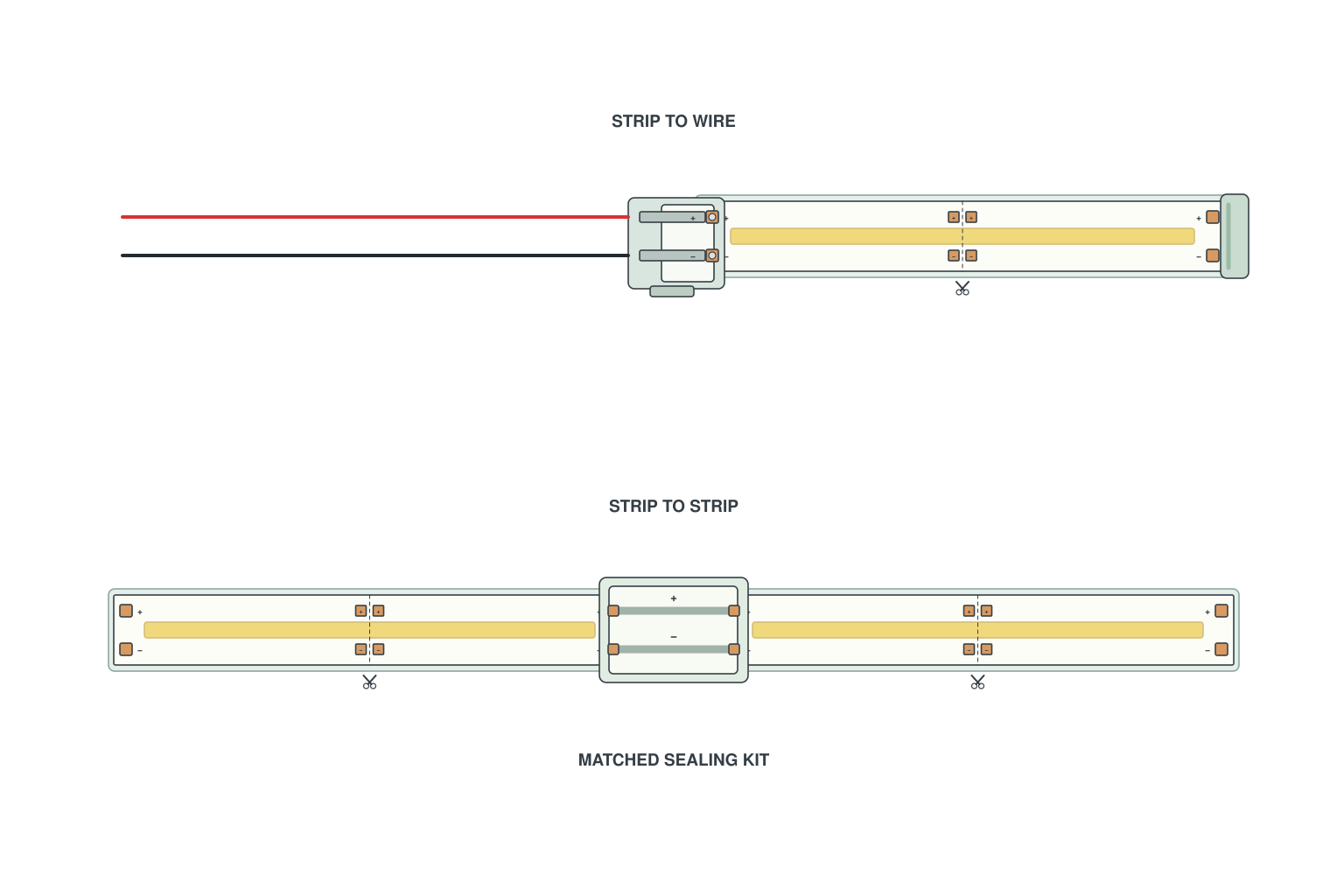
Cutting and joining outdoor strips step by step: can you cut LED light strips and how to choose LED strip light connectors.
2. How much brightness do I need?
LED brightness is normally talked about with density and lumen.
LED density
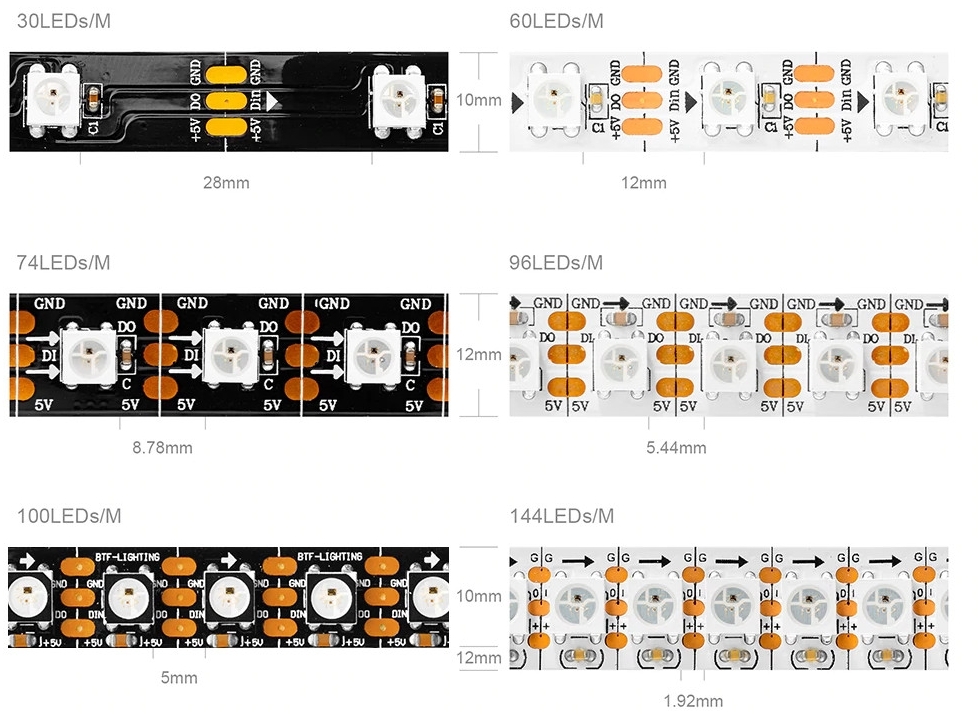
The density of the led light strip refers to the total number of LED lights on the strip. An led light strip usually indicates the total number of LED lights in 5 meters and the number of LED lights per meter. The denser the density, the more uniform the light distribution of the led strip, because the light-emitting angle of each SMD LED light is 120 degrees.
There are low-density(30-72 LED lights), medium-density(72-120 LED lights), and high-density(above 120 LED lights).
Multiple-row led tape lights can tolerate higher densities. Still not satisfied with the density of the single-row led strip, please choose the multiple-row led strip lights. Of course, if there are multiple rows of led strip lights, there will be ultra-thin led strips. If you don't want the led tape light to be too wide or the installation environment is narrow, don't miss it.
If you desire the led tape light to be the main lighting source or the lighting area is large, maybe high-density is suitable for you. On the contrary, the space is small and you don’t have many requirements of brightness, you can choose low-density or medium-density. It entirely depends on yourself.
LED lumen
The lumen of the led light strip is closely related to the type of LED chip. The LED chip name is named after the LED size. Each chip type has its approximate lumens, but the lumens of specific led strips will be slightly different. If you are very concerned, you can check the specific lumens in the led strip specifications.
Lumen/Meter = Lumen/LED x Density/Meter Lumen/5M = Lumen/LED x Density/5M Lumen/Ft = Lumen/LED x Density/Ft |
SMD5050 and SMD2835 are the most commonly used chips. Among all SMD LED chips, SMD5050 and COB support color changes, such as the familiar RGB led strip lights. Other chips are white light, including single white light and dual-color temperature white light.
If you want higher lumens, in addition to looking at the LED chip, you must also pay attention to the density of the light strip. The denser the density, the higher the lumen. It is worth noting that high density and high lumen require high heat dissipation and high power.
How much brightness do I need? I believe you already have the answer. If you still have doubts, you can contact us and we will help you choose your best brightness.
|
LED |
Lumen / LED |
Density / Meter |
Lumen / 5M |
Density / Meter |
Lumen / 5M |
Wattage / LED |
Voltage |
|
6-7lm |
30 |
900-1050lm |
60 |
1800-2100lm |
0.1W |
24V |
|
|
7-8lm |
30 |
1050-1200lm |
60 |
2100-2400lm |
0.1W |
12V/24V |
|
|
10-12lm |
30 |
1500-1800lm |
60 |
3000-3600lm |
0.1W |
12V/24V |
|
|
7-8lm |
30 |
1050-1200lm |
60 |
2100-2400lm |
0.08W |
12V/24V |
|
|
14-16lm |
30 |
2100-2400lm |
60 |
4200-4800lm |
0.2W |
12V/24V |
|
|
20-22lm |
30 |
3000-3300lm |
60 |
6000-6600lm |
0.24W |
5V/12V/24V |
|
|
22-24lm |
30 |
3300-3600lm |
60 |
6600-7200lm |
0.5W |
12V/24V |
|
|
22-24lm |
30 |
3300-3600lm |
60 |
6600-7200lm |
0.5W |
12V/24V |
|
|
3-4lm |
30 |
450-600lm |
60 |
900-1200lm |
0.02W |
5V/12V/24V |
Related: What is COB?
How to choose the right color for your led strip lights?
Ultimate guide to choosing the right addressable led strip
3. The working voltage is available?
LED strips are mostly low-voltage strips, with 12V and 24V led strips being the most common. In our low-voltage led strip lights, in addition to 12V and 24V, there are 5V, 36V, and 48V led tape lights.
36V and 48V led strip lights are constant current led strips with no voltage drop over long distances, and the color and brightness of the led light strip are always consistent. This is the biggest feature of the constant current led strip, and it is also to compensate for the voltage drop of the low-voltage led rope light.
5V VS 12V VS 24V LED strip
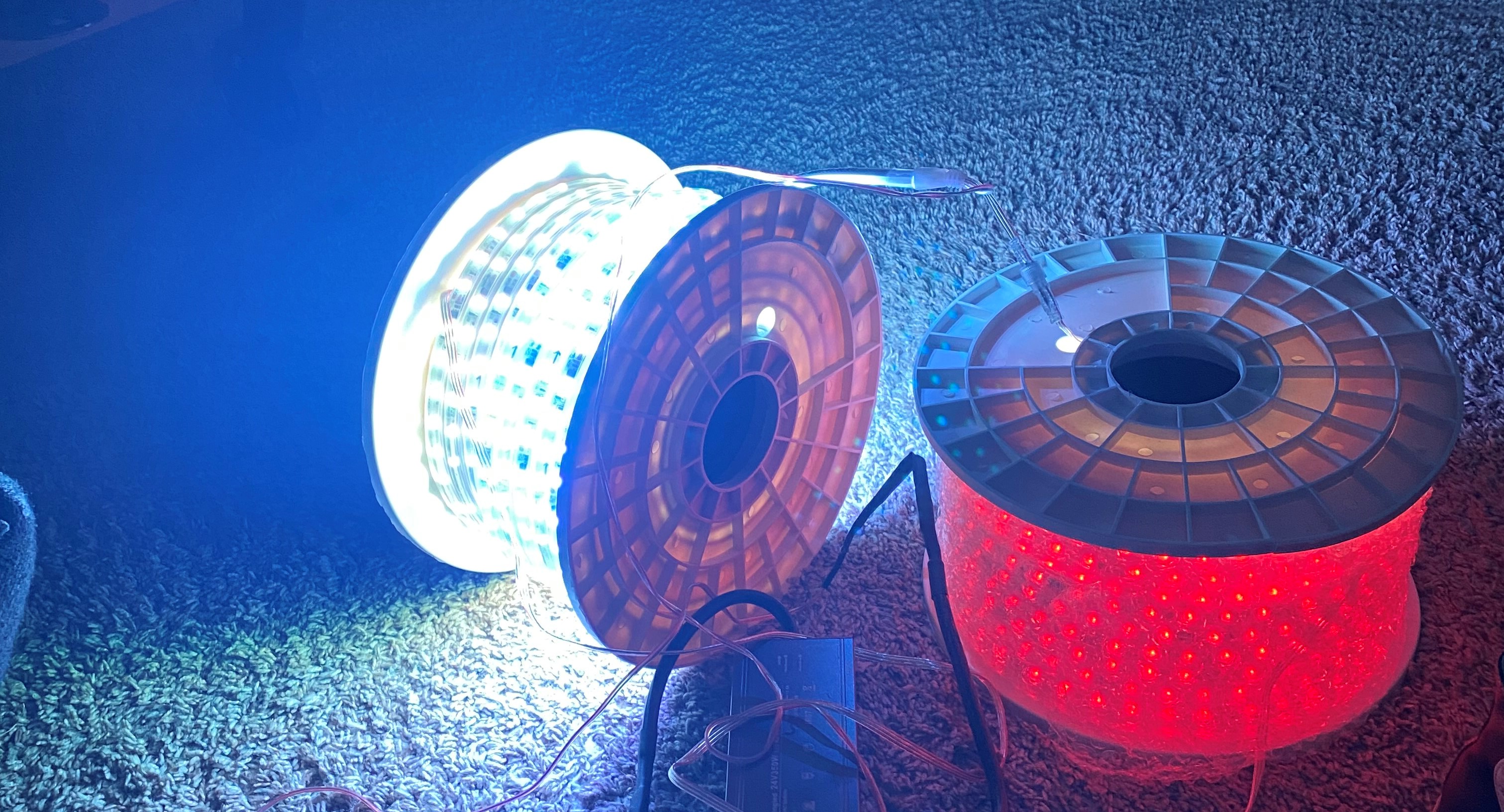
As mentioned above, low-voltage led strip lights have a voltage drop. Voltage drop refers to the attenuation of the voltage during transmission, which is manifested as the color and brightness of the same strip are inconsistent. The voltage drop of the white light led strip will have the following performance. First, the brightness will decay with the length, and then the color will also change, from the first white to yellow, then to red, and finally, the light disappears. Different voltages have different solutions for voltage drop. But in the end, it is to provide sufficient power for the led strip.
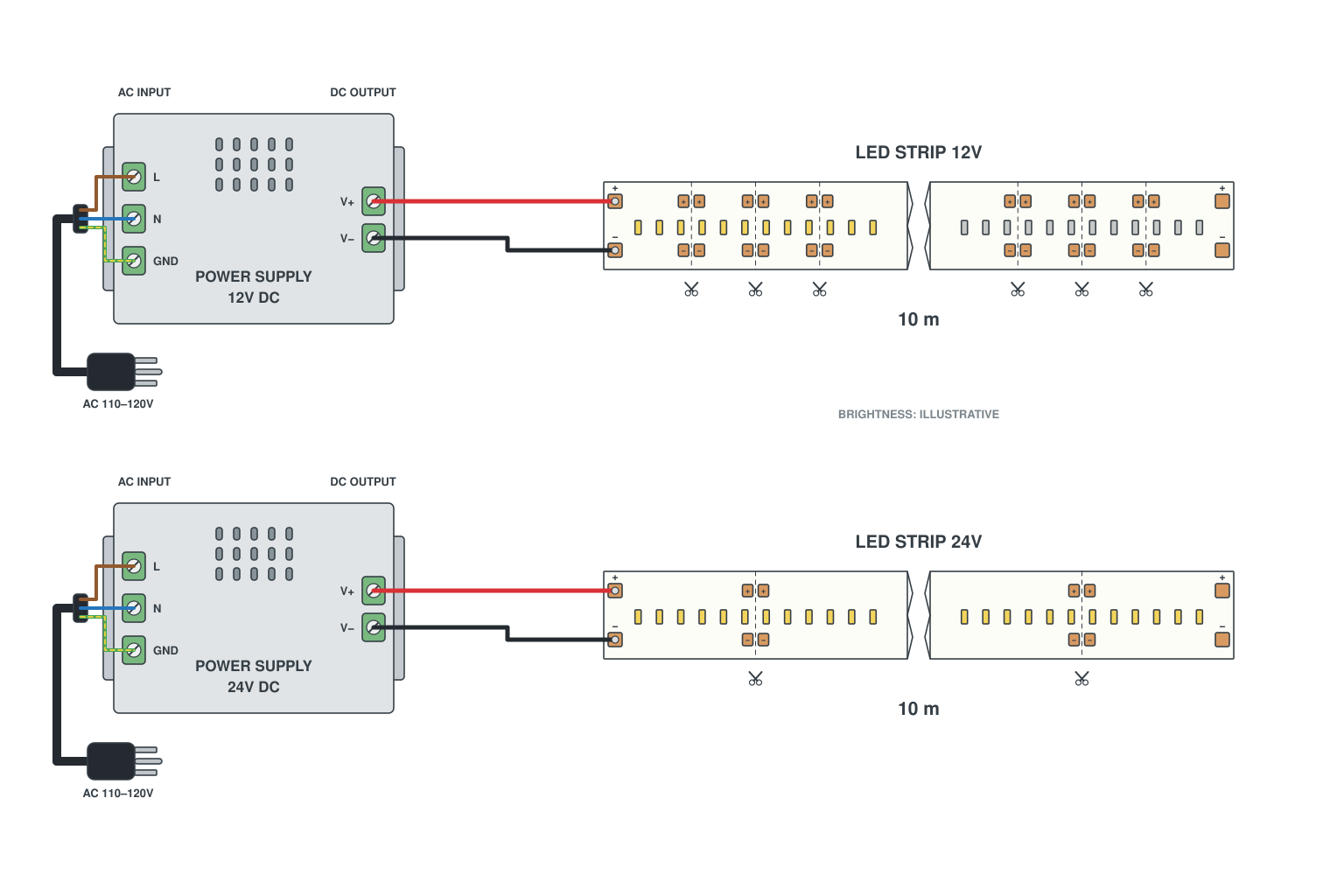
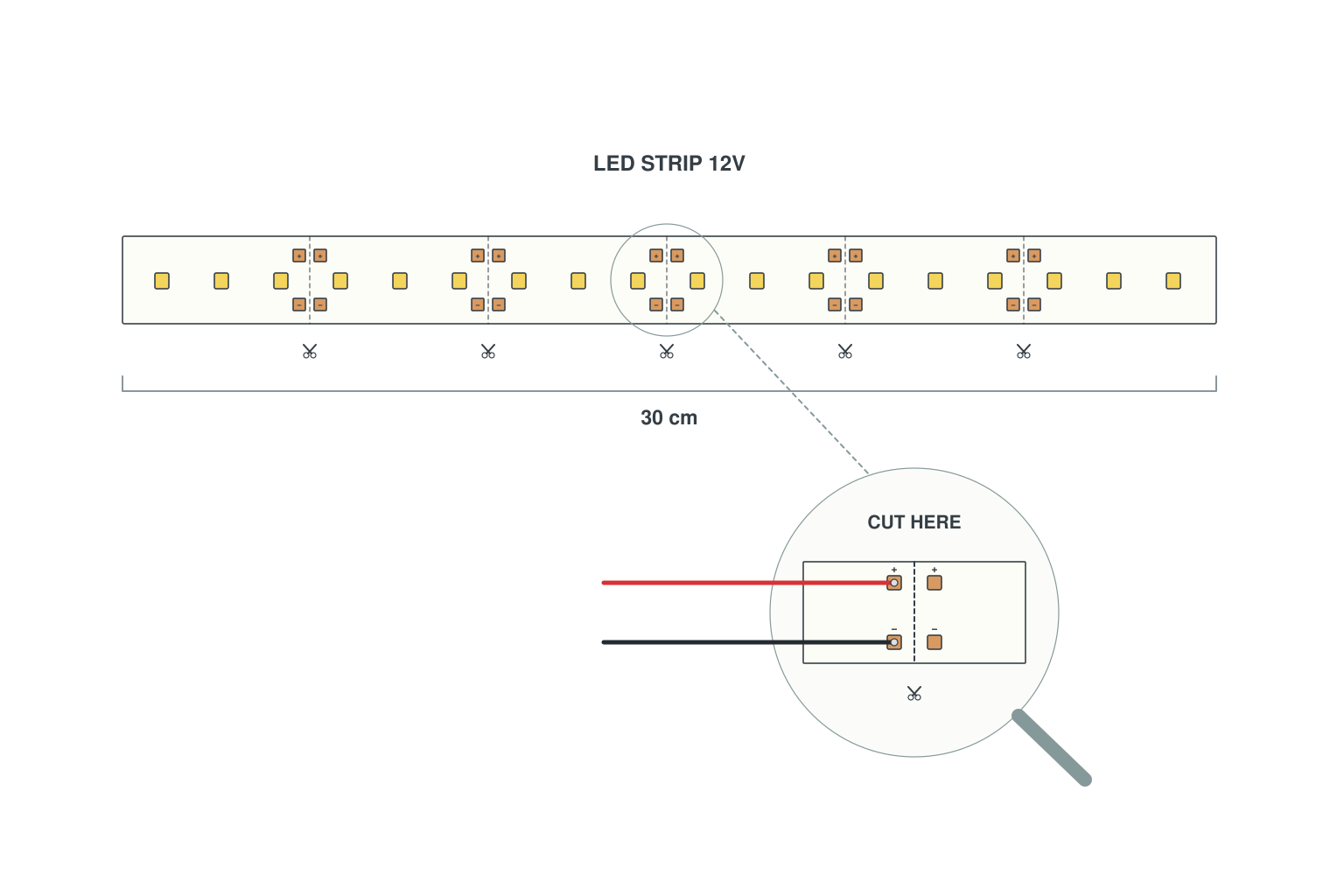
5V led strip lights have a voltage drop of five meters, and the cutting unit is an LED light, which can be more accurately cut to the length you need. And the 5V led strip needs a power supply at both ends to resist the voltage drop. 12V led strip lights are no voltage drop in 5-7 meters and cut 3 LED lights as a cut unit. The 12V led strip is powered at one end of five meters and needs to be powered at both ends for 10 meters. 12V light strips are also used in cars and boats. 24V led strip lights have no voltage drop in 8-10 meters, and can only cut 6 LED lights at a time. If you cut within the cut line interval, the LED lights in this area will not work. A 15-meter 24V led strip requires an led power supply at both ends, and a 10-meter strip can be powered at one end. |
The higher the voltage, the stronger the resistance to voltage drop, and the longer the operating length alone. However, the cutting accuracy will be reduced. The length of your project is long, 24V led strip light is selected. A constant current led strip with no voltage drop would be even better, if you like it. For cutting accuracy, choose the 5V led strip light. The 12V led strip is centered between these two points, so if you really don’t have a clue, you can try the 12V led strip light.
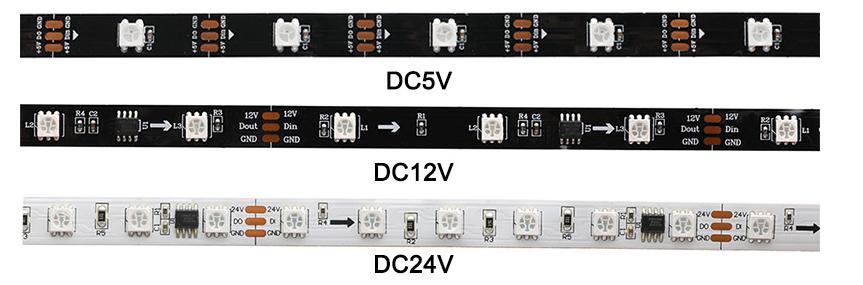
*LED white light voltage drop(white light/100% LED brightness - yellow light/50% LED brightness - red light/20% LED brightness - LED light disappear/0% LED brightness):
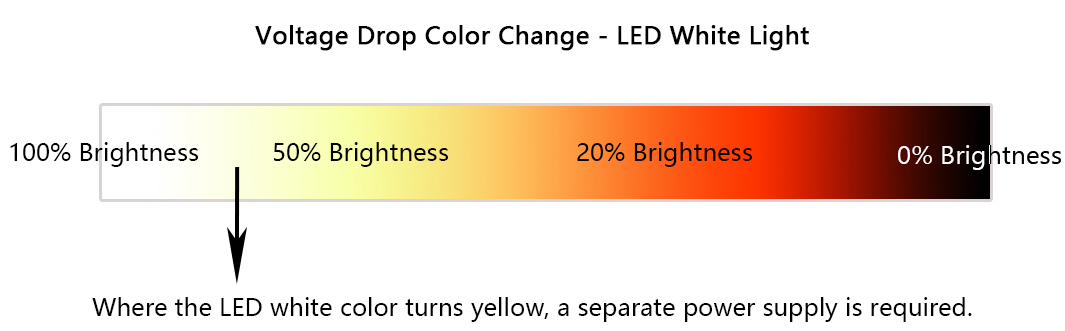
AC VS DC
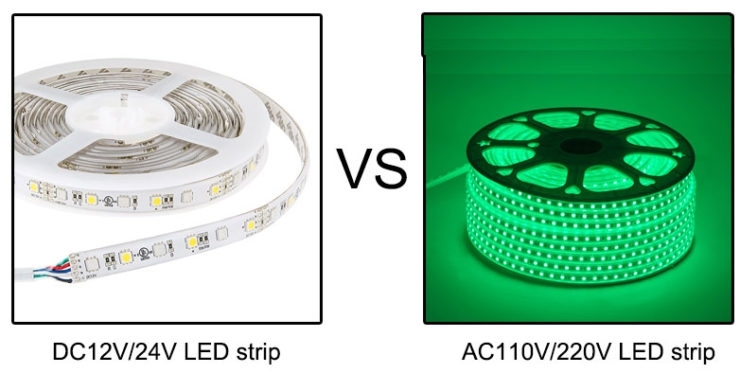
High-voltage led strip lights are also a large category of led strips. There are single color AC 110/220V led tape lights and high voltage RGB led strips according to the led color.
Alternating current is transmitted from the power grid. The power is large and the transmission distance is long, but it is not suitable for contact with the human body and has a great safety hazard. It is recommended to install the high-voltage led strip in a place out of reach, and the high-voltage led tape light is not easy to maintain.
The direct current is stable, but the transportation distance is short. Low voltage is safe and harmless to the human body. 36V is the human body safety voltage. Many electronic devices use low voltage, which will not damage the internal electronic precision parts. The most obvious thing about low-voltage led light strips is the voltage drop. We have already mentioned the voltage drop above, so I won't elaborate on it here.
In short, low-voltage led strip lights are recommended for household lighting or decoration, and high-voltage led strips are recommended for professionals.
Related: How to cut led strip lights?
How to connect led strip lights?
12V vs 24V LED strip lights (and 5V, 36V/48V, 110/220V)
Everything from section 3 in one table, plus two notes from our wiring diagrams library:
| Voltage | No voltage drop within | Cut unit | Power feed | Best for |
|---|---|---|---|---|
| 5V | Voltage drop at five meters | 1 LED | Power at both ends | Cutting accuracy |
| 12V | 5–7 m | 3 LEDs | One end for 5 m, both ends for 10 m | The middle ground; short runs, cars, boats, campers and anything fed from a battery |
| 24V | 8–10 m | 6 LEDs | One end for 10 m, both ends for 15 m | Long projects |
| 36V / 48V constant current | No voltage drop over long distances; color and brightness stay consistent | Check the product page | Saves a lot of wiring on ultra-long runs | Ultra-long lengths: ultra-long, DC 48V |
| AC 110/220V | Long transmission distance | Only at the 50 cm or 100 cm mark printed on the strip | Plug and inline rectifier; no separate power supply | Professionals; install out of reach. Also high voltage RGB |
- Why 24V runs further: at the same wattage a 24V strip draws half the current, so the far end stays bright. From one feed point: 12V up to 5 m, 24V up to 10 m.
- Never mix voltages: everything on one circuit must be the same voltage: strip, controller and power supply. Mix a 12V and a 24V strip and either the 12V strip burns out or the 24V strip will not light up.
- Buying a 12 volt LED strip? 12V still makes sense for short runs, boats, campers and battery power; if you really don’t have a clue, start with 12V.
More on long runs: how to calculate power for LED strip lights.
4. How long is the LED strip light suitable for my project?
The LED strip light length is typically 5 meters/16.4 feet. Length is not a big problem actually because LED strip lights can be cut and connected. However, note that only led strips of the same specification can be connected together. The 12V led strip light cannot work together with the 24V led strip light. Either the 12V led strip will burn out or the 24V led strip will not light up.
There are several led light strips that support short lengths such as 0.5 meters/1.64 feet, 1 meter/3.28 feet, and 2 meters/6.56 feet.
For ultra-long lengths, you can purchase multiple led strip lights for installation, or directly choose ultra-long constant current led strips, which will save a lot of wiring costs and make installation easier. Of course, which one to choose is completely up to you, and I am just providing suggestions. Regarding the wiring of multiple led strips, we will write in a follow-up article, so stay tuned.
The most important point is that we can provide you with customized services. Please contact us if you don't find the right length.
5. Do I need an LED controller to adjust the color and brightness?
If you want to change the brightness and color of the LED lights, an LED dimmer or an LED controller is essential for your project.
►Single color led strips and dual white led strips should be equipped with LED dimmer.
The single color led light strip is not boring and tasteless. The brightness of the led rope light can be adjusted arbitrarily from the brightest to the darkest by installing an led dimmer. Generally, the ordinary led dimmer is a knob button, and you can get the most suitable brightness by rotating the button. Of course, mobile phones, remote controls, and panel controls can also operate the led dimmer.
It is a huge project to fully understand all LED dimmers. Because there are so many types of LED dimmers, Triac dimming, 0/1-10V dimming, DALI dimming, DMX dimming, and PWM dimming. I believe you are stunned when you see so many types of LED dimmers. Triac dimming and 0/1-10V dimming are briefly mentioned in the article about led controllers. If you are interested, you can click to learn more.
Regarding LED dimming, in fact, you only need to understand that it ultimately achieves the function of adjusting brightness through different control methods. It's just that different dimming technologies have different precautions. Of course, if you feel that the current brightness of your led tape light does not affect you, you do not need to install an LED dimmer.
►Color changing led strip lights should be controlled by the LED controller.
WIFI led controller, RF led controller, IR led controller, Bluetooth led controller, and addressable led controller such as DMX512 series and SPI controller are all mentioned in the article about led controllers. Note that the led controller channel cannot be less than your led strip channel. For example, an RGB led strip has 3 color channels, and an led light controller with 3 or more channels should be selected.
When installing the led controller, the power of the controller and the power supply must be the same.
Related: How to choose the led strip light controller?
How to wire single color led strip lights?
6. How to power the LED strip light?
The led strip light needs the power supply to work. Choosing a suitable power source for your led strip is extremely important. The working voltage of the led tape light should correspond to the output voltage of the led power supply. Triac dimmer and 0/1-10V dimmer should choose the dimmable led driver. For waterproof or outdoor use, choose the waterproof or rainproof power supply. And constant current led strips also use the constant voltage controller and the constant voltage power supply.
There is one rule that must be followed about power wattage when choosing an led power supply, that is, the 80% rule. Four simple steps to teach you to calculate the power you need, click on the article link to view.
Related: How to calculate the led strip power you need?
How to connect led strip to the power supply?
Sizing and choosing the power supply type
Multiply the length by the watts per meter printed on the reel: 5 m × 14.4 W/m = 72 W. Add 20–30% headroom so the supply is not running flat out: 72 W × 1.25 = 90 W, so choose a 100 W supply. Then pick the type: a plug-in adapter (up to about 60 W) for one 5 m strip, an enclosed metal supply (100–600 W) with screw terminals, or a waterproof IP67 driver for outdoors or damp rooms.
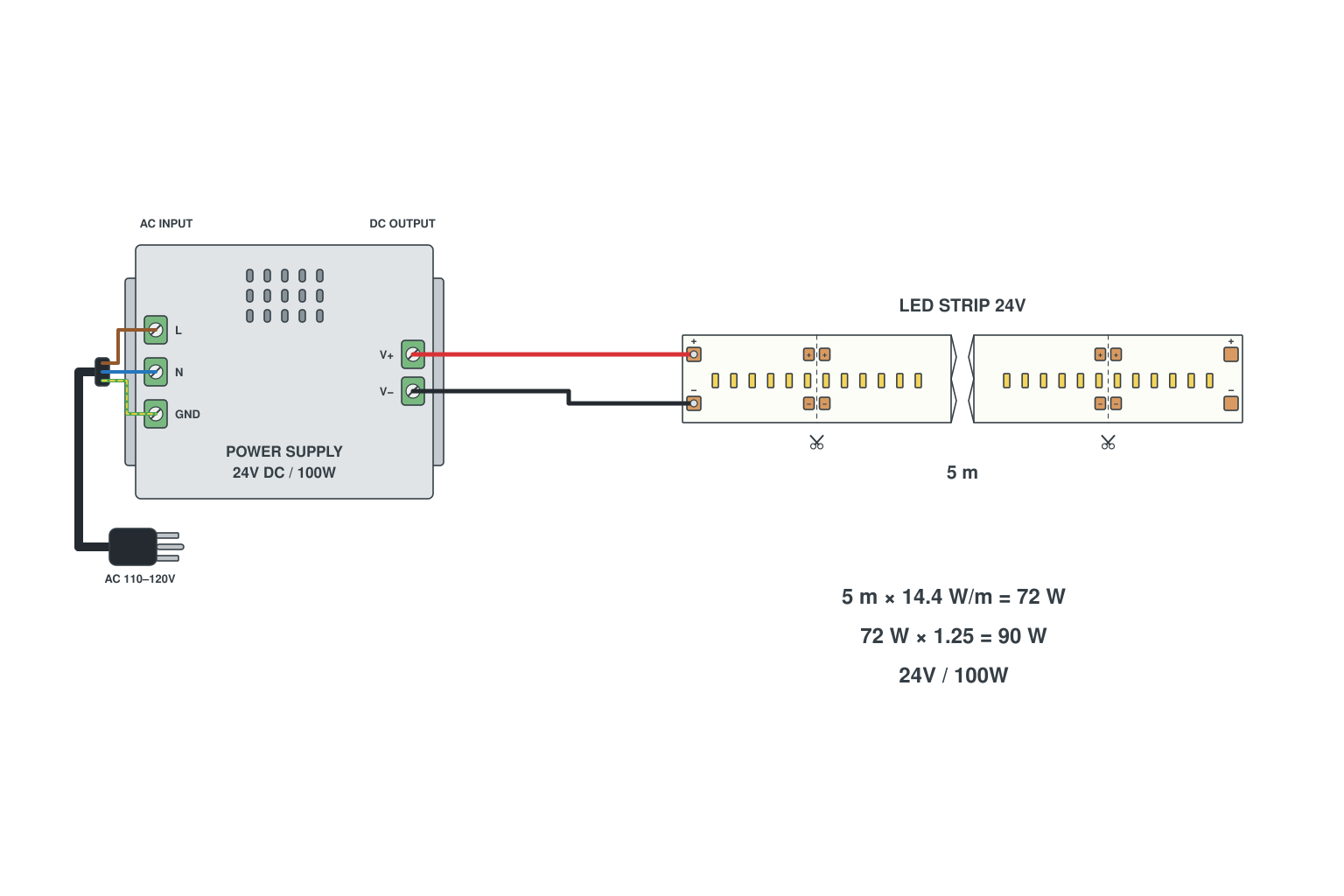
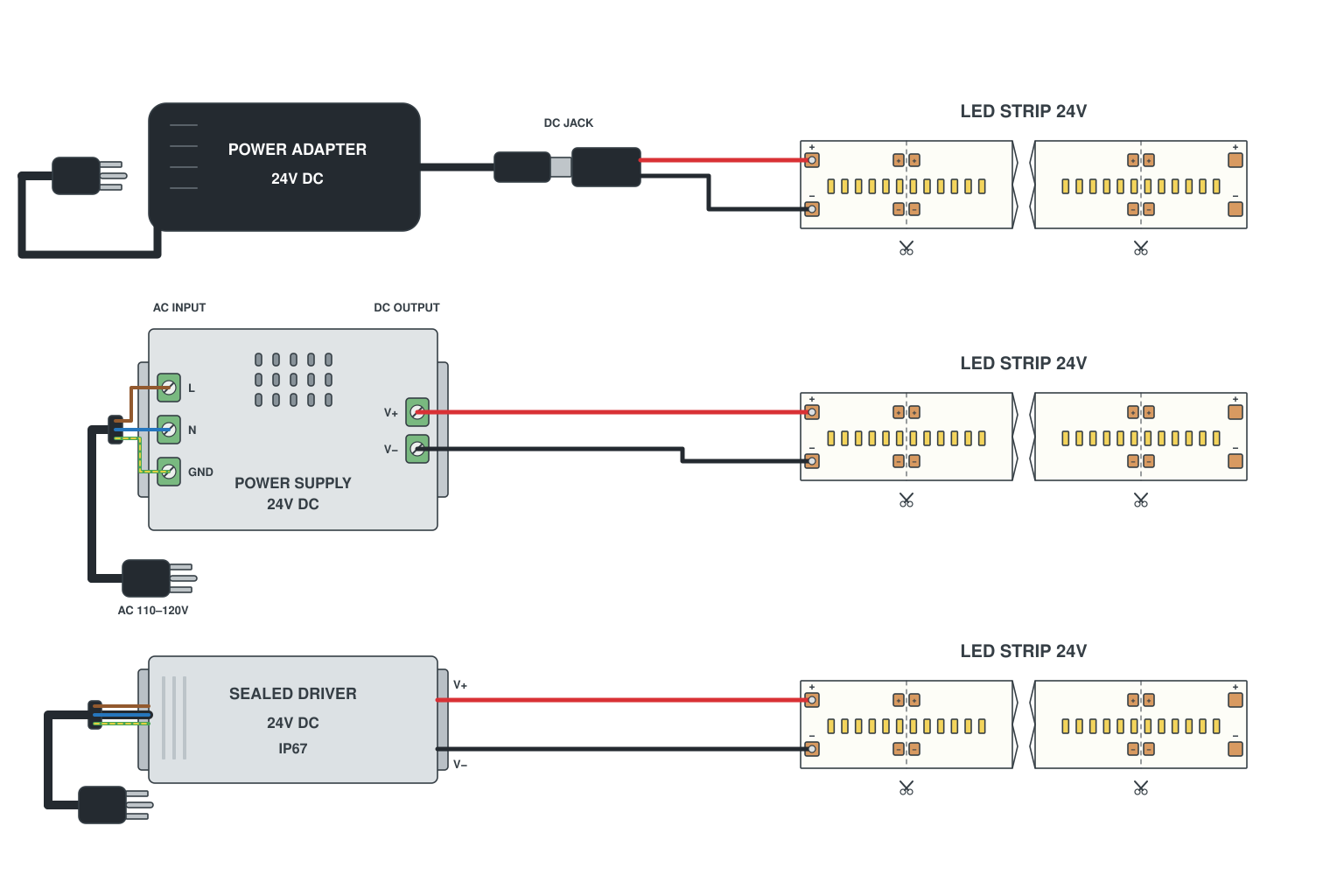
Full guides: how to choose LED strip light power supply and how to connect LED strip to the power supply.
In conclusion
First determine the color of your led strip, whether it is a single color, multi-color, addressable dream color, or led neon light. Click into the relevant category to select the appropriate voltage, PCB width, density, and waterproof level for your light strip. Then choose the matching led controller and led driver according to the determined led strip.
If you have other questions about the choice of led strips, please feel free to contact us.
What you need to know about led strip installation
How to connect two light strips together?
How to wire single color led strip lights?
How to wire tunable white/CCT led strip lights?
How to wire RGB color changing led strip lights?
How to wire RGBCCT led strip lights?
How to wire addressable led strips?
More LED strip buying guides
Shop LED strip lights by category
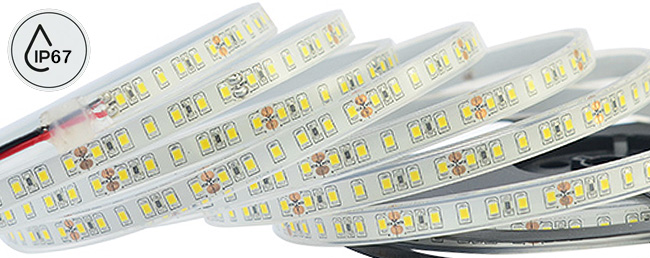 IP67 water resistant LED stripsFor outdoor environments
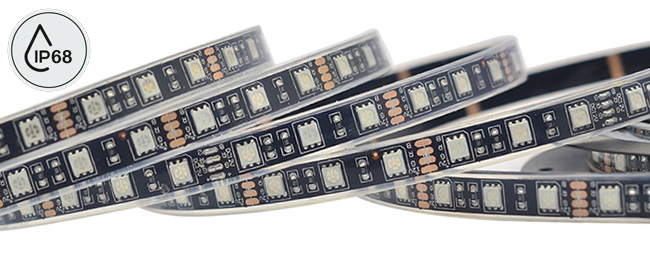 IP68 LED strip lights for poolsCompletely sealed
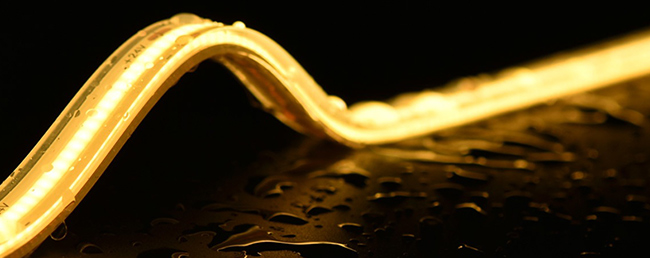 Waterproof COB LED stripsCOB strips for wet places
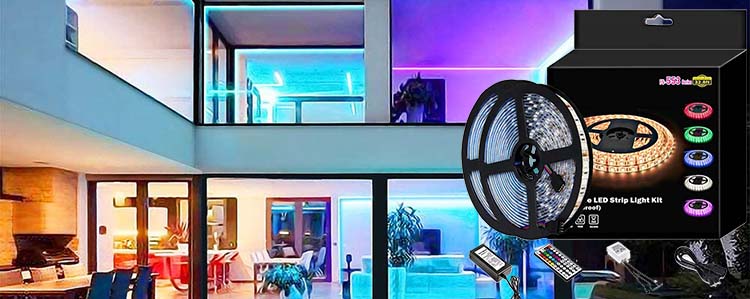 Weatherproof LED strip light kitsComplete kits for outdoors
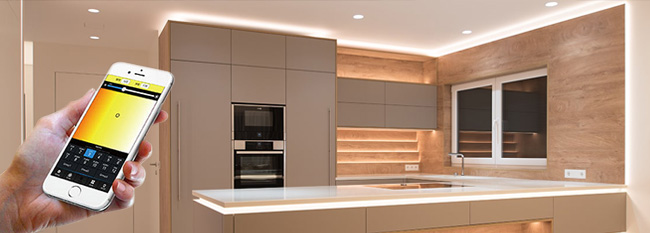 Single color LED strip lightsEvery chip in the lumen table
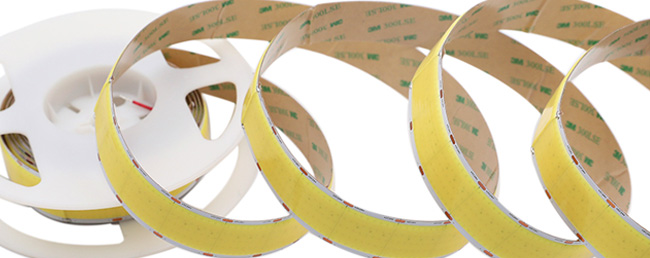 Brightest LED tape lightWhen brightness comes first
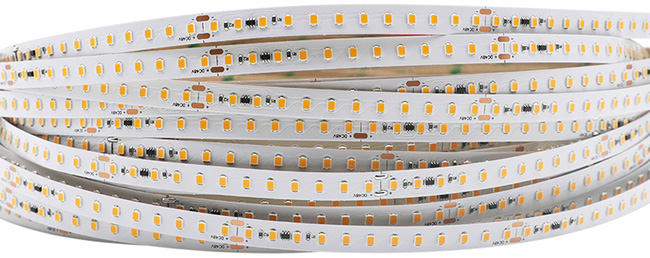 Ultra-long constant current LED stripsLong runs, no voltage drop
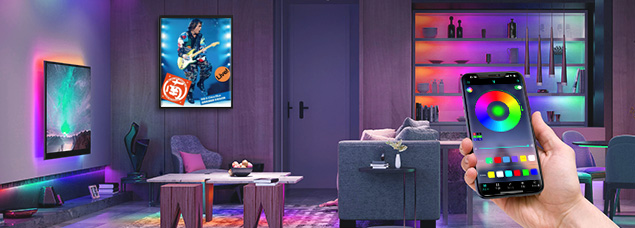 LED smart controller seriesDimmers and color controllers
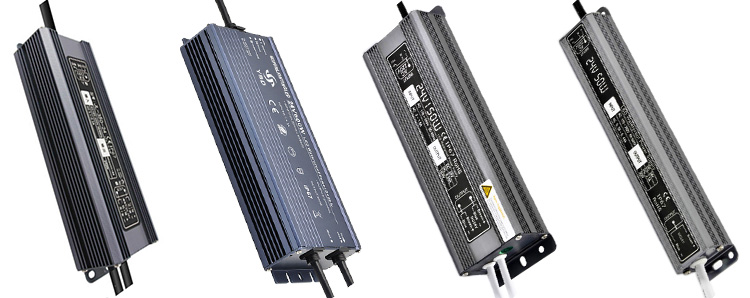 DC24V waterproof power suppliesOutdoor and damp locations
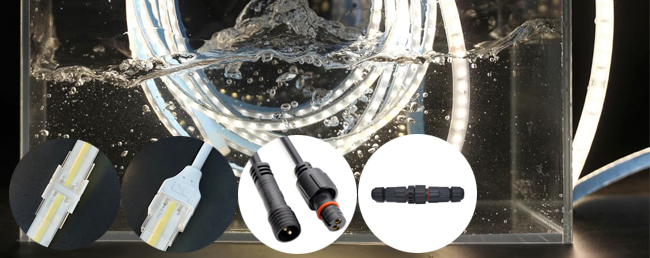 Waterproof IP68 connectorsSeal every outdoor joint
LED strip buying FAQ
What should I look for when buying LED strip lights?
Six things: the IP rating for where it goes (IP20 or IP65 indoors, IP67 or IP68 outdoors), the LED chip and density for brightness, the voltage (5V, 12V, 24V, 36V/48V or AC 110/220V), the length, whether you need a dimmer or controller, and a power supply with the same output voltage sized by the 80% rule.
IP65 vs IP67 LED strip: which one for outdoor use?
IP67. An IP65 LED strip has a layer of glue over the parts: it is splash-proof and fine for kitchens or bathrooms, but it cannot be immersed and is not suitable for outdoor use. An IP67 strip is encapsulated in a silicone sleeve or heat shrink tube and is suitable for outdoor environments, but it cannot be soaked in water. For a swimming pool choose IP68.
What are the best waterproof outdoor LED strip lights?
An IP67 LED strip for outdoor runs and an IP68 strip for pools, used with sealed joints: IP67/IP68 connectors, end caps filled with silicone, and a waterproof or rainproof power supply.
Should I buy 12 volt or 24 volt LED strip lights?
24V for long runs: no voltage drop in 8-10 meters and 10 meters from one end, but you can only cut every 6 LEDs. 12V has no voltage drop in 5-7 meters, cuts every 3 LEDs and is also used in cars and boats. Never mix them on one circuit: the 12V strip burns out or the 24V strip will not light up.
How many LEDs per meter do I need?
High density (above 120 LEDs) if the strip is the main light source or the area is large; low (30-72 LEDs) or medium density (72-120 LEDs) for small spaces without many brightness requirements. The denser the strip, the more uniform the light and the higher the lumen, but it also needs more power and heat dissipation.
Tell us where the strip goes (indoor or outdoor), the length and how you want to control it, and the SuperLightingLED team will match the strip, controller and power supply, or build a custom length. Standard orders such as accessories and controllers ship within 24–48 hours; LED strip orders follow the production lead time shown on the product page. Contact our team · Browse complete LED strip kits