
Related Products
Tick the accessories you need and add them in one go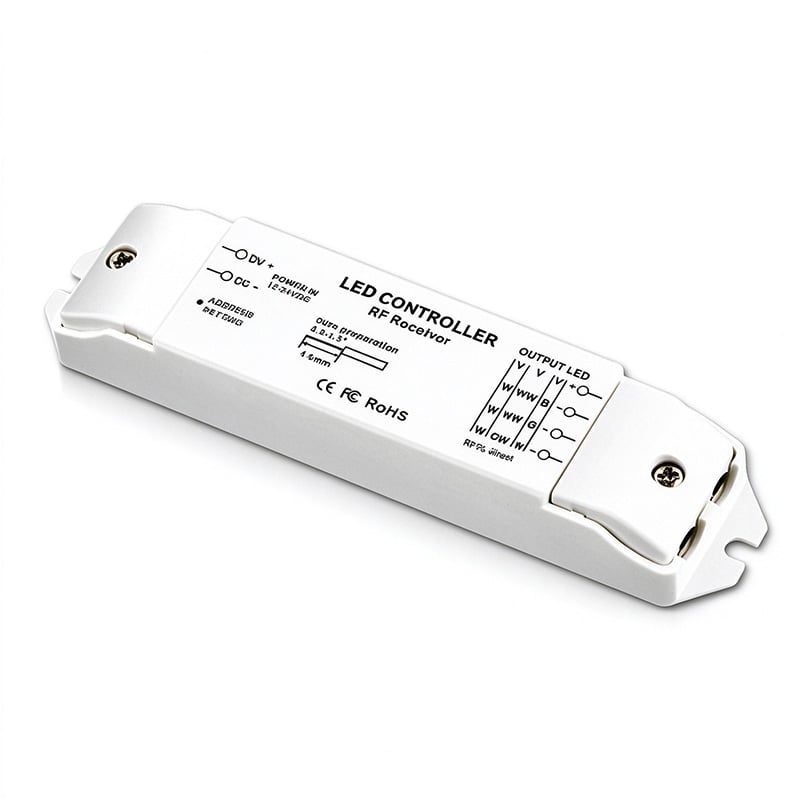 £13.64
 £26.54
 £26.55
 £26.54
 £34.89£37.948% off
 £22.75£24.286% off
 £19.71£22.7613% off
Product Information
The BinColor BC-R3M 3-channel led wireless receiver operates between DC12V and DC24V constant voltage to regulate low-voltage LED strip lights across residential and commercial zones. Engineered with an RF wireless reception span of 40m to 50m, this compact unit mounts inside aluminum extrusions or ceiling coves to control up to three single-color channels, one dual-channel tunable white circuit, or one multi-color RGB circuit. Rated at 3A per output channel (9A total load), it manages 108W at 12V or 216W at 24V with 4096-level PWM grayscale resolution to eliminate visible stepping during low-end dimming.
Key Features
3-in-1 Load Configuration
Configures as 3 independent single-color channels, 1 tunable white CCT channel, or 1 RGB channel without modifying internal hardware.
4096 Grayscale Resolution
Employs 12-bit PWM output across 4096 steps to ensure flicker-free, continuous transitions from 0.1% to 100% brightness.
40M to 50M Reception
Receives wireless RF commands reliably at distances up to 50 meters in open spaces and through standard drywalls.
9A Total Current Capacity
Supports 3A per channel continuously, providing 108W total capacity at DC12V and 216W total capacity at DC24V.
Ultra-Slim 20mm Profile
Enclosed in a durable 135 x 30 x 20 mm housing that fits directly into narrow architectural channels and compact junction boxes.
Industrial Temperature Range
Operates continuously within severe ambient conditions ranging from -30 degrees Celsius up to 55 degrees Celsius.
Technical Highlights
- Pairs only with BinColor T-Series handheld wireless remotes to adjust dimming, color temperature, and static RGB hues without running control wiring through walls.
- Drives up to three runs of monochrome white COB LED strip simultaneously, giving you independent level setting across accent zones.
- Enables dual-channel mixing for a tunable white COB LED strip, providing kelvin-range adjustments from warm 2700K to cool 6500K.
- Executes smooth color transitions and static color selection when wired directly to a standard RGB COB LED strip.
- Requires connection to a constant-voltage LED power supply rated between DC12V and DC24V to match the voltage requirement of your LED strip.
- Features 4096-level dimming curves that suppress camera flicker and smooth out low-end dimming artifacts, making it suitable for broadcast studios and hospitality venues.
- Includes internal memory retention to automatically restore previous brightness levels, color states, and dynamic settings following a mains power cut.
Product Specifications
| Parameter | Details |
|---|---|
| Model Number | BC-R3M |
| Product Category | LED Wireless Receiver |
| Input Voltage | DC 12V - DC 24V |
| Output Type | Constant Voltage (PWM) |
| Number of Channels | 3 Channels |
| Max Output Current | 3A per channel (9A total) |
| Max Output Power (12V) | 108W (36W per channel) |
| Max Output Power (24V) | 216W (72W per channel) |
| Grayscale Levels | 4096 levels (12-bit) |
| Wireless Frequency | RF Wireless |
| Receiving Distance | 40m - 50m (line of sight) |
| Supported LED Configurations | 3x Single Color / 1x Tunable White (CCT) / 1x RGB |
| Terminal Type | Screw terminals (Input/Output) |
| Power-off Memory Function | Yes (restores last operational state) |
| Working Temperature | -30°C to +55°C |
| Enclosure Material | Flame-retardant ABS housing |
| Dimensions | 135 mm (L) x 30 mm (W) x 20 mm (H) |
| Product Weight | 48g |
| Ingress Protection Rating | IP20 (indoor dry location) |
Application Scenarios
How to Control & Use This Controller
- Disconnect AC mains power from your LED power supply before making any electrical connections.
- Connect the constant-voltage DC12V or DC24V power supply output leads to the receiver INPUT screw terminals, observing correct positive (V+) and negative (V-) polarity.
- Connect the LED strip wiring to the OUTPUT screw terminals: use V+ as common anode positive, and wire the negative channels to CH1/CH2/CH3 for single-color runs, WW/CW for CCT strips, or R/G/B for multi-color strips.
- Inspect all wire terminations to ensure no stray copper strands bridge adjacent screw terminals.
- Turn on the AC mains power; the LED indicator on the receiver will illuminate to show normal standby status.
- Press the pairing (learning) key on the receiver, then immediately press the assigned zone or power button on your compatible RF remote control to pair the devices.
- Verify smooth dimming, color shifting, and zone on/off operation across your connected LED strip run.
⚠ Precautions
- Voltage matching is mandatory: Ensure the input power supply DC voltage matches the working voltage of your connected LED strip lights exactly (DC12V in = DC12V out; DC24V in = DC24V out).
- Do not exceed the electrical capacity: Current must not exceed 3A on any single channel or 9A across all three channels combined (108W at 12V, 216W at 24V).
- Observe common-anode polarity when terminating 4-wire RGB or 3-wire CCT LED strip lights; reversing polarity will prevent illumination.
- This unit is rated IP20 for dry indoor environments; when installing outdoors or in damp basements, place the receiver inside an IP65 or higher rated junction enclosure.
- Do not encase the receiver entirely inside grounded, solid metal enclosures, as heavy shielding reduces the RF wireless range from 50m down to less than 5m.
What's in the Box
- ✓1 x BinColor BC-R3M 3-Channel LED Wireless Receiver
- ✓1 x User Wiring and Operation Instruction Manual
Frequently Asked Questions
Q: What types of LED strip lights work with the BC-R3M receiver?
A: This led strip light receiver works with constant-voltage DC12V and DC24V LED strip lights in three wiring configurations: up to three individual single-color strips, one dual-channel tunable white (CCT) strip, or one RGB strip.
Q: How much total electrical wattage can this receiver handle?
A: The receiver supports 3A per channel across 3 channels (9A total), delivering a maximum load of 108W when powered by a 12V driver or 216W when powered by a 24V driver.
Q: Does this receiver require a separate power supply?
A: Yes, this unit is a low-voltage receiver and dimmer that sits between your driver and your LED strip; it requires an external constant-voltage DC12V or DC24V power supply matching your strip voltage.
Q: What is the operational wireless control range?
A: The built-in RF module receives control signals up to 40m to 50m in open line-of-sight environments, and typically 20m to 30m when passing through standard interior drywall partitions.
Q: Does the BC-R3M remember its settings after a power failure?
A: Yes, the receiver incorporates non-volatile memory that retains your last active brightness, color temperature, or static RGB hue when AC line power is interrupted.
Q: How do I expand my LED installation if my total load exceeds 9A?
A: To run lighting loads beyond 9A (108W at 12V or 216W at 24V), add a compatible constant-voltage PWM data repeater / amplifier to take output signals from the BC-R3M and distribute supplementary power from an additional driver.
Q: Can multiple receivers be synced to a single wireless remote?
A: Yes, multiple BC-R3M receivers can be coded to the same wireless handheld or wall-mounted RF remote transmitter for simultaneous single-zone or synchronized multi-zone operation.
Q: What dimming resolution does this receiver provide?
A: The unit utilizes 4096-level (12-bit) PWM dimming technology, preventing visible stepped jumps or flickering when dimming down to low brightness thresholds.
Reviews
Customer Experience
Your feedback is important to us! Share your thoughts and photos with other customers.
Downloads
Files for BC-R3MImages
These images were taken with Canon EOS 5D Mark IV and the studio light source is provided by Ra 98's full spectrum LED strip to realistically reproduce the colors of the item itself. All copyrights are created by the superlightingled team, please feel free to browse and download if you are a registered user!
LED Strip Lights Guide
Here you can learn anything about LED strip lights — pick the topic you are interested in to go deeper. We cover LED strip lights, power supplies, controllers, accessories, and how to connect LED strip lights. You can also watch our demo videos.
Led strip lights
►Everything you need to know before you buying led strip lights
| Top 6 Considerations Before Buying LED Strip Lights 1. Where do I want to place the LED strip lights? Indoor or outdoor? • What are waterproof led strip lights? • How to cut and connect waterproof led strip lights? 2. How much LED brightness do I need? 3. The working voltage is available? • 5V VS 12V VS 24V led strips • AC VS DC 4. How long is the LED strip light suitable for my project? 5. Do I need an LED light controller to adjust the LED color and brightness? 6. How to power the LED strip lights? 1. How do led strip lights work? 2. How long can you run an LED strip? 3. How long do LED strip lights last? Is it worth getting led strip lights? 1. Do LED strip lights use a lot of electricity? 2. Why are LED lights energy efficient? 3. Are LED Strip Lights sustainable? 4. What are the pron and cons of led strip lights? 5. Precautions for led strip lights 1. Do LED strip lights overheat? 2. How do you stop LED strips from overheating? 3. Can LED strips catch fire? 4. Is it safe to sleep with LED strip lights on? What are the types of led strip lights? Flexible led strip lights VS rigid led strip lights - 1. What are flexible led strip lights? 2. What are rigid led strip lights? 3. What happens if you bend LED strip lights? 4. What is the difference between flexible led strips and rigid led strips? 1. Can you cut led light strips? 2. What happens if you cut an led strip? 3. How to cut led strip lights? 4. How to connect RGB color changing led strip lights with a connector? 5. How to know what your led strip light is? How to choose the correct SMD led for your strip? Which is the brightest SMD LED? What does SMD 5050 mean? How many lumens is a 5050 SMD LED? How to know what type of LED strip? What is the difference between 2835 and 5050 LED? |
►COB led strip light
| 1. What is COB? 2. What is the COB production process? 3. Different types of COB strip lights 4. What is the difference between COB and SMD led strip lights? 5. What is the difference between COB and LED? 6. Are COB led strips better? 7. How to cut and connect COB led strips? 8. How to install COB led strip lights? 9. Can COB light strips use aluminum channels? 10. Why choose superlightingled? |
►Led neon lights
| 1. What is led neon light? 2. What are neon led lights used for? 3. Are led neon lights good? 4. How to choose led neon rope lights? 5. Are led neon ropes use DC or AC? 6. Can you change the light-emitting angle or the luminous way of neon led strip? 1. How to cut led neon lights 2. Can led neon lights be connected? 3. Easy 7 steps to make led neon lights 4. How to install led neon rope? |
►Addressable led strip
| Ultimate Guide to Choosing the Right Addressable LED Strip What is an addressable LED strip? Can you cut addressable LED strips? How to judge if an LED strip is individually addressable? How to choose the best DC12V addressable led strips? How to choose the best DC5V digital led strips? How to choose the right IC for your project? Which IC is most commonly used? How do I know my IC type? How do I know if my IC is good or bad? How many types of IC are there? |
►Color, color temperature, and CRI
| The Color Difference Between Warm White 2700K, 3000K, 4000K, 6000K Pure White and 7000K Cool White 1. What is color temperature? 2. What color temperature is right for me? • 2700K VS 3000K • How obvious is the difference between 2700K and 3000K? • Warm White 3000K VS Natural White 4000K VS Daylight White 6000K • Warm White VS Cool White 3. Enjoy 2700K, 4000K, 6000K 4. Further Reading: How to install Warm White LED light strip? How to choose the right color for your led strip lights? - 1. How many colors are in LED strip lights? 2. What do LED light colors mean? 3. Why do white LED light turns to yellow? 4. Why are your led strip lights not the same color? 5. What is the most relaxing color for LED lights? 6. What color led lights is best for sleeping? 7. Are led lights bad for your eyes? 8. Is cool white or warm white better for eyes? 1. What is the best color temperature? 2. Does color temperature keep the same as time goes by? 3. What color temperature is best for night? 4. Led strip lights about color temperature,CCT VS RGBW VS RGBCCT; What is color rendering index? 1. What is CRI in led lights? 2. How to choose the right CRI when buying led strip lights? 3. What is the relationship between CRI and brightness? 4. Is higher CRI better? High CRI VS Low CRI; 5. How to find CRI value? |
Led strip light connection
| How to connect led strip lights? 1. How to connect led strip lights together? 2. How to connect LED light strips without connectors? 3. How to solder wires to LED strips? 4. How to connect LED strips without soldering? 5. Which one is better between soldering and using a connector? 6. How to connect mutiple led strip lights? 7. How many LED strip lights can you connect? How to connect led strip to the power supply? 1. Ensuring the working voltage and power first 2. How to hardwire led strip lights? 3. Can I connect multiple LED strips to the same LED power supply? How to wire led strip lights? How to wire single color led strip lights? How to wire tunable white/CCT led strip lights? How to wire RGB color changing led strip lights? |
Controller for led strip lights
| How to choose led strip light controllers? 1. WIFI controller 2. RF controller 3. IR controller 4. Bluetooth controller 5. Remote control and panel control 6. Single color controller and multi-color controller 7. DMX512 controller 8. SPI controller 9. DALI controller 10. 0/1-10V dimmer 11. Triac series 12. Sonsor series |
Led power supply
| How to calculate power for led strip lights? 4 steps to calculate the power you need Performance And Reasons Of LED Voltage Drop How to choose led strip light power supply? 1. Alternating current power supply VS Direct current power supply 2. Constant current power supply VS Constant voltage power supply 3. How to choose the best led power supply for your led strip light? |
Led strip light installlation
| How to install led strip lights? What accessories will be needed? 1. Adhesive installation for IP20 and IP65 led strip lights 2. How to choose the right led tape? 3. Can IP20 and IP65 led strip lights use aluminum profiles? 4. How to use aluminum profiles? 5. Mounted clip installation for IP67 and IP68 light strips How to install LED sensor stair lights? Lighting Up Your Stairs With LED Strip Lights Ideas How to install led strip lights on TV? How to install led strip lights outdoor? |
Accessories
| How to choose led strip light connectors? 1. Are all LED light strip connectors the same? 2. How do LED strip lights connectors work? 3. What connectors do you need for LED strip lights? 4. What are the different kinds of LED connectors? 5. How to choose the right connector for your led strip lights? Ultimate Guide on Aluminum Profile for LED Strip Lighting 1. What are aluminium profiles used for? 2. Why choose aluminum profiles? 3. Different types of LED aluminum profiles 4. LED aluminum profile VS COB LED strips 5. How to install LED aluminum channels? 6. How To Get Ideal Light Diffuser For Your LED Strip? 7. Add Black Aluminum LED Light Diffusers For Your Home Lighting 8. How To Find The Right Aluminum LED Light Strip Diffuser Channel? |