Related Products
Tick the accessories you need and add them in one go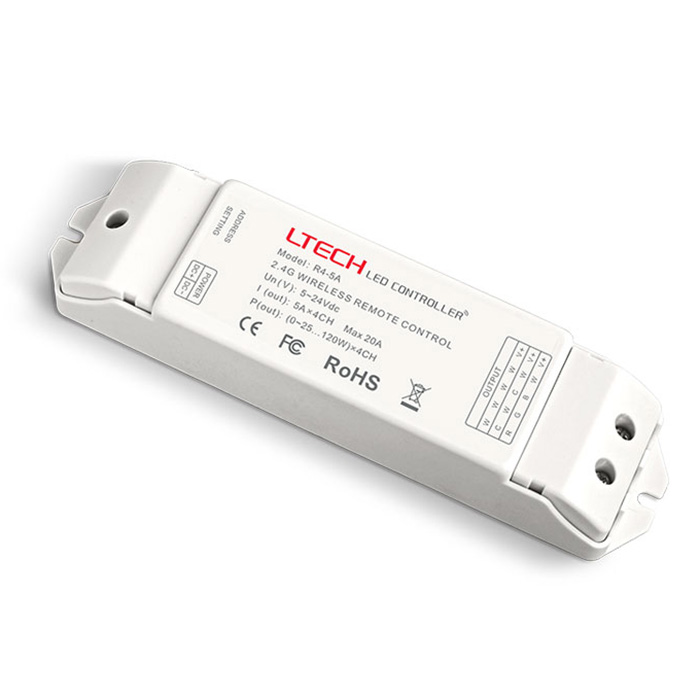 $54.98
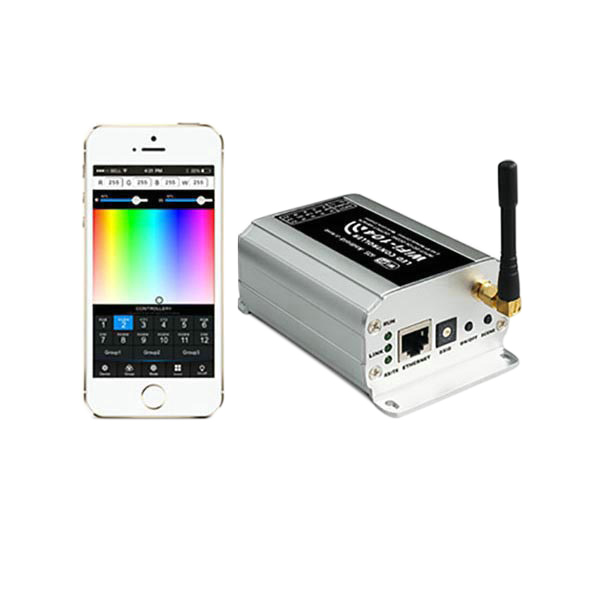 LED WiFi 16 Zones Wireless Synchronization Group Controller Work With M12 RF Remote and APP WiFi-104$129.98$150.0013% off
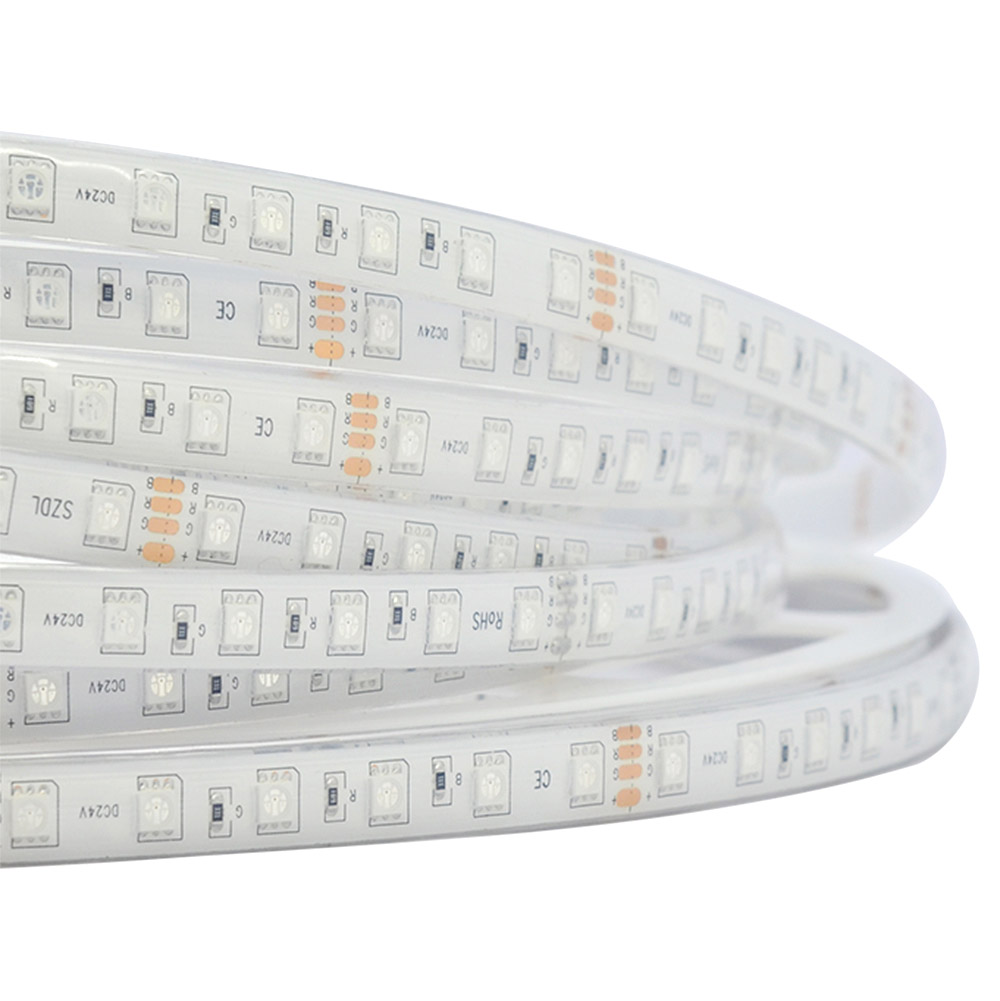 $68.98$170.0059% off
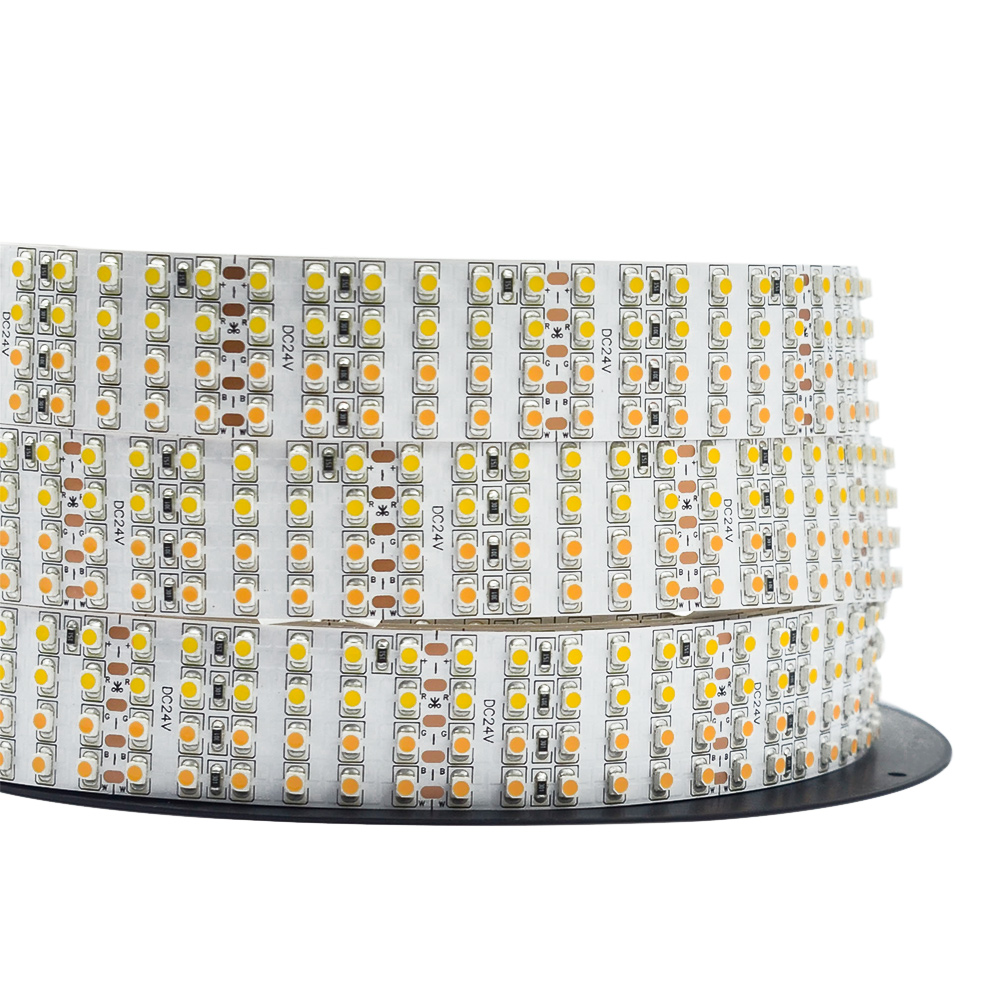 $86.98$90.984% off
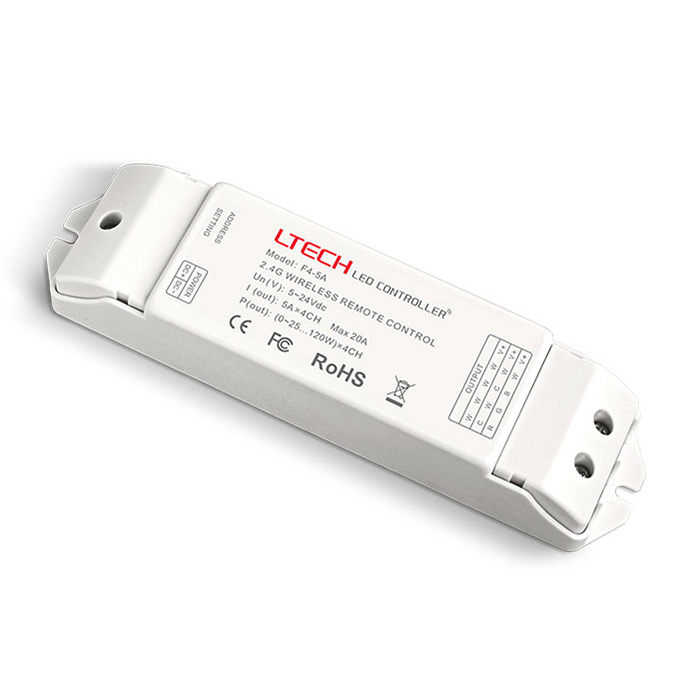 $57.98
 $29.98
- $54.98
Product Information
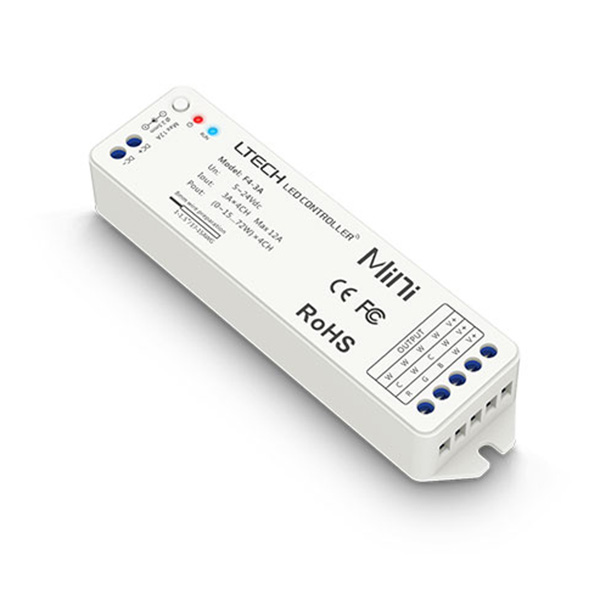
The Ltech R4-5A is a high-capacity, 4-channel wireless receiver engineered for professional multi-zone lighting systems. As a core component of the Ltech DX wireless ecosystem, this constant voltage (CV) receiver reliably translates commands from your remote into smooth, responsive control for your LED strips. Its wide 5-24V input range and robust 20A total output make it a versatile and powerful choice for ambitious architectural, commercial, and residential lighting projects. Whether you're driving extensive runs of single-color strips or creating dynamic scenes with RGBW LED strips, the R4-5A provides the stable, powerful link you need for seamless wireless control.
Key Features
High-Capacity 4-Channel Output
Delivers 5A per channel (20A total) to powerfully drive RGBW strips or four independent single-color LED zones.
Wide Voltage Compatibility
Operates on any DC voltage from 5V to 24V, offering flexibility for a wide variety of constant voltage LED strip lights.
Long-Range 2.4GHz RF Control
Features a stable 2.4GHz wireless signal with a 50-meter (164ft) range for reliable control that penetrates walls and obstacles.
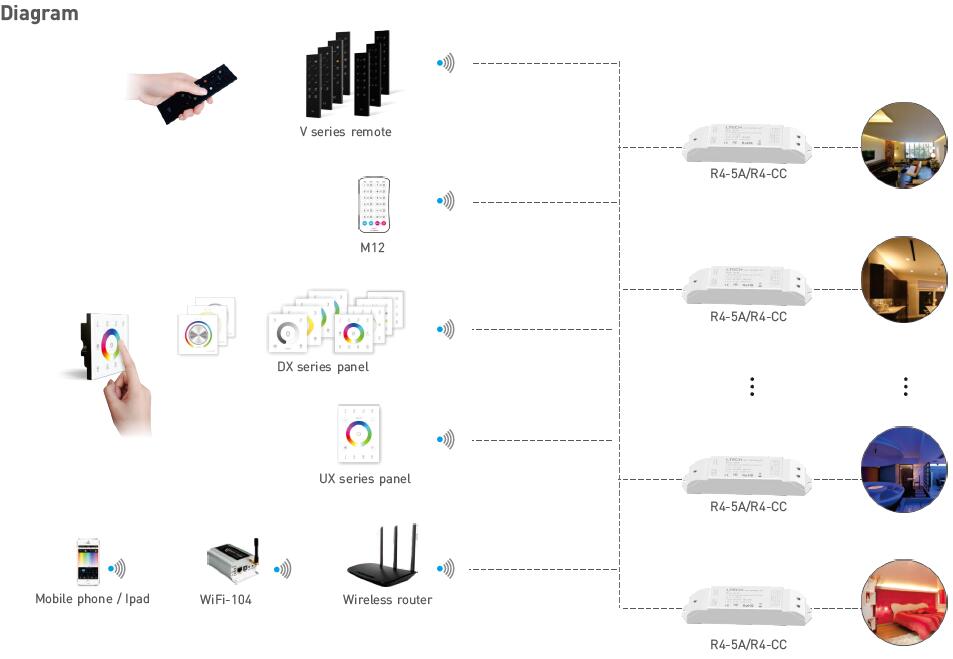
Multi-Zone System Integration
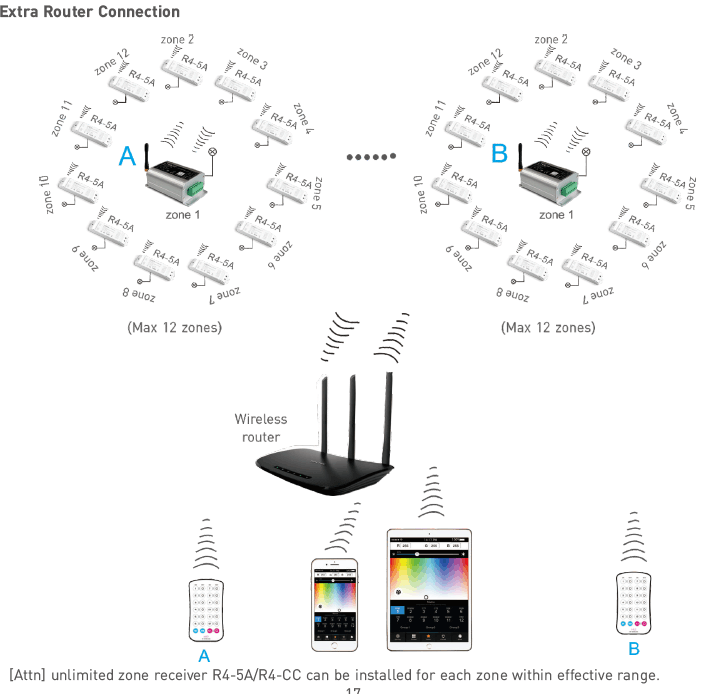
Functions as a dedicated zone receiver, allowing multiple units to be paired for synchronized or independent control via a multi-zone remote.
Seamless Ltech DX Ecosystem
Pairs effortlessly with Ltech's DX series of handheld remotes and wall panel controllers for a professional-grade control experience.
Product Specifications
| Parameter | Details |
|---|---|
| Model | R4-5A |
| Working Frequency | 2.4GHz |
| Input Voltage | DC5V ~ DC24V |
| Max Current Load | 5A × 4CH (Max 20A) |
| Max Output Power | 100W (5V) / 240W (12V) / 480W (24V) |
| Remote Distance | 50m (Unobstructed) |
| Working Temperature | -30℃ to 55℃ |
| Dimensions (L×W×H) | 175 × 44 × 30 mm |
| Package Size (L×W×H) | 178 × 48 × 33 mm |
| Gross Weight | 150g |
Application Scenarios
How to Control & Use This Controller
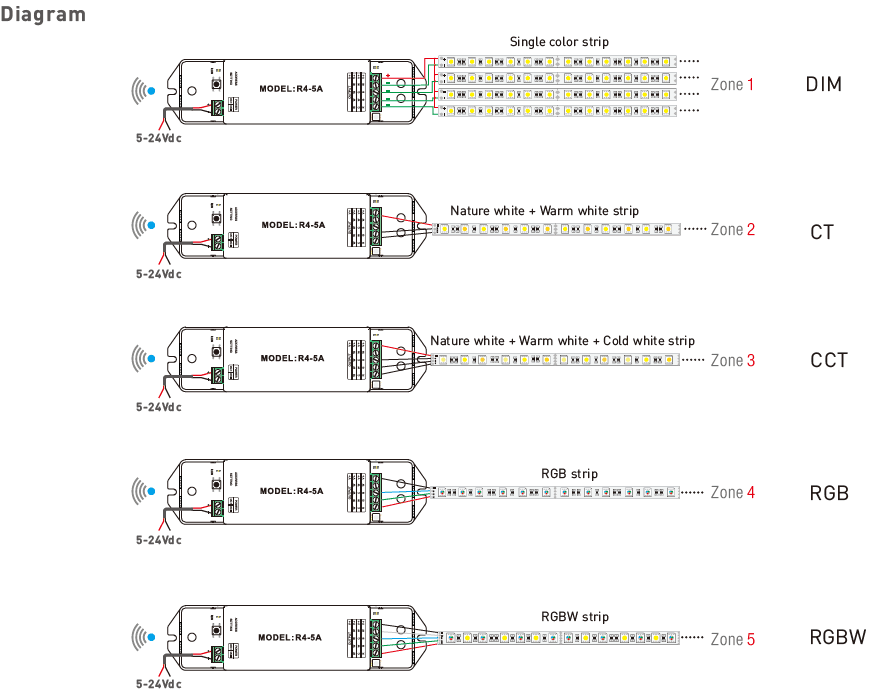
- Power Connection: Securely connect your DC 5-24V power supply to the INPUT terminals of the receiver. Ensure correct polarity (+ to + and - to -).
- LED Strip Wiring: Connect your constant voltage LED strips to the OUTPUT terminals (CH1, CH2, CH3, CH4, and V+). For RGBW strips, connect the R, G, B, and W wires to their corresponding channels.
- Pairing with Remote: Briefly press the "Learning Key" on the R4-5A receiver. Immediately press the desired zone button on your compatible Ltech DX series remote control. The connected LED lights will flash to confirm a successful pairing.
- Operation: Once paired, use the remote to control your lights. You can now switch them on/off, dim brightness, and change colors (if applicable) for the assigned zone.
- Ensure the voltage of your power supply matches the voltage of your LED strips (e.g., use a 24V power supply for 24V strips).
- Do not exceed the maximum load of 5A per channel or 20A total. For lighting runs that require more power, you must use an LED power repeater to extend the signal and provide additional power.
- Ensure adequate ventilation around the receiver to dissipate heat during operation.
- For detailed diagrams and advanced configurations, please refer to the R4-5A datasheet available in the Downloads section below.
What's in the Box
- ✓1x R4-5A CV Zone Receiving Controller
- ✓1x User Manual
⇩ Downloads & Documents
PDFR4-5A
Frequently Asked Questions
Q: What remote controls are compatible with the R4-5A?
A:The R4-5A is specifically designed to work with the Ltech DX series of 2.4GHz wireless remotes and wall panels. It is not a universal receiver compatible with other brands.
Q: Can this controller handle RGBW or RGBCCT LED strips?
A:Yes, its 4-channel output is perfect for controlling standard 4-wire RGBW LED strip lights. It does not have the 5 channels required for RGBCCT strips.
Q: How many R4-5A receivers can I control with one remote?
A:You can pair multiple R4-5A receivers to a single zone on your remote. All receivers paired to the same zone will respond synchronously to the remote's commands.
Q: What is the difference between this R4-5A (CV) model and the R4-CC?
A:This R4-5A is a Constant Voltage (CV) receiver for common LED strips. The R4-CC is a Constant Current (CC) model designed for specific CC LED modules. They serve different purposes and are not interchangeable.
Q: Do I need a WiFi hub for this receiver to work?
A:No, the R4-5A operates directly with 2.4GHz RF remotes out of the box. To enable control via a smartphone app, you would need to add a compatible Ltech WiFi gateway to your lighting system.
Q: My installation is over a long distance. How can I extend the control range?
A:The 50-meter range is for an unobstructed line of sight. To ensure a strong signal over greater distances or through dense walls, you can incorporate an Ltech RF signal repeater into your setup.
Reviews
Customer Experience
Your feedback is important to us! Share your thoughts and photos with other customers.

Super fast shipping
Downloads
Files for R4-5AImages
These images were taken with Canon EOS 5D Mark IV and the studio light source is provided by Ra 98's full spectrum LED strip to realistically reproduce the colors of the item itself. All copyrights are created by the superlightingled team, please feel free to browse and download if you are a registered user!
LED Strip Lights Guide
Here you can learn anything about LED strip lights — pick the topic you are interested in to go deeper. We cover LED strip lights, power supplies, controllers, accessories, and how to connect LED strip lights. You can also watch our demo videos.
Led strip lights
►Everything you need to know before you buying led strip lights
| Top 6 Considerations Before Buying LED Strip Lights 1. Where do I want to place the LED strip lights? Indoor or outdoor? • What are waterproof led strip lights? • How to cut and connect waterproof led strip lights? 2. How much LED brightness do I need? 3. The working voltage is available? • 5V VS 12V VS 24V led strips • AC VS DC 4. How long is the LED strip light suitable for my project? 5. Do I need an LED light controller to adjust the LED color and brightness? 6. How to power the LED strip lights? 1. How do led strip lights work? 2. How long can you run an LED strip? 3. How long do LED strip lights last? Is it worth getting led strip lights? 1. Do LED strip lights use a lot of electricity? 2. Why are LED lights energy efficient? 3. Are LED Strip Lights sustainable? 4. What are the pron and cons of led strip lights? 5. Precautions for led strip lights 1. Do LED strip lights overheat? 2. How do you stop LED strips from overheating? 3. Can LED strips catch fire? 4. Is it safe to sleep with LED strip lights on? What are the types of led strip lights? Flexible led strip lights VS rigid led strip lights - 1. What are flexible led strip lights? 2. What are rigid led strip lights? 3. What happens if you bend LED strip lights? 4. What is the difference between flexible led strips and rigid led strips? 1. Can you cut led light strips? 2. What happens if you cut an led strip? 3. How to cut led strip lights? 4. How to connect RGB color changing led strip lights with a connector? 5. How to know what your led strip light is? How to choose the correct SMD led for your strip? Which is the brightest SMD LED? What does SMD 5050 mean? How many lumens is a 5050 SMD LED? How to know what type of LED strip? What is the difference between 2835 and 5050 LED? |
►COB led strip light
| 1. What is COB? 2. What is the COB production process? 3. Different types of COB strip lights 4. What is the difference between COB and SMD led strip lights? 5. What is the difference between COB and LED? 6. Are COB led strips better? 7. How to cut and connect COB led strips? 8. How to install COB led strip lights? 9. Can COB light strips use aluminum channels? 10. Why choose superlightingled? |
►Led neon lights
| 1. What is led neon light? 2. What are neon led lights used for? 3. Are led neon lights good? 4. How to choose led neon rope lights? 5. Are led neon ropes use DC or AC? 6. Can you change the light-emitting angle or the luminous way of neon led strip? 1. How to cut led neon lights 2. Can led neon lights be connected? 3. Easy 7 steps to make led neon lights 4. How to install led neon rope? |
►Addressable led strip
| Ultimate Guide to Choosing the Right Addressable LED Strip What is an addressable LED strip? Can you cut addressable LED strips? How to judge if an LED strip is individually addressable? How to choose the best DC12V addressable led strips? How to choose the best DC5V digital led strips? How to choose the right IC for your project? Which IC is most commonly used? How do I know my IC type? How do I know if my IC is good or bad? How many types of IC are there? |
►Color, color temperature, and CRI
| The Color Difference Between Warm White 2700K, 3000K, 4000K, 6000K Pure White and 7000K Cool White 1. What is color temperature? 2. What color temperature is right for me? • 2700K VS 3000K • How obvious is the difference between 2700K and 3000K? • Warm White 3000K VS Natural White 4000K VS Daylight White 6000K • Warm White VS Cool White 3. Enjoy 2700K, 4000K, 6000K 4. Further Reading: How to install Warm White LED light strip? How to choose the right color for your led strip lights? - 1. How many colors are in LED strip lights? 2. What do LED light colors mean? 3. Why do white LED light turns to yellow? 4. Why are your led strip lights not the same color? 5. What is the most relaxing color for LED lights? 6. What color led lights is best for sleeping? 7. Are led lights bad for your eyes? 8. Is cool white or warm white better for eyes? 1. What is the best color temperature? 2. Does color temperature keep the same as time goes by? 3. What color temperature is best for night? 4. Led strip lights about color temperature,CCT VS RGBW VS RGBCCT; What is color rendering index? 1. What is CRI in led lights? 2. How to choose the right CRI when buying led strip lights? 3. What is the relationship between CRI and brightness? 4. Is higher CRI better? High CRI VS Low CRI; 5. How to find CRI value? |
Led strip light connection
| How to connect led strip lights? 1. How to connect led strip lights together? 2. How to connect LED light strips without connectors? 3. How to solder wires to LED strips? 4. How to connect LED strips without soldering? 5. Which one is better between soldering and using a connector? 6. How to connect mutiple led strip lights? 7. How many LED strip lights can you connect? How to connect led strip to the power supply? 1. Ensuring the working voltage and power first 2. How to hardwire led strip lights? 3. Can I connect multiple LED strips to the same LED power supply? How to wire led strip lights? How to wire single color led strip lights? How to wire tunable white/CCT led strip lights? How to wire RGB color changing led strip lights? |
Controller for led strip lights
| How to choose led strip light controllers? 1. WIFI controller 2. RF controller 3. IR controller 4. Bluetooth controller 5. Remote control and panel control 6. Single color controller and multi-color controller 7. DMX512 controller 8. SPI controller 9. DALI controller 10. 0/1-10V dimmer 11. Triac series 12. Sonsor series |
Led power supply
| How to calculate power for led strip lights? 4 steps to calculate the power you need Performance And Reasons Of LED Voltage Drop How to choose led strip light power supply? 1. Alternating current power supply VS Direct current power supply 2. Constant current power supply VS Constant voltage power supply 3. How to choose the best led power supply for your led strip light? |
Led strip light installlation
| How to install led strip lights? What accessories will be needed? 1. Adhesive installation for IP20 and IP65 led strip lights 2. How to choose the right led tape? 3. Can IP20 and IP65 led strip lights use aluminum profiles? 4. How to use aluminum profiles? 5. Mounted clip installation for IP67 and IP68 light strips How to install LED sensor stair lights? Lighting Up Your Stairs With LED Strip Lights Ideas How to install led strip lights on TV? How to install led strip lights outdoor? |
Accessories
| How to choose led strip light connectors? 1. Are all LED light strip connectors the same? 2. How do LED strip lights connectors work? 3. What connectors do you need for LED strip lights? 4. What are the different kinds of LED connectors? 5. How to choose the right connector for your led strip lights? Ultimate Guide on Aluminum Profile for LED Strip Lighting 1. What are aluminium profiles used for? 2. Why choose aluminum profiles? 3. Different types of LED aluminum profiles 4. LED aluminum profile VS COB LED strips 5. How to install LED aluminum channels? 6. How To Get Ideal Light Diffuser For Your LED Strip? 7. Add Black Aluminum LED Light Diffusers For Your Home Lighting 8. How To Find The Right Aluminum LED Light Strip Diffuser Channel? |
Customers who bought this product also purchased...
Scroll for more →